This is a weekly series with things I’m reading and pondering from Charles Spurgeon. You can read the original seed thought here, or type “Thursdays With Spurgeon” in the search box to read more entries.
Our Secure Future Hope
First, Christ is all. Next Christ is in all His people, but the consummation, the top-stone of all, is that God may be all in all [1 Corinthians 15:22-28]. …
The fact is, our Lord Jesus Christ has performed and is still performing a work that will end in putting everything into its proper order. …
Christ is come into the world that all of the evil that is in the world should be subdued. And He will drive it out of the world. There will remain no power that will dare revolt against the Majesty of Heaven! Over the whole surface of this globe, beneath the new heavens and on the new earth, there will yet be the kingdom established all of which Jesus Christ will be the Supreme Head and over which He will reign forever, King of kings and Lord of lords! The Lord hasten it in His own time! …
I don’t know whether you catch my thought yet, but it is just this: all evil subdued, all the saints having Christ dwelling in them, Christ the head of all these saints, and then God, still as God, all the more surely and securely supreme over all things, or the head of Christ is God and God is all in all. …
I want to you, beloved friends, so to live as to be persuaded that it will be so one day, that God will be all in all—that there will come a time when we will stand before the throne of God, God in us all, and everything in us of God, when all His elect, all His redeemed, all to whom Christ is all, and all in whom Christ is, will only know God as their All-in-All!
From All And All In All
What a glorious future hope is secured for God’s saints!
If we know what is coming, why would we fear today? If our hope is secure, that means our today is secure as well. That’s why David could confidently say: I keep my eyes always on the Lord. With Him at my right hand, I will not be shaken (Psalm 16:8).
Micah Berteau dismantles all of the false definitions of “love” the culture has concocted. Love Changes Everything is a great book! Check out my full book review by clicking here.
“Do not let your perception of reality shape God’s voice in your life. Rather, let God’s voice shape your reality.”
“It is difficult to know God’s values when we keep telling Him ours.”
“The world will always define love in a way that makes us thirst for a version that only benefits self.”
“If the culture is going to be obsessed with the thought of love, we must become possessed by the truth of it.”
“The dictionary defines a mirage as ‘something illusory, without substance or reality.’ Too often we find ourselves chasing an image mirage that has no substance or reality. We try to wear other people’s opinions, only to realize that’s the wrong measurement for our lives. Stop running after what you think you see and start running after what you know. Don’t chase an image mirage. Chase the Image Maker, Jesus Christ.”
“Real love pushes you away from a cycle of sin. Authentic love encourages you not to sit on your calling. Perfect love casts out all fear because the love of God will cause you to leave all that is comfortable.”
“God’s love does not equal God’s approval. … Love is not an approval to continue living a sinful life. Love is the power that possesses you to change everything. … Love is not a stamp of approval but a fire that consumes.”
“Hosea was not becoming the culture, he was bringing love to a dark place. Jesus was a friend of sinners. How can we win a world that we are distanced from? We do not embrace immorality to reach people; that is a ridiculous idea. However, we are called to love all people and to be a light in the darkness. It is time to get out of the pews and show Jesus in the streets.”
“Feelings are fleeting things that we buy into. Emotions then begin to disguise themselves as truth. When we start listening to our emotions, we even weigh them against the voice of God. It then becomes difficult to discern which voice is leading you—your own or God’s?”
“Do not let what’s happened in your past stop you from receiving God in your present.”
“Loneliness is not the result of being alone but of not letting God fill that missing void. … No other person can fill the emptiness that plagues our souls. Don’t put that pressure on another human being. Fulfillment is the job of the Almighty; submission is our job.”
“Love does not magically change things in your life. It does not do the work for you. Love is an altering agent that must be received and applied. Love has to be in charge. Once this love is in you, then it can do work within you. Once it is working within you, it must come out of you. You are not loved just so you can walk around being loved. You are loved so you can be love. The places where love does not reach go unchanged.”
Micah believes our culture has watered down and diminished what love really means. And I heartily agree with him! There’s an old children’s song that says, “Jesus loves me this I know,” but Micah entitles one of his chapters: “Jesus loves me… this I don’t know.” This book is meant to help us recapture what real love is.
Weaving aspects of the rescuing love Hosea had for Gomer throughout the entire book, Micah teases out thoughts that many may not have considered. He then skillfully uses his own personal life journey to bring a modern-day feel to this love story. Each chapter opens a new facet of God’s love that is intended to dismantle all of the false definitions of love too many have previously taken to heart.
Although this book is a good reminder for a wide audience, I especially think this would be a good discussion guide for a mature Christian to use with someone who is struggling to believe that God can unconditionally love and forgive them.
When my father-in-law was still on his faith journey he asked me, “How can you reconcile the differences in God’s temperaments in the Bible? In the Old Testament He is full of judgment and in the New Testament He is all mercy.”
Quite simply, both are God’s character. They are two sides of the same coin. In fact, we more dearly appreciate God’s mercy and grace when we’ve clearly seen how we are subject to His justice and wrath.
Amos talked about both of these attributes, too, but he does so in a masterful way in which mercy and justice swirl around each other. It’s almost as if Amos can’t talk about justice without mentioning mercy or vice versa.
How do we know God’s judgment is coming? Because God said so! Amos quotes God saying judgment is coming “because of three sins, even for four” (see these verses in Amos’ first and second chapters). Even as Amos uses that phrase he is pointing to God’s mercy. He’s stating, “God could have punished you the very first time you sinned, but He is giving you another chance, and another chance, and another chance….”
But make no mistake: a day of judgment is coming. God concludes, “Now then I will crush you” (2:13).
God tries to get people’s attention by sending famines and plagues and disasters, but after each one of these God sadly notes “yet you have not returned to Me”—five times He says this in Amos 4!
But even as God calls them out on their lack of repentance He reminds them twice of the solution—“Seek Me and live” (5:4-6).
Finally, Amos concludes his book by letting us know God’s judgment IS coming, but so is God’s mercy (9:1-4, 11-15)!
Dear Christians, our responsibility is to let people know that there is a Heaven to gain and a Hell to shun. We must boldly and lovingly tell people of…
… God’s justice AND His mercy
… God’s wrath AND His grace
… Heaven for the repentant AND Hell for the unrepentant
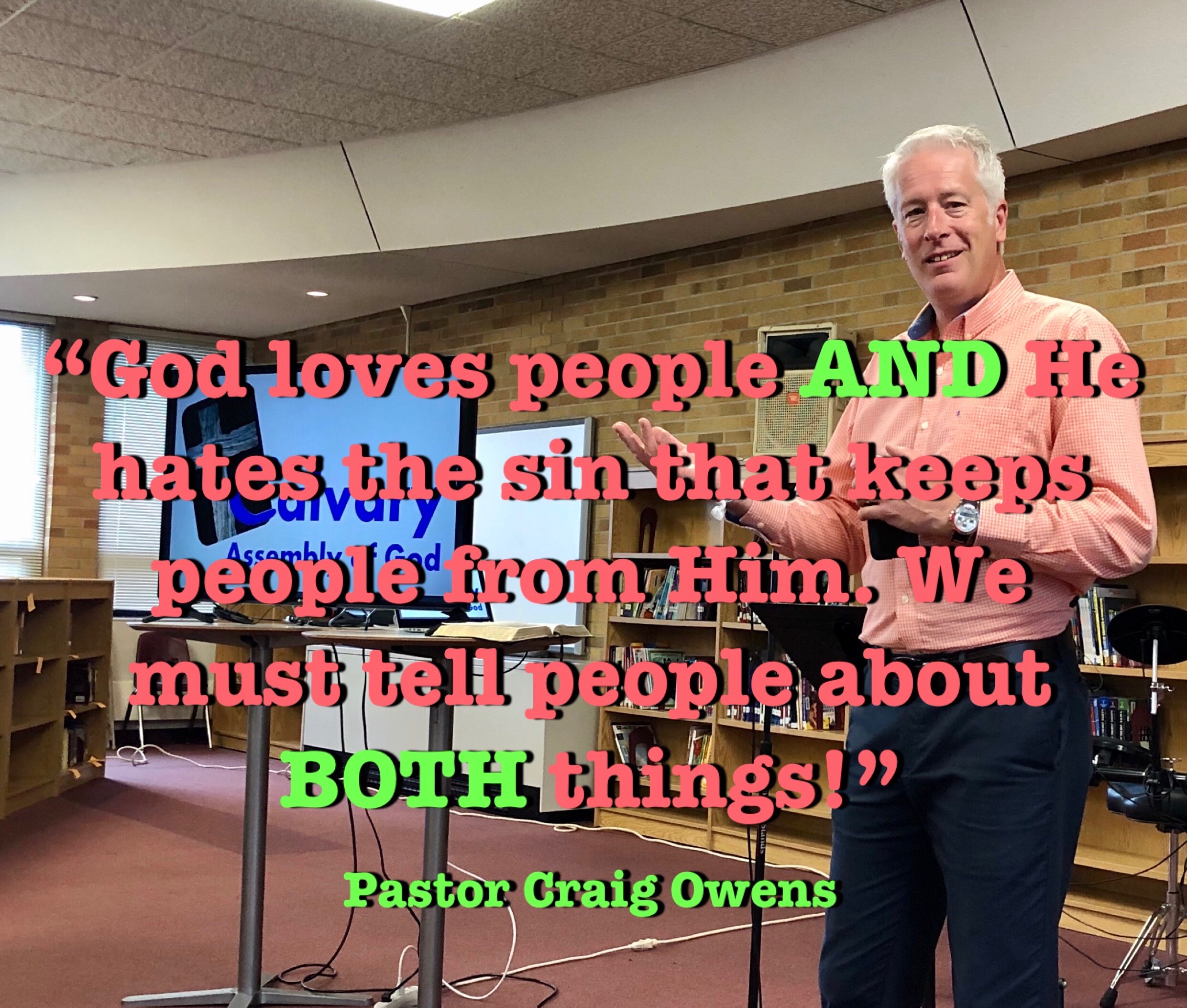
God loves people AND He hates the sin that keeps people from Him. It’s a message people need to hear, although they may not like to hear it. Like Amos, can God use you to warn this world of His judgment AND to woo this world by His love? Our world needs to hear BOTH-AND. They need to hear the whole story.
This is a weekly series with things I’m reading and pondering from Charles Spurgeon. You can read the original seed thought here, or type “Thursdays With Spurgeon” in the search box to read more entries.
Christ Is Glorified In Your Uniqueness
To my mind it is a very beautiful thing that the Lord Jesus Christ, when He comes into the soul, does not annihilate any part of the personality, but shines in each separate being, for He is not only all, but He is in all His people [Colossians 3:11]! Very well, the grace of God does not turn the Gentile into a Jew. He remains a Gentile, but Christ is in him, and therefore he is made into a new creature [Colossians 3:9-10]. … Then comes the Jew. When he is saved, Christ is in him. … The Lord Jesus Christ, dwelling in the Jew, leaves him still a member of the house of Abraham, but through the presence of the Lord Jesus within him, how wondrously his whole character is exalted! …
Yes, let a man be a brown man, or a yellow man, or a red man, or whatever color God made him! The more he keeps to his own nationality and reflects the glory of Christ from that angle, the more will Christ’s gospel triumph and the more will Christ Himself be honored! …
Christ is all, and Christ is in all His people, each one remaining the same in his individuality, but Christ shining in each one! … So note again that because Christ dwells in him, every believer becomes a copy of Christ. …
What is more, Christ in each one of these believers creates them all into one body [Colossians 3:14-15]. … Christ in you all makes you into one body in a mysterious and unique manner.
From All And All In All
God isn’t in the cloning business. He made all of us unique. Think of that: in all of human history there has never been another YOU. In all the 7.5 billion people on planet Earth right now YOU aren’t duplicated. And for however long history goes on there will never be another YOU!
When Jesus is your Lord and Savior, He doesn’t want to turn YOU into a copycat. He wants YOU to be YOU, with all your glorious, inimitable uniqueness. His Holy Spirit in YOU, helps YOU to be more YOU because the One who created YOU is now living in YOU.
How amazing is that?!
YOU be YOU. That is how God is most glorified through YOU!
“Friendship is born at that moment when one person says to another, ‘What! You too? I thought I was the only one!’” —C.S. Lewis
“Friendship is precious, not only in the shade, but in the sunshine of life, and thanks to a benevolent arrangement the greater part of life is sunshine.” —Thomas Jefferson
“Friendship is a single soul dwelling in two bodies.” —Aristotle
“Friendship is not a way of accomplishing something but a way of being with another in which we become more authentically ourselves.” —Eugene Peterson
“The glory of friendship is not the outstretched hand, not the kindly smile, nor the joy of companionship; it is the spiritual inspiration that comes to one when you discover that someone else believes in you and is willing to trust you with a friendship.” —Emerson
“If the first law of friendship is that it has to be cultivated, the second law is to be indulgent when the first has been neglected.” —Voltaire
“Friendship is agreement with kindliness and affection about things human and divine.” —Cicero
“The light of friendship is seen plainest when all around is dark.” —Grace Noll Crowell
“For spiritual friendship, which is what we mean by true friendship, should be desired not with a view to any worldly good, nor for any reason extrinsic to itself, but from the worthiness of its own nature, and the feeling of the human heart, so that it offers no advantage or reward other than itself. … For in this true friendship one makes progress by bettering oneself, and one bears fruit by experiencing the enjoyment of this increasing degree of perfection. And so spiritual friendship is born among good people through the similarity of their characters, goals, and habits in life.” —Aelred of Rievaulx
“The quickest way to initiate friendship is to give people freedom to be themselves.” —Andy Braner
Imagine being close enough to hear God’s voice—Your ears will hear a word behind you, “This is the way, walk in it,” whenever you turn to the right or to the left. (Isaiah 30:21)
Here’s a great question I recently heard: “What if God doesn’t want to give us answers, because He wants to give us His presence?”
Perhaps if God showed me my whole path, I might just take off down the path as fast as I could. Maybe I’d even say something like, “Thanks, God, I’ll take it from here!”
But God wants me close to Him. He wants me to hear His voice at every single step saying, “This is the way, walk in it.”
And forgive us our debts, as we also have forgiven our debtors [close enough to know His forgiving love for me and for others].
Lead us not into temptation, but deliver us from the evil one [close enough to His strength to say “no” to temptations that would entice me off of His path].
For Yours is the kingdom, and the glory, and the power forever [close enough to bask perpetually in His glory and His power].
God wants us THAT close to Him—to rely on Him, to lean into Him, to be empowered by Him, to be protected in Him.
A good question for all of us to ponder: How close to God am I?
Have you ever had someone walk into your life—even if it was just for a moment—and say something you needed to hear? You might not have liked what they had to say, but it was definitely something you needed to hear.
My hunch is that those timely messengers were not necessarily “experts” in the area in which they talked to you. They may have been a doctor talking about a medical need, or it may have been a friend talking about some health issues. Most of the time our valuable messengers are just everyday people.
God loves using “everyday people”!
You don’t have to be a trained pastor to minister to people.
You don’t have to be a trained theologian to tell people what you believe about God.
You don’t have to be a trained counselor to encourage someone.
You just have to be who God created you to be. And you have to be available. Like Amos.
Amos was simply taking care of his farm and his herds when God called him to deliver a timely message to His people.
Amos introduces himself as just one of the shepherdsof Tekoa (1:1) and tells another priest that he was simply minding his own business when God said, “Go, prophesy to My people” (7:10-15).
Amos’ name means burden-bearer—he had a burden for his kinsmen. He saw their sin and knew what defiance of God would mean for them. This burden made him available to hear God’s voice say, “Go.”
“But I’m not a trained prophet,” Amos could have said. “You are telling me to ‘prophesy’ but all I really know is farming and shepherding.”
God said, “Say what you know.”
What did Amos know?
Amos knew God’s voice—In this short book, 43 times(!) Amos uses phrases like says the Lord, declares the Lord, or hear the word of the Lord.
Amos knew his business—This book is filled with language about sheep and shepherds, farmers and farm equipment, gardens and vineyards.
Amos knew God had told him “Go and speak” so Amos had boldness.
You can put your name in all three of those places that say Amos. You can know God’s voice through the Bible, you know your “business” (whether it’s parenting, or coaching, or your own profession), and you can hear God saying, “Go, tell people about Me.”
God wants to use you for His glory. He just needs your availability. Will you be open to being that person?



 The wretch in me is not a scheming or





 Craig T. Owens