The Reagan Diaries (book review)

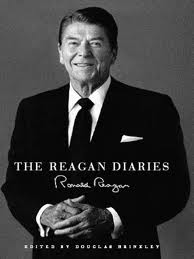
The Reagan DiariesPresident Ronald Reagan was the first president I was old enough to vote for, so he’s always held a special place in my own personal history. After reading several books about President Reagan, I wanted to read something in his own words. I’m so glad I did! The Reagan Diaries is a forthright look at an amazing man.

If you have studied American history during the Reagan presidency—or maybe you lived through that era of our history—you will gain a greater appreciation for the tough decisions that were made during this time. Reagan came into office on a platform that brought a sense of encouragement to an American people who were feeling a bit beat up, and then he tirelessly worked to follow through on the promises he had made, despite a Congress that was initially very antagonistic toward his policies.

Several things really stood out in these diaries. First is Reagan’s reliance on God. Time and again he writes about the wisdom he found in the Scriptures, or the strength he received in prayer. His faith is inseparable from his success in the White House. His faith was one that came to the forefront especially in dark times. Laying in the emergency room after being shot by a would-be assassin, he wrote:

“I focused on that tiled ceiling and prayer. But I realized I couldn’t ask for God’s help while at the same time I felt hatred for the mixed up young man who had shot me. Isn’t that the meaning of the lost sheep? We are all God’s children & therefore equally beloved by Him. I began to pray for his soul and that he would find his way back to the fold. …Whatever happens now I owe my life to God and will try to serve Him in every way I can.”

Another thing that appears in page after page is his love for Nancy. He writes frequently about how lonely the White House seemed when she was gone, he counted down the days until they would be reunited, and he looked forward to the all-too-short times when they could vacation together or take a break on the weekend just to be alone. On the first wedding anniversary they celebrated in the White House, he wrote, “more happiness than any man could rightly deserve.” And back at George Washington Hospital after the assassination attempt he said,

“I opened my eyes to find Nancy there. I pray I’ll never face a day when she isn’t there. Of all the ways God has blessed me giving her to me is the greatest and beyond anything I can ever hope to deserve.”

Finally, I love Reagan’s “realness.” He never took himself too seriously. He remained accessible to as many people in the White House as he could, and spent a lot of time calling and mailing United States’ citizens he read about in the newspapers or saw on the news reports. He was also brutally honest about his own shortcomings. After one press conference he wrote, “I wasn’t very scintillating.”

This is an excellent book to read for both a study in leadership, and as a companion to other U.S. history books of that period. At 700+ pages, it’s a hefty read, but well worth your time.
O Lord, Forgive

A friend of mine gave me some solid counsel a number of years ago that has always stuck with me: The mark of a maturing Christian is one who is closing the gap between sin and repentance.

Sin is open treason against God. Why would I want to overlook it or excuse it?! Once I recognize it as sin, why would I want to hold on to it?!

If we freely admit that we have sinned and confess our sins, He is faithful and just (true to His own nature and promises) and will forgive our sins—dismiss our lawlessness—and continuously cleanse us from all unrighteousness—everything not in conformity to His will in purpose, thought, and action. (1 John 1:9 AMPC) 

“Come now, let’s settle this,” says the Lord. “Though your sins are like scarlet, I will make them as white as snow. Though they are red like crimson, I will make them as white as wool.” (Isaiah 1:18) 

May we all take the time to reflect on our words and actions to see if we have sinned, and then to quickly confess that sin and ask for our loving God’s forgiveness.

“If my soul has turned perversely to the dark;

If I have left some brother wounded by the way;

If I have preferred my aims to Yours;

If I have been impatient and would not wait;

If I have marred the pattern drawn out for my life;

If I have cost tears to those I loved;

If my heart has murmured against Your will,

O Lord, forgive.” —F. B. Meyer

11 Quotes From “Visioneering”

VisioneeringIf you’ve got a big dream to pursue, Visioneering by Andy Stanley could be a big help. You can read my full book review by clicking here. Below are 11 quotes from this book which especially caught my eye.

“As Christians, we do not have a right to take our talents, abilities, experiences, opportunities, and education and run off in any direction we please. We lost that right at Calvary. …At the same time, we have no right to live visionless lives either. If God—think about it—if God has a vision for what you are to do with your allotment of years, you had better get in on it. What a tragedy to miss it. Missing out on God’s plan for our lives must be the greatest tragedy this side of eternity.” 

“What could be and should be can’t be until God is ready for it to be.”

“Three important things are taking place while we wait: (1)The vision matures in us; (2) We mature in preparation for the vision; (3) God is at work behind the scenes preparing the way.”

“Prayer is critical to vision development. Here’s why: We see what we are looking for; we often miss what we don’t expect to see. …Prayer keeps us looking. Prayer keeps the burden fresh. It keeps our eyes and hearts in an expectant mode. Prayer doesn’t force God’s hand. But it keeps us on the lookout for His intervention. Prayer sensitizes us to subtle changes in the landscape of our circumstances.”

“God is using your circumstances to prepare you to accomplish His vision for your life. Your present circumstances are part of the vision. You are not wasting your time. You are not spinning your wheels. You are not wandering in the wilderness. If you are ‘seeking first’ His kingdom where you are, then where you are is where He has positioned you. And He has positioned you there with a purpose in mind.” 

“An agonizingly important principle: what always precedes how. You will know what God has put in your heart to do before you know how He intends to bring it about. …How is never a problem for God. It is usually a big problem for us. But how is God’s specialty.”

“I think it is safe to assume that most Christians are not attempting anything that requires God’s intervention. They are not looking for God to do anything special. They are not aware that they need Him to do anything special. They are trusting that He will step in once they breathe their last breath. But other than that, they live as if they have everything under control. If you want to know how you score on this issue, listen to your prayers and prayer requests. What do you pray for? What are the things you find yourself praying for night after night? Those are your passions. Those are the things that matter most to you. Pretty scary, huh? A little embarrassing? Somewhat self-centered? What was your response the last time someone asked you for a prayer request? Did you have to think for a moment? Was your response kind of … well … less than inspiring? Or did your eyes light up as you thought about that thing, that person, that ministry you were trusting God for? Other than Heaven, and possibly your health, what are you consciously depending on God to do?” 

“This world is filled with people who stopped one question short of finding an avenue that would allow them to pursue their vision. Don’t let the discouragement of a few slammed doors cause you to walk away from the vision God has birthed in your heart. Investigate. Look around. Think outside the lines. Few destinations have only one point of access. The same is true of your vision. If your initial approach is blocked, look for alternatives. Don’t give up too quickly. You may be one question away from discovering the key that will unlock the door that stands between you and God’s vision for your life. God will use this period of investigation to confirm, sharpen, and, sometimes, redirect your vision.”

“When a man or woman is willing to give up something valuable for a God-ordained vision, God looks upon it as worship.” 

“Our natural response to criticism is to defend ourselves. This is especially true when our vision is under attack. We are tempted to begin a dialogue with our critics or with those who are parroting their criticism. Consequently, we waste energy and thought trying to answer questions for people who are often not really interested in answers. Without realizing it, our focus begins to shift. Instead of being vision centered, we slowly become critic centered.”

“You have a destiny to fulfill. God has placed before you opportunities and responsibilities that are brimming with divine significance. He has given you gifts, talents, and relationships that are waiting to be exploited on behalf of His kingdom.”

A Checklist For Growth

Listen to the podcast of this post by clicking on the player below, and you can also subscribe on AppleSpotify, or Audible. 

Take just a moment to read these words from the apostle Peter—

So then, dear friends, since you are looking forward to this, make every effort to be found spotless, blameless and at peace with Him. … Therefore, dear friends, since you have been forewarned, be on your guard so that you may not be carried away by the error of the lawless and fall from your secure position. But grow in the grace and knowledge of our Lord and Savior Jesus Christ…. (2 Peter 3:14, 17-18)

How do I know I’m looking forward and growing? Here’s a checklist that needs to be reviewed regularly:

  • Am I spending more time preparing for my future than I am repairing my past?
  • Do I know that growth is both hard and rewarding work?
  • Do even the littlest of sins disturb me, rob me of peace, and send me quickly to confession and repentance?
  • Do I filter all my reading, studying, and learning through the standard of Scripture?
  • Is my faith stronger now than it was a year ago?
  • Am I exhibiting more Christ-like characteristics—grace, forgiveness, patience—now than I was last year?
  • Am I thrilled every time I get to learn more about Jesus?
  • Am I more reliant on the Holy Spirit now than I have been in the past, and do I converse with Him more frequently?
  • Would those closest to me say that I am becoming more like Jesus?

I hope we can all answer “Yes” to more and more of these items!

Growth is not automatic—this is especially true for spiritual growth. Growth must be intentional or it will not happen. I want to keep going forward in Christ!

May we add our “Amen” to Peter’s prayer: May God give you more and more grace and peace as you grow in your knowledge of God and Jesus our Lord (2 Peter 1:2).

►► Would you please prayerfully consider supporting this ministry? My Patreon supporters get behind-the-scenes access to exclusive materials. ◀︎◀︎

Visioneering (book review)

VisioneeringWhat a great word! Visioneering: A blueprint for developing and maintaing personal vision by Andy Stanley is how God want to use you to help engineer the vision He has birthed in you.

Andy Stanley is an author that I thoroughly enjoy reading. His wisdom is profoundly practical, which means he uncovers things I never would have seen, but does it in a way that I can immediately apply. Visioneering uses the story of Nehemiah in the Bible as the template to guide us through the steps necessary to see a God-breathed vision become a reality.

Andy uncovers in the life of Nehemiah the things that are universal to anyone who has a burning desire to see things around them taken to a higher level. Things like: second-guessing whether God actually spoke that particular vision, the first steps to take, how to handle criticism, pulling together a team to work together on fulfilling the vision, handling setbacks, keeping all of the team members aligned behind the vision, and what the ultimate purpose of a God-given vision really is.

Each chapter concludes with some thought-provoking questions, and a place to record your answers to those questions. These guides help put “feet” to the concepts shared in each chapter.

After reading Visioneering you will be more energized and equipped to do the great things God is calling you to do.

I am a Multnomah book reviewer.

Check out some quotes from this book here.

Responding To The Voice

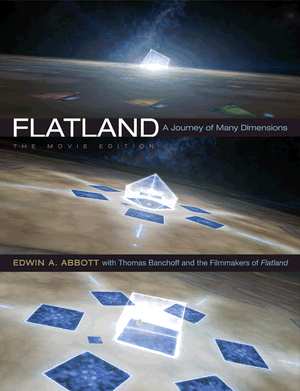
FlatlandIn 1880, Edwin A. Abbott wrote Flatland, a book that would later become a favorite of Albert Einstein. Abbott was a college-trained mathematician and a theologian; in fact he was actually better known for his theological writings than for Flatland. Later on Einstein would say that “things should be made as simple as possible, not simpler.” In other words, don’t dumb-down the concept, but state it on a level where more people can grasp it. That’s why, I believe, Einstein loved Flatland.

Flatland is told through the eyes of Square, a two-dimensional shape that lives in Flatland. Square has length and width, but no height. So the inhabitants of Flatland can move back-and-forth, and side-to-side, but not up-and-down. To get an idea of this, put your eye right on the level of a tabletop, and look at an item on the table. Imagine you can only see what is touching the tabletop (but nothing that rises any higher or lower than that), and you will get an idea of Square’s two-dimensional world.

One day Sphere visits Flatland. Sphere is three-dimensional, so he can move up-and-down. This means that Square can only see the part of Sphere that happens to be in his line of sight at that immediate moment. So he sees just a “slice” or “layer” of Sphere as Sphere moves through Flatland. Sometimes Sphere is nothing more than a disembodied voice when he is hovering above Flatland.

This gives us a little bit of an idea of how we perceive God. He exists in dimensions that we cannot fully comprehend, so we only see “slices” of Him as He passes though our line of sight. Sometimes He is just a disembodied Voice—or as the Bible calls Him, the Word of God.

But the Word of God compressed Himself into our dimension (John 1:14). All of the fullness—all of the other-dimension-ness—of His omnipotence, omnipresence, omniscience came to our “level” in the Person of Jesus Christ (Philippians 2:6-7). The Word was the complete and total fullness of God (John 1:1-3; Colossians 2:9). But unlike Square who couldn’t fully know Sphere, God is fully knowable in The Word—in Jesus Christ!

The question is: What are you going to do with The Word? The Word of God (the Bible) allows us to fully know The Word of God (Jesus). But we need to be willing to let the Holy Spirit strip away our puny, smaller-dimensioned, finite thinking of God.

Alvin TofflerAlvin Toffler wrote, “The illiterate of the future are not those who cannot read or write, but those who cannot learn, unlearn, and relearn.”

I would modify this to say, “Those illiterate of The Word (Jesus) are not those who cannot read The Word (the Bible), but those who won’t let the Holy Spirit help them learn, unlearn, and relearn who God is.” 

There is so much more to learn about The Word (Jesus), so let the Holy Spirit guide you in your reading of The Word (the Bible). I pray as Paul did that you will begin to experience more of the multi-dimensional-ness of God as revealed in The Word—

I pray that out of God’s glorious riches He may strengthen you with power through His Spirit in your inner being, so that Christ may dwell in your hearts through faith. And I pray that you, being rooted and established in love, may have power, together with all the Lord’s holy people, to grasp how wide and long and high and deep is the love of Christ, and to know this love that surpasses knowledge—that you may be filled to the measure of all the fullness of God. (Ephesians 3:16-19)

If you have missed any of the messages in this series called Who Is Jesus?, you can find them all here.

Unreached

UnreachedThis really weighs heavily on me…

Our guest this morning began to lay down 3×5 cards with the names of students on them. These students haven’t heard about Jesus yet. Let this weigh on your heart—

There are 150 million unreached students in his area of the world.

If all their names were laid end-to-end on 3×5 cards, the line would stretch 11,500 miles.

If you were flying over these cards in a 747, it would take you 20 hours to cover them all.

Stacked together these cards/names would weigh 190 tons.

If you prayed just 1 second for each name, you would be praying for 4.5 years.

We all need to be praying, giving, or going. Or maybe all three.

  • Praying for our missionaries and the unreached people they are trying to reach
  • Giving financially to missions
  • Going on the mission field yourself

Refrain From Rhetoric

My dear fellow pastor, we should all heed these words—

C.H. Spurgeon“…If some preachers would refrain from rhetoric and tell their plain unvarnished tale, they would succeed better than they do now. Do you think that God meant his ministers to kill themselves in order come out on Sundays with one or two splendid displays of ‘intellect’ and eloquence? Surely this is not God’s way of doing things. I do not believe that Paul ever preached a fine sermon, or that Peter ever dreamed of any display of intellect. I asked the other day of one who had heard a sermon if it was likely that sinners would be converted by it. He said, ‘Oh no; by no means; but it was an intellectual treat.’ Is there anywhere in the Bible a word about intellectual treats, or anything approximating to such an idea?” —Charles Spurgeon

I’m not sure I can add much to this advice from the “prince of preachers” except to say, preach to glorify God, not to impress your earthly audience. Jesus said if we would lift Him up, He will draw everyone to Himself.