This is a weekly series with things I’m reading and pondering from Charles Spurgeon. You can read the original seed thought here, or type “Thursdays With Spurgeon” in the search box to read more entries.
Listen to the podcast of this post by clicking on the player below, and you can also subscribe on Apple, Spotify, or Audible.
Bragging About God
I will extol the Lord at all times; His praise will always be on my lips.I will glory in the Lord; let the afflicted hear and rejoice.Glorify the Lord with me; let us exalt His name together. (Psalm 34:1-3)
Boasting is a very natural propensity, and if it were used as in this case, the more it were indulged the better. The exultation of this verse is no mere tongue bragging; the soul is in it, and the boasting is meant and felt before it is expressed.
What scope there is for holy boasting in Jehovah! His Person, attributes, covenant, promises, works, and a thousand things besides are all incomparable, unparalleled, matchless; we may cry them up as we please, but we shall never be convicted of vain and empty speech in so doing.
What is even more remarkable about the praise David offers up in this psalm is the setting. The introduction to the psalm tells us it is while David is running from Saul and trapped in a Philistine stronghold.
It is a choice of his will. David didn’t wait until he felt like praising God, or until his circumstances were improved. We are more likely to act ourselves into feeling than we are to feel ourselves into action. So David says, “I will extol the Lord … His praise will be on my lips.”
This bragging about God—when from a human standpoint there appears to be nothing to brag about—becomes a testimony. David’s personal pronouns “I” and “my” quickly turn into the plural pronoun “us” as David invites others to ponder the beauty of Jehovah! “Glorify the Lord with me; let us exalt His name together.”
Our bragging about God, especially in the face of difficult circumstances, is a powerful testimony that will draw others to Him. You may start out praising Him on your own, but it won’t be long until others join your worship chorus.
Friends, your praising and bragging about God is more powerful than you may realize. When God is worshipped, He is lifted up for all to see, so keep on bragging about Him!
This is a weekly series with things I’m reading and pondering from Charles Spurgeon. You can read the original seed thought here, or type “Thursdays With Spurgeon” in the search box to read more entries.
Listen to the podcast of this post by clicking on the player below, and you can also subscribe on Apple, Spotify, or Audible.
New Songs Everyday
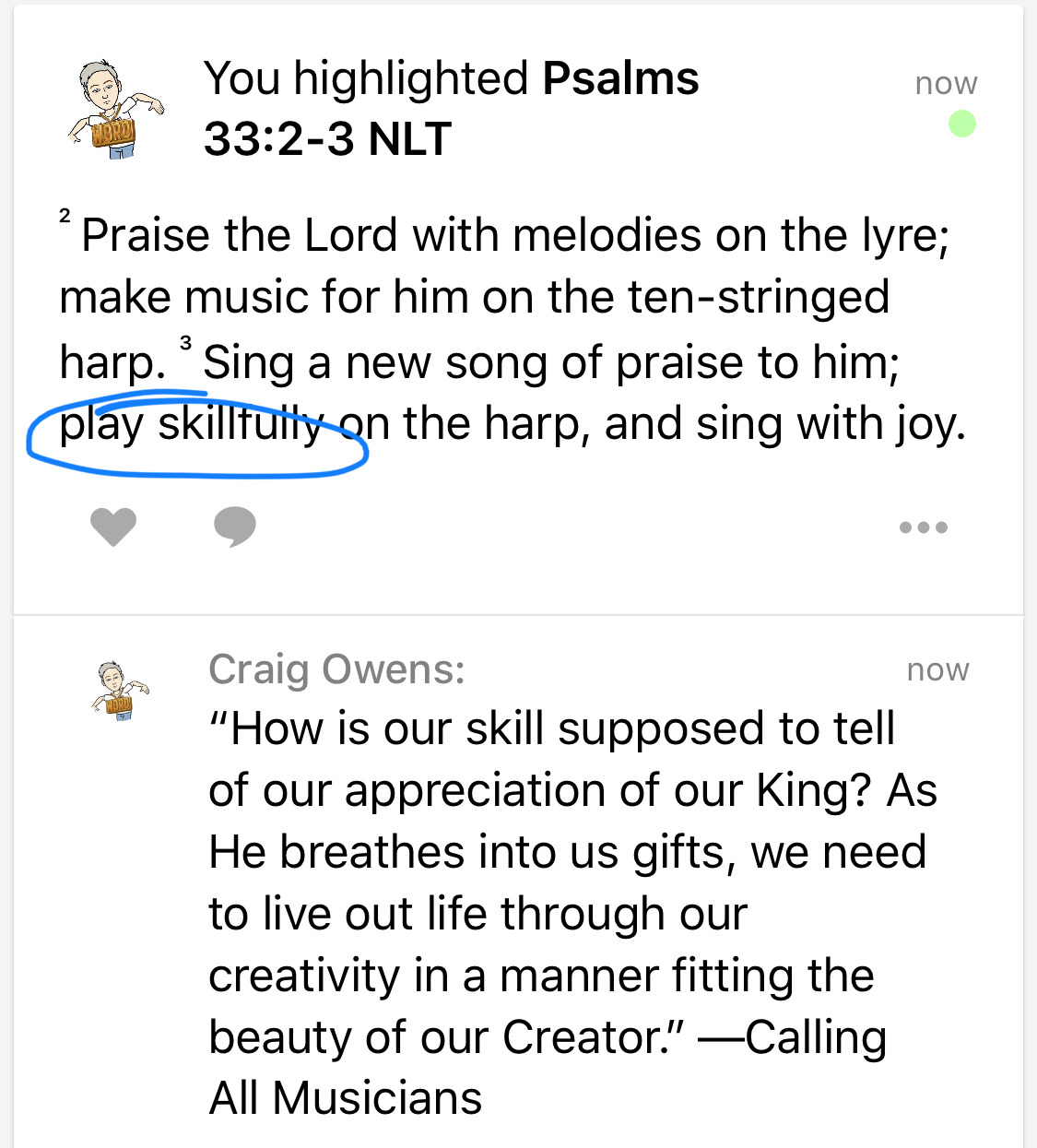
Sing joyfully to the Lord, you righteous; it is fitting for the upright to praise Him. Praise the Lord with the harp; make music to Him on the ten-stringed lyre. Sing to Him a new song; play skillfully, and shout for joy. (Psalm 33:1-3)
To keep up the freshness of worship is a great thing, and in private, it is indispensable. Let us not present old, worn-out praise but put life and soul and heart into every song, since we have new mercies everyday and see new beauties in the work and Word of our Lord.
It is wretched to hear God praised in a slovenly manner. He deserves the best we have. All Christians should endeavor to sing according to the rules of the art so that they may keep time in tune with the congregation. The sweetest tunes, and the sweetest voices, with the sweetest words, are all too little for the Lord our God; let us not offer Him limping rhymes, set to harsh tunes, and growled out by discordant voices.
Every Thursday night is going to be our date night. I’m going to plan something special, dress up in some nice clothes, and be totally tuned in to your needs. I’m going to listen to everything you have to say to me, express my unending love to you, ask forgiveness for areas I may have messed up that week, and then endeavor to put into practice everything you tell me that you would like.
I promise I’ll be there every Thursday.
The other days of the week, I’ll think about you every once in a while—especially if I need something—but other than that I’ll be doing my own thing.
How rich and meaningful would you expect that relationship to be?
Sadly, this is how many people who call themselves Christians view their relationship with Jesus. They put on nice clothes every Sunday, show up at church, sing some songs, listen to a sermon, repent of sins, and promise to live a better life in this new week. But after they leave their church service, they seldom give their Savior another thought—unless they get themselves into trouble where they really need a Savior’s immediate help.
In Psalm 33, the psalmist is calling us to—as Spurgeon puts it—“freshness in worship” not just in a public worship service, but in private worship at every moment of every day. Our God is continually revealing Himself to us in new and fresh ways, so our worship should be equally as fresh, vibrant, and passionate—both planned times of worship and spontaneous songs of praise.
Both our relationship with God and with our loved ones will go to new levels of intimacy when we seek to know the other one more deeply. Our God is worthy of the very best praise we can give Him, which means we will always be finding new ways to sing our worship to Him every single day.
Listen to the podcast of this post by clicking on the player below, and you can also subscribe on Apple, Spotify, or Audible.
We have looked at all of the psalms with a Selah pause, but there is one bonus message that we need to consider, and I think it’s a perfect wrap up to this series.
Outside the book that bears his name, there is no other mention of Habakkuk anywhere else in the Bible. The author himself gives us no biographic information, nor does he give us dates as most of the other prophets do. However, there is enough information inside his short book that allows us to make some solid inferences:
based on his instructions in 3:19 we can infer he is a Levite and a worship leader—notice that he says “my instruments”
we know for certain he is a song writer and a prophet (1:1; 3:1)
he is a prophet with a heavy message—the word oracle in in the opening verse is probably better translated a “burden”
he is a contemporary of Jeremiah, who spoke to backsliders, but Habakkuk speaks to the godly remnant to help them make sense of what’s happening in their crumbling culture
Habakkuk does something that isn’t seen anywhere in the Bible except in the Psalms: he calls godly people to Selah—not once, but three times!
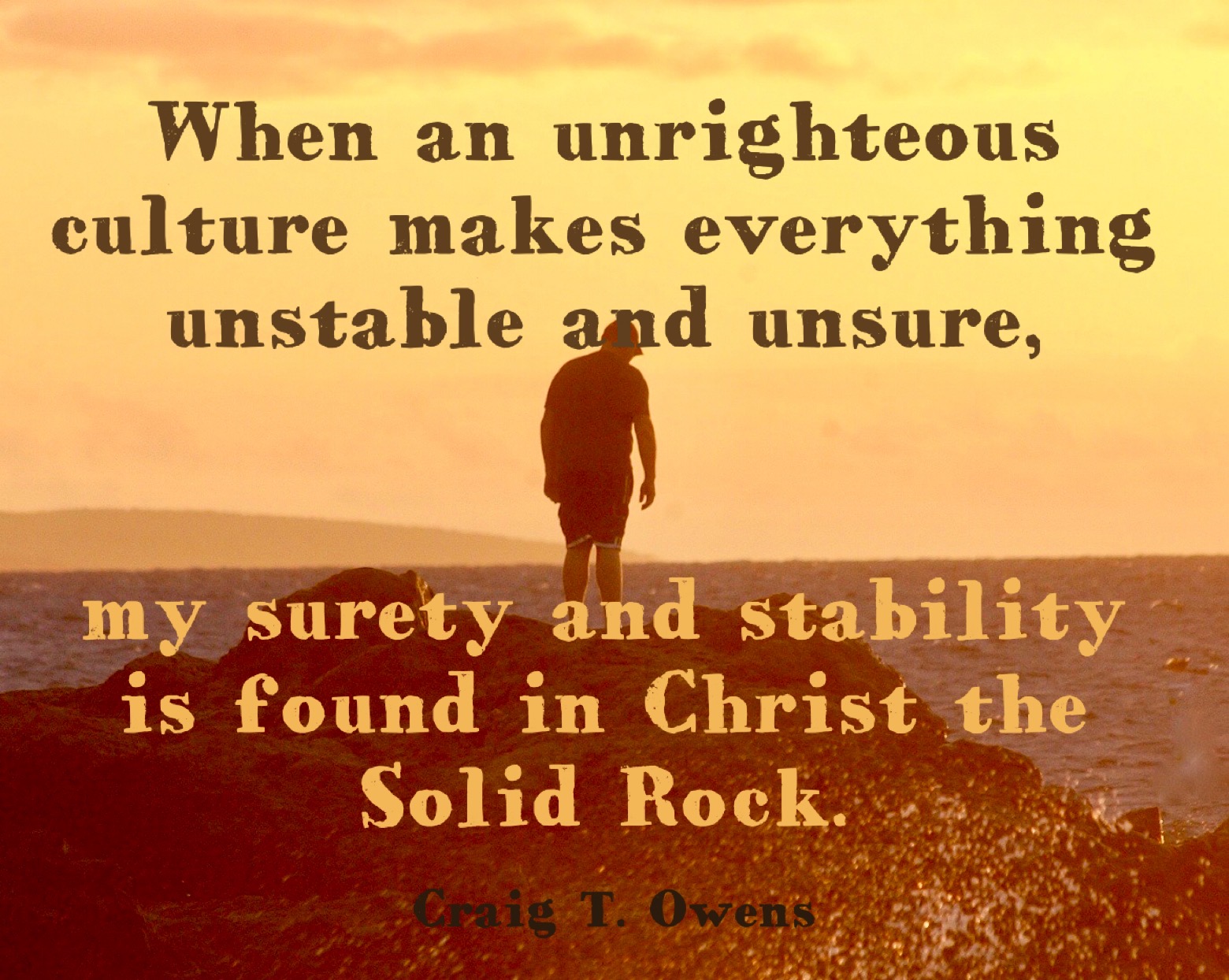
In our look at the Selahs of Psalm 55 we noted how David’s Selahs almost came as an interruption of his anxious thoughts. Habakkuk’s Selahs follow this same theme. That’s because Habakkuk’s culture (like ours today) was increasingly unrighteous, unstable, and unsure. This prophetic worship leader wants righteous people trying to stand strong in their unrighteous culture to know that our surety and stability must come from our unshakable relationship with our righteous God.
We’ve said that one of the definitions for Selah is “pause and calmly think of that,” but for Habakkuk’s Selahs I want to modify it slightly: Pause to interrupt your doubtful thoughts and consider this…. What he wants us to consider, I believe, comes from the opening words of his song in chapter 3—
Lord, I have heard of Your fame; I stand in awe of Your deeds, O Lord. Renew them in our day, in our time make them known; in wrath remember mercy (v. 2).
We are to pause to consider that God has already shown His unrivaled power in the past, and then we stand firm to see Him move again “in our day, in our time” so that the unrighteous will have an opportunity to repent and turn to Him.
The first Selah is after v. 3 in which Habakkuk references Mount Paran. How did God show His fame there? Moses recorded it this way:
The Lord came from Sinai and beamed upon us from Seir; He flashed forth from Mount Paran, from among ten thousands of holy ones, a flaming fire, a law, at His right hand. (Deuteronomy 33:2)
Selah—pause to interrupt your doubtful thoughts and consider this: God did this before and He can do it again. His glory will cover the heavens, His praise will fill the earth, His power will be so evident that the earth will quake and nations will tremble (vv. 4-6). All of this to reassure the righteous and arrest the attention of the wayward unrighteous.
The second Selah is after v. 9 where Habakkuk is still describing all that God will do personally to rescue His righteous ones. Selah—pause to interrupt your doubtful thoughts and consider this: God did this before—see the almost identical language David uses in Psalm 18:3-17—and He can do it again. All of this to reassure the righteous and arrest the attention of the wayward unrighteous.
The final Selah is at the end of v. 13 where Habakkuk describes what God will do to the enemies of His people. He uses words of decisive victory—crushed, stripped, pierced, trampled.
Once again, Selah—pause to interrupt your doubtful thoughts and consider this: God did this before and He can do it again. More specifically, Jesus is the Decisive and Ultimate Victor over sin and death! Check this out:
Then the end will come, when [Jesus] hands over the kingdom to God the Father after He has destroyed all dominion, authority and power. For He must reign until He has put all His enemies under His feet. The last enemy to be destroyed is death. (1 Corinthians 15:24-26)
And having disarmed the powers and authorities, He made a public spectacle of them, triumphing over them by the Cross. (Colossians 2:15)
Do not be afraid. I [Jesus] am the First and the Last. I am the Living One; I was dead, and now look, I am alive for ever and ever! And I hold the keys of death and Hades. (Revelation 1:17-18)
When our culture is becoming increasingly unrighteous, unstable, and unsure, what an unshakable surety and security we have standing on Christ the Solid Rock. As the old hymn reminds us—when all around my soul gives way, He then is all my hope and stay!
Listen to the podcast of this post by clicking on the player below, and you can also subscribe on Apple, Spotify, or Audible.
C.S. Lewis, like many atheists, wondered if the God of the Bible might be an egomaniac because He is always encouraging people to praise Him. In his book Reflections on the Psalms, Lewis wrote a thoughtful response to this after he had become a Christian:
“Just as men spontaneously praise whatever they value, so they spontaneously urge us to join them in praising it. ‘Isn’t she lovely? Wasn’t it glorious? Don’t you think that magnificent?’ … I think we delight to praise what we enjoy because the praise not merely expresses but completes the enjoyment; it is its appointed consummation. It is not out of compliment that lovers keep on telling one another how beautiful they are; the delight is incomplete till it is expressed. … This is so even when our expressions are inadequate, as of course they usually are. But how if one could really and fully praise even such things to perfection—utterly ‘get out’ in poetry or music or pain the upsurge of appreciation which almost bursts you? Then indeed the object would be fully appreciated and our delight would have attained perfect development. The worthier the object, the more intense this delight would be.”
His phrase, “our expressions are inadequate” is especially true when we are attempting to appreciate and praise the Infinite, the Eternal, the Omnipresence, the Omnipotence of our God and Savior! But the biblical authors call for Christians to mature in this—we want to keep praising, keep expressing, until we finally find the perfect fulfillment in His presence.
Paul talks about the maturing nature of love—when I was a child, I talked like a child, I thought like a child, I reasoned like a child (1 Corinthians 13:11)—but then he prays for us to grow in both our understanding and our expressions of our Savior’s love (Ephesians 1:17-19).
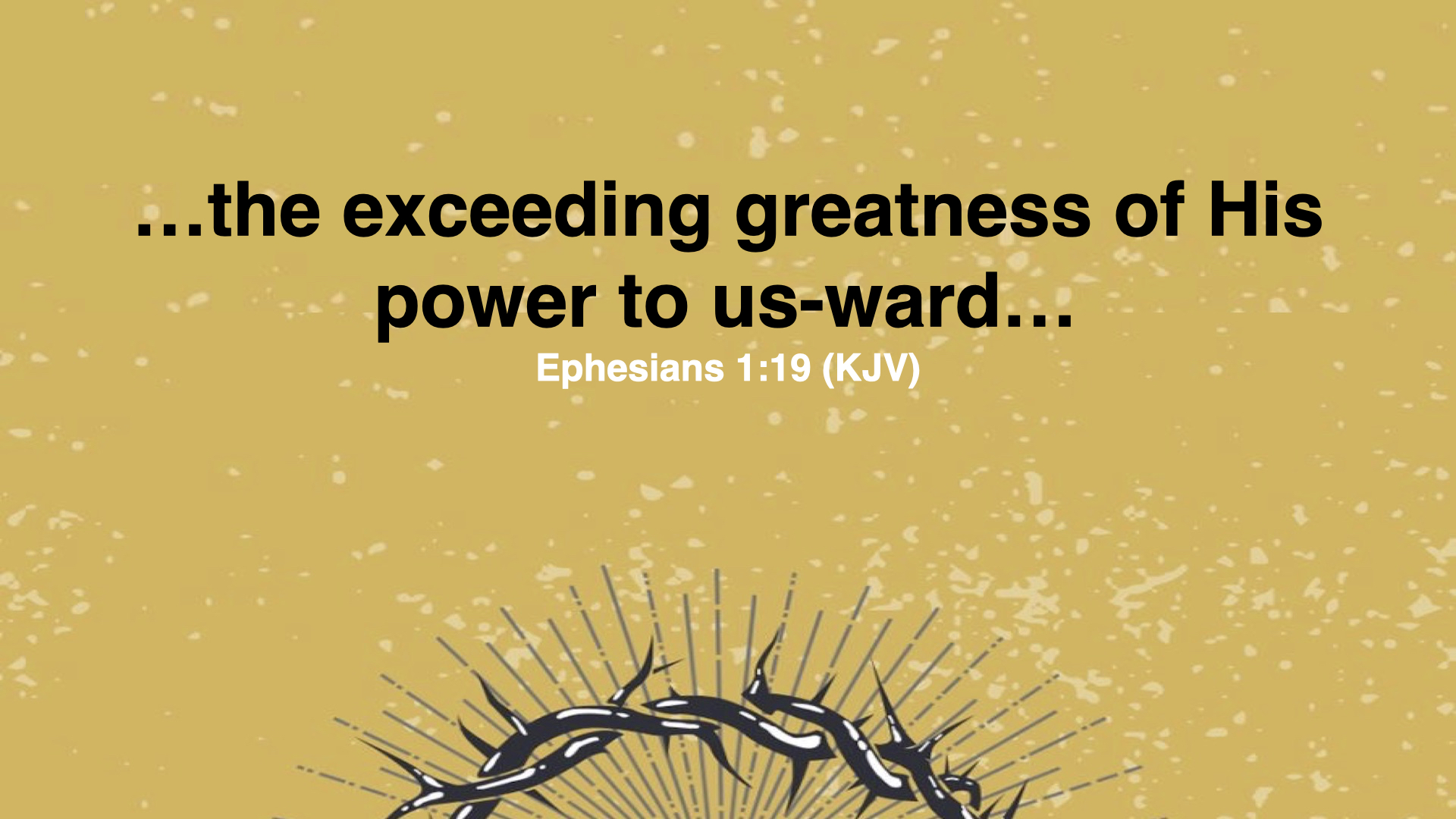
I like the wording of Ephesians 1:19 in the King James Version: the exceeding greatness of His power to us-ward. The word “exceeding” means God pours out in a way that is beyond human imagining. The Greek word that Paul uses for “greatness” is only used here, and it reinforces the truth that God is beyond our full comprehension. And then Paul adds that this overflowing, incomparable power is directed “to us-ward”!
Paul then prays for us to be able to understand ever-increasing new dimensions of this transcendent power and ability that God directs to us through His Son Jesus, and for us to be able to express it (Ephesians 3:14-19). In other words, we are to grow in our experience of Jesus so that we can grow in our praise to Jesus.
The incomparable Jesus means at least four things for us. It means Jesus is…
…beyond comparison. Isaiah, God Himself, and the psalmists ask rhetorically, “Who is like God? Who could ever compare to Him?” (Isaiah 40:13-14, 18, 25; Psalm 89:5-8).
…matchless in His power. Isaiah 40:12 says God holds the waters of the world in the hollow of His hand. How much water is this? Scientists estimate the Earth’s water supply to be 326 quintillion gallons of water (that’s 326 followed by 18 zeros)! Not only does God hold all of the water, but He directs its activities on behalf of His children (Exodus 15:11-13).
…unequaled in knowledge.Isaiah 40:12, 26 tell us that all of the stars in our universe fit onto God’s outstretched hand, and that He knows all of the stars by name. How many stars is this? Astronomers calculate the heavens to contain 10 septillion stars (that’s 10 followed by 24 zeros)! Not only does God know each star by name, He knows each human by name, and thesmallest of details about each of them (Isaiah 49:16; Matthew 10:29-31).
…inimitable in His care. We humans can get to the end of our strength, but God never does. He cares for us unlike anyone else or anything else ever can (Isaiah 40:28-31). The Lord hears His people when they call to Him for help. He rescues them from all their troubles (Psalm 34:17).
Knowing we have a Savior like this, why would you ever settle for anything less The Genuine?!
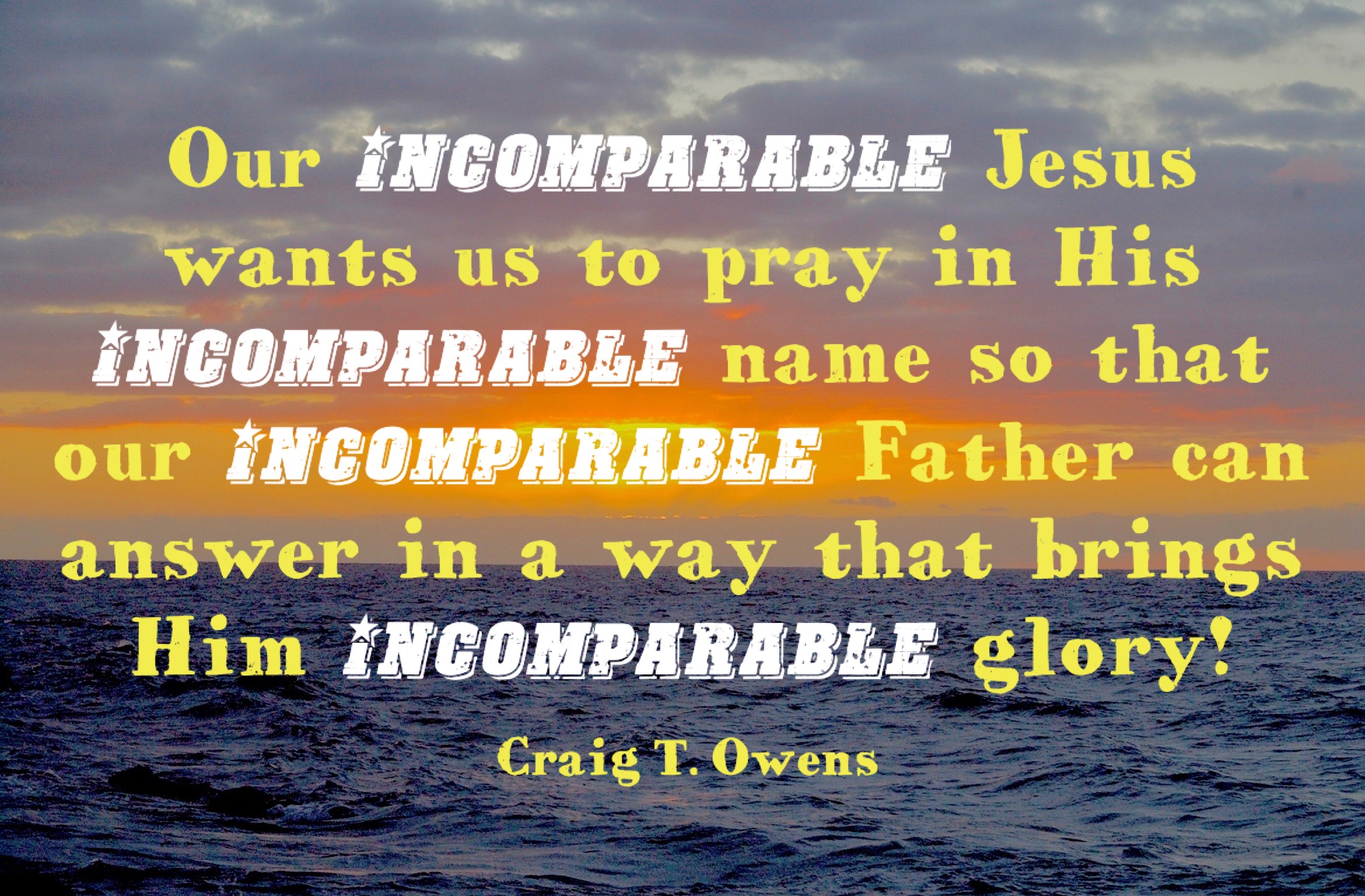
Our incomparable Jesus wants us to pray in His incomparable name so that our incomparable Father can answer in a way that brings Him incomparable glory! We’re helped, He’s lifted up, and others are drawn to Him.
Listen to the podcast of this post by clicking on the player below, and you can also subscribe on Apple, Spotify, or Audible.
My heart is resting, O my God—
I will give thanks and sing;
My heart is at the secret source
Of every precious thing.
Now the frail vessel Thou hast made
No hand but Thine shall fill
For the waters of the Earth have failed,
And I am thirsty still.
I thirst for springs of heavenly life, And here all day they rise— I seek the treasure of Thy love, And close at hand it lies. And a new song is in my mouth To long-loved music set Glory to Thee for all the grace I have not tasted yet.
Glory to Thee for strength withheld, For want and weakness known— And the fear that sends me to Thy breast For what is most my own. I have a heritage of joy That yet I must not see; But the hand that bled to make it mine Is keeping it for me.
There is a certainty of love That sets my heart at rest— A calm assurance for today That to be poor is best— A prayer reposing on His truth Who hath made all things mine, That draws my captive will to Him, And makes it one with Thine.
I will give thanks for suffering now, For want and toil and loss— For the death that sin makes hard and slow, Upon my Savior’s Cross— Thanks for the little spring of love That gives me strength to say, If they will leave me part in Him, Let all things pass away.
Sometimes I long for promised bliss, But it will not come too late— And the songs of patient spirits rise From the place wherein I wait; While in the faith that makes no haste My soul has time to see A kneeling host of Thy redeemed, In fellowship with me.
There is a multitude around Responsive to my prayer; I hear the voice of my desire Resounding everywhere. But the earnest of eternal joy, In every prayer I trace; I see the glory of the Lord: On every chastened face.
How oft, in still communion known, Those spirits have been sent To share the travail of my soul, Or show me what it meant! And I long to do some work of love No spoiling hand could touch, For the poor and suffering of Thy flock Who comfort me so much.
But the yearning thought is mingled now With the thankful song I sing; For Thy people know the secret source Of every precious thing. The heart that ministers for Thee In Thy own work will rest; And the subject spirit of a child Can serve Thy children best.
Mine be the reverent, listening love, That waits all day on Thee, With the service of a watchful heart Which no one else can see— The faith that, in a hidden way No other eye may know, Finds all its daily work prepared, And loves to have it so.
My heart is resting, O my God, My heart is in Thy care I hear the voice of joy and health Resounding everywhere. “Thou art my portion,” saith my soul, Ten thousand voices say, And the music of their glad Amen, Will never die away. —Anna Laetitia Waring
Listen to the podcast of this post by clicking on the player below, and you can also subscribe on Apple, Spotify, or Audible.
In the Foreword to my book Shepherd Leadership: The Metrics That Really Matter, Dick Brogden observes, “God plucked David from the sheepfold. God chose a sheep to be a shepherd. And though we all are stupid sheep, when God plucks us out of obscurity to serve others, we can have the humble confidence for as long as we are asked to lead that God has chosen us. That confidence both faithfully drives us to our knees and fearlessly propels us against our giants. It is good to be a sheep; it is good to be an under-shepherd. Just remember you are stupid, chosen by the Wise One, and as long as you serve as a shepherd, you and your flock will be safe.”
How true it is that all of us are sheep. The role of the shepherd is to care for the sheep and create a healthy environment for them. The role of healthy sheep is to reproduce more sheep. In this, both shepherds and sheep are ministers—we all minister to those God has placed around us.
God calls all Christians to be ministers. The Church is the sheepfold that equips us, but then we must go out to minister in a way that will bring lost sheep to a personal relationship with Jesus.
Our foundational truth statement about church ministry says: A divinely called and scripturally ordained ministry has been provided by our Lord for the fourfold purpose of leading the Church in evangelism, worship, sanctification, and compassion.
(1) Evangelism. When we looked at the foundational belief about the Church, we noted that it’s not either-or—evangelism or discipleship—but it’s both-and. Christians are being the Church when they are intentionally living in a way that makes Jesus known (Matthew 10:1, 7-8; 28:18-20).
(3) Sanctification. Remember that we are all in-process of becoming saints (I like to remember this by calling it saint-ification). We need each other to do this, which is why God gives gifts to bring out Christ-like maturity in us (Ephesians 4:1-7, 11-16).
So here are two important questions we need to ask ourselves: (1) Am I doing quality work? (2) Am I faithfully doing my work?
To help answer those questions, I like this thought from Leonard Sweet’s book I Am A Follower: “The most important metrics we must rely on, the crucial ‘deliverables’ we can present, must focus on the newly formed lives of the disciples we are making, the followers who are following Christ into a place of serving Him by serving others. The most important measure of our faithfulness to Christ must be the extent of transformation into the living image of Christ Himself. … The quantifiable fruit of our church is not found in the number of people we can gather on a weekly basis. What counts is what is happening in the lives of those who have gathered.”
These are questions we should all ask the Holy Spirit to reveal to us:
What is happening in my life?
Am I telling others about Jesus?
Am I worshipping God so consistently that everyone can see it?
Am I maturating as a saint and am I helping other saints mature?
Is my faith seen in my compassionate actions?
Our individual answers to those questions will determine the success of our individual churches, which will ultimately determine the effectiveness of the global Church of Jesus Christ. I hope you will take some time to consider these questions for yourself.