Here’s the seed thought for this episode of Think On This…
Do to others what you would like them to do to you. (Matthew 7:12)
Think on this: Do I apply the Golden Rule negatively (just trying to avoid offending)? Or do I apply it positively (creatively trying to find ways to help others)?
I have been friends with Greg Heeres for nearly 30 years. During that time we have truly lived out the truism from wise King Solomon, “As iron sharpens iron, so a friend sharpens a friend.”
Greg and I have partnered together on both for-profit and non-profit ventures. We learned together, sharpened each other, and are both better off because of our close friendship.
Now it’s time for us to give back to others.
I’m so excited to announce a new podcast series we are launching on YouTube in just a couple of weeks. It’s called “The Craig And Greg Show.” We are passionate about investing in emerging leaders so each podcast is a short conversation designed to help sharpen leaders.
Check out the Maximize Leadership channel—both our website and our YouTube channel. Be sure to subscribe and click the bell on YouTube so that you are notified when each episode posts.
You can also get in touch with us through Twitter and Facebook.
Here’s the seed thought for this episode of Think On This…
Do not answer a fool according to his folly, or you yourself will be just like him. Answer a fool according to his folly, or he will be wise in his own eyes. (Proverbs 26:4-5)
Think on this:
Do I have a solid relationship with this person?
Do I need to respond for their benefit?
Can I ask any clarifying questions before I speak?
Here’s the seed thought for this episode of Think On This…
In the fifteenth year of Amaziah son of Joash king of Judah, Jeroboam son of Jehoash king of Israel became king in Samaria, and he reigned forty-one years. He did evil in the eyes of the Lord and did not turn away from any of the sins of Jeroboam son of Nebat, which he had caused Israel to commit. He was the one who restored the boundaries of Israel from Lebo Hamath to the Dead Sea,in accordance with the word of the Lord, the God of Israel, spoken through His servant Jonah son of Amittai, the prophet from Gath Hepher. The Lord had seen how bitterly everyone in Israel, whether slave or free, was suffering; there was no one to help them. And since the Lord had not said He would blot out the name of Israel from under heaven, He saved them by the hand of Jeroboam son of Jehoash. (2 Kings 14:23-27)
Think on this: Just because God has used me to do something amazing doesn’t necessarily mean that I am free of sin.
Have you ever noticed that it seems a lot easier to say, “God bless you” than it does to say, “God bless me”? Why is that?
Do I feel unworthy of His blessing? If I am a Christian, I need to remind myself that I am in Christ, and He is in me, and He has brought me into the Father. This means that I am as blessed as the Father blesses the Son (John 14:20; Ephesians 1:3-6). God is blessed by our being blessed!
Or perhaps I feel that “God bless me” is an arrogant prayer, while saying “God bless you” is a humble prayer. There is an EGO that God always blesses, and He delights to show us what that is!
In Hebrew literature, the key point is found in the middle of a poem or story. In Psalm 67, that would make the middle verse: May the nations be glad and sing for joy, for You rule the peoples justly and guide the nations of the earth. Selah. (v. 4)
The nations rejoice because God judges fairly and God guides the nations. Selah—pause and take that in. The natural attitude is actually a God-negative attitude—“I prefer to be in charge … I don’t like anyone telling me what to do!” But the unnatural attitude is a God-positive attitude—“I trust God more than I trust me, so I’m glad He is in charge … I trust God to judge justly more than I trust world institutions, so I’m glad He is the final Judge!”
This is very good news:Only God can rule and judge correctly! Men have biases and agendas; men are selfish and self-seeking; men seek their own glory and their own advancement. So the psalmist wants us to Selah/pause to remember that only God can lead and judge in a way that brings Him glory and brings us blessing. God is blessed by our being blessed!
Working outward from verse 4, we see verses 3 and 5 are identical, teaching us that our God-honoring desire should be for all peoples in all nations to experience the blessing of an intimate relationship with God.
A similar theme is sounded in the “bookend” verses of 1-2 and 6-7: We are asking God to bless us so that “all the ends of the earth will fear Him.” Once again we Selah/pause to consider this: Do I have the right EGO to request this blessing? Remember: There is an EGO that God always blesses.
In his book Lead Like Jesus, Ken Blanchard identifies two types of E.G.O.s in our relationship with God:
Negative E.G.O.—Edging God Out
Positive E.G.O.—Exalting God Only
The negative EGO says things like, “Bless me” and “Shine on me.” The positive EGO says, “Bless me so that I can be a blessing to others” and “Shine Your light on me so that others will see You.”
Jesus told us to not let the light of our life be hidden. We are blessed by God so that we can be a blessing to all of the peoples in all of the nations. We desire that all may know the joy of serving a Righteous King. We want everyone to know the praise that comes from Exalting God Only.
Oh God, be merciful to me. Cause Your face to shine on me. Bless me indeed so that I may teach others to fear You, so that they may come to know You as their All-Righteous, Good, and Loving King!
Psalm 60 may have the longest introduction of any of the psalms, and it gives us some key historical information. David has been successful against the Philistines and the Moabites, and now he is fighting in Mesopotamia. While the army was focused elsewhere, the Edomites must have seen an opportunity to attack Israel, where they won a temporary victory (see the intro to Psalm 60 and 2 Samuel 8:1-3).
David’s reflexive response to this temporary setback was not retaliation or blaming, but remorse and repentance. In verses 1-4 he says “You have” five times, acknowledging that God allowed this temporary defeat. He also acknowledges that only God can restore.
Then David comes to the Selah pause: But You have raised a banner for those who fear You—a rallying point in the face of attack. Selah. (NLT)
The Selah here is David calling us to evaluate our options just as he did. We are to consider things like:
God’s help vs. our own strength
the benefits of righteousness vs. the consequences of sin
depending on God vs. depending on man
rallying under God’s banner vs. rallying under our own banner
It’s interesting to note that in the list of David’s long string of victories in 2 Samuel 8, we read this: “The Lord gave David victory wherever he went” (v. 6). But how can that be since the Israelites were temporarily defeated by the Edomites?
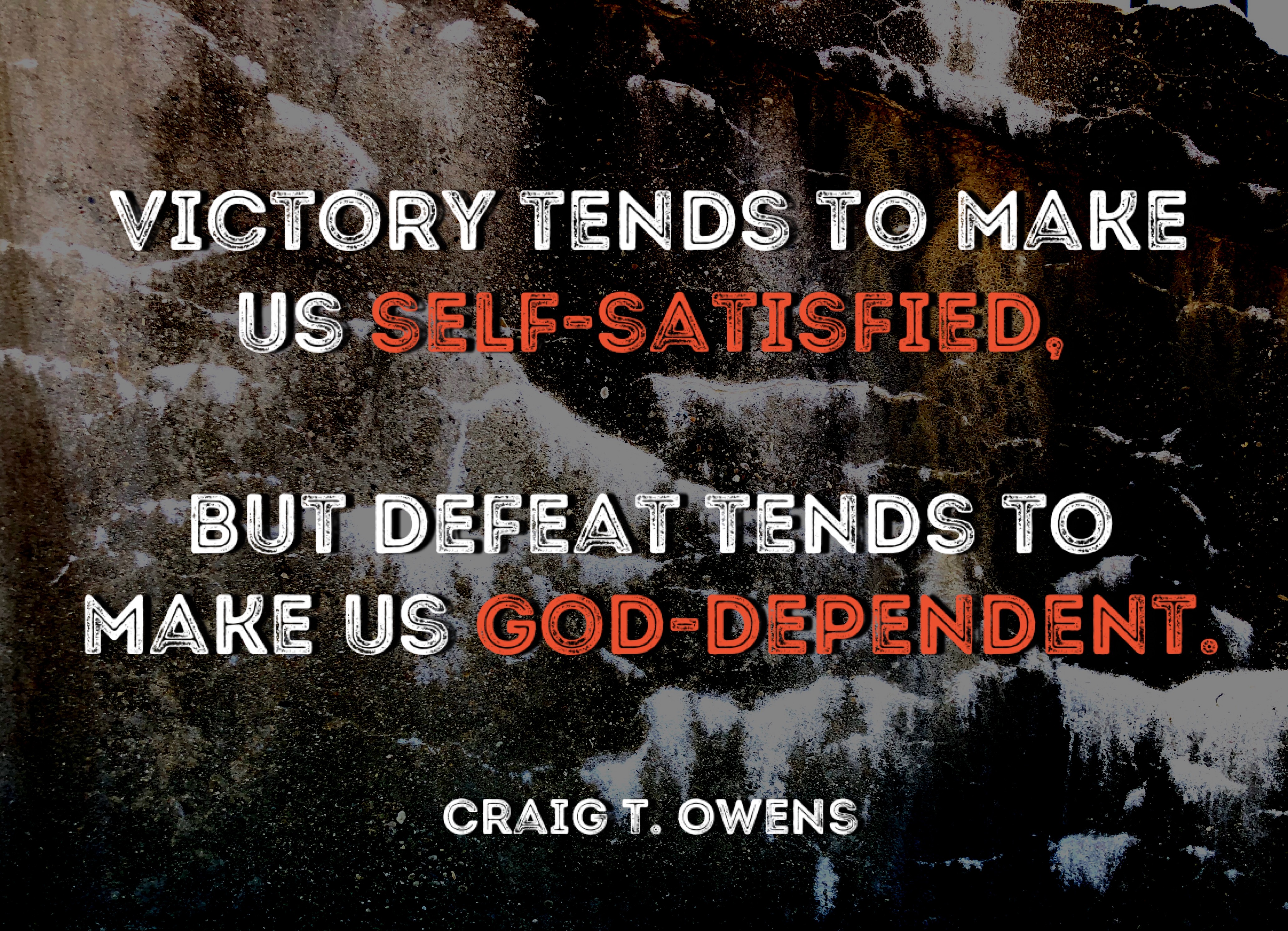
I think this is the key principle—We are more vulnerable to an attack (and a temporary defeat) after a victory than after a defeat. Why is that? Because victory tends to make us self-satisfied, but defeat tends to make us God-dependent.
When David confesses that God has allowed this temporary defeat, he is really confessing that he had attempted to navigate things on his own. Perhaps he thought his strategy would keep Israel secure, or that his men were trained and resourced enough to be victorious, or that David didn’t even have to pay attention to the Edomites any longer.
Whatever went through David’s mind, it was clear that he had become more self-satisfied than he was God-dependent. So David correctly recognized that he needed to run to God’s banner. He recognized that was the only secure place for him to stay.
This psalm is also called an imprecatory psalm, which is the theological way of saying, “Get ‘em, God!” Since King Saul has sent assassins to try to kill David, you can understand why David is praying this way. But I sort of wonder why he inserts a Selah pause after two rather angry-sounding sentences in verses 5 and 13.
When we are reading—or even praying—an imprecatory prayer, here are some important things to keep in mind:
This prayer is inspired by the Holy Spirit. All of the words in the prayer, including the Selah pauses, are directed by the Holy Spirit. Getting our angry thoughts out in God’s presence is the safest place to vent.
This is a prayer for justice because an injustice has been done, not just a prayer because David is upset with someone.
Since this prayer says, “Get ‘em, God,” it’s a prayer that turns matters over to God as the Ultimate Judge, taking the judgment out of my hands.
Really this is a prayer that seeks to balance something vital: The desire to see evil punished while at the same time desiring to see all evildoers come to salvation.
Think of it this way: When I sin, do I want to meet a God of justice or a God of mercy? Since we are to treat others the way that we would want to be treated, if I want to receive God’s mercy, I have to desire that for others too. Even those evildoers who have hurt me.
David’s first Selah pause comes after saying that he is innocent of any offense or wrongdoing. When we pray an imprecatory prayer, we would do well to ask the Holy Spirit to search our hearts to reveal any trespasses we have committed (see Psalm 19:12-13; 139:23-24).
David’s second Selah pause comes after he says, “Then it will be known to the ends of the earth that God rules over Jacob.” Is my “Get ‘em, God” prayer a desire for me to be seen as the overcomer or for God to be seen as glorious?
As long as my focus is on my trespassers, my focus is off my God.
I cannot be consumed by thoughts of “them” because then I rob myself of thoughts of Him!
So when you get angry enough at someone who has trespassed against you that you want to pray a “Get ‘em, God” prayer, Selah pause and pray, “Holy Spirit…
…show me my trespasses;
…help me forgive my trespassers; and
…help me to focus on my God, and not on my trespassers or my forgiven trespasses.”
…David sought the face of the Lord… (2 Samuel 21:1).
בָּקַשׁ פָּנִים יְהֹוָה
The Hebrew phrase is baqash paniym YHWH:
baqash is to ask for, beg, desire “specifically in worship or prayer.” It’s a “searching as done by touching.”
paniym literally means the face, but it carries the idea of being in someone’s presence.
YHWH (Yahweh) is Jehovah God.
David repeatedly asked, sought, and begged through both prayer and worship that he might be in God’s presence. “Almighty God, I want to be with You. I want to know your heart intimately. I want to see Your face. I’m not seeking help from any other source, but I am resolutely seeking You alone.”
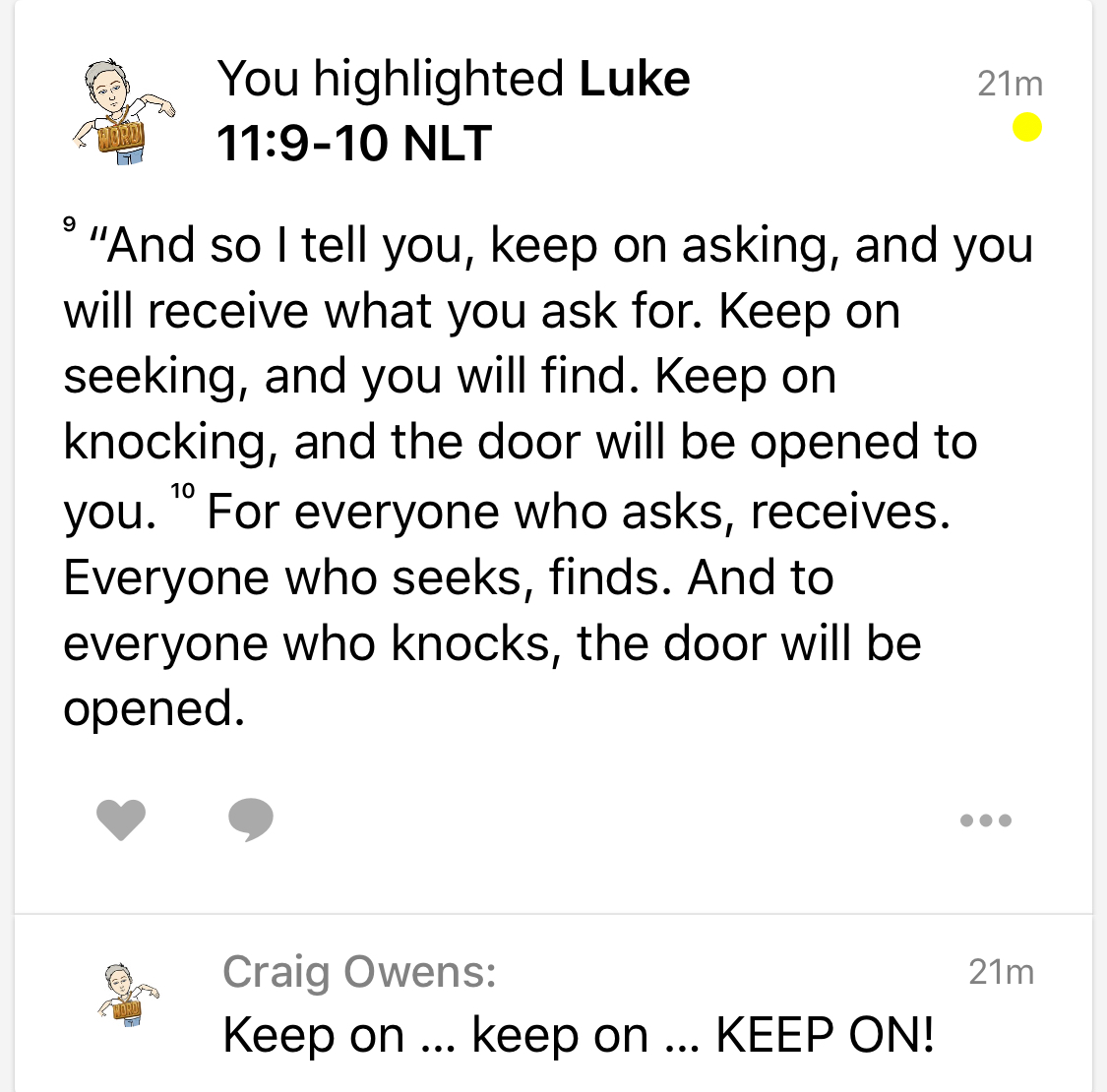
Perhaps Jesus had this in mind when He told us, “Keep on asking, keep on seeking, keep on knocking. You will get an answer, you will find what you’re seeking, the door to God’s presence will be opened to you. Your Father—YHWH, God Almighty—longs to reveal Himself to you.”
Q: How long did David seek the face of the Lord?
A: Until God spoke, until God delivered, until God opened the door.
Q: How long am I willing to keep on seeking the face of the Lord?
A: I hope I can say until God speaks, until God delivers, until God opens the door.



 I have been friends with Greg Heeres for nearly 30 years. During that time we have truly lived out the truism from wise King Solomon, “As iron sharpens iron, so a friend sharpens a friend.”





 Craig T. Owens
Think On This…
September 4, 2020 — Craig T. OwensDo to others what you would like them to do to you. (Matthew 7:12)
Think on this: Do I apply the Golden Rule negatively (just trying to avoid offending)? Or do I apply it positively (creatively trying to find ways to help others)?
Share this: