17 Quotes From “What Matters Most”

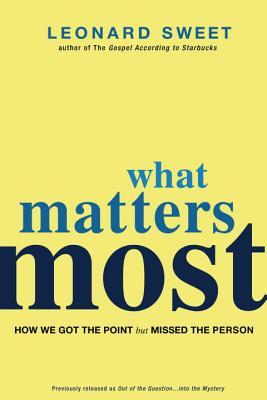
What Matters Most is sure to be a thought-provoking, conversation-starting, paradigm-challenging book. You can read my full review of Leonard Sweet’s book by clicking here. To help whet your appetite for this book (that you’re going to read very soon, right?), here are 17 quotes that especially caught my attention…

“To save the world we don’t need the courage of our convictions. We need the courage of our relationships… Especially the courage of our relationship with the Creator, the creation, and our fellow creatures. Our problem in reaching the world is that we’ve made rules more important than relationships.”

“Western Christianity is largely belief based and church focused. It is concerned with landing on the right theology and doctrine and making sure everyone else toes the line. The Jesus trimtab, in contrast, is relationship based and world focused. It is concerned not so much with what you believe as with Whom you are following.” 

“Relationship is one of the things that distinguishes Judaism and its radical Christian revision from other religions: God calls us into a relationship. Christianity is much more than a wisdom tradition or a moral system or a path leading to higher states of existence.”

“We don’t follow Jesus because we understand Him or because we know the truth about Him. We follow Jesus because He is the Truth, and He leads us into truth through our relationship with Him. …The Jesus call to discipleship is an invitation to enter a relationship with the person doing the teaching, not simply an intellectual encounter with the principles He taught.”

“The postmodern quest has been misunderstood as an abandonment of the quest for truth. It is far from an abandonment, but is rather a rerouting of the quest for truth along more relational and less rational paths.”

“If we shift our focus away from truth as right teaching and correct doctrine, and instead center our lives on truth as a Person and faith as a relationship with that Person, what does this do to evangelism? Evangelism shifts from an attempt to indoctrinate a skeptic into a new belief system and makes the gospel proclamation a process of inviting others into a relationship with God. Evangelism is as much invitation as it is proclamation. It is inviting others into a relationship with God so that the Holy Spirit can make Christ come alive in them and live in them and they can live in God’s fullness and providence. Evangelism is not leading people into right beliefs about Jesus. It is introducing people to a relationship with Jesus the Christ.” 

“Obedience, in the biblical sense, is not ‘doing what you are told.‘Obedience is living relationally, even ‘indivisibly,’ with the Holy One so that we honor, uphold, receive, and follow all that God is and all that God is calling us to become.”

“It’s time to end the theological error of talking about how to make the Scriptures ‘come alive.’ The Word of God is alive. It’s we who must ‘come alive’ to the Scriptures.

“I can either be right, or I can be in a relationship with my neighbor.”

“The Holy Spirit is not a gift to individuals. The Holy Spirit is a gift to the body of Christ.”

“Relationship, not numbers, show if growth is biblical, healthy, and truly fruitful. Perhaps it’s times to declare a moratorium on statistics in the church. What if the only thing we reported was the answer to this question: ‘Is spiritual fruit in evidence in your church? Give me the stories, not more statistics.’ My dream for the church? God’s people telling more God stories than golf stories. An authentic Great Awakening is when people can’t stop talking about what God is doing.”

“James Hillman defines deepening growth as ‘work in the dirt.’ Plants can’t grow heavenward without first growing downward. Colorful blossoms are the byproduct of bland, down-and-dirty roots. Relationships that blossom are knee-bending, hands-dirtying digs into the bedrock issues. …If our relationships are to bear fruit, they first must become rooted in the soil of the Spirit. …If you’re concerned about your dignity, think about this: Where’s the dignity in being hung naked on a tree? Where’s the dignity in kneeling down to wash the dirtiest parts of someone’s body? Where’s the dignity in being born in a manger?”

“Prayer doesn’t plunge us deeper into ourselves, but deeper into others. The early church looked at prayer as a conversation with God that brings us into greater intimacy with God and others. Prayer is not what you do to get God’s attention. Prayer is what you do to bring yourself to attend to God and to pay attention to others.”

“For Jesus it was not ‘Poor people and other outcasts, find yourself a church’; it was ‘Church people, find yourself the poor and the outcasts.’” 

“Sadly, the church is too busy connecting people with the memory of Jesus, the Jesus Who ‘once was’ or the promise of a returning Christ Who ‘is to come.’ Meanwhile, the church is neglecting the Jesus Who ‘is right now,’ the Jesus Who lives all around us in the lives of the poor, the sick, the disabled, the persecuted, and the dying.”

“Being a Christian is more about relationship with God than beliefs about God; more about the presence of God than the proofs of God; more about intimacy with truth than the tenets of truth; more about knowing God’s activities than knowing God’s attributes. It is time to move from a religion that seeks to comprehend God to a relationship that seeks to encounter and be a home for God.”

“God does not come to us offering rules; God comes offering relationship. Truth is not found in the solving of difficult theological riddles. Truth is found as we get lost in the mystery of faith. You can maintain your bearings while getting lost… if Jesus is leading the way.”


God’s Truth, Not Your Comfort

Some time ago I was asked to speak in a church setting outside of my church. The audience was a blend of people from all different church backgrounds, and perhaps even some without any church background. I talked about the hopelessness of trying to pay-off our sin debt on our own, and the amazing love that Jesus showed when He paid our debt in full.

After the service, a couple of pastors in the audience wanted to speak with me about my message. They were moved by what they called “the impact” of the message, and especially about the way I called sin “sin.” As I spoke with them further, I discovered that they were somewhat hesitant to speak so openly and plainly about sin, because it unsettled some people in their congregations.

But here is the sober reality—

The Word of God IS unsettling because we cannot read it or hear it and remain unchanged.

Our job as pastors or preachers is to speak the Word. When we do, the Holy Spirit will bring the necessary conviction and pull hearts toward repentance. Here’s what Oswald Chambers wrote about this:

“When we preach, we are not simply proclaiming how people can be saved from Hell and be made moral and pure; we are conveying good news about God.

“In the teachings of Jesus Christ the element of judgment is always brought out—it is the sign of the love of God. Never sympathize with someone who finds it difficult to get to God; God is not to blame. It is not for us to figure out the reason for the difficulty, but only to present the truth of God so that the Spirit of God will reveal what is wrong. The greatest test of the quality of our preaching is whether or not it brings everyone to judgment. When the truth is preached, the Spirit of God brings each person face to face with God Himself.”

Pastor, just speak the truth. You’re not trying to win a popularity contest, but to share with people how to step into a deeper relationship with God Almighty!

One final thought from Chambers: “Never water down the truth of God. Let it have its way and never apologize for it.

Thoughts From C.S. Lewis

I’ve been re-reading some of my notes that I made on a collection of essays from C.S. Lewis. He is one of my favorite authors, always helping me to see the spiritual realm in a whole new light.

These are just a few quotes that have me thinking…

“A live body is not one that never gets hurt, but one that can to some extent repair itself. In the same way a Christian is not a man who never goes wrong, but a man who is enabled to repent and pick himself up and begin over again after each stumble—because the Christ-life is inside him, repairing him all the time, enabling him to repeat (in some degree) the kind of voluntary death which Christ Himself carried out.”

“There are two ways in which the human machine goes wrong. One is when human individuals drift apart from one another, or else collide with one another and do one another damage. The other is when things go wrong inside the individual—when the different parts of him either drift apart or interfere with one another.”

“Those cautions which the tempter whispers in our ears are all plausible…. That is the truth in the temptation. The lie consists in the suggestion that our best protection is a prudent regard for the safety of our pocket, our habitual indulgences, and our ambitions.”

“When a man is getting better he understands more and more clearly the evil that is still left in him. When a man is getting worse he understands his own badness less and less. … Good people know about both good and evil: bad people do not know about either.”

If you haven’t read C.S. Lewis for yourself, he writes in so many different genres that you can find something for almost any taste: science fiction, children’s fairy tales, theology, apologetics, and on and on. He was truly gifted by God to see our world in a different light, and you will be greatly enriched by reading as much as you can from this master author.

Thursdays With Oswald—Me, Me, Me

This is a weekly series with things I’m reading and pondering from Oswald Chambers. You can read the original seed thought here, or type “Thursdays With Oswald” in the search box to read more entries.

Me, Me, Me

     The greatest peril is the peril within, which men never think of as a peril. My right to myself, self-pity, self-conceit, consideration for my progress, my ways of looking at things, those things are the satanic perils which will keep us in perfect sympathy with satan…. 

     In all probability satan is as much upset as the Holy Spirit is when men fall in external sin, but for a different reason. When men go into external sin and upset their lives, satan knows perfectly well that they will want another Ruler, a Savior and Deliverer; as long as satan can keep men in peace and unity and harmony apart from God, he will do so (see Luke 11:21-22). Remember, then, satan’s sin is dethroning God. 

From Biblical Psychology

My natural bent is to internalize. In other words, I want to ponder my circumstances, think about solutions myself, and reach my own conclusion. This, Oswald Chambers says, is dangerous.

When I’m thinking subjectively, everything runs through the filter of me, me, me. But when I verbalize—when I get my thoughts out in the open—the Holy Spirit can use God’s Word to help me think objectively.

I need an objective, external standard to keep me on the right path. If I keep it all inside, my natural subjective bent (that all of us humans have) will lead me down the path of quietly dethroning God and enthroning myself.

Watch Your Mouth

I was reading Proverbs 10 the other day, and a recurring theme seemed to show up in this chapter. Since you’re reading this blog, I know you are highly intelligent, so I’m sure you can spot the theme as well as I can…

If you have good sense, you will listen and obey; if all you do is talk, you will destroy yourself.

If you have good sense, it will show when you speak….

If you have good sense, you will learn all you can, but foolish talk will soon destroy you.

You will say the wrong thing if you talk too much—so be sensible and watch what you say.

Honest people speak sensibly, but deceitful liars will be silenced.

If you obey the Lord, you will always know the right thing to say….

I’d say the theme was pretty obvious, wouldn’t you?

But one question still remains: What are YOU going to do with this?

Beat Up

Some snippets from a few conversations I have had the past week—

  • “What’s the point?”
  • “My life doesn’t make sense.”
  • “I probably deserve this.”
  • “I don’t know how I got here … I don’t know how to get out of here.”
  • “Why me?”
  • “I feel beat up.”

C.S. Lewis got it exactly right when he wrote, “If satan’s arsenal of weapons were restricted to a single one, it would be discouragement.”

Have you ever worked with someone whose attitude changed after giving his 2-week notice? His job performance slips … his attitude stinks … he does things against company policy … and he justifies it all by saying, “What are they going to do, fire me?” He’s got nothing to lose by acting like a complete jerk!

satan has already been “fired”—he knows he’s got a terrible end coming. And all he wants to do is make other people feel rotten … beat up … discouraged … defeated. He wants to take you down. He’s a jerk!

Did you know that the word devil means slanderer? By his very nature, he only tells lies. Everything he says is intended to harm you. He slings mud at your character, tries to get you thinking you’re no good, turns your attention to anything that’s dark, picks on your faults, jumps on your weaknesses. Like a jerk, he beats you up and beats you down until you start believing his lies.

He is a LIAR!

You are invaluable.

You are a masterpiece.

You are desperately loved by God.

You are integral to God’s plan.

I know you may want to ignore satan’s slandering, to tune out his lies, but can I suggest something else? Listen to them. Listen very carefully. If you are listening closely, you will be able to identify the lies and then demolish them. satan is hoping you will simply accept what he’s saying without analyzing it.

Here’s the next step. After you’ve identified the lies, you have to speak the truth OUT LOUD that contradicts those lies. The Bible says that we defeat satan’s slander by the power of Jesus AND the true words from our mouth. If you’re not sure what biblical truth counteracts the lies that are discouraging you, email me and I’d be happy to help you.

You are so very valuable! There’s a bully who wants to intimidate you, but your Big Brother Jesus is ready to take care of him!

Winning The Argument Or The Battle

When I entered college, I did so as a science major: pre-med biomedical chemistry, to be exact. I still really enjoy all of the medical sciences: biology, microbiology, organic chemistry, inorganic chemistry, and the like.

As you might be aware many of the scientists today have a bent toward the theory of evolution. That means that a few of my professors and several of the authors I was reading taught and wrote from that paradigm.

This set up the environment for me to want to debate for my Creationist beliefs.

I had one professor who would specifically challenge me during lectures to refute what he had just said about evolution. An author who wrote a lengthy book about evolution carried on a year-long correspondence with me where we each brought out our best arguments. In all instances—although we believed passionately in our positions and could adequately defend them—the discussions never became shouting matches.

The Bible taught me how to do this.

(This week I’m discussing my favorite book—the Bible—from a couple of different aspects. You can read some of those thoughts here, here and here.)

At times I was tempted to “cross the line” to win the argument. And I may have won the argument, but I would have put myself in a position to lose the overall battle. There are two key passages of Scripture that I keep in mind to help me with this.

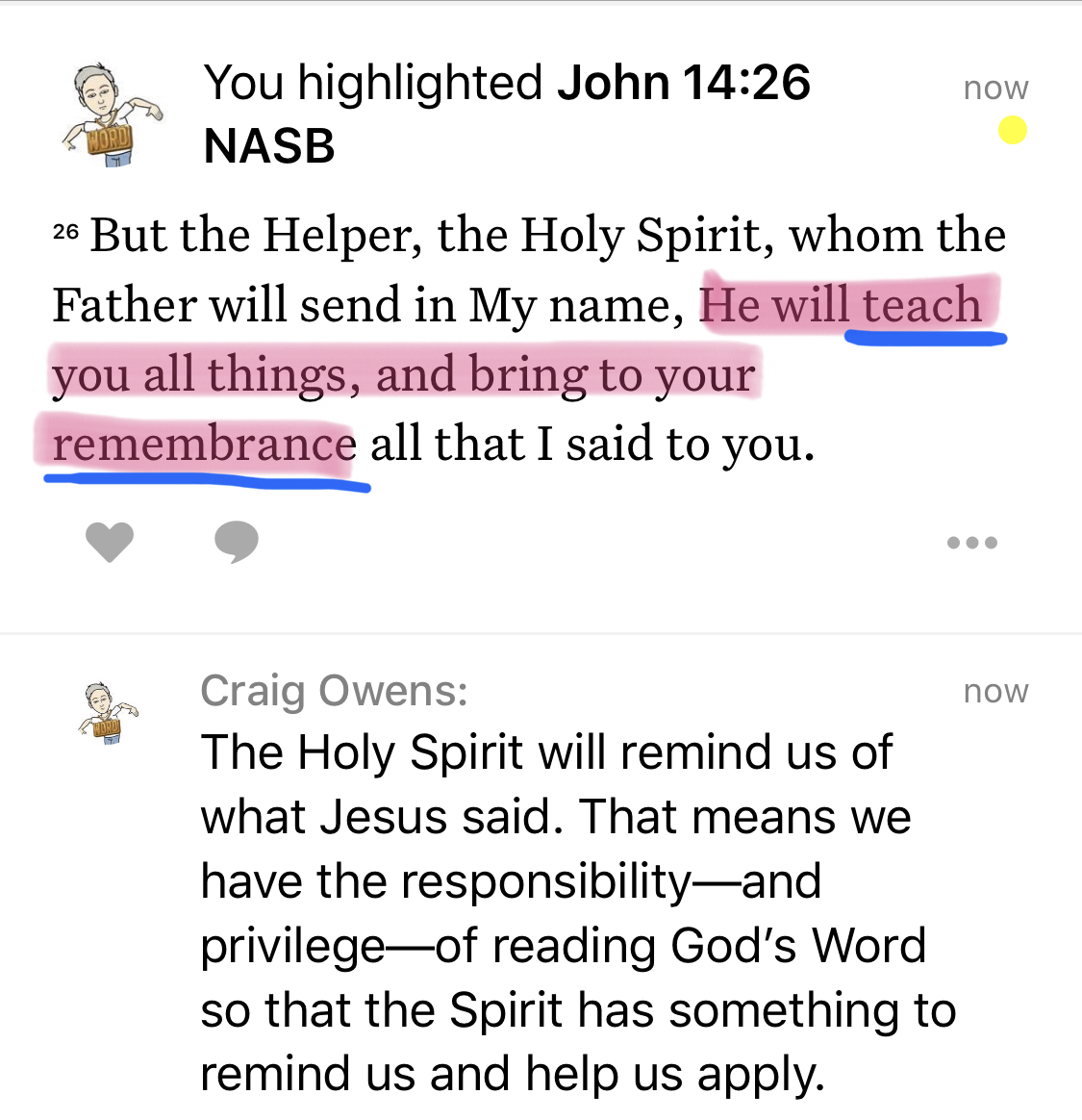
(1) In telling His followers about the Holy Spirit (John 14-16), Jesus said, “But when He, the Spirit of truth, comes, He will guide you into all truth” (John 16:13). And also, “But the Counselor, the Holy Spirit, whom the Father will send in My name, will teach you all things and will remind you of everything I have said to you” (John 14:26).

The Holy Spirit helps me apply biblical truths and principles to my everyday life. He guides me and reminds me of what I have studied.

(2) The second key passage is, “But in your hearts set apart Christ as Lord. Always be prepared to give an answer to everyone who asks you to give the reason for the hope that you have. But do this with gentleness and respect, keeping a clear conscience, so that those who speak maliciously against your good behavior in Christ may be ashamed of their slander” (1 Peter 3:15-16).

Yes, it is important for me to be prepared to give an answer, but this is the middle thought. First, I have to make sure what I’m saying is exalting Christ as Lord. Then I do my best to study and prepare to give an answer, but I must give that answer gently and respectfully.

Allowing the Holy Spirit to help you prepare from the Bible, and allowing Him to guide you into answering questions/critics gently and respectfully honors Christ. And that always wins the battle.

Poetry

Just finished a nice book of poems by Ralph Waldo Emerson and I thought I’d share a few maxims with you—

  • “To be great is to be misunderstood.”
  • “Happy is the house that shelters a friend.”
  • “Nothing great was ever achieved without enthusiasm.”
  • “A friend is a person with whom I may be sincere. Before him, I may think aloud.”
  • “Beauty without grace is the hook without the bait.”
  • “Life is not so short but there is time for courtesy.”
  • “Beware when the great God lets loose a thinker on this planet. Then all things are at risk.”
  • “No man thoroughly understands a truth until he has contended against it.”
  • “In skating over thin ice, our safety is in our speed.”

If you haven’t read any poetry lately, I encourage you to give it a try. It sounds/reads differently, but the rhythm and pace sort of sings to your mind and heart as you read it. For Americans I recommend starting out with some American poets like Emerson or Henry Wadsworth Longfellow; for you Brits, try some Robert Browning.

Happy reading!