12 Quotes From “Keeping The Ten Commandments”

Keeping The Ten CommandmentsJ.I. Packer wrote a very readable, but scholarly, book examining how 21st-century people should live out the biblical Ten Commandments. You can read my full book review by clicking here, but I’m sharing some of my favorite quotes below.

“God’s love gave us the law just as His love gave us the gospel, and as there is no spiritual life for us save through the gospel, which points us to Jesus Christ the Savior, so there is no spiritual health for us save as we seek in Christ’s strength to keep the law and practice the love of God and neighbor for which it calls.”

“Where the law’s moral absolutes are not respected, people cease to respect either themselves or each other; humanity is deformed, and society slides into the killing decadence of mutual exploitation and self-indulgence.”

“The negative form of the Commandments has positive implications. ‘Where a sin is forbidden, the contrary duty is commanded’ (Westminster Larger Catechism, Question 99). The negative form was needed at Sinai (as in the West today) to curb current lawlessness that threatened both godliness and national life.” 

“Moral permissiveness, supposedly so liberating and fulfilling, is actually wounding and destructive: not only of society (which God’s law protects), but also of the lawless individual, who gets coarsened and reduced as a person every time.”

“Law-keeping is that life for which we were fitted by nature, unfitted by sin, and refitted by grace, the life God loves to see and reward; and for that life liberty is the proper name.”

“The Bible, however, takes promises very seriously; God demands full faithfulness of our vows. Why? Partly because trustworthiness is part of His image, which He wants to see in us; partly because without it society falls apart.”

“We honor God by respecting His image in each other, which means consistently preserving life and furthering each other’s welfare in all possible ways.”

“We have in us capacities for fury, fear, envy, greed, conceit, callousness, and hate that, given the right provocation, could make killers out of us all. … When the fathomless wells of rage and hatred in the normal human heart are tapped, the results are fearful.”

“When you lie to put someone down, it is malice; when you lie to impress, move, and use him, and to keep him from seeing you in a bad light, it is pride.”

“Reformed theologians said that God’s law has three uses or functions: first, to maintain order in society; second, to convince us of sin and drive us to Christ for life; third, to spur us on in obedience, by means of its standards and its sanctions, all of which express God’s own nature.”

“What is God’s ideal? A God-fearing community, marked by common worship (commandments 1, 2, 3) and an accepted rhythm of work and rest (commandment 4), plus an unqualified respect for marriage and the family (commandments 5, 7), for property and owner’s rights (commandments 8, 10), for human life and each man’s claim on our protection (commandment 6), and for truth and honesty in all relationships (commandment 9).”

“When God’s values are ignored, and the only community ideal is permissiveness, where will moral capital come from once the Christian legacy is spent? How can national policy ever rise above material self-interest, pragmatic and unprincipled? How can internal collapse be avoided as sectional interests, unrestrained by any sense of national responsibility, cut each other down? How can an overall reduction, indeed destruction, of happiness be avoided when the revealed way of happiness, the ‘God first, others next, self last’ of the Commandments, is rejected? The prospects are ominous. May God bring us back to Himself and to the social wisdom of His Commandments before it is too late.”

Keeping The Ten Commandments (book review)

Keeping The Ten CommandmentsI am just completing a series of messages at my church on the Ten Commandments. This was no small undertaking, and one that I undertook with great reverence. I knew I needed some scholarly resources to guide my study time, and there is none who fits the bill better than J.I. Packer and his work Keeping The Ten Commandments.

Packer is indeed a most-learned man, but he has a God-given gift to discuss doctrine and theology on a level that is accessible to even someone like me! He doesn’t water-down the biblical doctrines contained in the Ten Commandments, but he presents God’s intent in them in a way that the reader can immediately grasp and then put into action.

Before looking at each of the commandments individually, Packer opens the book with a couple of chapters giving us a bird’s-eye view of how the Ten Commandments fit in with the balance of Scripture. Then he walks us through the commandments one-by-one, and concludes with a couple of chapters that help us live out the commandments today. Each chapter includes a “for further study” list of questions and Bible verses, which I highly recommend.

For getting to know the Ten Commandments better, Keeping The Ten Commandments should definitely be on your reading list.

Blessing Or Burden?

Blessing or burdenGod’s commandments aren’t a bunch of Don’ts. If we look at them through the perspective of a loving Lawgiver, they are really Dos that will keep us in a place that God can bless.

Take the 9th Commandment: You shall not give false testimony against your neighbor (Exodus 20:16; Deuteronomy 5:20). This is the first of two commandments that emphasize the damage that can be done to our neighbor if we violate the law. Speaking falsely against someone does real harm to our neighbor, so in a sense God says, “Don’t do it!

But God also tells us what to Do so that He can bless us—

  • How good and pleasant it is when brothers live together in unity! … For there the Lord bestows His blessing, even life forevermore (Psalm 133:1, 3).
  • Psalm 15 says that he who will live in God’s presence is the one who speaks the truth from his heart and has no slander on his tongue, who does his neighbor no wrong and casts no slur on his fellowman (vv. 1-3).

The word for false in this commandment can mean: (1) an untruth; (2) insincere or deceptive words (e.g. flattery); (3) being purposely vague; or (4) speaking words that are true but harmful. So we Don’t want to do those, but what should we Do?

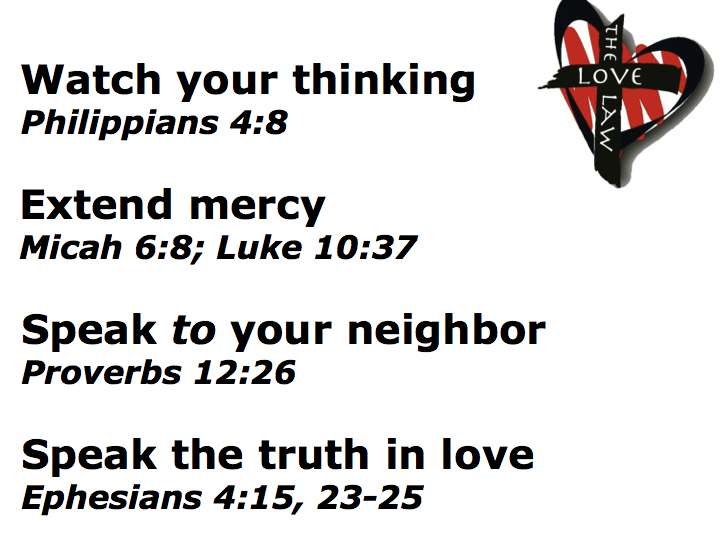
Jesus said that the way we speak is an indication of what has been going on in our heart and mind (Luke 6:45), so the way to fulfill the Do part of the commandment starts inside. A good guide is Paul’s list in Philippians 4:8—are my thoughts about my neighbor focused on what’s true? noble? right? pure? lovely? admirable? excellent? and praiseworthy?

In the New Testament, the word “blessing” is a compound word that literally means good words. So here’s the question I’m asking myself: Are my words to and about my neighbor a burden to them or a blessing?

If you have missed any of the messages in our series The Love In The Law, you can find them all by clicking here.

Keeping The Ninth Commandment

4 ways to give true testimonySome folks asked that I post a couple of things I shared in my message this morning about the ninth commandment: You shall not give false testimony against your neighbor.

Here are 4 ways to observe the positive side of this 9th commandment:

Good name in man and woman, dear my lord,
Is the immediate jewel of their souls.
Who steals my purse steals trash; ‘tis something, nothing;
‘Twas mine, ‘tis his, and has been slave to thousands;
But he that filches from me my good name
Robs me of that which not enriches him,
And makes me poor indeed. —Iago, in William Shakespeare’s Othello

Are You A Thief?

Don't Be A ThiefThere are different kinds of thieves. There’s the one that acknowledges, “I’m a thief. I take things that don’t belong to me. I use cunning and skill, and force if I need to.” Then there’s the one who steals quietly without ever realizing he’s stealing.

In the Ten Commandments when God says, “You shall not steal” (Exodus 20:15), guess what type of thief He’s talking about? It’s not the brazen, bold thief, but the one who may not even realize he’s stealing.

The Hebrew word for steal means move by stealth, take something secretly, or deceive someone. How can we steal?

All of these are subtle, stealthy, secretive ways of robbing someone of time, ideas, value, interest, credit, or even actual possessions!

So here are 4 ways to avoid becoming an thief:

  1. Learn to be content with what you have—Philippians 4:12-13.
  2. Don’t let worry rule your life—Matthew 6:25-34.
  3. Work hard for your employer or employees—Ephesians 6:5-9.
  4. If you have stolen, make full restitution as quickly as possible—Luke 19:8.

Every one of the Ten Commandments are broken in our hearts long before they are worked out in our bodies. So listen to what the Holy Spirit is saying to you to make sure you are not a sneaky thief!

If you have missed any of the messages in our series The Love In The Law, you can find them all by clicking here.

7 Ways To Avoid Becoming An Adulterer

DisciplineGod said quite simple, “You shall not commit adultery” (Exodus 20:14; Deuteronomy 5:18). This entire verse is just one word in the Hebrew language—na’aph—but it packs quite a punch.

Na’aph has two dimensions to it: physical and spiritual. Physically it prohibits sexual relations between a married person and someone not their spouse. Closely related to adultery is fornication, which is unmarried people engaging in sexual activity outside the covenant of marriage. Spiritually na’aph prohibits worship of anything other than Jehovah God.

This means that an inappropriate intimate relationship on the physical level affects our spiritual relationship with God, and vice versa. That is why immoral sexual acts are almost always incorporated into the worship of false gods. But which came first? Did someone leave behind God’s design for sexuality and begin a downward slide away from Him, or did someone’s heart stray from God and the evidence was the illicit sexual acts? It starts when we leave God’s love behind (see Romans 1:21-32).

Adultery and fornication are fueled by lust. Lust is rooted in selfishness. And by it’s very definition, selfishness kills love. Adulterers and fornicators cannot truly love each other; they are only using each other to satisfy their own selfish cravings, and in so doing, they are actually abusing each other.

So here are 7 ways to avoid becoming an adulterer:

  1. Love God passionately—Mark 12:30.
  2. If you’re married, invest in your marriage—emotionally, physically, mentally, spiritually.
  3. If you’re single, develop discipline. I define discipline as choosing what you want most over what you want now.
  4. Guard your eyes—Job 31:1.
  5. Avoid tempting places—Proverbs 5:8.
  6. Fill your mind with God’s Word—Proverbs 6:20-24.
  7. Have an accountability friend—Proverbs 7:6-9.

Any sexual relationship outside of God’s prescription—one man married to one woman for life—short-circuits God’s design, so it can never fully satisfy. Adultery and fornication break God’s heart because of the damage it does to our relationship with Him and to our relationships with each other.

If you have missed any of the messages in our series The Love In The Law, you can find them all by clicking here.

A Murderer’s Checklist

Murderer's checklistYou shall not murder (Exodus 20:13) sounds pretty straightforward. This verse is actually just one word in the Hebrew language: ratsach. The idea is a human killing another human in an animalistic way.

Think of a predatory animal like a lion. The lion attacks as an angry response when it is provoked. There is no thought about consequences or possible alternatives, but it simply lashes out in anger. A lion will also lie in wait to ambush its prey. Humans who kill in this animalistic way are regarded in the Bible as murderers (see Exodus 21:14; Numbers 35:20-21, and Deuteronomy 19:11, 13).

The legal definition of homicide today says it is “the killing of a human being by a sane person, with intent, malice aforethought (prior intention to kill the particular victim or anyone who gets in the way) and with no legal excuse or authority.”

God determines our day of conception (Psalm 139:16), the value and purpose of our life  while we are alive (Ephesians 2:10), and the day of our death (Job 14:5). Taking any of these things out of God’s hand, and putting them into our own hands, not only constitutes murder but dishonors God.

Some things are obviously homicide: Abortion is murder, suicide is murder, euthanasia is murder. Because these things put man in the place of God, they are unlawful.

But think of this: Slander is also murder. According to rabbinical scholars, publicly humiliating someone is murder, because it is character assassination. Jewish law also forbids the sharing of true but harmful information about someone else. Both of these things devalue a human being’s God-given value and purpose. Jesus echoed these teachings in Matthew 5:21-22 and Matthew 15:19.

J.I. Packer wrote, “We all have in us capacities for fury, fear, envy, greed, conceit, callousness, and hate that, given the right provocation, could make killers out of us all. … When the fathomless wells of rage and hatred in the normal human heart are tapped, the results are fearful.”

Here’s a quick checklist to make sure we aren’t getting close to becoming murderers:

  • Do I get too angry too quickly, and stay angry too long?
  • Do I harbor unforgiveness against anyone?
  • Have assassinated someone’s character?
  • Am I “lying in wait” for anyone to catch them doing wrong?

To stay clear of these murderous ways:

If you have missed any of the messages in our series The Love In The Law, you can find them all by clicking here.

10 Ways Children Can Honor Their Parents

Honor your parentsThe Bible is fairly clear on a child’s relationship with his or her parents:

The Bible also gives some directives for parents:

So children are to honor their parents, and their parents are to behave honorably. This can be a virtuous cycle, if both parent and child are doing this correctly. But what if a parent is not behaving honorably? Does the child still have to honor that parent?

In a word: Yes. The Bible doesn’t give children an option on this command. Nowhere do we read, “Only obey your Christian parents,” or “Honor your father only if he’s godly,” or “Respect your mother only if she is virtuous.” Children are simply called upon to honor and obey.

I like what Dr. Laura Schlessinger wrote—

“Honor does not mean unquestioned obedience, we truly honor our parents when we hold them accountable to God’s law. If my parents abandon me, I will honor them by seeking, though not forcing, reconciliation. If my parents abuse me, I will honor them by praying for them, so that they might see their error – and by escaping, if possible, so that they cannot continue to sin upon me. If my parents are unfaithful, I will honor them by calling for righteousness and by being willing to forgive them when they repent. If they are breaking the law, I will honor them by calling the police. Making them accountable to the highest moral order is honoring them in that I esteem them capable of responsible action.

So here are 10 biblical ways children can honor their parents—

  1. Guard your thoughts about them.
  2. Obey their lawful commands.
  3. Submit to their correction.
  4. Hold them accountable to the moral law.
  5. Show appreciation for what they have given you.
  6. Keep them connected to the family (socially, emotionally, financially, physically).
  7. Don’t expect too much of them.
  8. Don’t resent them for what they aren’t, or for what they didn’t do.
  9. Forgive them and seek reconciliation.
  10. Emulate their virtues and reverse their shortcomings.

Not only does this please God, but it opens us up to the blessing He wants to give to children who honor their parents (Deuteronomy 5:16 and Ephesians 6:2-3).

If you have missed any of the messages in our series The Love In The Law, you can find them all by clicking here.

Make A Holy Rest

Sabbath = do somethingWe are an on-the-go-all-the-time society. It seems to be a status symbol to be always “on.” If not a status symbol, maybe there’s a fear of what we might miss, “If I don’t keep up on the latest TV shows [sports team, books, music, Dancing With The Stars], I’ll feel out of place when my friends are talking about it.”

Even when we do slow down, often what we call a “rest” really isn’t. (Have you ever needed a vacation to recover from your vacation?)

This all-go, never-stop lifestyle is not only unsustainable and unhealthy, it’s also displeasing to God. In His love for us, God says we need to take a Sabbath rest (see Exodus 20:8 and Deuteronomy 5:12). The problem is: we think “Sabbath” means doing nothing, and we feel guilty for doing nothing when there is still so much to do.

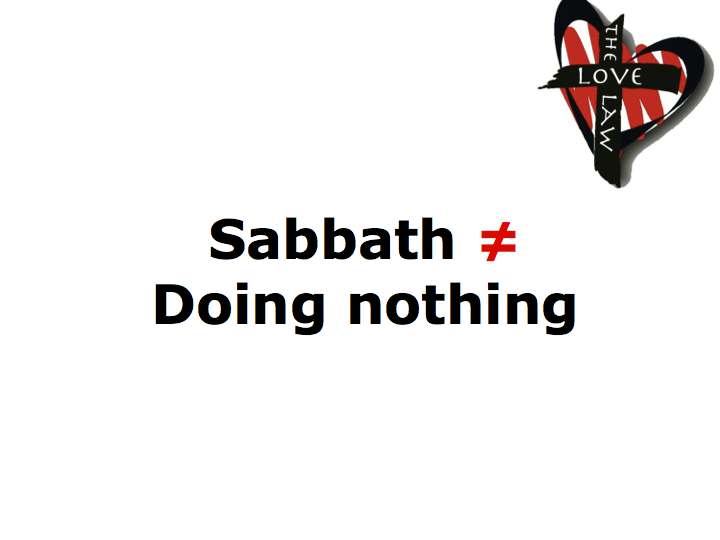
Here’s the good news: Sabbath ≠ doing nothing.

Take a look at the origin of the Sabbath—And on the seventh day God ended His work which He had made; and He rested on the seventh day from all His work which He had made. (Genesis 2:2 KJV)

That’s an unusual phrase—His work which He had made—which is repeated twice, so let’s dig into two specific words: work and made.

The verb tense for work is imperfect, which means God still had work to do. But the verb tense for made is perfect. So instead of trying to find more time in His week, God made His “To Do” list fit the timeframe. Then far from doing nothing on the Sabbath day, God reviewed His work, appreciated the beauty of Creation, and celebrated all that had been made.

This is what He calls us to do as well. Genesis 2:3, Exodus 20:8 and Deuteronomy 5:12 all tell us the Sabbath is to be holy = special, withdrawn from the usual … unique. God doesn’t want us to do nothing on the Sabbath, but to do what we don’t normally have the time to do the rest of the week.

Our modern cliché says, “You never appreciate what you have until it’s gone.” But the Sabbath says, “Stop, appreciate God’s blessings, and celebrate them while you can still enjoy them.”

God doesn’t ask you to take a rest. Instead He asks you to make your “To Do” list fit into six days, so that there can be a unique day of appreciation and celebration.

So … how are you doing on making a Sabbath?

If you have missed any of the messages in our series The Love In The Law, you can find them all by clicking here.

Don’t Misuse God’s Name

Representing God's nameYou’ve heard the old nursery rhyme: Sticks and stones may break my bones but words will never hurt me. We all know this isn’t true: words do hurt, and names that people call us may leave lasting wounds.

Words and names are important to God. God used His word to create the universe (God said, “Let there by light”); Jesus was called The Word (see John 1:1); God has named people and even renamed them to reflect their character or destiny.

The most important name of all is God’s own name, so the Third Commandment says, “You shall not misuse the name of the LORD your God…” (Exodus 20:7). How can we misuse God’s name? There are five ways—

(1) As emptiness or nothingness

  • Are our words empty? Do we use filler phrases like “Oh my God!” that neither talk to Jehovah or about Jehovah? We shouldn’t use God’s name unless we’re talking to Him or about Him in a respectful way.

(2) In vanity

  • In reality this means calling ourselves a Christian, but speaking in an un-Christlike way.
  • “Giving God a ‘bad name’ might diminish or demolish people’s belief, respect, and awe for God, a tragedy for a world that needs holiness. … It is a major responsibility to represent God; one which should not be taken lightly.” —Dr. Laura Schlessinger

(3) Being insincere

  • Are our promises empty, or is our word our bond? If we have to use phrases like “I swear to God that I will…” then that means we cannot be trusted on our own merits. When we claim to be Christians but cannot be trusted, we undermine the trustworthiness of God in the minds of other people.
  • “The godly man, therefore, will make promises cautiously but keep them conscientiously once they are made, knowing that irresponsibility and unreliability here are great and grievous sins.” —J.I. Packer

(4) Having an unholy vocabulary

  • Holy means something set apart for a special use. Perhaps there are words we use to describe God that we are also using for lesser things. It might be good to listen to how the Holy Spirit would challenge us to have a unique vocabulary to talk to or about our unique God.

(5) Worthlessness of conduct

  • As the cliche goes, “What you do speaks so loudly that I cannot hear what you are saying.” So we need to make sure that we both talk like Jesus talked and live like Jesus lived.

Anything less than these standards just may be misusing God’s holy name and character by misrepresenting Him or giving Him a “bad name.” What do you think?

If you have missed any of the messages in our series The Love In The Law, you can find them all by clicking here.