The Present Of Presence

Listen to the podcast of this post by clicking on the player below, and you can also subscribe on AppleSpotify, or Audible.

The words Paul writes to Timothy (his young protege) are the wise counsel of a seasoned veteran to a young pastor. These are words of wisdom that pastors should be especially attentive to, but they also apply to anyone who is in a position of leadership (like a parent, teacher, coach, or employer).

After challenging Timothy to set an example by his lifestyle, Paul adds these words—

Be diligent in these matters; give yourself wholly to them, so that everyone may see your progress. Watch your life and doctrine closely. Persevere in them, because if you do, you will save both yourself and your hearers. (1 Timothy 4:15-16)

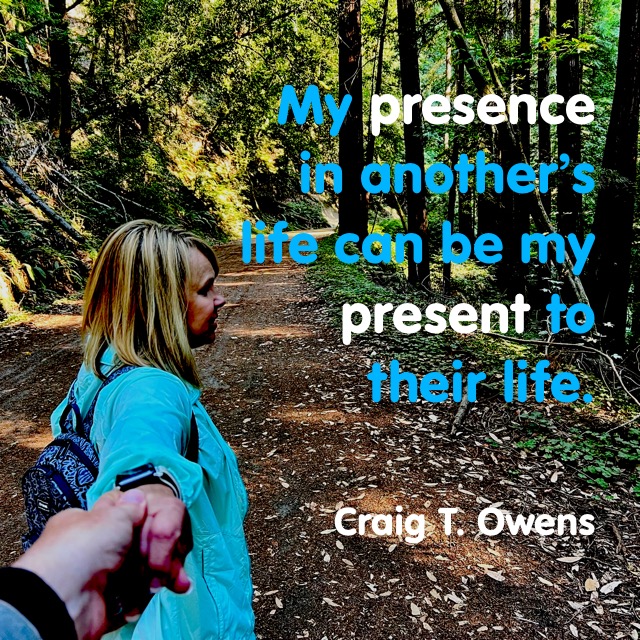
“So that everyone may see your progress.” Quite simply: you have to be present—you have to be around people so they can see what’s going on in your life. Your presence in their lives is your present to their lives!

I need to monitor what I’m doing and why I’m doing it; what I’m teaching and how I’m teaching; what I believe and why I believe it.

I need to have goals and benchmarks. I need to make my goals—and my successes and failures in hitting my goals—known to others.

I need to be in it for the long haul. It’s awfully difficult to be an example in the present if my eyes and thoughts are always on “the next thing” down the road.

Look at the blessings—the presents—of living this way: You will save both yourself and your hearers.

Not only is my presence a present to others, but having others present in my life is a present to me! The present of presence works both ways! 

Are you living so that everyone may see your progress? If not, start giving the present of your presence today!

►► Would you please prayerfully consider supporting this ministry? My Patreon supporters get behind-the-scenes access to exclusive materials. ◀︎◀︎

Thursdays With Oswald—What Motivates My Service?

This is a weekly series with things I’m reading and pondering from Oswald Chambers. You can read the original seed thought here, or type “Thursdays With Oswald” in the search box to read more entries.

What Motivates My Service?

     If my love is first of all for God, I shall take no account of the base ingratitude of others, because the mainspring of my service to my fellowman is love to God. The point is very practical and clear. If I love someone and he treats me unkindly or ungenerously, the very fact that I love him makes me feel it all the more, and yet Paul says loves “takes no account of evil,” because self is absorbed and taken up with love for Jesus Christ. 

     If you are going to live for the service of your fellowman, you will certainly be pierced through with many sorrows, for you will meet with more base ingratitude from your fellowman than you would from a dog. You will meet with unkindness and “two-facedness,” and if your motive is love for your fellowman, you will be exhausted in the battle of life. But if the mainspring of your service is love for God, no ingratitude, no sin, no devil, no angel, can hinder you from serving your fellowman, no matter how they treat you. 

From Biblical Psychology

The Bible tells me to love my neighbor as I love myself. But I also know that my heart is naturally evil, that I am naturally self-centered and self-absorbed. I can only love myself correctly if I see myself correctly, and that can only happen if my heart has been made new through the forgiveness of my sins.

That’s why the first greatest command is: Love the Lord your God with all your heart, and with all your soul, and with all your mind, and with all your strength (Mark 12:29-30). When I love God first and best, I can see myself correctly: As a trophy of His grace. Then—and only then—can I love others in a way that will never be exhausted, nor offended; nor will my motivation to love my fellowman be diminished by others’ ingratitude.

Going Up, Please

I’m leading a fun discussion at the En Gedi Youth Center with a bunch of excited 6th graders. Our class is called “An Elevation, A Mirror, And A Guy Called Bob” which is based on John Maxwell’s book Winning With People.

In Winning With People, Dr. Maxwell shares 25 principles for improving our interpersonal skills. In my class at the youth center, we’ve already covered the lens principle and the elevator principle.

The elevator principle basically says that we can only take people up or take them down in our interactions with them. There are no “neutral” interactions. I’m encouraging our students to always take people up.

One way we do that is by pausing to T.H.I.N.K before we speak. Before speaking, ask yourself, “Is what I’m about to say…

  • True
  • Helpful
  • Inspiring
  • Necessary
  • Kind?”

This isn’t just good advice for 6th graders. We all would do well to remember to T.H.I.N.K. As Winston Churchill said,

“By swallowing evil words unsaid, no one has ever harmed his stomach.”

Live Like A Star

Listen to the podcast of this post by clicking on the player below, and you can also subscribe on AppleSpotify, or Audible.

Do you want to influence people?

The first step may sound simple, but it takes a lot of work: People have to want to be around you.

Think about it—it’s hard to influence anyone who doesn’t even want to be in the same room with you, let alone get up-close-and-personal! Here are some wise words:

Do everything without complaining or arguing, so that you may become blameless and pure, children of God without fault in a crooked and depraved generation, in which you shine like stars in the universe as you hold out the word of life… (Philippians 2:14-16)

Here’s what the Bible says we can do to be the kind of person others want to be around:

  • Don’t be a complainer when things don’t go your way.
  • Stop arguing about everything. There is a time to stand up, and there’s a time to quiet down. Learn the difference between the two.
  • Live above reproach. Simply stated: do the right thing all the time.
  • Live a life that pleases God.
  • Set an example worth following and people will want to follow you!
  • Use the Bible as the infallible standard for all of your life choices.

Living this way makes you shine like a star. Not a rock star or a superstar, but a powerful influencer.

Want to see something cool? The dictionary gives this amazing bit of information about the origin of the word influence

An astrological term which meant the streaming ethereal power from the stars acting upon the character or destiny of men.

If you live the way the Bible says in these three verses, you will not only shine like a star, you will be positively affecting the character and destiny of those in your circle of influence. How cool is that?!

And that is a great reason to live a God-pleasing life!

►► Would you please prayerfully consider supporting this ministry? My Patreon supporters get behind-the-scenes access to exclusive materials. ◀︎◀︎

17 Quotes From “What Matters Most”

What Matters Most is sure to be a thought-provoking, conversation-starting, paradigm-challenging book. You can read my full review of Leonard Sweet’s book by clicking here. To help whet your appetite for this book (that you’re going to read very soon, right?), here are 17 quotes that especially caught my attention…

“To save the world we don’t need the courage of our convictions. We need the courage of our relationships… Especially the courage of our relationship with the Creator, the creation, and our fellow creatures. Our problem in reaching the world is that we’ve made rules more important than relationships.”

“Western Christianity is largely belief based and church focused. It is concerned with landing on the right theology and doctrine and making sure everyone else toes the line. The Jesus trimtab, in contrast, is relationship based and world focused. It is concerned not so much with what you believe as with Whom you are following.” 

“Relationship is one of the things that distinguishes Judaism and its radical Christian revision from other religions: God calls us into a relationship. Christianity is much more than a wisdom tradition or a moral system or a path leading to higher states of existence.”

“We don’t follow Jesus because we understand Him or because we know the truth about Him. We follow Jesus because He is the Truth, and He leads us into truth through our relationship with Him. …The Jesus call to discipleship is an invitation to enter a relationship with the person doing the teaching, not simply an intellectual encounter with the principles He taught.”

“The postmodern quest has been misunderstood as an abandonment of the quest for truth. It is far from an abandonment, but is rather a rerouting of the quest for truth along more relational and less rational paths.”

“If we shift our focus away from truth as right teaching and correct doctrine, and instead center our lives on truth as a Person and faith as a relationship with that Person, what does this do to evangelism? Evangelism shifts from an attempt to indoctrinate a skeptic into a new belief system and makes the gospel proclamation a process of inviting others into a relationship with God. Evangelism is as much invitation as it is proclamation. It is inviting others into a relationship with God so that the Holy Spirit can make Christ come alive in them and live in them and they can live in God’s fullness and providence. Evangelism is not leading people into right beliefs about Jesus. It is introducing people to a relationship with Jesus the Christ.” 

“Obedience, in the biblical sense, is not ‘doing what you are told.‘Obedience is living relationally, even ‘indivisibly,’ with the Holy One so that we honor, uphold, receive, and follow all that God is and all that God is calling us to become.”

“It’s time to end the theological error of talking about how to make the Scriptures ‘come alive.’ The Word of God is alive. It’s we who must ‘come alive’ to the Scriptures.

“I can either be right, or I can be in a relationship with my neighbor.”

“The Holy Spirit is not a gift to individuals. The Holy Spirit is a gift to the body of Christ.”

“Relationship, not numbers, show if growth is biblical, healthy, and truly fruitful. Perhaps it’s times to declare a moratorium on statistics in the church. What if the only thing we reported was the answer to this question: ‘Is spiritual fruit in evidence in your church? Give me the stories, not more statistics.’ My dream for the church? God’s people telling more God stories than golf stories. An authentic Great Awakening is when people can’t stop talking about what God is doing.”

“James Hillman defines deepening growth as ‘work in the dirt.’ Plants can’t grow heavenward without first growing downward. Colorful blossoms are the byproduct of bland, down-and-dirty roots. Relationships that blossom are knee-bending, hands-dirtying digs into the bedrock issues. …If our relationships are to bear fruit, they first must become rooted in the soil of the Spirit. …If you’re concerned about your dignity, think about this: Where’s the dignity in being hung naked on a tree? Where’s the dignity in kneeling down to wash the dirtiest parts of someone’s body? Where’s the dignity in being born in a manger?”

“Prayer doesn’t plunge us deeper into ourselves, but deeper into others. The early church looked at prayer as a conversation with God that brings us into greater intimacy with God and others. Prayer is not what you do to get God’s attention. Prayer is what you do to bring yourself to attend to God and to pay attention to others.”

“For Jesus it was not ‘Poor people and other outcasts, find yourself a church’; it was ‘Church people, find yourself the poor and the outcasts.’” 

“Sadly, the church is too busy connecting people with the memory of Jesus, the Jesus Who ‘once was’ or the promise of a returning Christ Who ‘is to come.’ Meanwhile, the church is neglecting the Jesus Who ‘is right now,’ the Jesus Who lives all around us in the lives of the poor, the sick, the disabled, the persecuted, and the dying.”

“Being a Christian is more about relationship with God than beliefs about God; more about the presence of God than the proofs of God; more about intimacy with truth than the tenets of truth; more about knowing God’s activities than knowing God’s attributes. It is time to move from a religion that seeks to comprehend God to a relationship that seeks to encounter and be a home for God.”

“God does not come to us offering rules; God comes offering relationship. Truth is not found in the solving of difficult theological riddles. Truth is found as we get lost in the mystery of faith. You can maintain your bearings while getting lost… if Jesus is leading the way.”

Negotiating Conflict

Last week I spent two jam-packed days at the Willow Creek Leadership Summit. As always, I was on information overload with the great content that is presented every year. So I’ve been taking some time to ponder what I learned.

There are a couple of past post on my blog that consistently rank near the top of the list of “most read”:

With that in mind, William Ury’s discussion on how to successfully negotiate conflict really caught my attention.

Ury pointed out that conflict isn’t bad; it’s natural. Therefore, we don’t need to eliminate conflict, but find ways to deal with it in constructive ways.

I’ve tried to learn to look at myself in the mirror before entering into discussions where the potential for conflict is high. This thought was reinforced when Ury said: The greatest obstacle to successful negotiation is: Me. Why? Because I tend to react. “When you’re angry, you’ll make the best speech you’ll ever regret,” he said.

The greatest power we have in negotiation is the power NOT to react. 

Here are some strategies William Ury shared for successful negotiations:

  • Separate people from the problem. Be soft with people and hard with the problem. Soft means listening, empathy, and respect. Change the game: instead of squaring-off against each other face-to-face, be side-by-side facing the problem.
  • Focus on interests not positions. Probe behind the position to find out what the underlying interest is. He gave a great example about two girls who each wanted the one remaining orange. Our natural instinct is to divide the orange so each girl gets one half. But in watching what happens next, we see one girl throw away the peel and eat the fruit; the other throws away the fruit and uses the peel to complete her cake recipe. If we had figured out the interests of each girl, both girls could have had a whole orange! 
  • Develop multiple options. Search for creative options that meet the needs of everyone. Ury shared an example of a successful solution to a problem in the Middle East. Egypt wanted the Sinai peninsula because it was their historic possession; Israel wanted the same piece of land as a security buffer. The solution: let Egypt have sovereign control of the Sinai peninsula, but make it a demilitarized zone. Both sides got what they wanted.
  • Expand the pie before we divide it up. Uses standards that are objectively fair to each side.

The final piece of advice William Ury shared was the concept of BATNA = best alternative to a negotiated agreement. I need to think this through before any negotiations start. This is what I have determined ahead of time that I will walk away with if the negotiation doesn’t go as planned. Ury pointed out that we can negotiate with more confidence if we have a BATNA.

I thought this was pretty good advice. What do you think?

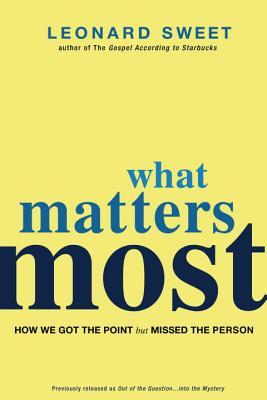
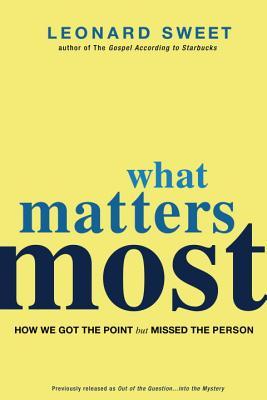
What Matters Most (book review)

The Old Testament prophet thundered out, “Thus saith the Lord!” and called the people back into a right relationship with God. The prophet’s words were not always well-received or well-liked, but they were always proved correct by God Himself. In many ways I felt like I was hearing a prophet’s voice in Leonard Sweet’s thundering words in What Matters Most, words calling us back into a right relationship with God.

The subtitle of the book is dead-on: How we got the point but missed the Person. Wow, how true that is! Christians and the Church today have so focused on getting the point of Christianity right, that we’ve missed the central point of CHRISTianity: Jesus Christ!

Leonard Sweet reminds us that we weren’t created to follow the rules of religion in isolated, solitary lives, but we were created to be in an intimate relationship with the Creator and with His creation. Sweet writes:

“What makes us human is the same thing that makes us created in the image of God. We are not isolated entities, self-contained, existing apart from God or from one another or even from God’s creation. We are made for “community” and “communion” and “ecology” …. We are judged by the world not on the basis of how “right” we’ve gotten what we believe but on how well we’re living it—on how we love God and people.”

So in What Matters Most Leonard Sweet focuses on those living relationships that should be the hallmark of Christians. Things like our relationship with…

  • our faith
  • our Creator
  • other people of faith
  • other people outside the faith
  • creation
  • arts
  • the unseen spiritual world

As I wrote earlier, often the prophet’s message was not received well initially. This is how you may feel when you first read What Matters Most. But if you will prayerfully read through this book, I think you will find (as I did) how these words resonate with the “Thus saith the Lord” tenor of Scripture and cause you to reevaluate your relationship with God and others.

I am a Waterbrook book reviewer. Check out some of the quotes I shared from this book by clicking here.

Getting A Checkup

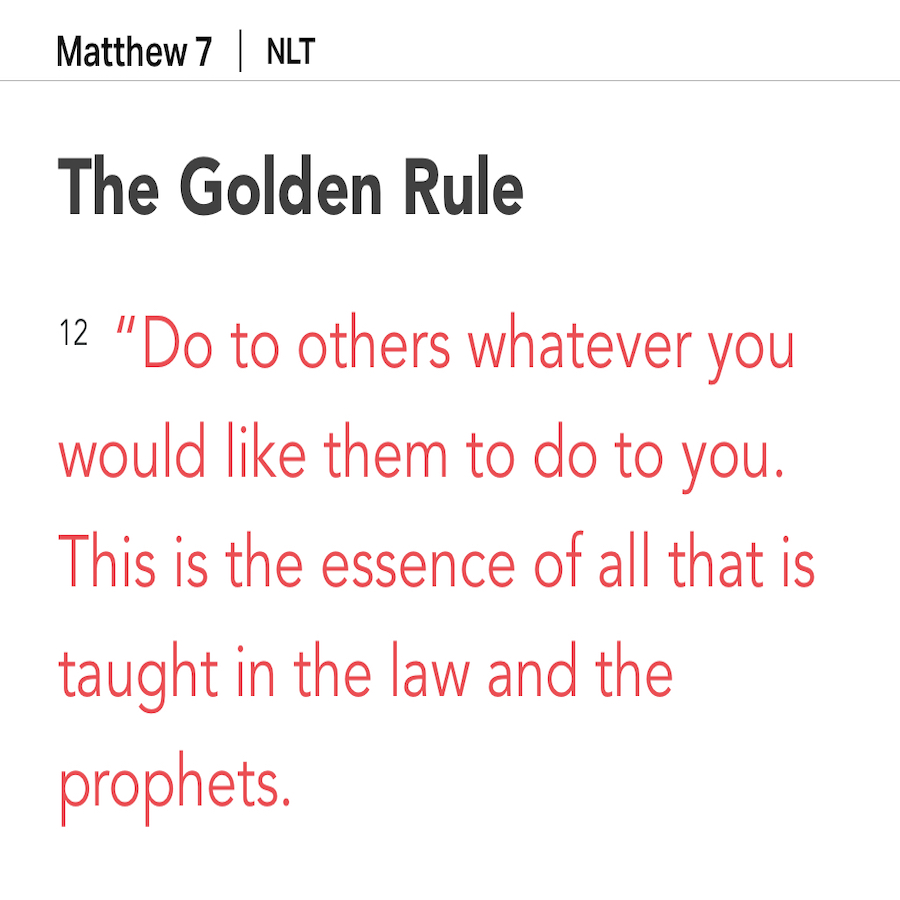
Probably almost everyone has heard the so-called Golden Rule that Jesus gave us:

So in everything, do to others what you would have them do to you, for this sums up the Law and the Prophets. (Matthew 7:12)

Most of the time we apply this verse from an I-perspective. That is, we ask, “How would I want to be treated in this situation,” and then we treat others like that.

What about if we switch it? What if we took the time to find out how the other person wanted to be treated?

In Romans 12, Paul says we are all interdependent on one another (v. 6). And he gives us some ways to live out the Golden Rule from an others-perspective. So from his teaching, here’s a checkup I’m giving myself:

  • Am I truly devoted to others, like I would be to my own family members (v. 10a)?
  • Do I honor others’ wishes ahead of my own (v. 10b)?
  • Do I work to find harmony (v. 16)?
  • Am I willing to do what others think is right (v. 17)?
  • Do I work hard to find a peaceful solution for everyone involved (v. 18)?

Now here’s the real test:

  • How would others answer the above questions about me?
  • How would someone who doesn’t like me answer those questions about me (v. 20)?

This checkup is making me think. How about you?

Don’t Stop Now

Today is Valentine’s Day—a day set aside for us to express our love to our sweethearts. Sadly, for many people, other than their birthday this may be the only day that someone is focused on them.

My encouragement to you is don’t stop today. Don’t let today be the only day those close to you see and hear and experience your love for them.

Don’t let your spouse wonder.
Don’t let your kids guess.
Don’t let your friends hope.

Don’t stop “studying” your loved ones. Learn what love language they speak, and then don’t stop speaking it. (If you haven’t read it already, I highly recommend Dr. Gary Chapman’s great book The Five Love Languages.)

Flowers, candy, cards, and romantic dinners today are a start. Don’t stop now. Keep it going all year long.

What Is He Thinking?? (book review)

So many times I overhear guys trying to figure out what the women in their lives are thinking. So it just seems natural that women would have the same questions about guys. So to help the ladies out, Rebecca St. James has interviewed several guys, and complied the results in her latest book What Is He Thinking??

Here’s how Rebecca describes part of her motivation in writing this book—

“Not too long ago I was out in the sunshine going for a long rollerblade. And I was lost in my thoughts. Thinking about a boy. Dissecting every detail of my relationship with said boy. About halfway through my ride I felt the Holy Spirit gently nudge me, “Rebecca, look up.” I realized that I had been staring at the ground as I bladed, worrying, analyzing my dating life, not looking up and around, and—most of all—not looking for God to speak to my situation. I realized that I wasn’t awake to a few necessary things.

“Awake to the fact that I could trust God to take care of me, that I didn’t have to be anxious.

“…I think it’s very easy for us girls to get so caught up in relationships that we become blind to the other things that are going on around us. The spiritual dimension of a relationship is very important. Here’s what I discovered about how guys feel about their walk with God and how it relates to the girls they pursue.”

So Rebecca chose both single and married guys, older and younger guys, friends and family. She both interviewed them with specific questions, and allowed them an “open forum” to share what’s on their minds about relationships, dating, marriage, and sex. These guys shared their turn-ons and turn-offs, their dreams, and their ideals. As a guy, I resonated with what these guys shared, and was pleasantly surprised by how many guys were so tuned-in to the biblical standards of relationships.

I would highly recommend this book for any parents with teenage daughters. Perhaps you could even do what my daughter and I are doing: Reading AND discussing the content of this book together. Relationships can be so confusing, so What Is He Thinking?? can take some of the mystery out of it.

I am a FaithWords book reviewer.