16 Quotes From “Firsthand”

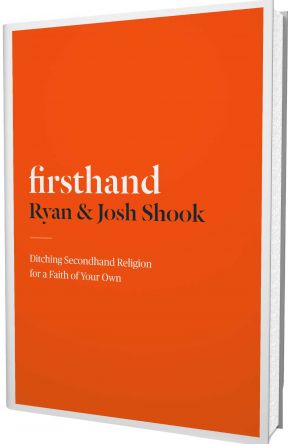
FirsthandI strongly encourage Christian parents to put a copy of Firsthand into the hands of their children, high school age and older. This book will help them think through making their faith in Jesus something personal to them. You can read my book review by clicking here. Below are some quotes that stood out to me. All of these quotes are by the authors, unless otherwise noted.

“You must be emptied of that of which you are full, so that you may be filled with that of which you are empty.” —Augustine

“One of the most liberating and powerful statements of all time comes from the lips of Jesus: ‘You will know the truth, and the truth will set you free’ (John 8:32). And we’re writing this chapter to tell you something that will set you free. The only way we’ve been able to experience freedom is by making the choice to get completely gut-level honest with God and others.

“God can use you and me through our brokenness, but first we have to get real and vulnerable with Him and with others. I think this powerful ‘get real’ dynamic works for a few reasons. First of all, being real with God and those around us invites us to drop the pride and pretense and to walk in humility. Second, honesty invites us to live every day in gratitude for the incredible grace that Lord has shown us. And third, since now we know we can’t make it on our own—and that’s okay—we’re ready to invite God’s power to do for us what we can’t do for ourselves. Paul said in 2 Corinthians 12:9, ‘I will boast all the more gladly about my weaknesses, so that Christ’s power may rest on me.’ This turns the concept of weakness and vulnerability on its head. We are saying that God makes up for our weaknesses. We are admitting that He is ready to work through them. Our weaknesses can actually become our greatest assets because they draw us closer to the Lord. And once we see how God can use them, we have all the more reason to be open about our struggles.”

“When all you see is a life in pieces, remember: the Remodeler wants to change you from the inside out. And He’s at work building your character to match His great calling and purpose for your life.”

“We have to decide, moment by moment, if we want to act changed or be changed.”

“It is more important to live one word of Scripture than it is to memorize volumes.” —Tim Hansel

“When our faith looks like a long list of things we should do, it’s usually a sign we’re not really focused on knowing God today for ourselves. Firsthand faith is all about a relationship with the God who is always faithful.”

“God is no less with you in your doubts that He is with you in your certainties.”

“Firsthand faith means we’re not afraid to bring our burning questions directly to God. But it also means that we’re not afraid to simply relax in His love. Even when all our questions haven’t yet been answered.”

“The needs of this world are endless. So whenever we feel a divine disturbance, it’s essential that we respond with firsthand action. If we don’t, it will quickly turn into secondhand bitterness.”

“James tells us that faith without works is dead (James 2:26). The most certain way to go back to living a secondhand faith is to refuse to act upon the Holy Spirit’s movement in your heart…. When you do not respond to a divine disturbance of the Holy Spirit, you get bitter and you criticize. That helps no one. … When you don’t respond to a divine disturbance in your life, you become the greatest obstacle between an unbelieving world and a loving God—a judgmental Christian.”

“Your eternal footprint—the impact you make on this earth—will be determined by whether you respond to the calling of the Spirit of the Lord in your heart to love a broken world, to step into the gifts and passions the Lord has blessed you with yo meet the needs that others overlook.”

“When we set out to discover our own firsthand faith, we were disillusioned with church. We had seen how imperfect the church could be, and we were certain that church was the problem. Coming full circle with our firsthand faith, we now realize that church was not the problem. The problem was out view and definition of the church itself. It took us a long time to understand that church wasn’t a building or a pastor or a sermon series. It’s easy to point out everything wrong with the church when you stand outside it and approach it with a consumer mentality. We thought the church had given us a secondhand faith, when in reality we had chosen to avoid a firsthand relationship with the community of Christ follower we claimed to care about.”

“The church is messy and imperfect because it is made up of broken and imperfect people. Are you sitting on the sidelines because the people in your church are imperfect or ‘just not like you’? … God designed you to be in community with your local church. He designed you to have firsthand relationships not only with Him but also with the people in your church. You can come up with plenty of excuses not to get involved and reasons that your church has it wrong, but when was the lat time you looked inside yourself and really searched your own heart for issues?”

“You can try to live out a firsthand faith on your own for as long as you want, but until you live out that faith in a community, you will never realize your full potential in Christ.”

“As a Christian, you are part of a movement that will outlast you, and you are part of the Firsthand Generation. As communities of believers rise up, we will gain momentum and create a movement that is stronger than anything we could ever accomplish on our own. Perhaps God is calling you to gather people and become a leader in the Firsthand Generation. Take up the challenge.”

Embracing Conflict

Listen to the podcast of this post by clicking on the player below, and you can also subscribe on AppleSpotify, or Audible.

A quick survey: Please raise your hand if any of these pertain to you:

  • Have you ever had a disagreement with someone?
  • Have you had a disagreement with someone you love?
  • Have you had a disagreement with someone you love, who also called themself a Christian?

If you raised your hand, you joined 100% of my congregation who answered “yes” to all three.

When we are in close proximity to anyone, there will be conflict. In fact, close proximity usually leads to more conflict because closeness increases friction. For a Christian the issue is not if we will have conflict with others in the Church, but how will we navigate and resolve these conflicts.

The apostle Paul wrote a thank you letter to the church at Philippi, in which he speaks in some of the most glowingly loving terms of any of his letters. Clearly, this was a group of people close to his heart. So when he heard about a conflict between two ladies in this congregation, he took time to address it publicly in his letter—

I plead with Euodia and I plead with Syntyche to be of the same mind in the Lord. (Philippians 4:2)

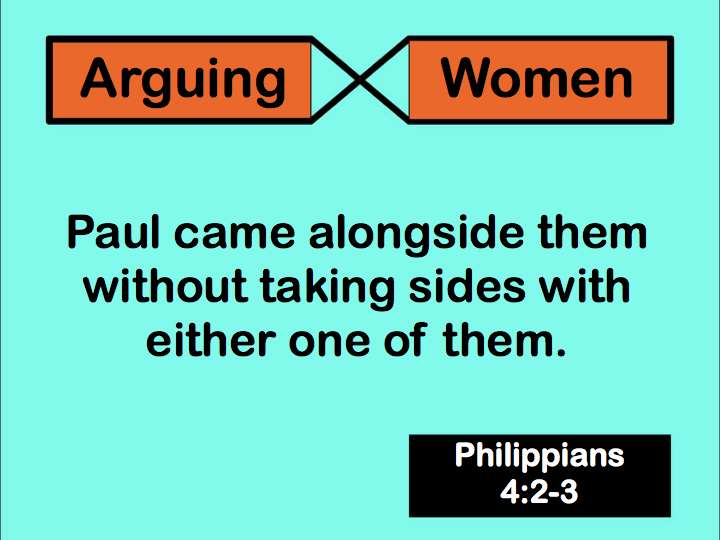
We don’t know why these ladies were arguing but notice that Paul doesn’t take sides. He simply says, “I please with Euodia AND I plead with Syntyche.” The word for plead means someone who comes alongside to help. In using this terminology, Paul gives us an important principle:

We can come alongside those in conflict without taking sides with either one of those in conflict.

In the next verse, Paul implores the rest of the church to join him in this alongsided-ness

And I exhort you too, my genuine yokefellow, help these two women to keep on cooperating…. (v. 3 in the Amplified Bible)

In other words, Paul wants the rest of the church to embrace these at-odds sisters, also without taking sides. He addresses the members of the church as yokefellow. It’s not a word we use too often today (although it is still in the dictionary), but it paints a crystal clear picture of our role. Here’s what we CAN’T do as yokefellow:

  • Look away
  • Mind our own business
  • Hope the situation will work itself out
  • Try to navigate around the problem

Instead, we embrace the conflict by embracing those in the conflict. We help them to cooperate and to work in harmony in the Lord (v. 2 in the Amplified Bible). It’s our responsibility to help maintain the bonds of peace so that the Body of Christ can grow in a way that is healthy and God-honoring.

Do you know someone in conflict right now? Are you in the conflict yourself? Ask God to show you how you can come alongside—not take sides—with those in this conflict so that you can help bring about peace.

If you have missed any messages in this series called Life Together, you can find them all by clicking here.

►► Would you please prayerfully consider supporting this ministry? My Patreon supporters get behind-the-scenes access to exclusive materials, like a map and an app I just shared to help with your personal Bible study time. ◀︎◀︎

Life Together

Life TogetherOne of the things that stands out so clearly about the first century church is this—they really liked being around each other! Even though the early Christians faced persecution, rejection by the Jewish religious leadership, and even martyrdom, they truly enjoyed a special bond with one another.

In fact, that’s the key phrase: one another. The New Testament says they were devoted to one another, they helped one another, they prayed with one another, they confessed their sins to one another, they opened up their homes to one another, and on and on. This doesn’t mean they were without problems and personality clashes at times, but they found that one another was so much more enjoyable and productive than being on their own.

This Sunday at Calvary Assembly of God as I begin a brand new series called Enjoying Life Together With One Another. If you missed any of the messages, you can check them out here:

23 Quotes From “The 5 Levels Of Leadership”

5 Levels of LeadershipThere is always so much rich content in a John Maxwell book, and The 5 Levels Of Leadership is no exception. You can read my full book review by clicking here. These are a few of the quotes that especially caught my attention. Unless otherwise noted, these quotes are from John Maxwell.

“At any level, a leader doesn’t automatically stay at that level. You must earn your level of leadership with each person, and that level can go up or down at any time.” 

“You have no control over how much talent you possess. You control only what you do with it.”

“Leadership is accepting people where they are, then taking them somewhere.” —C.W. Perry 

“Often to make themselves look better or to keep people from rising up and threatening them, positional leaders make other people feel small. How?

  • By not having a genuine belief in them.
  • By assuming people can’t instead of assuming they can.
  • By assuming people won’t rather than believing they will.
  • By seeing their problems more readily than their potential.
  • By viewing them as liabilities instead of assets.”

“Anytime you think you’ve arrived—whether your position is the lowest or the highest in the organization—you’ve lowered your expectations for yourself, sold your leadership short, and fallen into a no-growth mind-set.”  

“Above all else, good leaders are open. They go up, down, and around their organizations to reach people. They don’t stick to established channels. They’re informal. They’re straight with people. They make a religion out of being accessible.” —JackWelch

“You see, when there is danger, a good leader takes the front line. But when there is celebration, a good leader stays in the back room. If you want the cooperation of human beings around you, make them feel that they are important. And you do that by being humble.” —Nelson Mandela 

“People will not get ahead with others unless they are willing to work behind others.”

“[Good leaders] have more than an open-door policy—they know the door swings both ways. They go through it and get out among their people to connect.” 

“If you want to be successful on Level 2, you must think less in terms of systems and more in terms of people’s emotions. You must think more in terms of human capacity and less in terms of regulations. You must think more in terms of buy-in and less in terms of procedures. In other words, you must think of people before you try to achieve progress.”

“Care without candor creates dysfunctional relationships. Candor without care creates distant relationships. But care balanced with candor creates developing relationships. …Caring values the person while candor values the person’s potential. …Caring establishes the relationship while candor expands the relationship. … Caring defines the relationship while candor directs the relationship.” 

“Before having a candid conversation, make sure you can answer yes to the following questions:

  • Have I invested enough in the relationship to be candid with them?
  • Do I truly value them as people?
  • Am I sure this is their issue and not mine?
  • Am I sure I’m not speaking up because I feel threatened?
  • Is the issue more important than the relationships?
  • Does this conversation clearly serve their interests and not just mine?
  • Am I willing to invest time and energy to help them change?
  • Am I willing to show them how to do something, not just say what’s wrong?
  • Am I willing and able to set clear, specific expectations?”

“If achieving the vision is worth building the team, it is also worth risking the relationship. Building relationships and then risking them to advance the team creates tension for the leader. That tension will force you to make a choice: to shrink the vision or to stretch the people to reach it. If you want to do big things, you need to take people out of their comfort zones. They might fail. They might implode. They might relieve their own tension by fighting you or quitting. Risk always changes relationships. If you risk and win, then your people gain confidence. You have shared history that makes the relationship stronger. Trust increases. And the team is ready to take on even more difficult challenges. However, if you risk and fail, you lose relational credibility with your people and you will have to rebuild the relationships. Risk is always present in leadership. Anytime you try to move forward, there is risk. Even if you’re doing the right things, your risk isn’t reduced. But there is no progress without risk, so you need to get used to it.” 

“You can issue all the memos and give all the motivational speeches you want, but if the rest of the people in your organization don’t see you putting forth your very best effort every single day, they won’t either.” —Colin Powell

“The job of a leader is to build a complementary team, where every strength is made effective and each weakness is made irrelevant.” —Stephen Covey

“If you want to be an effective leader, you must move from perfectionist to pragmatist.”

“Since you can’t prevent mistakes, why not adopt and attitude in which you and your team learn from them?” 

“The individual leads in order that those who are led can develop their potential as human beings and thereby prosper.” —Socrates

“The highest goal of leadership is to develop leaders, not gain followers or do work.”

“Leadership is an opportunity to serve.” —J. Donald Walters

“No matter where you are in your leadership journey, never forget that what got you to where you are won’t get you to the next level.” 

“The reality is that no one is indispensable. Worse, allowing others to become dependent does little more that satisfy a leader’s ego. It is a very limiting leadership style that has a very short life span. The first step in developing leaders is to have a desire to develop people so that they can succeed without you. …If you want to develop people, you must help them discover and build upon their strengths. That’s where people have the most potential to grow. Helping to develop their strengths is the only way to help leaders become world-class.”

“What you do daily, over time, becomes your legacy.”

Love The Sinner

Love the sinnerIf anyone sees his brother commit a sin…he should pray…. (1 John 5:16)

The King James Version says this a little more poetically, “If any man see his brother sin a sin.” The Greek does not have the indefinite “a” in front of sin, and the verb tense makes this an ongoing process, so it’s probably more accurate to say it like this: “If anyone sees his brother sinning sins.”

The apostle John is head-over-heels in love with Jesus. So time and time again his counsel is for us also to fall more in love with God, and to demonstrate this by loving others. There is no more loving thing we can do for someone sinning sins than to pray for them (see also Galatians 6:1 and James 5:19-20).

John doesn’t ask us to catalogue their sins; otherwise he would have said “a sin” or even “their sinS.” We are not to be the sin police trying to document each and every infraction! Instead, when we see a brother or sister with a lifestyle that is separated from the love of God, we need to pray for them.

I think John might ask us to pray that they would see the love of God so clearly that the love of sin would become cold and pale and unattractive.

Get Some Face Time

Listen to the podcast of this post by clicking on the player below, and you can also subscribe on AppleSpotify, or Audible. 

The apostle John closed his second and third letters very similarly—

I have much to write to you, but I do not want to use paper and ink. Instead I hope to visit you and talk with you face to face, so that our joy may be complete. (2 John 12; 3 John 13)

John didn’t use his advanced years, or the difficulty and expense of travel, or the busyness of his schedule, or even the inconvenience of trying to work something into someone else’s schedule as an excuse to stay home and fire off letters.

Certainly letters have their value, but they are a one-way talking TO people. Personal visits are face to face time. They are a two-way talking WITH people. And this, John says, leads to joy for both parties!

How many excuses could I use today?

  • My schedule is so busy
  • Technology is very convenient to use
  • I’m not sure if they have the time
  • I really don’t have that much to say

Can I paraphrase John’s desire in a modern setting?

I have much to say to you, but I do not want to use Facebook or Twitter or texting. Instead I hope to visit you and talk with you face to face, so that our joy may be complete.

Make some time for face time, and you’ll be increasing both your joy and the joy of your friend as you talk WITH each other.

You may also be interested in a related post called Our Growing Communication Problem.

►► Would you please prayerfully consider supporting this ministry? My Patreon supporters get behind-the-scenes access to exclusive materials. ◀︎◀︎

Love Is… (part 2)

Love is… worksheet 2We are taking a practical look at the incredible definition of love in 1 Corinthians 13. We’re doing this in the context of learning how to love the “unloveable”—or maybe I should say, loving those who are the most resistant to real love. If we can show them love, how much more will the love of Jesus be seen!

All of these verbs are present tense verbs. That means they aren’t exhausted in the past, and they aren’t waiting for future conditions to improve—they are in operation NOW.

Far too many people know Christians more by what we’re against than by what we’re for. So where the biblical text say “love does not” or “love isn’t,” I’ve changed it into the positive “love is.”

You can read about the first five attributes love love by clicking here.

The next five attributes are:

Love is graceful

  • The root word means something that should be covered up, or something we’re ashamed of. Because our words and actions are graceful, they are things we wouldn’t have to defend, or explain, or apologize for later. They are words and actions that wouldn’t embarrass us.
  • Agape will do nothing that misbecomes it.” —Matthew Henry

Love knows our relationship > my rights

  • True love “does not demand its own way” (New Living Translation) nor does it “insist on its own rights” (Amplified Bible). Instead it always seeks ways that the relationship can be repaired or enhanced, even if that means giving up something I consider to be “my right.”
  • NOTE: I’m not saying that you become a doormat. This is not a license for someone to abuse you, but it is a call for us to balance our responses. Romans 12:18 says as far as it depends on you, live at peace with everyone.
  • Here are some great balancing verses. Balance Proverbs 26:4-5 (here is a video where I expand on this idea), and then balance Philippians 2:3-4.

Love is even-tempered

  • The Amplified Bible says it well: love is not touchy or fretful or resentful.
  • This Greek word means not getting stirred up or exasperated. So we need to lighten up!
  • There are some places where we’ve become too sensitive, too touchy, too short-fused. The fire of hurt has replaced the fire of love. So Matthew Henry advises us: “Where the fire of love is kept in, the flames of wrath will not easily kindle, nor long keep burning.”

Love is forgiving

  • The New International Version says love keeps no record of wrongs.
  • This Greek phrase speaks of an accountant tallying up the hurts (where there is an overdrawn account), seeing there is a debt to be paid back, and then appointing himself as the bill collector. True love cancels those IOUs.
  • We don’t forgive others because they deserve forgiveness, but we forgive others because we received forgiveness from God that we did not deserve!
  • For if you forgive people their trespasses [their reckless and willful sins, leaving them, letting them go, and giving up resentment], your heavenly Father will also forgive you. (Matthew 6:14 AMP)

Love is God-honoring

  • Agape loves what God loves and hates what God hates.
  • Agape loves when people find God’s truth, and hates anything that blocks that pursuit.
  • Agape loves the sinner and hates the sin.
  • “The sins of others are the grief of an agape spirit [not] its sport or delight; they will touch it to the quick….” —Matthew Henry

Here’s where the real test comes in: How will you apply these attributes of love to someone in your life? More specifically: to someone you think is “unloveable”?

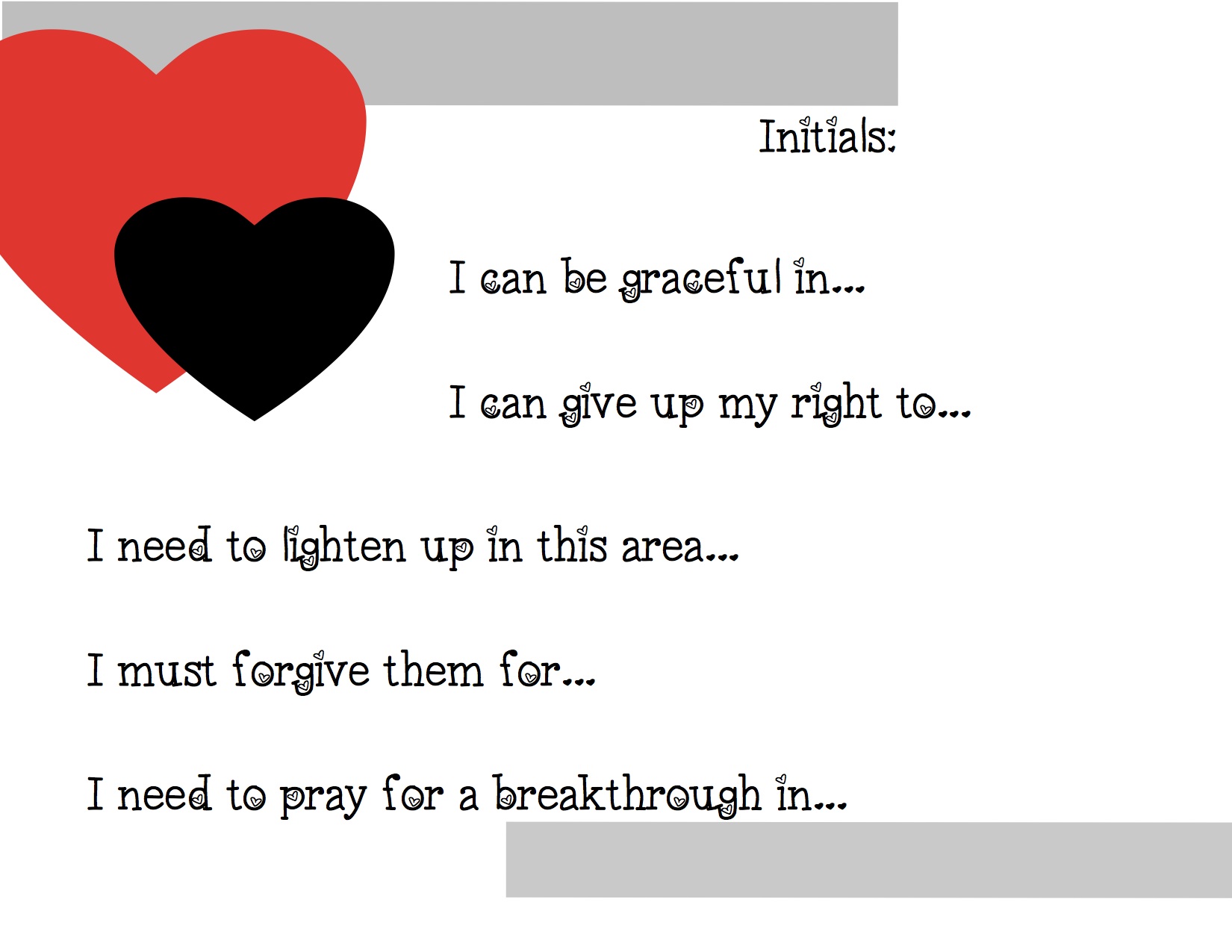
I know you have someone in your life that you think is unloveable. With that person’s face clearly in mind, how will you fill in the blanks:

  1. I can be graceful in…
  2. I can give up my right to…
  3. I need to lighten up in this area…
  4. I must forgive them for…
  5. I need to pray for a breakthrough in…

If you would like a downloadable PDF of this worksheet, click here –> Love is… worksheet 2

If you missed any of the messages in our Loving the Unlovable series, you can check them all our here.

Loving The Unloveable

Loving The Unlovable [web]Jesus came to love us. And for those that have received His love, He commands us to love others just like He loved us. In fact, Jesus said all of the commandments in the Bible could be summed up in just one word: LOVE.

Love the Lord your God with all your heart and with all your soul and with all your mind and with all your strength…. Love your neighbor as yourself. There is no commandment greater than these. (Mark 12:30-31)

But what about people who aren’t very lovable? Are we really supposed to love them? Isn’t there some sort of “escape clause” to let us out of loving those people who get on our nerves, or who are mean to us?

Although you probably already know what the answer is (in case you don’t: we’re commanded to love everyone), the Bible helps us learn how and why to love the unloveable.

If you missed any of the messages in this series, check them out here:

Thursdays With Oswald—Don’t Let Others Stumble Because Of Me

This is a weekly series with things I’m reading and pondering from Oswald Chambers. You can read the original seed thought here, or type “Thursdays With Oswald” in the search box to read more entries.

Don’t Let Others Stumble Because Of Me

     There is a difference between “offense” and “stumbling.” And they were offended in Him. But Jesus said unto them, “A prophet is not without honor, save in his own country…” (Matthew 13:57). But Jesus knowing in Himself that His disciples murmured at this, said unto them, “Does this cause you to stumble?” (John 6:61; see also Matthew 5:29; 11:6; 13:41; 16:23; 17:27; 18:6-7). Offense means going contrary to someone’s private opinion, and it is sometimes our moral duty to give offense.

     …Stumbling is different from offense. For example, someone who does not know God as well as you do, loves you and continually does what you do because he loves you, and as you watch him you begin to discern that he is degenerating spiritually, and to your amazement you find he is doing what you are doing. No offense is being given, but he is stumbling, distinctly stumbling.

From Biblical Psychology

In 1 Corinthians 8 and 9 Paul talks about not causing someone else to stumble because of what we do. It’s a fine line sometimes between offense and stumbling, but it’s a distinct line that the Holy Spirit can help us discern.

Jesus often offended people because their mindset was so rigid, and He didn’t act in a way that fit their rigid religious stereotypes. But Jesus was very cautious about making sure He never caused someone to stumble. As Matthew points out, Jesus fulfilled the prophesy of Isaiah: He will not quarrel or cry out…. A bruised reed He will not break, and a smoldering wick He will not snuff out… (Matthew 12:19-20; Isaiah 42:1-4).

My prayer: Lord Jesus, please don’t let others stumble because of me! Let me have the discernment of the Holy Spirit to know when to offend, but to never cross the line to cause others to stumble. May I have Your same gentle spirit to not quarrel, and to treat the “bruised reeds” with utmost care.

Giving Thanks For Gifted People

Listen to the podcast of this post by clicking on the player below, and you can also subscribe on AppleSpotify, or Audible.

Have you ever noticed how quickly we label people? We tend to give them a label based on their education, their socio-economic status, their race, their age, their job, even their choice of vocabulary.

We may not verbally express these labels, but we think them. And we will always treat people as we label them! In fact, it’s impossible to treat someone differently than you think about them.

What sort of label does God use? Well, He says that He knit you together in your mother’s womb; that He saw all of the days of your life before you were even a twinkle in your father’s eye; He knows the number of hairs on your head; He knows the thoughts in your head; He knows what you’re going to say before you say it. And then there’s this beautiful thought—

For we are God’s workmanship, created in Christ Jesus to do good works, which God prepared in advance for us to do. (Ephesians 2:10)

The label God puts on you:

My one-of-a-kind, irreplaceable, invaluable masterpiece!

When you are givingthanksgiving for people (that means you are always thankful for people), you will begin to see them as God’s masterpieces too!

Everyone you meet is God’s gift. He gave them to humanity to do the good works which He prepared in advance for them to do. You are surrounded by gifted people!

If you don’t see people this way—or if you tend to label them with less-than-flattering tags—perhaps you should begin to pray for them. Try a prayer like this:

I thank my God for you; in fact, I always thank God for you. And every time I thank God for you, I pray for you, night and day. In all my prayers for you, I always pray with joy, being confident of this, that He who began a good work in you will carry it on to completion until the day of Christ Jesus. And this is also my prayer: that your love may abound more and more in knowledge and depth of insight, so that you may be able to discern what is best and may be pure and blameless until the day of Christ, filled with the fruit of righteousness that comes through Jesus Christ—to the glory and praise of God. So I urge you to join me in offering requests, prayers, intercession and thanksgiving for everyone. (This prayer is taken from Romans 1:8; 1 Corinthians 1:4; Colossians 1:3; 2 Timothy 1:3; Philippians 1:3-11; 1 Timothy 2:1)

Don’t just express your thanks for people on Thanksgiving Day, but be givingthanksgiving all the time. Remember: everyone you meet is a gifted person because everyone you meet is God’s one-of-a-kind, irreplaceable, invaluable masterpiece.

Check out the other message in this two-part series series here.

►► Would you please prayerfully consider supporting this ministry? My Patreon supporters get behind-the-scenes access to exclusive materials. ◀︎◀︎