Killing Mammon’s Covetousness

Listen to the podcast of this post by clicking on the player below, and you can also subscribe on AppleSpotify, or Audible.

Max Lucado wrote, 

“The United States economy endured ten recessions between 1948 and 2001. These downturns lasted an average of ten months apiece and resulted in the loss of billions of dollars. Every five years or so, the economy dumps its suitors and starts over. What would you think of a man who did the same with women? What word would you use to describe a husband who philandered his way through nine different wives over fifty years? And what word would you use to describe wife number ten? How about this one? Fool. Those who trust money are foolish. They are setting themselves up to be duped and dumped into a dystopia of unhappiness.” —Max Lucado, Fearless  

Yikes! It sounds like money can be a scary thing. So let’s consider statement #12 in our series asking “Is that in the Bible?”—Money is the root of all evil. Is that in the Bible? No! 

That phrase is close to one that is in the Bible, but “close” misses the real meaning. What Paul actually wrote to Timothy is, “For the love of money is a root of all kinds of evil” (1 Timothy 6:10). 

That three-word phrase “love of money” is actually just one word in Greek, and it means “friend of silver.” 

The Bible teaches that money itself is neither good nor evil. It’s merely a tool like a hammer that is used for building something or for destroying something. If the hammer builds or destroys, it’s not the hammer that is good or evil but the attitude of the one gripping the hammer determines the good or evil outcome. 

So too with money. Money keeps the lights on, puts gas in our car, clothes on our backs, and food in our stomachs, it even helps people share the Gospel here and around the world. It’s our attitude toward money that leads us to good or evil thoughts and actions. 

In describing people who were a friend of silver, Paul uses phrases like this to describe them: teaches false doctrine … does not agree to sound instruction…and godly teaching … who think godliness is a means to financial gain … want to get rich … eager for money (1 Timothy 6:3-5, 9-10). 

In 1923 a group of the world’s most successful financiers gathered at the Edgewater Beach Hotel in Chicago. Together these men controlled more wealth than the United States Treasury! They met together to discuss how they could use their present wealth to gain even more wealth. Their plan was put into place and it began to reap the results they planned: they expanded their influence and their bank accounts. 

Then six years later, on October 29, 1929, Black Tuesday happened. The worst day for the New York Stock Exchange ever and the beginning of the Great Depression in the USA. 

What about that group of wealthy financiers who wanted more, more, more? 

  • Charles Schwab—president of Carnegie Steel Company—lived the last years of his life on borrowed money and died penniless 
  • Arthur Cutten—the world’s largest wheat speculator—died insolvent 
  • Richard Whitney—president of the NYSE—served a prison term for embezzlement 
  • Albert Fall—a member of the president’s cabinet—also went to prison 
  • Jessie Livermore—the “bear of Wall Street,” Leon Frazer—president of the Bank of International Settlements, and Ivar Kreuger—head of the world’s largest monopoly (a match company)—all committed suicide 

Their friendship with silver—their love of Money—led to their disastrous downfalls. 

Jesus said, “No one can serve two masters. Either you will hate the one and love the other, or you will be devoted to the one and despise the other. You cannot serve both God and Money” (Matthew 6:24). 

The word Jesus used for “Money” is Mammon: wealth personified and deified. When we make Money our god—Money (with a capital “M”)—we naturally begin to covet what isn’t ours. Nothing satisfies and so we covet to possess more and more and more. 

Remember Jesus we cannot serve two masters. If we replace God with Mammon, it is inevitable that we will break all of the Ten Commandments. Has anyone ever made an idol to their Money, or murdered for money, or committed adultery, or stolen, or told lies? They sure have! 

Paul described those who worship Mammon this way—

Those who want to get rich fall into temptation and a trap and into many foolish and harmful desires that plunge people into ruin and destruction. For the love of money is a root of all kinds of evil. Some people, eager for money, have wandered from the faith and pierced themselves with many griefs. (1 Timothy 6:9-10)

But those who worship God, Paul described like this—

But godliness with contentment is great gain. For we brought nothing into the world, and we can take nothing out of it. But if we have food and clothing, we will be content with that. (1 Timothy 6:6-8) 

Simply put: Contentment with God kills Mammon’s covetousness! 

Want to know how to check your attitude toward money? When you think about giving God His tithe, or when the Holy Spirit prompts you to give to a missionary, what thought comes to your mind? Do you think, “Ugg, I have to give this” or do you rejoice to say, “Yes, I get to give this”? The answer to that question will give you a really good indication of how much pull Mammon has over your heart. 

We all have a choice to make: yield to God or yield to Mammon. But remember only God can give us contentment today and pleasures that last for eternity. 

If you’ve missed any of the messages in our series Is That In The Bible?, you can find the full list by clicking here. 

►► Would you please prayerfully consider supporting this ministry? My Patreon supporters get behind-the-scenes access to exclusive materials. ◀︎◀︎

Unexpected Response

Listen to the podcast of this post by clicking on the player below, and you can also subscribe on AppleSpotify, or Audible. 

I’m a bit of a nut about the exactness of words, so one of my pet peeves is the incorrect use of imply and infer. “Imply” is something I do as the speaker; “infer” is something you do as the listener. Or you might say implying is like throwing and inferring is like catching. 

A big problem arises when I infer something that you didn’t imply. Or even worse, when I infer something based on something you didn’t say. People will often say something like this, “Since Jesus didn’t specifically talk about ________ then it must be okay.” In logic, this would be called an argument from ignorance: concluding that an action must be acceptable because it has not been specifically stated to be unacceptable. 

Statement #10 in our series asking “Is that in the Bible?” is—Love your neighbor. Is that in the Bible? Yes!  

Remember Jesus called “Scripture” all of the words we would now call “Old Testament.” So in Matthew 5:43 Jesus quoted Scripture: Do not seek revenge or bear a grudge against anyone among your people, but love your neighbor as yourself. I am the Lord (Leviticus 19:18). 

Later on, Jesus would add to this Deuteronomy 6:5—Love the Lord your God with all your heart and with all your soul and with all your strength—to answer the question about the greatest commandment of all. 

In Leviticus 19, the Hebrew word for love means love in the broadest sense of the word, and neighbor means a friend or a fellow citizen. Unfortunately, the rabbis inferred that someone not a Jew was therefore an enemy and therefore not worthy of love. They further inferred that the opposite of love was hate. 

Matthew Henry commented, “They were willing to infer what God never designed.” 

Statement #11 is—Hate your enemy. Is that in the Bible? Yes, in the fact that it appears in print in Matthew 5:43, but it doesn’t appear in the Scripture that Jesus knew. It had become so ingrained in the thinking of people that they now assumed it was in the Bible. 

In many ways, the Old Testament laws were easier to live out because they were all external and easy to measure, like don’t murder or don’t sleep with someone who isn’t your spouse. But Jesus made it a heart issue—He said lust is the same as adultery and hate is the same as murder. 

Jesus also made love for enemies a heart issue. The word He used for love in the Greek is agape—the same word describing God’s love for His enemies in John 3:16—For God so LOVED the world, that He gave His one and only Son, that whoever believes in Him would not perish but would have everlasting life. 

Jesus said our enemies were really our neighbors and were worthy of sacrificial love because they, too, were loved by God. 

Matthew 5:44 is shortened in the NIV and has a footnote explaining that the longer verse was not seen in the earlier manuscripts. But given the fact that Jesus demonstrated everything found in the longer version of this verse, I think we are safe in using it. So let’s look at the response Jesus calls us to from the NKJV: But I say to you, love your enemies, bless those who curse you, do good to those who hate you, and pray for those who spitefully use you and persecute you. 

Here’s what Jesus says it means for us to love our enemies:

(1) Bless the cursers. We’ve all been “cursed out” with nasty, hateful words. When that happens, Jesus wants to bless that neighbor. The word He used for bless literally means to say good words. 

(2) Help the haters. Jesus said we are to do those things that are beautiful and excellent—like the Good Samaritan did for his enemy-turned-neighbor (see Luke 10:25-37).  

(3) Pray for the persecutors. Talk to God about them; don’t talk to others about them. 

This response from Christians toward people whom others would call an enemy is totally unexpected by the world. This unexpected response will begin to draw enemies toward Jesus (1 Peter 2:12). If we will treat enemies and neighbors, they may soon become brothers and sisters in the family of God! 

When the world hits us Christians out of hate, let’s respond with unexpected love: blessing those who curse us, helping those who hurt us, and praying for those who persecute us. 

If you’ve missed any of the other messages in our Is That In The Bible? series, you can find the full list by clicking here. 

►► Would you please prayerfully consider supporting this ministry? My Patreon supporters get behind-the-scenes access to exclusive materials. ◀︎◀︎

A Pastor’s Personal Preparation

Listen to the podcast of this post by clicking on the player below, and you can also subscribe on AppleSpotify, or Audible. 

Pastor, I’m sure you are busy this week. But then again, aren’t you always busy? 

I’ve got a quick but powerful question to ask you that will make a world of difference in how you are prepared to meet the demands of your week. Check this out… 

Dietrich Bonhoeffer said, “We are reading the Word of God as God’s Word for us. Therefore, we do not ask what this text has to say to other people. For those of us who are preachers that means we will not ask how we would preach or teach on this text, but what it has to say to us personally.” 

►► Would you please prayerfully consider supporting this ministry? My Patreon supporters get behind-the-scenes access to exclusive materials. ◀︎◀︎

Trading Rights For Responsibilities

Listen to the podcast of this post by clicking on the player below, and you can also subscribe on AppleSpotify, or Audible. 

“When you become a leader, you lose the right to think about yourself.” —Gerald Brooks 

Sadly, I encounter far too many “leaders” (at least they are leaders in title only) who think being a leader means they have more rights. It might be the right to a better parking place, or to be first in line, or to ignore some of the rules that others have to follow. 

That certainly wasn’t the attitude of the apostle Paul in 1 Corinthians 9, a chapter which the NIV gives the heading ‘Paul Gives Up His Rights’:

Since we have planted spiritual seed among you, aren’t we entitled to a harvest of physical food and drink? If you support others who preach to you, shouldn’t we have an even greater right to be supported? But we have never used this right. We would rather put up with anything than be an obstacle to the Good News about Christ. (1 Corinthians 9:11-12 NLT) 

Paul said the natural thing was for those in leadership to feel entitled to certain rights, but the spiritual thing is to turn those rights into responsibilities toward the people around us. 

Spiritual leadership is not about gaining more rights, it’s about fulfilling God-given responsibilities. In fact, the higher you progress in a leadership role, the fewer rights you have. Godly servant leaders gladly trade rights for responsibilities. 

A mark of a godly leader is one who has stopped demanding his “rights.”

To trade our rights for responsibilities is a sacrifice. But I don’t mean a sacrifice that comes with a “Woe is me!” feeling. God will only ask us to sacrifice what is holding us back. God wants to use His leaders to minister to His people. He will not give us a larger position if we are only going to use that for our own benefit.

Consider the rights Jesus had because He was fully God. Yet He made the ultimate rights-for-responsibilities sacrifice by going to the Cross in our place. “The Son of Man did not come to be served, but to serve, and to give His life as a ransom for many” (Mark 10:45). 

Leaders, I encourage you to ask the Holy Spirit to show you where you may be clinging to your rights, and how you can exchange those rights for responsibilities to the people God has placed under your care.

This is part 65 in my series on godly leadership. You can check out all of my posts in this series by clicking here. 

►► Would you please prayerfully consider supporting this ministry? My Patreon supporters get behind-the-scenes access to exclusive materials. ◀︎◀︎

Be The One

Listen to the podcast of this post by clicking on the player below, and you can also subscribe on AppleSpotify, or Audible. 

John Maxwell was right: “Everything rises and falls on leadership.” 

As the leader goes, so goes the family, the neighborhood, the business, the church, the country. Just as Israel’s leaders fell into sin and took the people down with them, so too the religious and political leaders in America are leading people to sin. 

God told Ezekiel, “See how each of the princes of Israel who are in you uses his power to shed blood” (Ezekiel 22:6). These ungodly leaders were described as:

  • disintegrating the family 
  • mistreating orphans and widows 
  • despising God’s holiness 
  • slandering the righteous 
  • promoting idolatry 
  • living lewdly
  • winking at sexual depravity 
  • being dishonest in their business dealings
  • defrauding their neighbors 
  • treating people like possessions 
  • pursuing immoral gain
  • whitewashing evil (vv. 6-12, 25-28)

The bottom line: God says, “You have forgotten Me” (v. 12). 

This kind of evil must be punished by an All-Righteous God. 

But God is still merciful. He is still looking for just one who will turn away from the sins of the culture and live righteously. He is looking “for someone among them who would build up the wall and stand before Me in the gap on behalf of the land so I would not have to destroy it” (v. 30). 

God is looking for just one leader who will seek God’s glory and not personal gain, who will stand for righteousness even if he has to stand alone. 

Will you be that one? 

I pray I may be that one! 

I pray for godly leaders to stand up! “Holy God, may we stand for You in this evil culture. May Your Holy Spirit strengthen us to stand unmoved against the onslaught of depravity. Strengthen us against the evil one and against evil people, knowing that greater are You in us than the evil that is in the world. May we be the ones that refuse to bend our knee to anyone or anything but You. In the powerful name of Jesus, I pray this. Amen!” 

►► Would you please prayerfully consider supporting this ministry? My Patreon supporters get behind-the-scenes access to exclusive materials. ◀︎◀︎

Spirit-Filled Dads 

Listen to the podcast of this post by clicking on the player below, and you can also subscribe on AppleSpotify, or Audible. 

Last week I mentioned that there are numerous people who only appear in the Bible once. They come on the scene—many of them nameless to us—to play their part and then we never hear about them again. 

But we still hear from them because their lives are still teaching us. 

Remember that each of you is God’s gift to the world IF you are using God’s gift in you to glorify God in the world. We meet one of those gifts in the Book of Luke that can teach us Dads some valuable lessons. 

There are several “one-timers” listed by Luke in the Advent story. Luke was a first-rate historian, researching his subject and talking to eyewitnesses to the events. Some of these one-timers have a few details Luke shared with us: 

  • Zechariah and Elizabeth—we know their family lineage (priestly), Zechariah’s role in the temple, and the fact that Elizabeth was barren 
  • Shepherds—we know where they came from (the fields surrounding Bethlehem) and their occupation. 
  • Anna—we know her tribe (Asher), her father (Phanuel), and role (prophetess), and that she had been married and is now widowed. 

But all Luke can say of Simeon is, “There was a man called Simeon…” (Luke 2:25-35). 

Although, even that short introduction is packed with meaning. 

Simeon in Greek means harkening while Simeon in Hebrew means heard. So he was both one who heard God and one who was heard by God. This speaks to me of an intimacy of relationship. Simeon didn’t view his conversation with God as a monologue but as a dialogue. I think that far too often we view our Bible reading time as God simply speaking to us, and our prayer time as us speaking to God. But both of these activities should be a two-way dialogue.

A.W. Tozer has a great definition of a godly leader that I believe accurately portrays Simeon: “A true and safe leader is likely to be one who has no desire to lead but is forced into a position of leadership by the inward pressure of the Holy Spirit and the press of the external situation.” 

I think this means that a safe, godly leader is one who sees what is happening in a Christ-less culture, who then cries out in pain to God, and then who hears the Holy Spirit telling him how to live a holy life in that Christ-less culture.

We could call this external pressure grief over unrighteousness. Simeon so stood out in his culture that Luke calls him “righteous.” This is one whose way of thinking, feeling, and acting is wholly conformed to the will of God. 

He also calls Simeon “devout.” This is a compound Greek word that only Luke uses in the New Testament which means to catch good things and make them your own. Simeon took hold of the things of God, made them his own, and then observed them carefully.

Finally, Luke tells us that Simeon was “waiting for the consolation.” He was living expectantly to see God’s Word come to its fulfillment. He could do all of this because the Holy Spirit was upon him and the Holy Spirit had revealed truth to him. 

That phrase “revealed to him by the Holy Spirit” again speaks to the intimate relationship Simeon had with God. 

Simeon knew that what God promises, He fulfills. He knew the consolation God had promised through Isaiah (Isaiah 40:1-2), and then Simeon saw its fulfillment in Jesus the Christ—

“Sovereign Lord, as You have promised, You may now dismiss Your servant in peace. For my eyes have seen Your salvation, which You have prepared in the sight of all nations: a light for revelation to the Gentiles, and the glory of Your people Israel.” (Luke 2:29-32)

In today’s darkening, Christ-less culture, godly men like Simeon are needed again. 

Dads, do you feel the external pressure of today’s culture? If so, I pray that you will also feel the inward strengthening of the Holy Spirit drawing you into a more intimate relationship with Himself.

God gives His Word to men that will wait expectantly and pray fervently for its fulfillment. God is looking for men—for Dads—that will not cave in to cultural pressure. 

Guys, let the Holy Spirit’s inward pressure strengthen you to stand strong. As you see the external downward spiral away from God, don’t collapse, don’t complain, but hear God’s Word and remain a righteous and devout man for your family and your community. 

In our series We Are: Pentecostal, we talked much more in-depth about how the Holy Spirit wants to help us. You can check out all of those messages by clicking here.

►► Would you please prayerfully consider supporting this ministry? My Patreon supporters get behind-the-scenes access to exclusive materials. ◀︎◀︎

Mother’s Day 2022

Our foolishness can get us into a lot of trouble, so thank God for mothers!

We are going to celebrate Moms by sharing three valuable lessons from a mother we meet in the Bible, as we learn how she saved her family from the consequences of their foolishness.

How wonderful to be able to say with Abraham Lincoln, “All I am, or can be, I owe to my angel mother. … I remember my mother’s prayers and they have always followed me. They have clung to me all my life.”  

If you don’t have a church home, we would love to have you join us.

Thursdays With Spurgeon—The Natural Out-Gushing

This is a weekly series with things I’m reading and pondering from Charles Spurgeon. You can read the original seed thought here, or type “Thursdays With Spurgeon” in the search box to read more entries.

Listen to the podcast of this post by clicking on the player below, and you can also subscribe on AppleSpotify, or Audible. 

The Natural Out-Gushing

If you remain in Me and My words remain in you, ask whatever you wish, and it will be done for you. (John 15:7) 

   He does not say, ‘If you abide in Me, and My words abide in you, you will do spiritual things,’ but ‘you will ask.’ By prayer you will be enabled to do. But before all attempts to do, you will ask. The choice privilege here given is a mighty prevailing prayerfulness. Power in prayer is very much the gauge of our spiritual condition. …  

     Prayer comes spontaneously from those who abide in Jesus. … Prayer is the natural out-gushing of a soul in communion with Jesus. Just as the leaf and the fruit will come out of the vine without any conscious effort on the part of the branch but simply because of its living union with the stem, so prayer buds and blossoms and produces fruit out of souls abiding in Jesus. … They do not say to themselves, ‘Now is the time for us to get to our task and pray.’ No, they pray as wise men eat—namely, when the desire for it is upon them. …  

     Habitual asking comes out of abiding in Christ. You will not need urging to pray when you are abiding with Jesus. … 

     ‘If you abide in Me, and My words abide in you, you will ask’—and you will not wish to cease from asking. He has said, ‘Seek My face,’ and your heart will answer, ‘Your face, Lord, I will seek’ (Psalm 27:8). … 

     This power in prayer is like the sword of Goliath. Wisely may every David say, ‘There is none like it; give it to me’ (1 Samuel 21:9). This weapon of all-prayer beats the enemy and at the same time enriches its possessor with all the wealth of God.

 From The Secret Of Power In Prayer

When I first met the beautiful young lady that would eventually become my wife, we spent hours and hours and hours talking with each other. It was how I got to know her heart, and how she got to know mine. My conversations with Betsy are still some of the most cherished times I have. 

But what if after we got married I said to Betsy, “I love you, my darling, and I’m so looking forward to a lifetime with you! I will make it a priority to give you my undivided attention for 90 minutes every Sunday morning. Other than that, I’ll be thinking about you while I go about my busy life.” How intimate is this relationship going remain? 

Sadly, this is how many Christians treat their relationship with Jesus. “Thank You for saving me from the penalty of my sin, Jesus! I love You and I’m so looking forward to an eternity with You in Heaven. I will make it a priority to give You my undivided attention every week at church. Other than that, I’ll be thinking about You while I go about my busy life.” 

This is not abiding. 

No branch can remain healthy and produce any fruit if it is only occasionally attached to the vine. In order for the branch to be fruitful, it must be continually abiding in the life-giving sap of the vine. 

Intimacy with Jesus means abiding with Him at all times. It means engaging in conversation with Him at all times. Brother Lawrence commented, “The time of business does not with me differ from the time of prayer; and in the noise and clatter of my kitchen, I possess God in as great tranquility as if I were upon my knees at the blessed sacrament.” 

My friend, let’s all seek to become more aware of the closeness of Jesus. Let us “take delight in the Lord” (Psalm 37:4) and continually engage Him in intimate conversation. As we do, the fruitfulness of our prayer life cannot help but blossom into beautiful things that give God great joy and glory.

►► Would you please prayerfully consider supporting this ministry? My Patreon supporters get behind-the-scenes access to exclusive materials. ◀︎◀︎

The Approachable Jesus

Listen to the podcast of this post by clicking on the player below, and you can also subscribe on AppleSpotify, or Audible. 

A friend of mine who was in a position of leadership in the Assemblies of God used to joke with people, “Since you’re bowing and walking backwards out of my office, would you like to kiss my ring too?” There are some people that we feel are in a special class so that we have to approach them differently. 

If we feel that way about certain people, what might we be thinking when we consider approaching the supreme, awesome, preeminent, incomparable Jesus?! It’s very likely that we could feel Him to be unapproachable, as though we aren’t worthy of His attention. 

But when Jesus Himself told us, “When [not ‘if’] you pray,” He is assuming that we will pray. And then He adds this amazing thought: “And I will do whatever you ask in My name, so that the Father may be glorified in the Son” (John 14:13)! 

Jesus loves to help us. He died a cruel death on the Cross so that He could help us! Jesus ties our trusting prayer with His willingness to serve us (Luke 12:22-37). Note this last line from our approachable Savior: 

It will be good for those servants whose Master finds them watching when He comes. Truly I tell you, He will dress Himself to serve, will have them recline at the table and will come and wait on them. (v. 37) 

Jesus serves us?! What an amazing thought! But does this make Jesus somehow less majestic? I like what John Piper has to say about this: “Does this belittle the risen Christ—to say that He was and is and will ever be the servant of His people? It would, if ‘servant’ meant ‘one who takes orders,’ or if we thought we were His masters. Yes, that would dishonor Him. But it does not dishonor Him to say that we are weak and need His help.” 

How do we not treat Jesus as an order-taking servant? First, we have to remember that approachable doesn’t mean something we do casually. I think this is discovered in our attitude—it’s the difference between being childlike and being childish. 

The childlike attitude is one of wonder and trust. One that calls God, “Daddy.” One that is lovingly dependent on Him. One that says, “I don’t understand what I’m going through right now, but I trust Your wisdom.” 

The childish attitude is one who treats majestic things flippantly. Perhaps the childish one talks about God as “the Big Guy upstairs.” Or one who remains selfishly independent, or who says, “Do it my way—now!”

The childlike attitude glorifies Jesus as our approachable Servant Savior. 

The childlike attitude also recognizes that there are more dimensions of the majesty of God to be discovered in an abiding relationship with Jesus. Our approachable Savior wants us to come to Him, to call to Him for help, and to know Him more intimately (Jeremiah 29:13-14; Matthew 11:28-30; Hebrews 4:16; 10:19, 22). 

Prayer not only unlocks deeper, proper intimacy with Jesus, but it conforms our heart more and more to His heart. As we are conformed to Him, we reflect His approachable glory to others (2 Corinthians 4:6, 3:18). 

We approach the awesome Jesus reverently in childlike faith. It’s in God’s presence that the Holy Spirit matures our faith so that we become glory-reflectors that point others to Jesus. 

If you’ve missed any of the eight messages in our series Awesome: Learning to pray in the awesome name of Jesus, you can find the list of all of the messages by clicking here. 

►► Would you please prayerfully consider supporting this ministry? My Patreon supporters get behind-the-scenes access to exclusive materials. ◀︎◀︎

Thursdays With Spurgeon—Where We Live

This is a weekly series with things I’m reading and pondering from Charles Spurgeon. You can read the original seed thought here, or type “Thursdays With Spurgeon” in the search box to read more entries.

Listen to the podcast of this post by clicking on the player below, and you can also subscribe on AppleSpotify, or Audible. 

Where We Live

If you remain in Me and My words remain in you, ask whatever you wish, and it will be done for you. (John 15:7) 

     Believers do not enjoy the gifts of divine grace all at once. Coming to Christ, we are saved by a true union with Him. But it is by abiding in that union that we further receive the purity, the joy, the power, and the blessedness that are stored up in Him for His people. See how our Lord states this when He speaks to the believing Jews in the eighth chapter of this gospel, at the thirty-first and thirty-second verses: ‘Then Jesus said to those Jews who believed Him, “If you abide in My word, you are My disciples indeed. And you shall know the truth, and the truth shall make you free.”’ We do not know all the truth of God at once; we learn it by abiding in Jesus. 

     Perseverance in divine grace is an educational process by which we learn the truth of God fully. The emancipating power of the truth is also gradually perceived and enjoyed. The truth will make you free. One bond after another snaps, and we are free indeed. …  

     Every believer should be an abider, but many have hardly earned the name as yet. … You have to live with Christ to know Him, and the longer you live with Him, the more you will admire and adore Him, and the more you will receive from Him, even grace for grace. … Jesus, in the esteem of abiding believers, grows sweeter and dearer, fairer and lovelier each day. Not that He improves in Himself, for He is perfect. But as we increase in our knowledge of Him, we appreciate more thoroughly His matchless excellences. 

From The Secret Of Power In Prayer

All of us probably know what “house rules” are. In my home growing up, we took off our shoes when we came in the door; family members came in through the garage door, unless we were bringing a friend home, and then we came in through the front door. A casual observer may not catch these things, but the longer you were in our home, the more clearly you would see these things. 

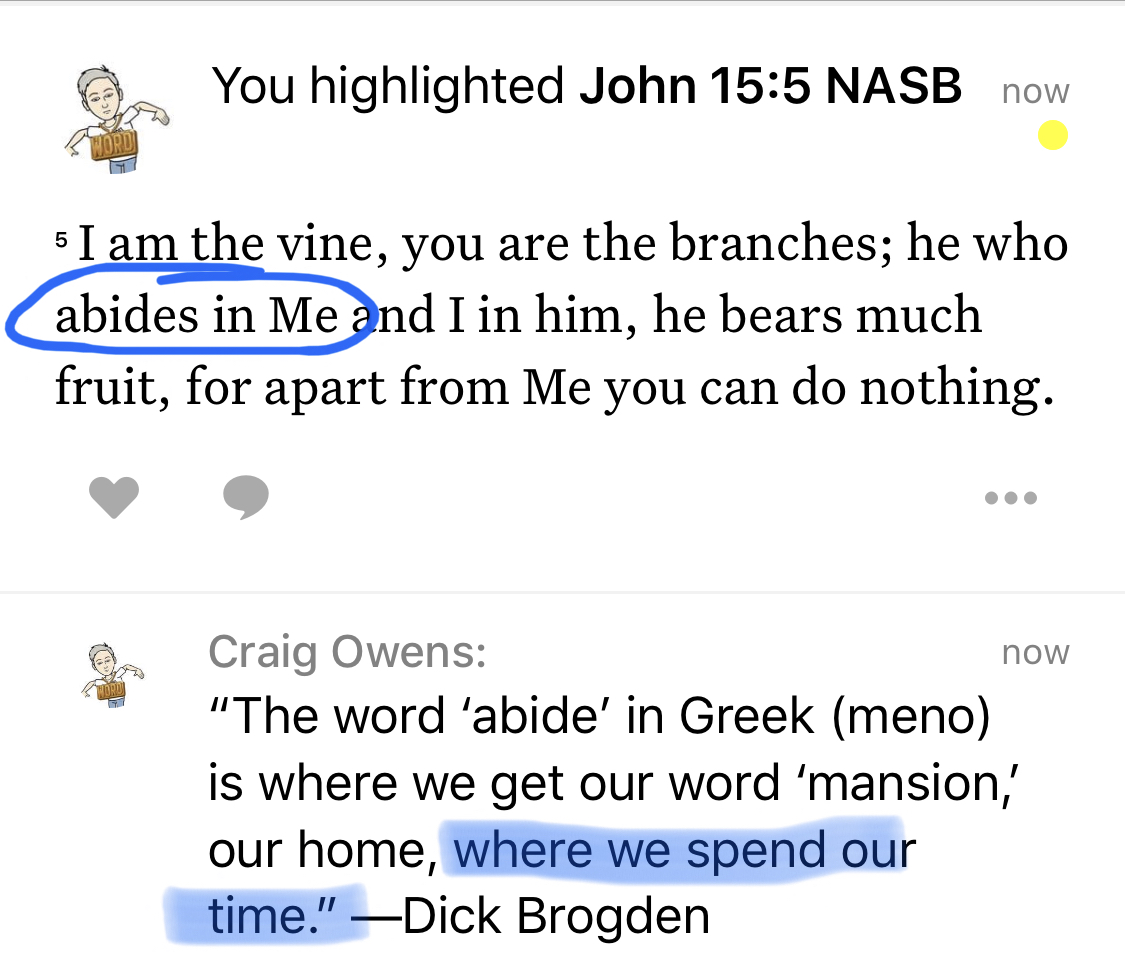
In the same way, we get more familiar with the “house rules” of our heavenly home the more time we spend there. My cousin Dick Brogden pointed out, “The word ‘abide’ in Greek (meno) is where we get our word mansion, our home, where we spend our time.” 

It’s also as we abide with Jesus that we get to know His heart. And then as we get to know Him better we can pray prayers more aligned to His will, prayers that He delights to answer. This makes our relationship with Him sweeter and sweeter. Just as the old chorus says—

He gets sweeter and sweeter as the days go by
Oh what a love between my Lord and I
I keep falling in love with Him
Over and over and over and over again

►► Would you please prayerfully consider supporting this ministry? My Patreon supporters get behind-the-scenes access to exclusive materials. ◀︎◀︎