This is a weekly series with things I’m reading and pondering from Charles Spurgeon. You can read the original seed thought here, or type “Thursdays With Spurgeon” in the search box to read more entries.
Listen to the podcast of this post by clicking on the player below, and you can also subscribe on Apple, Spotify, or Audible.
Accepting It For What It Is
…For the mouth of the Lord has spoken (Isaiah 1:20).
In the Word of God the teaching has unique dignity. This Book is inspired as no other book is inspired, and it is time that all Christians avowed this conviction. …
Where are we if our Bibles are gone? Where are we if we are taught to distrust them? If we are left in doubt as to which part is inspired and what is not, we are as badly off as if we had no Bible at all. I hold no theory of inspiration. I accept the inspiration of the Scriptures as a fact.
During the summer months, I like to lead my congregation through a study of the Book of Psalms. Currently, we are looking at the psalms that contain the word Selah.
It is distressing to me to see how many “modern” translations of the Bible either relegate the word Selah to a footnote (like the NIV which says, “The Hebrew has Selah [a word of uncertain meaning] here”), or completely disregard this word (e.g. The Message, The Contemporary English Version, and The Living Bible, to name a few).
Why? Do we think we are so much smarter now that we know which words the Holy Spirit truly inspired, and which ones we can leave out?
Once we start down this path, what is to stop us from modifying any word in the Bible? Many liberal-minded people want to tell us “what God really meant” in some passages, or to water down the inspiration so much to try to make it “culturally relevant” that they end up destroying its very meaning. This is not only a slippery slope, but it is something that God has already warned us against doing:
I warn everyone who hears the words of the prophecy of this scroll: If anyone adds anything to them, God will add to that person the plagues described in this scroll. And if anyone takes words away from this scroll of prophecy, God will take away from that person any share in the tree of life and in the Holy City, which are described in this scroll. (Revelation 22:18-19)
Let us accept the Word of God for what it is: Words that the mouth of Almighty God has spoken, not words that we think can be modified, improved, or eliminated.
Listen to the podcast of this post by clicking on the player below, and you can also subscribe on Apple, Spotify, or Audible.
As we rejoin our series looking at the Selahs in the Psalms, let me remind you of the definition of Selah: (a) a pause to reflect—or “pause, and calmly think of that,” as the Amplified Bible says; (b) notice the contrasts; or (c) get ready for a crescendo.
Psalm 85 is a longing for revival. Not only longing for it but giving us the path to revival.
Many Christians say they want revival, but I’m not so certain they have the biblical definition in mind. When most people define revival, they use descriptions about exuberant worship, manifestations of the gifts of the Holy Spirit, the church reenergized for ministry, and non-believers flocking to see what’s happening and then accepting Jesus into their hearts as a result.
But those are actually the results of revival, not the revival itself.
Take a look at this overview of Psalm 85:
a look back (vv. 1-3)
a look around (vv. 4-6)
a look ahead (vv. 8-13)
I am aware that I skipped verse 7 in that overview. That is the middle verse of this psalm, so it is presenting us with the main idea. It’s a longing to see the path forward, the path to revival. It’s not about “getting saved” again because verses 1-3 already thank God for His salvation.
But let’s notice the Selah. It seems to come mid-thought in the backward look. I think this is both a pause to consider deeply, and also a pause to look at the contrasts. It’s almost as if the sons of Korah, who wrote this psalm, have their breath taken away as they consider the immensity of God’s love that covers our sins!
That word “cover” means to cover our nakedness, conceal our shame, and hide us from our forgiven sins. The alternative is to live in fear of God’s righteous judgment on our unforgiven sin.
The sons of Korah long for this again. They long for a crescendo of righteousness, which is why in the “look around” section we see the phrases “restore us again” (v. 4) and “revive us again” (v. 6).
This Hebrew word for “restore” always means a turning:
men turning backfrom God (apostasy)
men turning away from God (backsliding)
men turning away from evil (repentance)
men turning back to God (revival)
The ball is in our court. God has remained faithful; we are the ones who have sinned and turned away from Him. God hasn’t gone anywhere; we have!
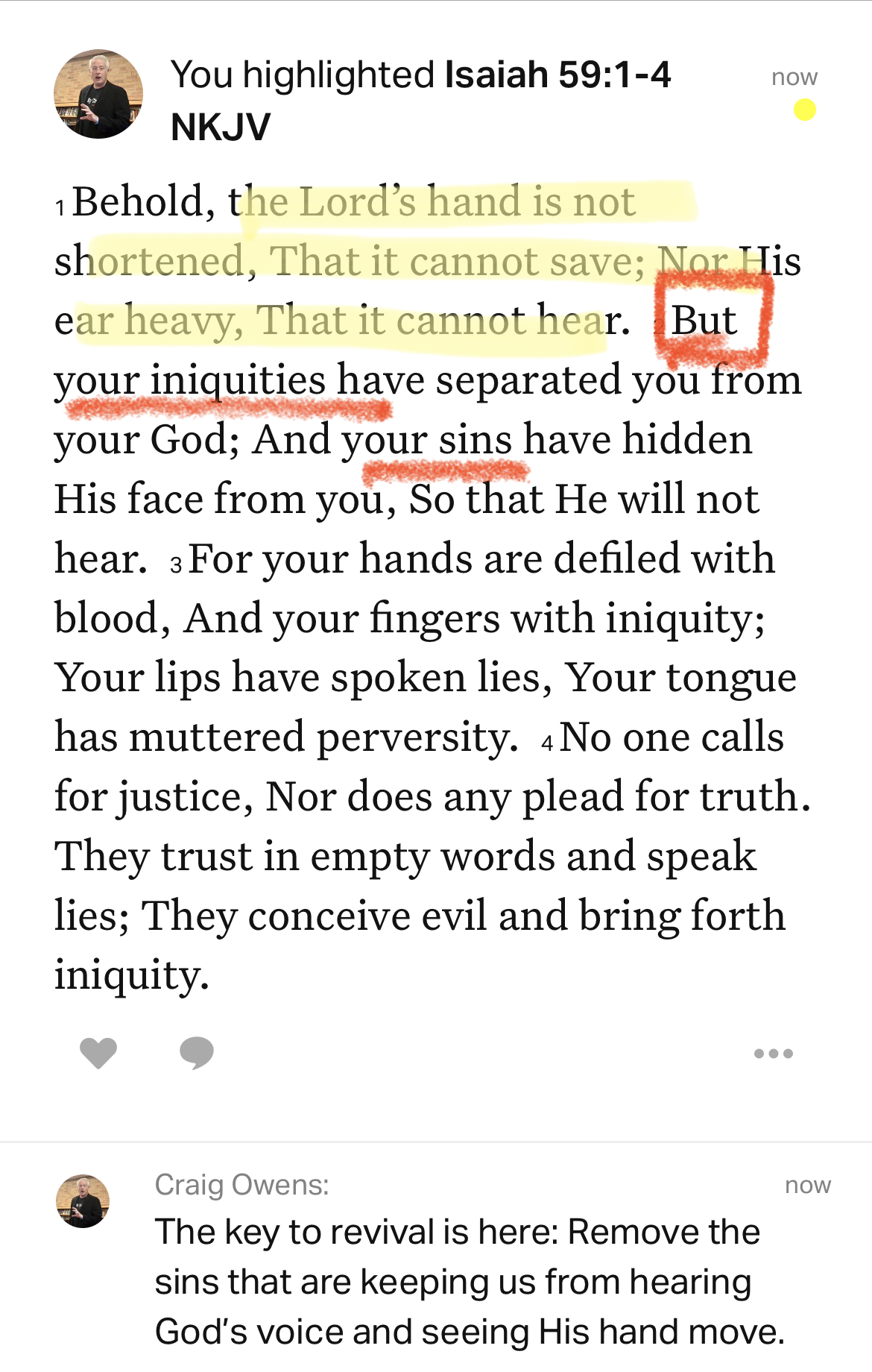
So revival begins with the recognition of our sin and profound repentance from that sin. Revival is a recognition that I have turned back from God, and now I need to turn away from evil and turn wholeheartedly back to God.
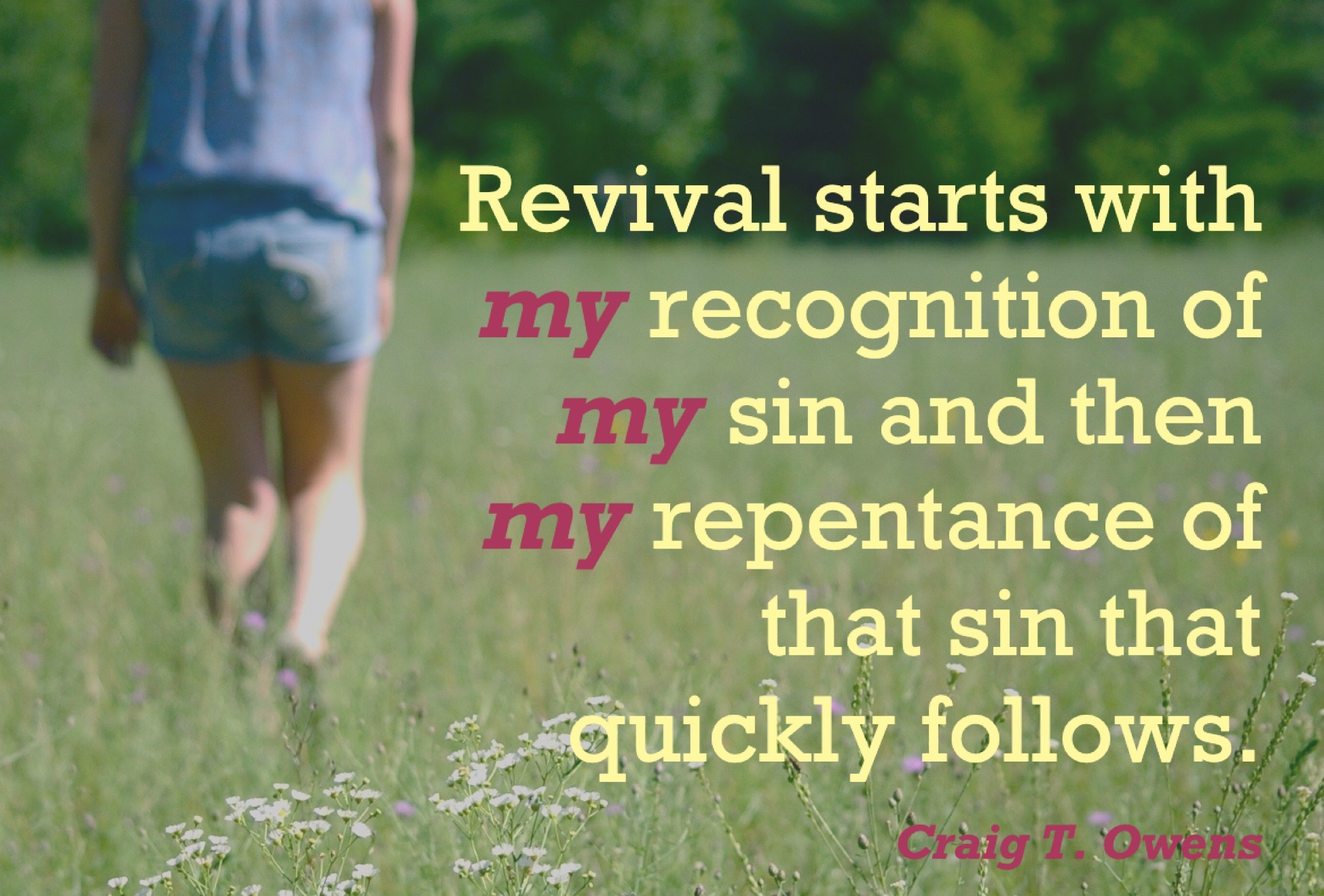
Immediately following thatmiddle verse notice the personal, singular pronoun “I” in verse 8. Revival starts with my recognition of my sin and then my repentance of that sin quickly follows.
The “show us the way” prayer of verse 7 is answered in verse 13: “Righteousness will go before Him, and shall make His footsteps our pathway” (NKJV). God Himself shows us the way! His footsteps mark the path for us to walk!
Listen to the podcast of this post by clicking on the player below, and you can also subscribe on Apple, Spotify, or Audible.
I just love it when science catches up with what God has already pronounced in the Bible!
I’ve blogged previously about psychology, archeology, and astronomy uncovering truths that have already been stated in the Bible, but there are also numerous recent medical discoveries that confirm what Scripture has already been telling us.
Like the fact that there is a healthy way to relieve stress, and that retaining the stress hormone cortisol in our bodies for too long has serious implications. The apostle Paul tells us to not “be anxious about anything” but to enjoy “the peace of God which transcends all understanding” (Philippians 4:4-7).
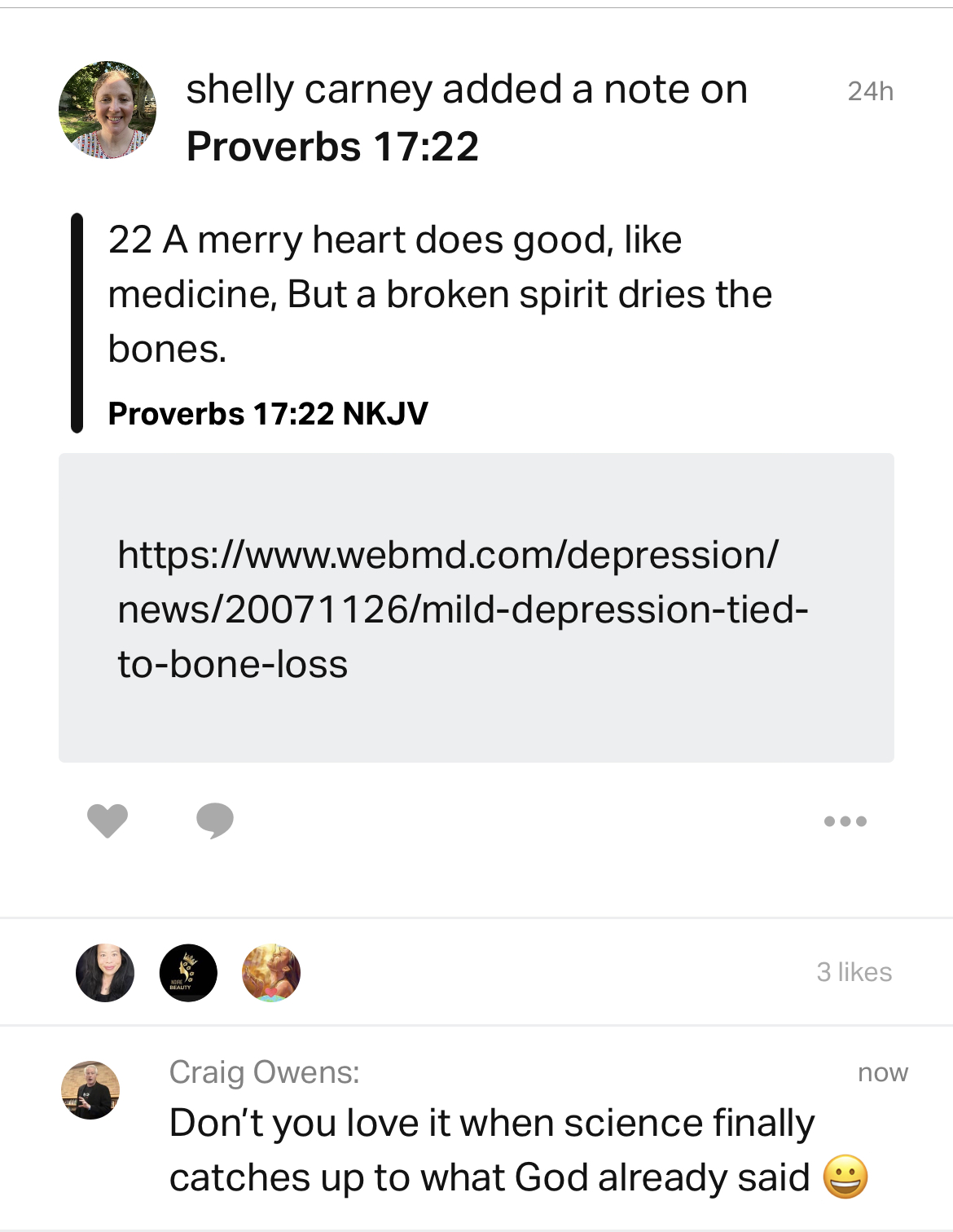
And then there is this finding that my YouVersion friend Shelly pointed out. “A happy heart is good medicine and a cheerful mind works healing, but a broken spirit dries up the bones” (Proverbs 17:22 AMP).
In a WebMD article, medical science confirms this truth of dried-up bones resulting from depression. They wrote, “Even mild depression may significantly increase a woman’s risk for developing osteoporosis. … The level of bone density loss attributed to depression in the study was similar to that previously associated with other well-known osteoporosis risk factors, including smoking cigarettes and getting little or no exercise. … Bone mineral density testing revealed that 17% of the depressed women showed evidence of bone thinning at a particularly vulnerable area of the thigh bone, compared to 2% of women who were not depressed.”
The Bible is God’s inspired Word to humankind, which means it is never out of date. The principles God has shared with us stand the test of time and are continually verified by the brightest scientific minds.
So here is my challenge to you: Take God at His Word, and apply the principles He has given you. I think you will find how much better your life will go when you live God’s way.
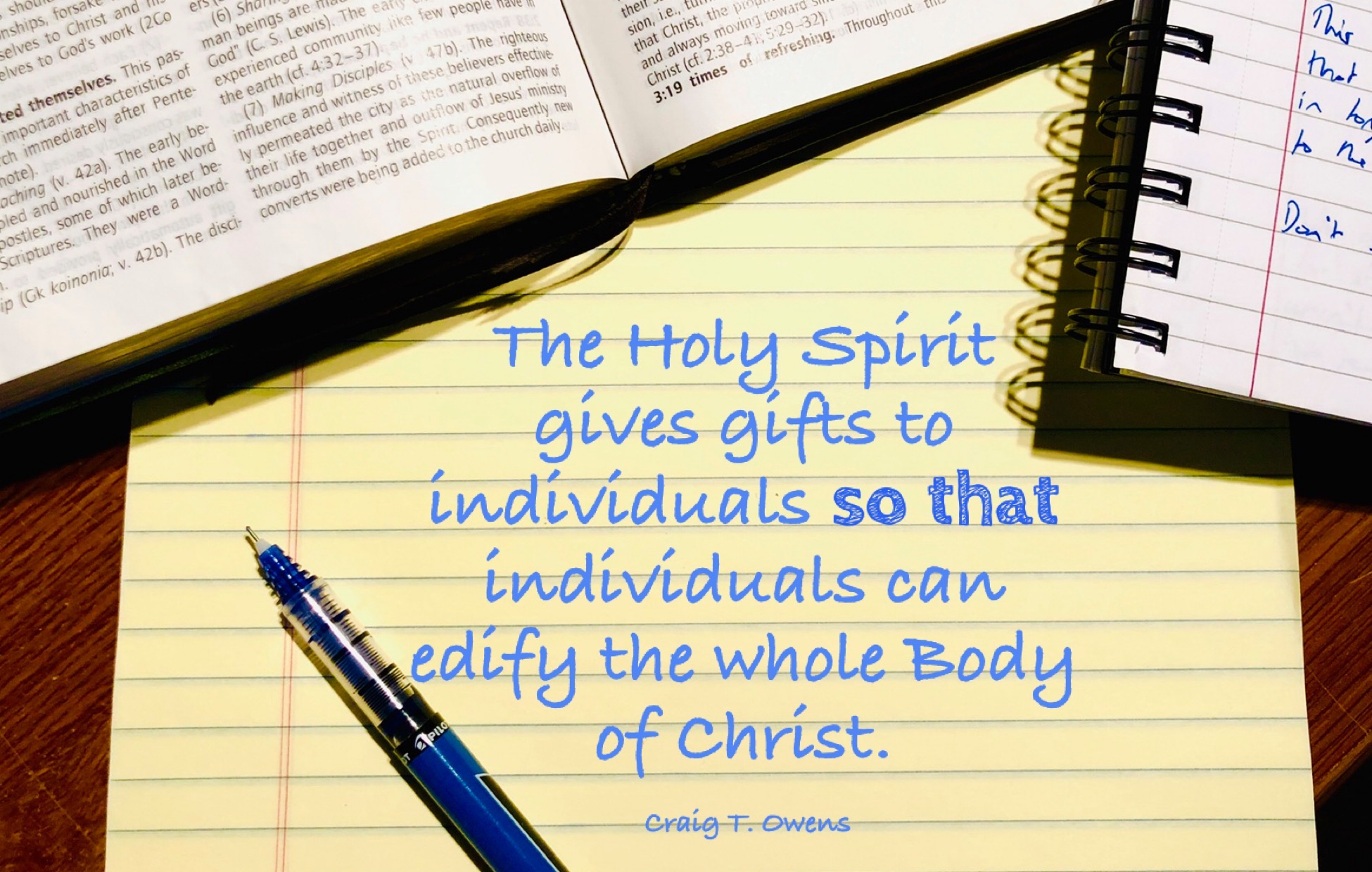
You are a one-of-a-kind creation. God is infinitely creative so He never has to duplicate any of His creative works. He saw your life and implanted in you what you need to glorify Him (Psalm 139:13-18). But we need to think about this uniqueness the right way.
Lucifer, an archangel, became satan, the Christian’s archenemy, because of his oversized pride. Pride is what turned Lucifer into satan, and it’s a tactic he still uses today on God’s creations. His other tactic is slander: attempting to get us to think we are insignificant and have no real purpose in the world.
In Romans 12, Paul talks about our lives being used as a living, breathing, God-honoring sacrifice. But Romans 12:1 begins with the word “therefore,” so we need to back up a few verses. The final four verses of chapter 11 are a beautiful doxology that is praising God for His wisdom and sovereignty. Paul then offers this conclusion: Therefore we need to think correctly about our place in the world, allowing the Holy Spirit to transform our thoughts.
Paul uses the word “think” twice in this passage. The root word is the same in each place (phroneo in Greek), but the prefix is what sets them apart from each other.The first has the prefix hyper-. That means it’s overly-analyzed thinking, overly self-concerned thinking, or self-focused.
The second time the prefix is soph- (which means “wise”). This is sound thinking, big-picture thinking, or others-focused. The Holy Spirit wants to give us sophroneo thinking to reveal our God-implanted gifts and talents that are to be used to benefit others—in fact, to benefit the whole Body of Christ.
In Romans 12, Paul uses the phrase “one body” twice as he talks about our spiritual gifts. He uses the same “one body” praise three times in 1 Corinthians 12 as he again talks about spiritual gifts (1 Corinthians 12:12-13, 20).
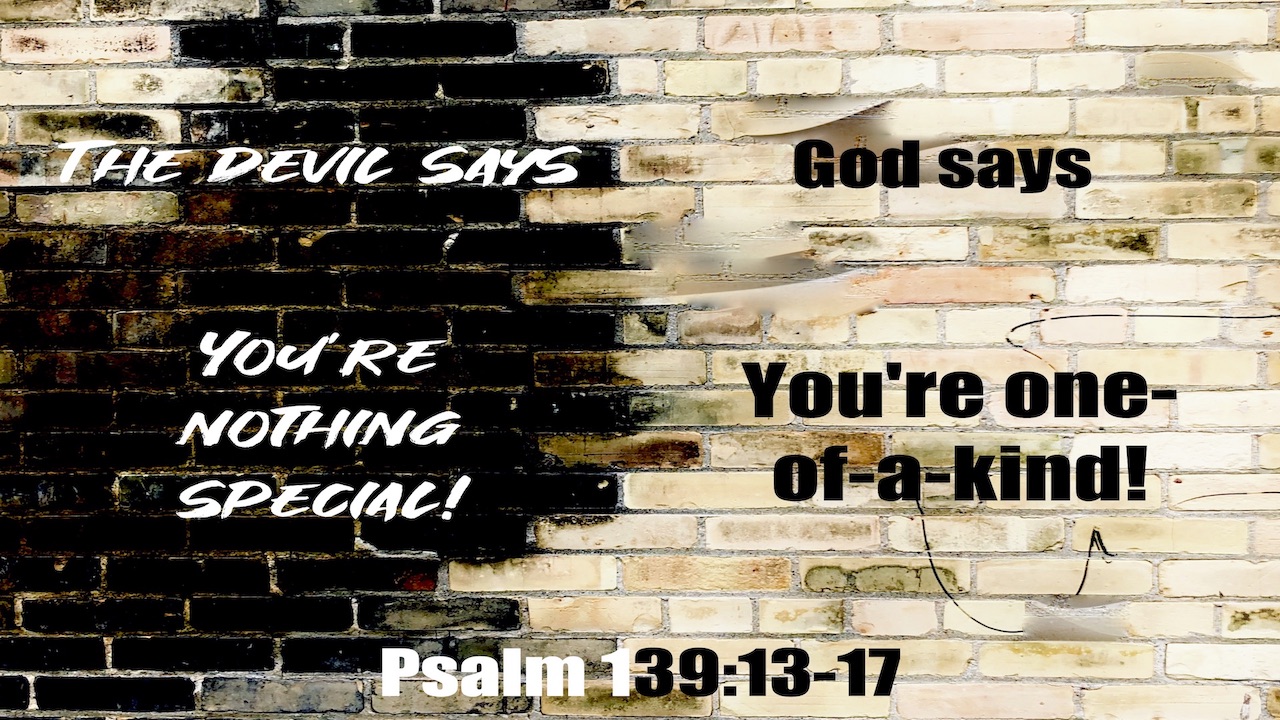
The Holy Spirit gives gifts to individuals so that individuals can edify the whole Body of Christ. It’s not competing with one another but completing one another.
Remember: Saints is always plural in the New Testament! I need you to bring out the saintly qualities in my life, as much as you need me to bring out the saintly qualities in your life.
Listen to the podcast of this post by clicking on the player below, and you can also subscribe on Apple, Spotify, or Audible.
Spurgeon And The Psalms hits a sweet spot for me: Charles Spurgeon is one of my favorite preachers and the Psalms are my go-to resource when I need encouragement, perspective, or vocabulary for my heartfelt prayers. The combination of the Prince of Preachers and the Psalter grabbed my attention before I even opened the cover.
After I opened the cover, I was not disappointed. I love the format of each chapter. For each chapter your eyes go to Charles Spurgeon’s commentary first, and then you can read the chapter itself. The reason why I like this layout is because Spurgeon has a tendency to tell us not what the psalmist says, but what we should look for as we read that psalm. This remains true to what Spurgeon himself felt about biblical commentaries.
I always make my Bibles my own. By that I mean that I underline, highlight, circle, and write margin notes throughout my Bible. The wide margins in this book make it ideal to use as a prayer companion. I believe the Bible is not a Book to be read through, but a Book to be prayed through. Nowhere is that more true than in the Psalms, where such deep emotions are poured out in God’s presence, helping us give voice to our deepest prayers.
If you have never read anything from Charles Spurgeon, this is an excellent place to get started. After you have read his insights here, I’m confident that you will want to read more. Even if you are familiar with Spurgeon’s sermons and books, this book is going to be an excellent addition to your library.
This is a weekly series with things I’m reading and pondering from Charles Spurgeon. You can read the original seed thought here, or type “Thursdays With Spurgeon” in the search box to read more entries.
Listen to the podcast of this post by clicking on the player below, and you can also subscribe on Apple, Spotify, or Audible.
Prayer Preparation And Prayer Expectation
In the morning, Lord, You hear my voice; in the morning I lay my requests before You and wait expectantly. (Psalm 5:3)
Do we not miss very much of the sweetness and efficacy of prayer by a want of careful meditation before it, and hopeful expectation after it? … We too often rush into the presence of God without forethought or humility. We are like people who present themselves before a king without a petition, and what wonder is it that we often miss the end of prayer? We should be careful to keep the stream of meditation always running, for this is the water to drive the mill of prayer. … Prayer without fervency is like hunting with a dead dog, and prayer without preparation is hawking with a blind falcon. Prayer is the work of the Holy Spirit, but He works by means. God made man, but He used the dust of the earth as a material. The Holy Ghost is the Author of prayer, but He employs the thoughts of a fervent soul as the gold with which to fashion the vessel. Let our prayers and praises be not the flashes of a hot and hasty brain but the steady burning of a well-kindled fire.
Sadly, I think we’ve become so accustomed to instant-everything in our society that it has seriously limited our prayer life. We walk into our prayer closet without an idea of what we’re going to pray, rattle off a few requests, say “Amen,” and walk out of our prayer closet exactly the same as we walked in.
There is certainly help for us when we are so distressed—so at our wits’ end—that we don’t even know what to pray, but this is not what David is saying in Psalm 5. David is making it a regular practice to come into God’s presence with his requests at the ready, and he is walking away from his prayer time in eager expectation of God’s soon-to-be-realized answers.
The Amplified Bible says, “I prepare a prayer…and watch and wait for You to speak to my heart.”
Listen to the podcast of this post by clicking on the player below, and you can also subscribe on Apple, Spotify, or Audible.
We said that when it comes to the Holy Spirit’s involvement in a Christian’s life: In > On. For instance, in our learning we don’t have to go to a tutor or attend classes only at set times, but we have The Tutor IN us. Or when need wisdom for decisions we don’t have to seek out the right advisors and try to coordinate their schedule with ours, but we have The Counselor IN us.
Let me point out the in-ness that permeates this 25th Psalm and then show you its fulfillment when the Holy Spirit comes to baptize believers in the New Testament.
(1) “IN You I trust” (v. 2). Not in human abilities or personal pedigree or earthly riches, but IN the in-ness of the Holy Spirit. Jesus said, “He who believes IN Me—who cleaves to and trusts IN and relies on Me—as the Scripture has said, ‘From his INNERmost being shall flow continuously springs and rivers of living water.’ But He was speaking here of the Spirit, Whom those who believed (trusted, had faith) IN Him were afterward to receive…” (John 7:38-39 AMP).
(2) “my hope is IN You” (vv. 3, 5, 21). A natural fruit of trusting IN the Holy Spirit’s empowerment is the hope that only that relationship brings. Paul talks abut this twice in his letter to the Romans. First, even in the midst of trials, Paul says we have this hope: “And hope does not put us to shame, because God’s love has been poured out INto our hearts through the Holy Spirit, who has been given to us” (Romans 5:5). And then Paul prays for his friends to experience this same in-ness of hope: “May the God of hope fill you with all joy and peace as you trust IN Him, so that you may overflow with hope by the power of the Holy Spirit” (Romans 15:13).
(3) “guide me IN Your truth … guide me IN what is right” (v. 5, 9). Jesus identified the Holy Spirit as the Spirit of Truth Who guides us INto truth (John 14:17, 16:13). This is how Jesus lived (Matthew 4:1) and it’s how we can live too: “But I say, walk and live habitually IN the Holy Spirit—responsive to and controlled and guided by the Spirit—then you will certainly not gratify the cravings and desires of the flesh…” (Galatians 5:16 AMP).
(4) “He instructs sinners IN His ways” (v. 8, 12). The Hebrew word David uses for “teach” in vv. 4, 5, 9 is “lamad.” It means being taught in a way that equips us to teach others. Jesus “gave instructions through the Spirit” to His disciples, and then He commanded them to teach others the same way (Acts 1:2; Matthew 28:20). The Spirit of Truth that inspired the Word of God can illuminate it to our hearts as He instructs us (see 2 Timothy 3:16-17).
(5) “the Lord confides IN those who fear Him” (v. 14). The KJV says, “The secret of the Lord is with those who fear Him.” Isaiah said, “Whether you turn to the right or to the left, your ears will hear a voice behind you, saying, ‘This is the way; walk in it’” (Isaiah 30:21). And Jesus said that every word He spoke was directed by the Holy Spirit IN Him (John 12:49).
(6) “I take refuge IN You”(v. 20). We can take refuge IN the One whom we trust and hope, the One who leads us INto truth and instructs us, the One who confides IN us. This in-ness helps us thwart the enemy’s attacks against us. As John wrote, “But you belong to God, my dear children. You have already won a victory over those people, because the Spirit who lives IN you is greater than the spirit who lives in the world” (1 John 4:4 NLT).
Don’t stop at salvation, but allow the Holy Spirit to baptize you and fill you. Don’t be satisfied with merely experiencing God’s presence ON you, but let His Spirit come IN you.
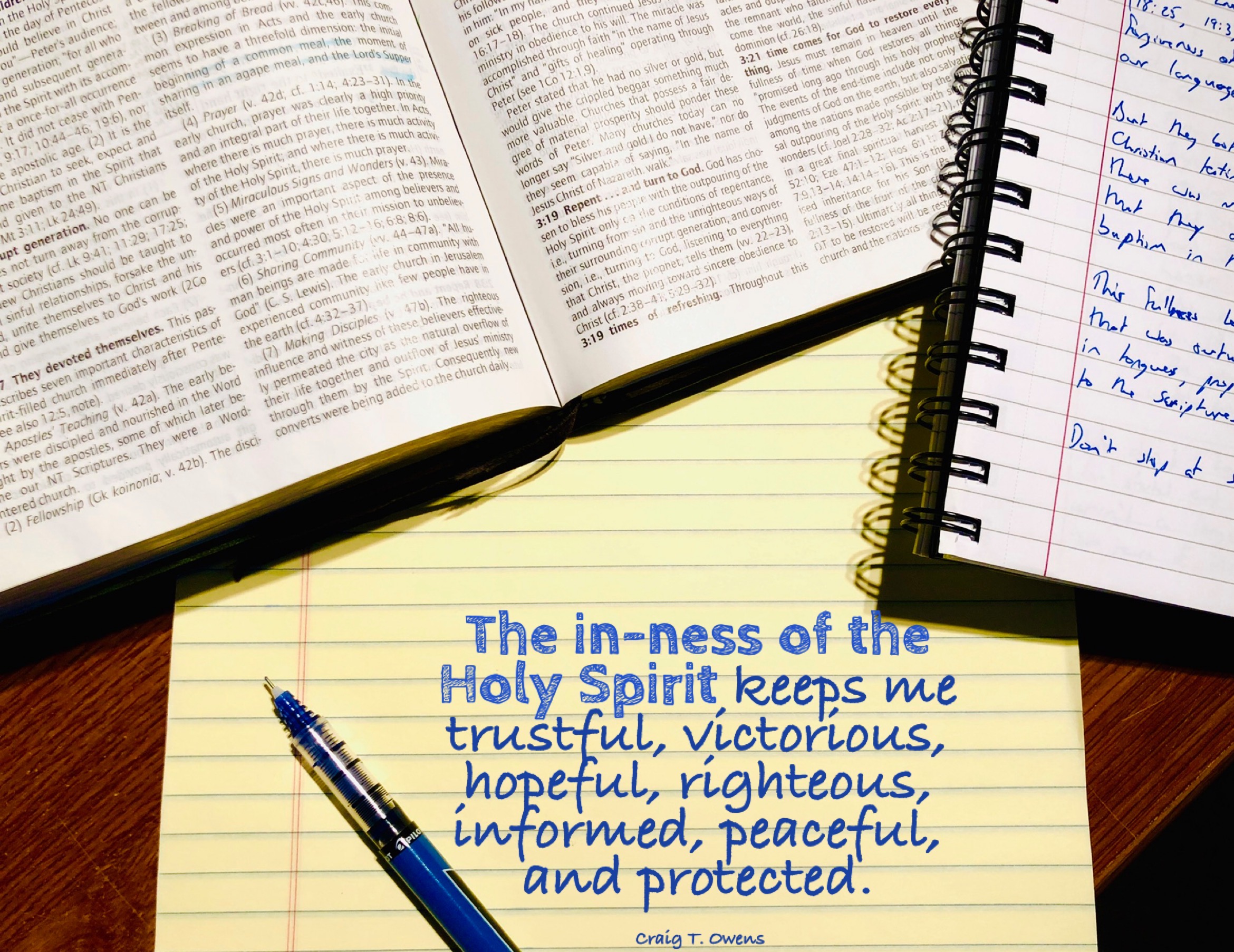
This in-ness keeps us trustful of God, victorious over the devil, hopeful of our future, righteous in a wicked world, informed of God’s ways, peaceful in trials, and fully protected from the enemy of our souls.
This is a weekly series with things I’m reading and pondering from Charles Spurgeon. You can read the original seed thought here, or type “Thursdays With Spurgeon” in the search box to read more entries.
Listen to the podcast of this post by clicking on the player below, and you can also subscribe on Apple, Spotify, or Audible.
Fully Equipped For Success
The words of the Lord are flawless, like silver purified in a crucible, like goldrefined seven times. (Psalm 12:6)
Oh, that we used more the naked Sword of the Spirit! I am afraid we keep this two-edged Sword in a scabbard, and somewhat pride ourselves that the sheath is so elaborately adorned. What is the use of the sheath? The Sword must be made bare, and we must fight with it, without attempting to garnish it. Tell forth the words of God. Omit neither the terrors of Sinai, nor the love notes of Calvary. …
My Master’s Word is a great opener of prison doors. … That is a most wonderful Word, which, like a battle-ax, smashes in the helmet of presumption, and at the same time, like the finger of love, touches the tender wound of the bleeding, and heals it in an instant! The words of the Lord—for breaking down or lifting up—are equally effective. …
The Bible may be compared to the locksmith’s bunch of keys. You handle them one by one, and say of one, ‘That is a strange key; surely it will fit no lock that ever was made!’ But one of these days the smith is sent for to open a very peculiar lock. None of his keys open it. At last he selects that singular specimen. Look! It enters, shoots back the bolt, and gives access to the treasure! …
Rest assured that you never will be in a labyrinth so complicated that this Book, blessed of the Spirit, will not help you through. …
Beloved, the words of God endure another test; they are our preservatives in times of temptation. You can write a book that may help a man when he is tempted in a certain direction. Will the same volume strengthen him when he is attracted in the opposite direction? … The devil himself cannot invent a temptation that is not met in these pages. And all the devils in hell together, if they were to hold parliament, and to call in the aid of all evil men, could not invent a device which is not met by this matchless Library of truth. It reaches the believer in every condition and position, and preserves him from all evil.
From The Bible Tried And Proved
There is no substitute for God’s Word, and there is no obstacle that the Holy Scripture cannot overcome—
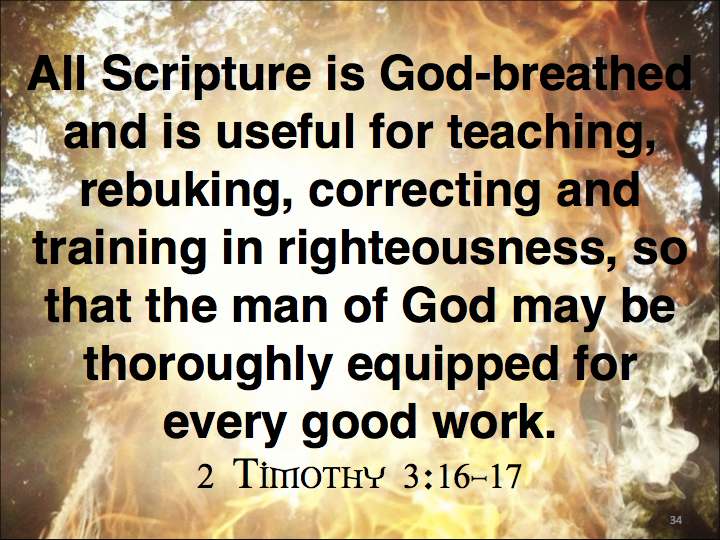
ALL Scripture is God-breathed and is useful for teaching, rebuking, correcting and training in righteousness, so that the servant of God may be thoroughly equipped for EVERY good work. (2 Timothy 3:16-17)
The Bible is our sword and battle-ax for fighting battles, it is our key to the most complicated problems, it is our map to guide us to safety, and it is our life preserver to help us overcome temptation.
I say a loud, “Amen!” to these concluding words of Charles Spurgeon: “I grieve that even to some who bear the Christian name, Holy Scripture is the least read book in their library. … Brothers and sisters, open the Book! Do it freely. Do it heartily. Do it constantly.”
Listen to the podcast of this post by clicking on the player below, and you can also subscribe on Apple, Spotify, or Audible.
I am so grateful for the blessings of a godly mother and a godly wife! I can relate to Abraham Lincoln who said, “All I am, or can be, I owe to my angel mother. … I remember my mother’s prayers and they have always followed me. They have clung to me all my life.”
Mothers—both the natural, physical, and adoptive mothers—can save the rest of us from a world of hurt. We see this in a story in the Bible of a mother that saved innumerable people from the consequences of folly. This is an amazing story in 1 Samuel 25, so please take some time to read it for yourself.
King Saul and David have finally separated from each other, with Saul returning home to Gibeah and David returning to his stronghold at En Gedi. Eventually, David moved west from En Gedi to the Desert of Moan, where the town of Carmel was nearby.
A prominent citizen of Carmel was a man named Nabal. He is described as “very wealthy,” owning 1000 goats and 3000 sheep. But he apparently gained his wealth through less-than-honorable means because he is described as “surly and mean in his dealings.” We find out later in the story that he’s also hard-hearted and hard-headed, not listening to any counsel others may offer him.
That fits him because his name means “fool.” I find it hard to believe that his parents named him this from birth. If they did, it reminds me of the opening words of C.S. Lewis’ book The Voyage Of The Dawn Treader: “There was a boy named Clarence Eustace Scrubb, and he almost deserved it.” Instead, I think Nabal’s dealings were so mean, surely, and foolish that the name stuck. Perhaps he even wore that name as a badge of honor.
It came sheep-shearing time—which is really payday for shepherds—so David sends some of his servants to Nabal to ask for whatever he might find to give as a gift to “your servants and your son David.” David’s men had been a constant source of protection for Nabal’s herdsmen, so a gift of gratitude does seem appropriate.
Nabal doesn’t just say, “No,” but he insults David. As his foolish nature controlled him, he not only insulted David, but he insulted God too by implying that David wasn’t anointed by God, but was merely ruthlessly climbing a ladder of success. Probably Nabal thought this way because that’s how he himself gained his fortune.
Nabal’s response lit David’s fuse! In fact, David’s response to his men was just four words long: “Put on your swords!”
Fortunately, one of Nabal’s servants informed his wife Abigail of this.
In the same verse where Nabal is described as mean and surely, Abigail is described as “intelligent and beautiful.” Whereas Nabal’s name means fool, Abigail’s name means “my father’s joy.” She must have been born at just the right time for her father and she continues to be a just-in-time woman!
This servant brought Abigail word of Nabal’s foolish response, telling her that David’s men were indeed “a wall around us” while they were in the desert. And then he says, “Think carefully about what you should do because disaster is hanging over us!”
Abigail acts quickly, wisely, and humbly.
The first thing she does is send hundreds of pounds of food to David and his men. She sends the gift that Nabal probably should have sent. Then Abigail herself follows the gifts on her own donkey. When she encounters David and his armed men coming down the mountain pass, she humbly falls at his feet asking David to reconsider.
Abigail doesn’t tell David he shouldn’t be angry, but she points him to something bigger and more long-lasting than his immediate thought of revenge. She reminds him that he is God’s anointed leader, and she asks, “When you become king, do you want this bloodshed on your conscience?”
Abigail’s words have an immediate effect on David, who calls off the attack, praises Abigail, and praises God for sending Abigail to him. Abigail rescued Nabal’s family and workers from imminent destruction, and she saves David from the consequences of his rash response.
The next morning, when she relates this story to Nabal, he has either a stroke or a heart attack, and then dies ten days later. Justice is served, but it’s served by God and not by David.
Later on, David takes the now-widowed Abigail as his wife.
Abigail’s name scarcely appears anywhere else in the Bible, but there is one notable appearance:
Sons were born to David in Hebron: His firstborn was Amnon the son of Ahinoam of Jezreel; his second, Kileab the son of Abigail the widow of Nabal of Carmel; the third, Absalom the son of Maakah daughter of Talmai king of Geshur; the fourth, Adonijah the son of Haggith; the fifth, Shephatiah the son of Abital; and the sixth, Ithream the son of David’s wife Eglah. (2 Samuel 3:2-5)
Amnon, first in line for the throne, raped his half-sister Tamar and was then killed by Absalom, who was Tamar’s brother. Absalom, third in line for the throne, not only avenged his sister’s disgrace but led a coup against David, where he was killed in battle.
That leaves Kileab as the obvious heir to King David’s throne, yet this is the only place he is mentioned in the Bible. I think Abigail’s wise influence saved Kileab from the drama of aspiring to be king, a painful future, and perhaps a premature death.
From this amazing story, I would like to offer three takeaways for Moms:
Use your inner beauty to persuade foolhardy men—1 Peter 3:2-3
Use your Holy Spirit-given wisdom to dissuade foolishness—Matthew 10:19
Use your prayer life to bring a legacy of peace—Psalm 116:16
Godly mothers, please be encouraged today at how much influence you exert over others in your life. Your inner beauty, God-given wisdom, humility, and prayers are making more of an impact than you may ever know. I believe in heaven the full story will be shared, and you will be praised for being a wise and faithful servant.
May God continue to bless, empower, and use our Moms to save us from the consequences of our foolishness!



 All people that on earth do dwell,



 Craig T. Owens
Spurgeon And The Psalms (book review)
June 7, 2022 — Craig T. OwensListen to the podcast of this post by clicking on the player below, and you can also subscribe on Apple, Spotify, or Audible.
After I opened the cover, I was not disappointed. I love the format of each chapter. For each chapter your eyes go to Charles Spurgeon’s commentary first, and then you can read the chapter itself. The reason why I like this layout is because Spurgeon has a tendency to tell us not what the psalmist says, but what we should look for as we read that psalm. This remains true to what Spurgeon himself felt about biblical commentaries.
I always make my Bibles my own. By that I mean that I underline, highlight, circle, and write margin notes throughout my Bible. The wide margins in this book make it ideal to use as a prayer companion. I believe the Bible is not a Book to be read through, but a Book to be prayed through. Nowhere is that more true than in the Psalms, where such deep emotions are poured out in God’s presence, helping us give voice to our deepest prayers.
If you have never read anything from Charles Spurgeon, this is an excellent place to get started. After you have read his insights here, I’m confident that you will want to read more. Even if you are familiar with Spurgeon’s sermons and books, this book is going to be an excellent addition to your library.
I am a member of the Bible Gateway Blogger Grid and I reviewed this book at their invitation.
►► Would you please prayerfully consider supporting this ministry? My Patreon supporters get behind-the-scenes access to exclusive materials. ◀︎◀︎
Share this: