Renewed Passion For Prayer

If I were to ask you if we should we pray for our friends in need, I think I’d probably get a universal “yes.” Even non-Christians might say we should “send good thoughts” or “best wishes” to our friends.

But if I were to ask, “How long should we pray for them?” we might get a lot of different answers. 

What about if we’re praying for a friend to get a job (and he gets it), or a friend to be healed (and she is), or a marriage to be restored (and it is)—do we stop praying then? 

Psalm 20 and 21 appear to be companion psalms: with Psalm 20 being David’s prayer of petition, and Psalm 21 being his prayer of praise. But there is also something quite interesting in each of these psalms about the placement of the word Selah. 

Remembering that Selah means some sort of pause, I find it very interesting where David tells us to pause in both of these psalms. In Psalm 20 we see the prayer request “may” either 6 or 7 times in the first five verse, but the Selah pause is right in the middle of them. Why would David start making his requests to God, tell us to pause in the middle, and then continue making his requests? 

I believe this Selah means to “pause and consider” that… 

  1. God invites us to participate with Him in fulfilling His plans. 
  2. God loves us so much that He wants to hear from us. 
  3. God is powerful enough to grant what we ask of Him. 

It’s as if in the middle of all of his petitions, David says, “Hold on a second. Do you realize what we are in the midst of doing? We are actually communing with the All-Knowing, All-Loving, All-Power Creator and Sustainer of the Universe!!”

In Psalm 21 David is offering up a prayer of praise for God’s answers to his prayers (note the similar language in Psalm 20:4 and 21:2), and once again he tells us to Selah pause right in the middle of those prayers of gratitude. 

I asked earlier, “When do we stop praying for a friend or for ourselves?” Is it when we get the job, or experience the healing, or have the breakthrough or restoration? What if the job, the healing, the restoration was just the beginning of what God wanted to do? The Selah in Psalm 21 is an accentuation: an explosion into so much more!! 

David prayed for victory in battle, but God gave him an everlasting victory; David prayed for long life, but God gave him eternal life (21:4); David prayed for blessings on his battle, but God gave him His eternal blessings (21:6).

Jesus said our Heavenly Father has gifts for us beyond our asking (Matthew 7:11), and the Apostle Paul said the same thing in Ephesians—

Now glory be to God, who by His mighty power at work within us is able to do far more than we would ever dare to ask or even dream of—infinitely beyond our highest prayers, desires, thoughts, or hopes. (Ephesians 3:20 TLB)

These two Selahs tell me: 

Don’t quit praying when times are tough. 
Don’t quit praying when you’ve prayed a long time. 
Don’t quit praying when it seems like God has answered. 
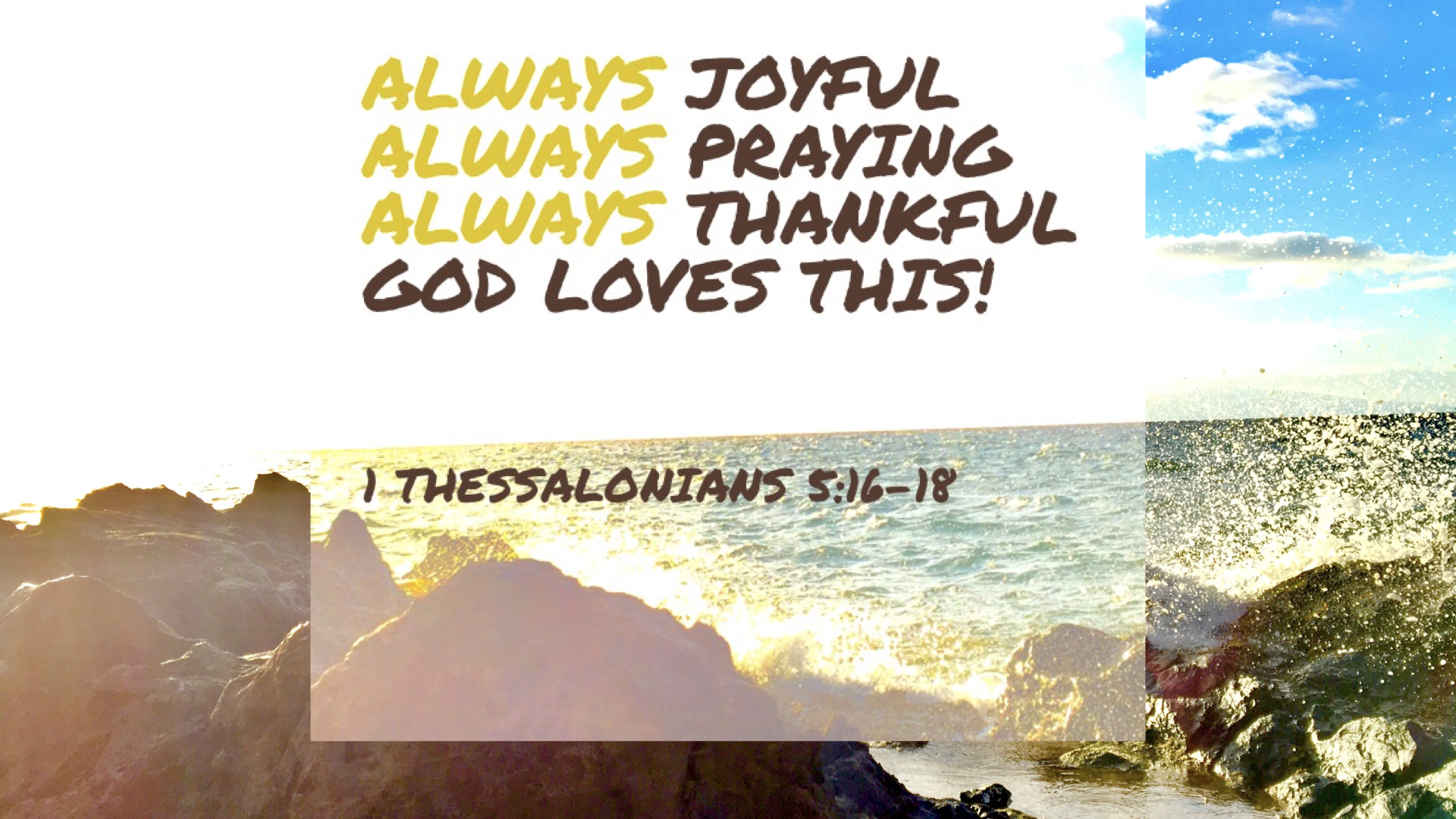
Keep on praying. Always. About everything!


Please join me this coming Sunday as we continue to look at the Selahs in the Psalms. You can join me in person or via Facebook Live. 
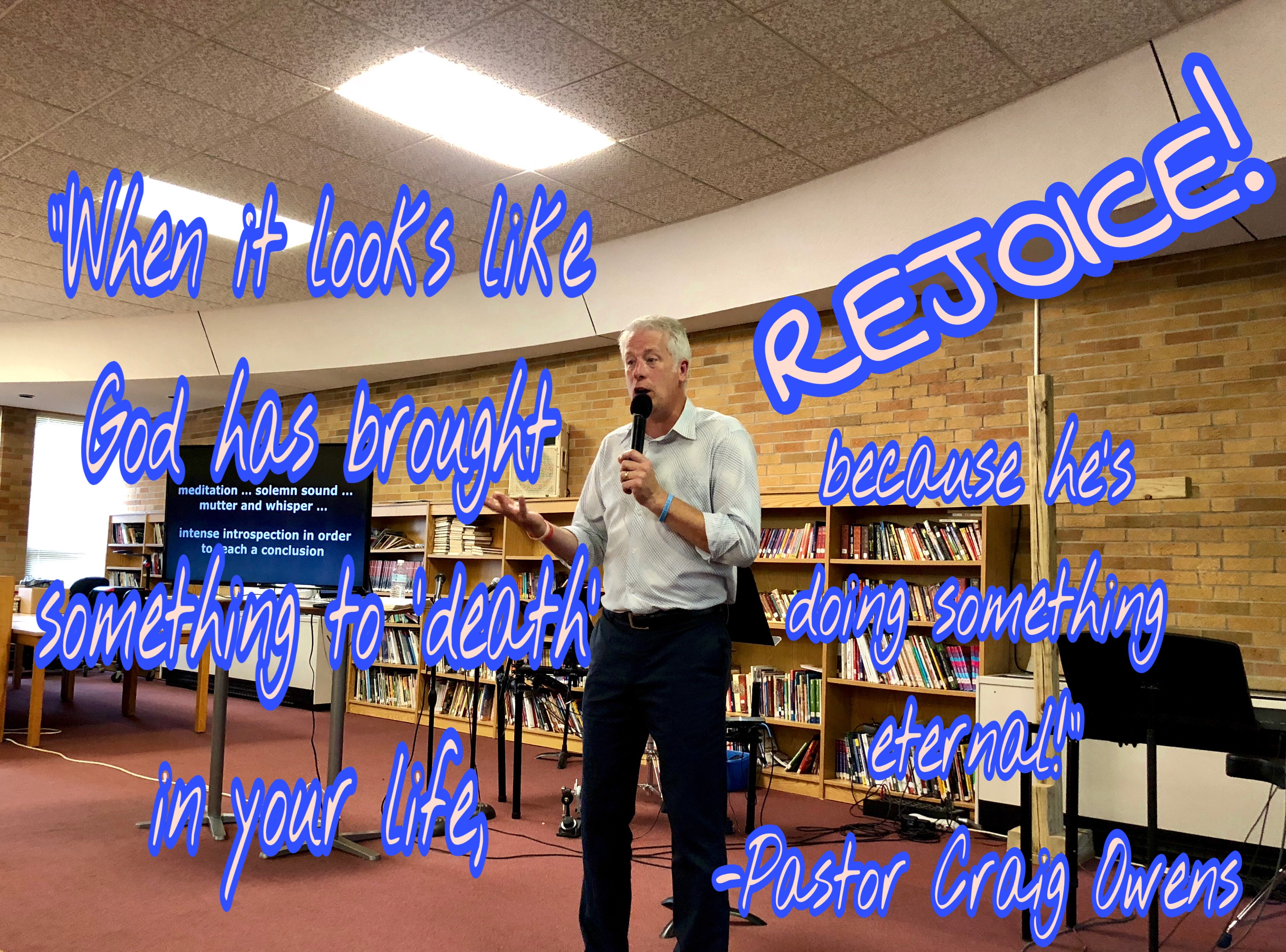
Unexpected Praise

Well, this isn’t what I expected! David says his song in Psalm 9 is supposed to be sung to the tune of “Death Of The Son,” so I’m expecting a prayer that is loaded with minor notes. But instead, David gives us … this! 

The opening verses show us David exploding in praise to God. Check out his vocabulary—

  • I will praise You—this literally means David is pumping his hands in the air
  • I will tell of all Your wonders—David is not doing this just one time but is ticking off a long list of God’s praiseworthy deeds and attributes
  • I will be glad—his face lights up with joy 
  • I will rejoice—this word means a roar of praise (see 1 Chronicles 16:32)
  • I will sing praise—there is a new melody with every praise David lifts to God

Why this loud, exuberant, unexpected praise? Because David has noticed that whatever has “died” on earth is only a temporary loss, but God is forever! 

There is an unusual word pairing at the end of verse 16: Haggaion and Selah. This is the only time these two words appear like this in all of Scripture, and it’s also the only time Haggaion is used without being translated. 

Haggaion appears just four times in the Bible—(a) in Psalm 19:14 where it is translated meditation; (b) in Psalm 92:3 where it is translated solemn sound; (c) in Lamentations 3:62 where it is translated whisper and mutter; and (d) here in Psalm 9 where it is untranslated. 

By combining Haggaion and Selah, David is wanting us to solemnly meditate on an important contrast: God’s way vs. man’s way. In verses 3-16, David uses huge and eternal terms for God like righteous Judge, reigns forever, refuge, stronghold, merciful, and prayer-answerer. 

Side-by-side with these eternal terms for God, David lists the temporary terms for man like stumble, perish, ruined, forgotten, and trapped. In fact, David ends this Psalm by reminding us evil men who do evil things are “mere men.” Other translations fill in the details: 

  • make them realize their frail nature (AMP)
  • show them how silly they look (MSG)
  • merely human (NLT) 
  • puny men (TLB)

Then David ends with a final Selah—one more call for us to allow this message to resonate with us, especially during the times others may call dark, depressing times. The message that should resonate in our hearts and cause us to throw our hands up in joyful celebration of God is…

these earthly things are temporary and God is eternal. He has never forsaken those who seek Him, and He has never forgotten those who call on Him for help. 

When a dark time—a “death of a son”—tries to rock your world, don’t do what puny mortals expect, but throw your hands up in the air, and sing and roar a praise to the Almighty God Who cares for you! 

Join me this coming Sunday as we continue our looks at the Selahs in the Book of Psalms. You can join me in person or on Facebook Live.

9 More Prayers From A.W. Tozer In “The Wisdom Of God”

In each chapter of The Wisdom Of God, A.W. Tozer prayers for us that we would see Wisdom as a Person to be known. Here are a few more of those prayers. 

“Let me not stay my heart till I have discovered Thee in all Thy fullness.” 

“Manifest Thy grace and wisdom in my life today as a witness to those around me.” 

“O Lord God, Thy wisdom has been poured into my heart, creating such a longing for Thee that nothing in this world can satisfy.” 

“Heavenly Father, open my eyes to recognize Thy hand in my life. … May I be aware of my surroundings in light of what Thou art doing.” 

“Let me penetrate the cloud of unknowing and see Thy face and allow it to transform every aspect of my being.” 

“I praise Thee for Thy faithfulness in pursuing me and going to the ultimate end to rescue me from myself.” 

“My heart, O God, needs Thy most sacred protection. Keep me from the infiltration of sin into my life so that I may glorify Thee in everything I do.” 

“I praise Thee, O God, for the restlessness of my spirit has driven me forward to discover my rest completely in Thee.” 

“Dear heavenly Father, may I sent before me only that which will glorify Thee in all the beauty of Thy purity and holiness. I pray Thy wisdom will guide me throughout my life in making the choices that will bless me and honor Thee.” 

You can check out some of the other prayers from The Wisdom Of God that I shared here. You can also read my review of this collection of sermons by clicking here.

Saturday In The Psalms—Creation Recognizes Its Creator

The sea saw it and fled; Jordan turned back, the mountains skipped like rams … rocks turned into a pool of water… (Psalm 114:3, 4, 8).

What would cause a sea to shrink?

Or a river to stop flowing? Or mountains and hills to quake in fear?

What could turn flint rocks into puddles?

God’s presence!

Creation recognizes its Creator!

Do we?

Waters and mountains and rocks cannot think or feel or appreciate majesty and beauty—but they can and do recognize their majestic Creator and bow in His presence.

How much more so we who can think and feel and appreciatehow much more so should we bow before our Majesty, the Creator of all!

Jesus may have had this Psalm 114 in mind when He said that rocks would cry out in praise if we humans did not [Luke 19:37-40]. I, for one, am not going to let rocks or waters praise on my behalf!

Saturday In The Psalms—Resolutions

I will… (9x in Psalm 101).

Psalm 101 is only eight verses long, but David makes nine I will resolutions to God. Perhaps you might consider making these resolutions yourself—

(1) I will sing of mercy and justice. These are two sides of the same coin; in fact, it’s only when we know God’s justice that we can appreciate His mercy. Both God’s justice and His mercy need to be celebrated.

(2) I will sing praises. Regardless of our situation or setting, God is worthy to be praised.

(3) I will behave wisely in a perfect way AND (4) I will walk within my house with a perfect heart. A commitment to integrity, living a godly lifestyle, and leaving a godly legacy.

(5) I will set nothing wicked before my eyes AND (6) I will not know wickedness. A commitment to be childlike in regard to wickedness, and watchfulness of anything impure.

(7) I will destroy AND (8) I will not endure AND (9) I will destroy all the wicked. A resolution to cut-off all relationships that are not God-honoring.

Resolutions aren’t just for New Year’s Day. Resolutions can be made any time we sense something in our life isn’t as God-pleasing as it could be.

What resolutions are you willing to make?

A “Hallelujah!” Lifestyle

David shows us a picture of a man who made prayer the cornerstone of all he did. He’s quick to cry, “Help!” when he’s in trouble, and he doesn’t hold back when he’s crying out to God.

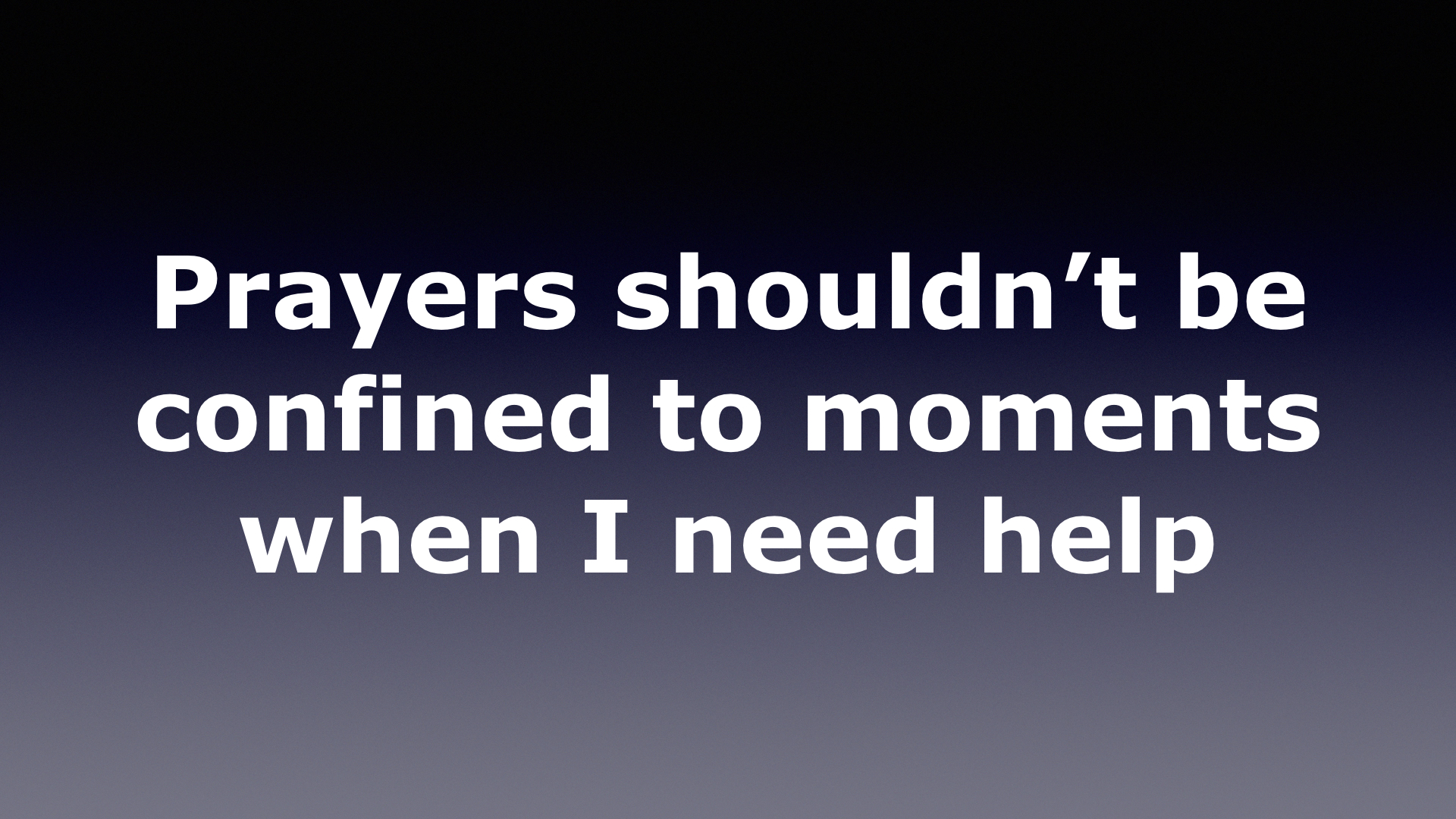
But he also shows us that prayer isn’t just for times of trouble. Prayer should be an ongoing conversation with God so that we can get to know His heart. God knows what’s going to happen (Isaiah 46:10), and He wants us to ask Him to make things clear to us (Jeremiah 33:3).

In Psalm 145, David challenges us to lift up our praise to God, as well as our prayers. This psalm of praise teaches us that we don’t have to only praise God for what He’s done—although that’s a great thing to do—but we can also praise God simply for Who He is!

In this psalm, David says God is…

…worthy of praise (v. 3a) 
…great beyond comprehension (v. 3b) 
…majestic (v. 5)
…awesome (v. 6)
…abundantly good (v. 7)
…gracious, compassionate, slow to anger, rich in love (v. 8)
…good to all (v. 9)
…mighty (v. 11)
…everlasting (v. 13)
…strong (v. 14)
…righteous and loving (v. 17) 
…near to us (v. 18)
…fulfilling (v. 19)
…watchful (v. 20)

Let’s not be known just for our petitions, but for our praise.

Let’s not be known just for our “Help!” but for our “Hallelujah!

Please join me in our continuing look at the Prayers Of David.

Saturday In The Psalms—Sing A New Song

Oh, sing to the Lord a new song! (Psalm 96:1).

God is so great—His worth is infinite—that He deserves a new song every time we sing to Him. There is no need to copy or duplicate something done before, but we should continually find new ways to praise Him.

Look at the angels encircling God’s throne. They continually sing out, “Holy! Holy! Holy!” as they perceive new dimensions of God’s grace, love, faithfulness, beauty, and majesty.

“Oh! Did you see that? Holy!” 

“Look at that! Amazing!” 

“Wow, I just saw something else breathtaking” Worthy!”

Our praise of God should follow that example: “Holy! Holy! Holy!” This is what Psalm 96 tells us…

Sing!
Bless His name!
Tell how good He is!
Declare His glory everywhere!
He is great!
He is greatly to be praised!
Look at His majesty!
Stand in awe of His beauty!
Give Him the glory due His name!
Worship! 
Thrill at the beauty of His holiness!
Bow before His majesty!
Rejoice!
Be glad!
Listen to creation praising their Creator!
Join creation in their song!
He is coming soon!
Maranatha!
Oh, sing to the Lord a new song!
Sing it now and forever and ever!

11 Quotes From “The Heart Of A Leader”

As the title hints, Ken Blanchard makes the case that the heart of great leadership is a leader’s great heart. You can check out my full book review of The Heart Of A Leader by clicking here.

“Remember, the best leaders are those who understand that their power flows through them, not from them.”

“Many well-intentioned leaders wait to praise their people until they do things exactly right, complete the project, or accomplish the goal. The problem here is that they could wait forever. You see, ‘exactly right’ behavior is made up of a whole series of approximately right behaviors. It makes more sense to praise progress.”

“An effective leader will make it a priority to help his or her people produce good results in two ways: making sure people know what their goals are and doing everything possible to support, encourage, and coach them to accomplish those goals.”

“If you don’t take time out to think, strategize, and prioritize, you will work a whole lot harder, without enjoying the benefits of a job smartly done.”

“Nice guys may appear to finish last, but usually they are running in a different race.” —Ken Blanchard and Norman Vincent Peale

“Being too hard on yourself is counterproductive. Don’t expect instant perfection. Though self-criticism is healthy, it should not be destructive. It’s unfair to be hard on yourself the first time you attempt something new. It is also unfair to expect others to meet such an unrealistic expectation. Keep in mind that it’s unnecessary to do everything exactly right the first time.”

“Here’s a great rule for doing business today: Think more about your people, and they will think more of themselves.”

“When you ask people about the best leader they ever had, one quality is always mentioned: they are good listeners. These leaders have learned to ‘sort by others.’ When someone says, ‘It’s a beautiful day,’ they respond by keeping the focus on the speaker. For example, they’ll respond, ‘It sounds like you’re pretty happy today.’ Poor listeners ‘sort by self.’ If you express a concern you have, they will express a concern they have.”

“Leading people is the opposite of trying to control them; it’s about gaining their trust through your integrity, developing their potential through your partnership, and motivating them through your affirmation.”

“Consistency does not mean behaving the same way all the time. It actually means behaving the same way under similar circumstances. … When you respond to your people in the same way under similar circumstances, you give them a valuable gift: the gift of predictability.”

“Remember that the primary biblical image of servant leadership is that of the shepherd. The flock is not there for the sake of the shepherd; the shepherd is there for the sake of the flock.”

Saturday In The Psalms—Like No One Else

Praise is awaiting You, O God… (Psalm 65:1).

Why is praising awaiting God? Because no one else does what He does!

  1. He hears all our prayers
  2. He turns no one away
  3. He atones for our transgressions
  4. He helps us approach Him
  5. He fills our lives with good things
  6. He longs for us to dwell with Him
  7. He satisfies our deepest longing
  8. He is All-Righteous
  9. He does awesome things!
  10. He is Salvation
  11. He is Confidence
  12. He answers our prayers
  13. He is Creator
  14. He is Wonderful
  15. He is Beauty
  16. He is All-Powerful
  17. He is Provider
  18. He is Abundance
  19. He is Good
  20. He is Joy

There is no like You, O God!

So my praise will be lifted to You—to You my vows will be fulfilled!

Who’s Driving Your Bus?

“So who’s driving your bus? You … or your what-if thoughts of cancer? Feel free to have a conversation with the disease and put it in its proper place. …

“If you want to empty your mind of those awful cancer what-ifs, you need to find something else to put in their place. Because if all you do is try really hard not to think about something, you’ll think about it all the more! … You need to crowd cancer what-ifs right out of your mind by pouring in much more productive thoughts. …

A mind filled with the best doesn’t have room for the worst. A mind filled with the beautiful doesn’t have space for the ugly. A mind filled with things to praise doesn’t have a spot for cursing.” —Lynn Eib, in Peace In The Face Of Cancer (emphasis mine)

Whatever things are true, whatever things are noble, whatever things are just, whatever things are pure, whatever things are lovely, whatever things are of good report, if there is any virtue and if there is anything praiseworthy—meditate on these things. (Philippians 4:8)

For some other beautiful things on which to meditate, check out some other quotes from Lynn Eib here and here.