Links & Quotes

link quote

These are links to articles and quotes I found interesting today.

4 Health Dangers Of People-Pleasing

“What is so profoundly disturbing here is that the one person who takes a specific oath to defend the Constitution—to protect the Constitution, to defend the laws of the United States and to enforce the laws—is the one bastardizing them. The rule of law is disintegrating before our eyes.” —Rush Limbaugh. Read this: How Far Can Obama Go?

Amazing story! Miracle Baby Born After Sustains The Life Of His Brain-Dead Wife

“You see, the Lord’s concept of ‘church’ is much different from ours. We think of church as being a ministry to people. It is a place where all the needs of God’s people—spiritual, physical and emotional—are met. Of course, that is all part of what makes up a church. But the true Church, according to Scripture, begins with ministry to Jesus Christ. His concept of the Church is anyplace there is ministry to Him.” —David Wilkerson

Belief in science takes faith: Statistical Errors In The Scientific Method. “Change your statistical philosophy and all of a sudden different things become important. Then ‘laws’ handed down from God are no longer handed down from God. They’re actually handed down to us by ourselves, through the methodology we adopt.” —Dr. Steven Goodman, a physician and statistician at Stanford

The Bible says God has placed eternity in every human heart. Can this be verified? Evidence Of Eternity In Our Hearts?

“With good reason the ancient proverb strongly recommended knowledge of self to man. For if it is considered disgraceful for us not to know all that pertains to the business of human life, even more detestable is our ignorance of ourselves, by which, when making decisions in necessary matters, we miserably deceive and even blind ourselves! But since this precept is so valuable, we ought more diligently to avoid applying it perversely. This, we observe, has happened to certain philosophers, who, while urging man to know himself, propose the goal of recognizing his own worth and excellence. And they would have him contemplate in himself nothing but what swells him with empty assurance and puffs him up with pride. But knowledge of ourselves lies first in considering what we were given at creation and how generously God continues his favor toward us, in order to know how great our natural excellence would be if only it had remained unblemished; yet at the same time to bear in mind that there is in us nothing of our own, but that we hold on sufferance whatever God has bestowed upon us. Hence we are ever dependent on him. Secondly, to call to mind our miserable condition after Adam’s fall; the awareness of which, when all our boasting and self-assurance are laid low, should truly humble us and overwhelm us with shame.” —John Calvin

The dangers of our national debt: America In Debt

Thursdays With Oswald—Prayer Works

This is a weekly series with things I’m reading and pondering from Oswald Chambers. You can read the original seed thought here, or type “Thursdays With Oswald” in the search box to read more entries.

Oswald Chambers

Prayer Works 

     The prayer of the feeblest saint on earth who lives in the Spirit and keeps right with God is a terror to satan. The very powers of darkness are paralyzed by prayer; no spiritualistic seance can succeed in the presence of a humble praying saint. No wonder satan tries to keep our minds fussy in active work till we cannot think in prayer. It is a vital necessity for Christians to think along the lines on which they pray. The philosophy of prayer is that prayer is the work. 

From Christian Disciplines

Pray is not getting ready to work; prayer is the work.

We don’t make time to pray; but by prayer our effective time is multiplied.

Christians need to stop seeing prayer as something to do before work, or something to do instead of work, or something that is done after our work doesn’t seem to work. Prayer is the work because prayer works!

Organization In The Church

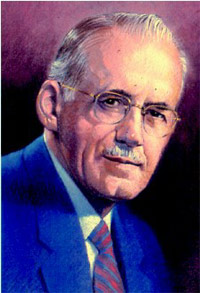
A.W. Tozer“The man who would oppose organization in the church must needs be ignorant of the facts of life. Art is organized beauty; music is organized sound; philosophy is organized thought; science is organized knowledge; government is merely society organized. And what is the true church of Christ but organized mystery? … Many church groups have perished from too much organization, even as others from too little. Wise church leaders will watch out for both extremes. A man may die as a result of having too low blood pressure as certainly as from having too high, and it matters little which takes him off. He is equally dead either way. The important thing in church organization is to discover the scriptural balance between two extremes and avoid both.” —A.W. Tozer (emphasis added)

Pastor, what do you think of Tozer’s thoughts of organization in the church? How do you balance against the extremes?

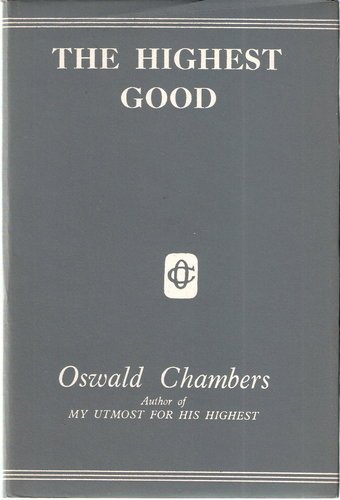
The Highest Good (book review)

The Highest GoodThe Highest Good is a collection of three books by Oswald Chambers: The Highest Good, The Pilgrim’s Song Book, and Thy Great Redemption

The Pilgrim’s Song Book is made up of Chambers’ commentary and insight on the ascension psalms (Psalms 120-128). This is an encouraging study that leads the reader higher and higher into God’s presence, just as the pilgrims climbed the roads to the heights of Jerusalem for the annual worship feasts. 

In The Highest Good portion of this collection, I felt like having arrived in “Jerusalem,” I was now receiving a series of thoughtful teachings on Christian ethics which were preparing me for my descent back into my every-day life. 

Finally in Thy Great Redemption I am getting ongoing refresher courses on the reality that the redemption of Jesus Christ should make in my life. As Chambers said, “Everything that has been touched by sin and the devil has been redeemed; we are to live in the world immovably banked on that faith.” 

As always, the insight of Oswald Chambers is like a graduate level class in theology, philosophy, and ethics. Very few authors expand my biblical paradigm and challenge me to go deeper into God’s Word, so I always highly recommend any Chambers book on which you can get your hands. 

Thursdays With Oswald—Overcoming Temptation

This is a weekly series with things I’m reading and pondering from Oswald Chambers. You can read the original seed thought here, or type “Thursdays With Oswald” in the search box to read more entries.

Overcoming Temptation

     In the silent years Our Lord learned how to be; at His Baptism He had revealed to Him what He had to do; in the Temptation what to avoid

     …The word “temptation” is built on a Latin word meaning “to stretch.” … Temptation is the test by an alien power of the possession held by a personality. 

     …Every temptation of satan is perfectly wise. The wisest, shrewdest, subtlest things are said by satan, and they are accepted by everybody as the acme of human philosophy; but when the Spirit of God is at work in a man, instantly the hollow mockery at the heart of what satan is trying to do, is seen. When we understand the inwardness of the temptation we see how satan’s strategy is turned into confusion by the Spirit of God. 

From Bringing Sons Unto Glory

We must always remember that the Holy Spirit led Jesus into the wilderness to be tempted by satan (see Luke 4:1-2). The Spirit would only do this after Jesus was ready to successfully face satan’s subtle temptations.

We, just like Jesus, can be victorious over these temptations by doing what Jesus did. (1) He was fully submitted to His Heavenly Father, (2) He was sensitive to go where the Holy Spirit led Him, and (3) He uncovered the shrewd and subtle arguments of satan by using the Word of God.

The One who overcame satan’s temptations wants to help you overcome as well—

For because He Himself [in His humanity] has suffered in being tempted (tested and tried), He is able [immediately] to run to the cry of (assist, relieve) those who are being tempted and tested and tried [and who therefore are being exposed to suffering]. (Hebrews 2:18, Amplified Bible)

Leadership Tension

Along time ago I was studying the virtues that the Greek philosophers taught. To the Greeks, the virtue was considered the “golden mean” between two opposite extremes. It was the ability to balance the tensions that produced the virtue.

In areas where I have leadership responsibilities, I try to find the virtue of leadership as the balance between these two tensions:

  • Here is a trustworthy saying: Whoever aspires to be an overseer desires a noble task. (1 Timothy 3:1)
  • Should you then seek great things for yourself? Do not seek them. (Jeremiah 45:5)

On the one side: desire leadership. On the other side: don’t desire leadership. Do your best at it, but be ready to give it up.

I love this statement on leadership from John Maxwell—

Leadership is the willingness to put oneself at risk.
Leadership is the passion to make a difference with others.
Leadership is being dissatisfied with the current reality.
Leadership is taking responsibility while others are making excuses.
Leadership is seeing the possibilities while others are seeing the limitations.
Leadership is the readiness to stand out in a crowd.
Leadership is an open mind and an open heart.
Leadership is the ability to submerge your ego for the sake of what is best.
Leadership is evoking in other the capacity to dream.
Leadership is inspiring others with a vision of what they can contribute.
Leadership is the power of one harnessing the power of many.
Leadership is your heart speaking to the hearts of others.
Leadership is the integration of heart, head, and soul.
Leadership is the capacity to care, and in caring, to liberate the ideas, energy and capacity of others.
Leadership is the dream made reality.
Leadership is, above all, courageous.

I am trying to balance the pulls of leadership, but while I do I’m loving the leadership tension!

UPDATE: This idea of leadership tension became one of the key seed thoughts for my book Shepherd Leadership: The Metrics That Really Matter

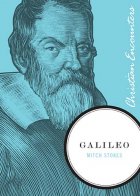
Galileo (book review)

You can quickly spot the influential people throughout history: they typically only need one name to distinguish them from all others. And Mitch Stokes does a masterful job showing why this noted scientist/mathematician/philosopher deserves the one-name designation in Galileo.

The first thing that stood out to me was how Galileo “found his way.” As the son of a musician, the field of science was never on his horizon. In fact, the start of his university career was in medicine. But as he quickly showed no aptitude nor passion for these pursuits, it was refreshing to see how his father let Galileo explore other areas of study to find his niche.

The next thing that amazed me was how Galileo’s new study and future employment in mathematics quickly evolved and expanded into areas such as philosophy, and later in life, astronomy and cosmology. Although Galileo is known today for his studies of the heavens through his improved telescope, those discoveries were only pursued to bolster his mathematic hypotheses.

Then it was amazing to see how deftly Galileo handled himself when he foresaw that his new discoveries that supported Copernicus’ claims of a heliocentric universe would upset those in the Catholic Church. Galileo said and wrote often that he was not trying to make new theology or correct old theology, but was simply trying to show how the Bible and science fit together. It was really the politically-minded (and Inquisition-minded) Cardinals in the Church that stirred up trouble for Galileo, but never the other way around.

Galileo demonstrated so beautifully through his observations and careful mathematic theorems how God had created an orderly and wonderfully-made universe. He believed that scientists had the responsibility to use their skills of observation and calculation to show how God and science are companions and not adversaries.

This is a part of Thomas Nelson’s Christian Encounters Series, and I not only highly recommend this book, but I’m looking forward to reading others in the series as well.

I am a Thomas Nelson book reviewer.