I Like Giving (book review)

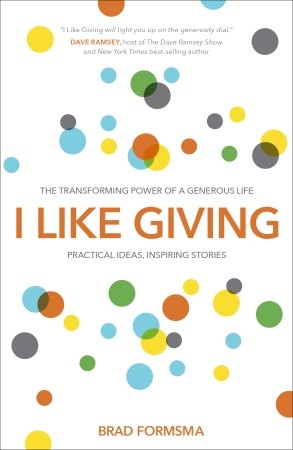
I Like GivingWhen you read a title like I Like Giving you might immediately think, “This is a book telling me to tithe, or give bigger offerings to my church, or support my local charity.” And you would be dead wrong. Brad Formsma’s book isn’t really about giving money away, it’s about giving yourself away.

Brad writes, “When we choose to give, we change, and the people around us change. When we move from awareness to action, miracles happen. When we allow giving to be our idea, a world of possibilities opens up before us, and we discover new levels of joy.”

Indeed, Brad weaves together his own personal stories, with stories from other givers, and even a healthy dose of medical and psychological research data to show us just how life-transforming and joy-producing it is when we are giving people. Not only are the gift receivers benefitted, but so are the gift givers.

Let me state it again: this book isn’t about giving your money to a charitable organization or a church; it’s about you seeing a need and finding a way to take care of that need. If everyone took on this mindset, just imagine how our communities would change!

One final thought from author Brad Formsma—“I don’t think we can ever overestimate just how profound the effects of giving can be. You can give without loving, but you can’t love without giving. The reality is that other people are watching how we live our lives, and what we do can have extraordinary effects in our communities. Generosity is for all of us. It is available to all of us, even when the cultural tide is moving in the opposite direction. Why not be brave and live differently?” (emphasis added)

Let I Like Giving be a springboard for you to live differently and to make a difference where you live!

I am a Waterbrook book reviewer.

Finding God In Hidden Places (book review)

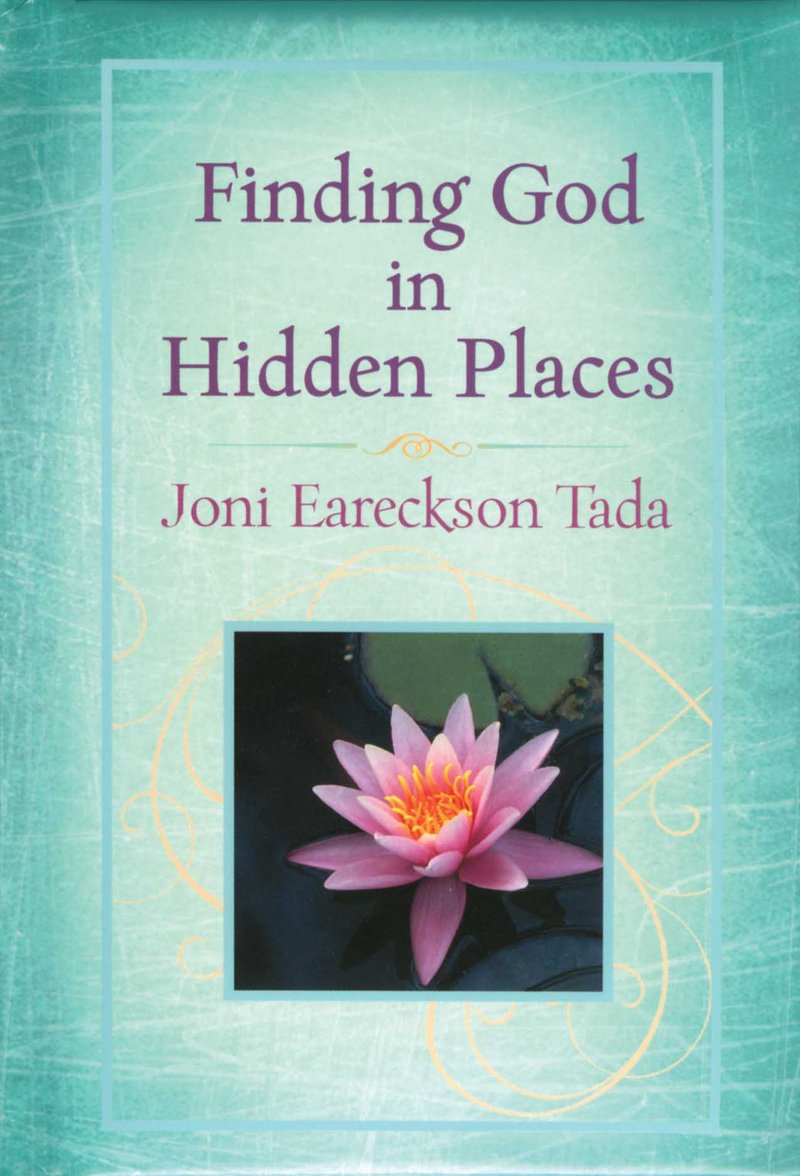
Finding GodThe life of Joni Eareckson Tada is a marvel! The way she has transparently lived out her disability, with all its challenges and opportunities, has been encouraging to many, including myself. In her book Finding God In Hidden Places I got even more insight into this godly woman’s unique paradigm.

This book is really a collection of short stories in which Joni shares how God has revealed Himself to her through the people she’s met and the experiences she’s had. The title of the book sounds like God is hidden, but as Joni shares, God is actually revealing Himself all the time, if we will only have open eyes and hearts to see Him.

In fact, near the end of the book Joni shared how she has grown through all of her experiences—“God is always revealing Himself to us through His Word and through the works of His hands. He’s an intentional God, brimming over with purpose, infusing meaning into everything around us. But we need to open ‘the eyes of our heart’ before we can see; and that, my friend, begins with a prayer from Ephesians 1:17-18.”

Not too long I ago I realized that most of the books I was reading were authored by men and I determined that I needed to be intentional in getting a feminine perspective in my reading material. Find God is the first book I selected after making this decision, and I don’t think I could have picked anything more eye-opening than these sensitive, thought-provoking insights from Joni.

Learning & Teaching

LamedhI’ve been leading my congregation through a spiritual workout from the 119th Psalm. This psalm is unique for a couple of reasons: (1) It’s the longest chapter in the Bible; (2) It’s divided into twenty-two 8-verse segments, with each segment beginning with its own Hebrew letter; and (3) All but four of the 176 verses directly mention God’s Word (using words like command, precept, statues, commands, etc.).

Something else that makes this psalm interesting to study is the Hebrew alphabet itself. In our western world, a letter is just a letter: an L is just an L. But in the Hebrew language, the letters have a name, a meaning, and even a numeric value. So the Hebrew equivalent to our English L is the letter/word lamedh.

Lamedh is the tallest of all the Hebrew letters, so that means it stands out. The section called lamedh in Psalm 119 is one of big proportions. Words like eternal, boundless, established, enduring, and forever are prominent in these eight verses. The psalmist is inviting us to climb up into God’s Word and get a bigger view, a higher vantage point of who God is.

When we are in difficult places, we tend to focus more on our problems, and less on God’s awesomeness. So lamedh is a call to shift our gaze.

But this letter/word also has a definition, and lamedh is a double-edged definition. This word can mean to learn. Indeed, as we gaze upon God’s majesty, we learn so much more about Him! But lamedh also means to teach.

I have found that as I go through difficult times and choose to change my focus from my situation to my Savior, that I learn more about His faithfulness. But at the same time, others are learning from that decision to switch my gaze to God.

So I’ve got one word of advice for you if you feel like your problem is too big and you’re thinking about throwing in the towel: DON’T!!

By focusing on God’s bigness instead of your circumstance, you will learn to grow in faith. And at the same times you will be teaching others to place their faith in God too.

Those who wait on God will soar to new heights!

If you have missed any of the messages in our P119 series, you can access them all by clicking here.

Responding To The Voice

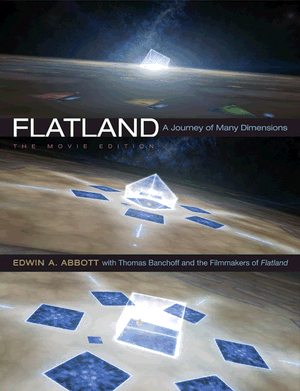
FlatlandIn 1880, Edwin A. Abbott wrote Flatland, a book that would later become a favorite of Albert Einstein. Abbott was a college-trained mathematician and a theologian; in fact he was actually better known for his theological writings than for Flatland. Later on Einstein would say that “things should be made as simple as possible, not simpler.” In other words, don’t dumb-down the concept, but state it on a level where more people can grasp it. That’s why, I believe, Einstein loved Flatland.

Flatland is told through the eyes of Square, a two-dimensional shape that lives in Flatland. Square has length and width, but no height. So the inhabitants of Flatland can move back-and-forth, and side-to-side, but not up-and-down. To get an idea of this, put your eye right on the level of a tabletop, and look at an item on the table. Imagine you can only see what is touching the tabletop (but nothing that rises any higher or lower than that), and you will get an idea of Square’s two-dimensional world.

One day Sphere visits Flatland. Sphere is three-dimensional, so he can move up-and-down. This means that Square can only see the part of Sphere that happens to be in his line of sight at that immediate moment. So he sees just a “slice” or “layer” of Sphere as Sphere moves through Flatland. Sometimes Sphere is nothing more than a disembodied voice when he is hovering above Flatland.

This gives us a little bit of an idea of how we perceive God. He exists in dimensions that we cannot fully comprehend, so we only see “slices” of Him as He passes though our line of sight. Sometimes He is just a disembodied Voice—or as the Bible calls Him, the Word of God.

But the Word of God compressed Himself into our dimension (John 1:14). All of the fullness—all of the other-dimension-ness—of His omnipotence, omnipresence, omniscience came to our “level” in the Person of Jesus Christ (Philippians 2:6-7). The Word was the complete and total fullness of God (John 1:1-3; Colossians 2:9). But unlike Square who couldn’t fully know Sphere, God is fully knowable in The Word—in Jesus Christ!

The question is: What are you going to do with The Word? The Word of God (the Bible) allows us to fully know The Word of God (Jesus). But we need to be willing to let the Holy Spirit strip away our puny, smaller-dimensioned, finite thinking of God.

Alvin TofflerAlvin Toffler wrote, “The illiterate of the future are not those who cannot read or write, but those who cannot learn, unlearn, and relearn.”

I would modify this to say, “Those illiterate of The Word (Jesus) are not those who cannot read The Word (the Bible), but those who won’t let the Holy Spirit help them learn, unlearn, and relearn who God is.” 

There is so much more to learn about The Word (Jesus), so let the Holy Spirit guide you in your reading of The Word (the Bible). I pray as Paul did that you will begin to experience more of the multi-dimensional-ness of God as revealed in The Word—

I pray that out of God’s glorious riches He may strengthen you with power through His Spirit in your inner being, so that Christ may dwell in your hearts through faith. And I pray that you, being rooted and established in love, may have power, together with all the Lord’s holy people, to grasp how wide and long and high and deep is the love of Christ, and to know this love that surpasses knowledge—that you may be filled to the measure of all the fullness of God. (Ephesians 3:16-19)

If you have missed any of the messages in this series called Who Is Jesus?, you can find them all here.

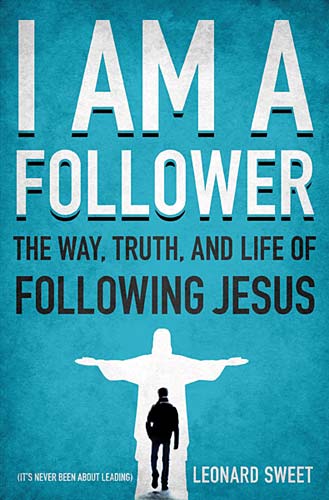
15 Quotes From “I Am A Follower”

I Am A Follower by Leonard Sweet turned my leadership thoughts upside down (or is that right-side up?). I would strongly encourage you to read this book, especially if you are in church “leadership.”

It wasn’t easy to do, but here are 15 great quotes from I Am A Follower —

“The Greek noun perichoresis was the early church’s favorite word to describe the interrelationship of the holy Trinity. When the prefix peri (around) is linked with the root of the verb choreuein (to dance), a compelling metaphor is formed or  ‘choreographed’ to describe the ‘one nature in three Persons’ of God the Father, Son, and Holy Spirit. Literally they ‘dance around.’ The choreia or dance of God is the choreography of the cosmos, the interrelationship of Creator, creation, and life itself, the holy creativity of the All in All.”

“Following is the most underrated form of leadership in existence.”

“The cry for leadership is deafening amid our social disintegration, our moral disorientation. We have come to believe that we have a leadership crisis while all along we have been in a drought of discipleship. The Jesus paradox is that only Christians lead by following.”

“The church has become what [Dwight] Eisenhower predicted: a place where everyone is trying to get everyone else to do what they want done but don’t want to do themselves.”

“Leadership is a function. Followership is an identity. … Leadership is a functional position of power and authority. Followership is a relational posture of love and trust. … Being a follower is less about showing how much you know than showing humble gratitude for how much there is to be known.”

“Have we made Christianity more a moment of decision than a momentum for life? Both are important, but have we spent more time on how you become a Christian than on what it means to live as a Christian? Both are important, but have we made holiness more about a destination than a direction?” 

“But to think we can capture and tame Truth is a delusional trap. In fact, the desire for command and control above our desire to please God dams up the rivers of Living Water.”

“Christ does not ask of His followers great success or great fame or great distinction. Christ expects of His followers what He expected of Himself: simply ‘to do the will of Him Who sent Me.’”

“Never in the history of humanity has knowledge been more accessible and of such quality. But when our thirst for information, expertise, and control begins to outrun our thirst for Christ, we can easily trade the waters of the Spirit for a soda-pop substitute. When we place our faith in fillers instead of allowing the Spirit to fill us, we end up selling out not only Christ but ourselves.”

“Leadership culture is strength based. Followership culture is weakness based. …We bless others naturally through our strengths. But we bless others supernaturally through our weaknesses.”

“The disciples were instructed to feed the sheep, not lead them. Christ will lead them. Jesus is the Shepherd. We are the sheep. All of us.”

“Near the end of John’s gospel we find Jesus’ poignant words: ‘As You have sent Me into the world, so I have sent them into the world.’ Did you catch that sneaky as? Jesus’ commissioning of His disciples was simply an echo of His own commissioning.”

“The relationship between leader and follower is this: leaders are over, followers are among. We are all Jesus followers.”

“The leadership paradigm creates folk heroes. Followership creates heroes who are folk.”

“Jesus told His disciples that the sheep always know the Master’s voice. To follow Jesus is not to demand road signs but to respond to the Voice of the Spirit along the way.”

Thursdays With Oswald—Am I Anti-Christ?

This is a weekly series with things I’m reading and pondering from Oswald Chambers. You can read the original seed thought here, or type “Thursdays With Oswald” in the search box to read more entries.

Am I Being Anti-Christ?

     Christianity is not consistency to conscience or to convictions; Christianity is being true to Jesus Christ. Over and over again a man’s personal relationship to Jesus Christ gets into his convictions and splits them, like new wine put into old wine-skins, and if he sticks to his convictions before long he will become anti-Christ. The standard for my conscience and for the conscience of the whole human race is the Cross, and if I do not take care to rectify my individual conscience by the Cross I become ‘persnickety’ and end in criticizing God. The standard for the Christian is never—Is this thing right or wrong? but, is it related to the blood and passion and agony of the Cross of Christ?

From Biblical Ethics

Every time I read God’s Word, or the Holy Spirit challenges me on my paradigm, I have a choice to make: am I going to try to justify my position, or am I going to submit to His position?

It’s a tough word, but it is right on target. If I persist in sticking with what I know is right, and I disregard the voice of the Holy Spirit, I am becoming anti-Christ and pro-Me.

I must die to my own agenda, so that He may live fully in me.

The Refinement Of Pain

I was recently invited to join a bunch of guys—mostly staff in the Cedar Springs schools—for some early morning basketball. I love playing basketball, I’m a morning guy, and getting to know new people in Cedar Springs made this an invitation I couldn’t refuse. So I started hoopin’ this week. It was nice to get back on the hardwood floor!

Yesterday morning, I jumped in my car to come home to shower. It’s a mile from the school to my house, but by the time I got home, my back muscles had seized up and I was barely able to stand up to get out of the car. I’ve had this happen to me once before, and it’s a whole lot of no fun!

So all day yesterday my schedule had to be modified, as it hurt to move, it hurt to stand for too long, and it hurt to sit for too long. I couldn’t get in the car. In fact, I couldn’t even bend over far enough to put my own socks on! All my plans for the day were shot.

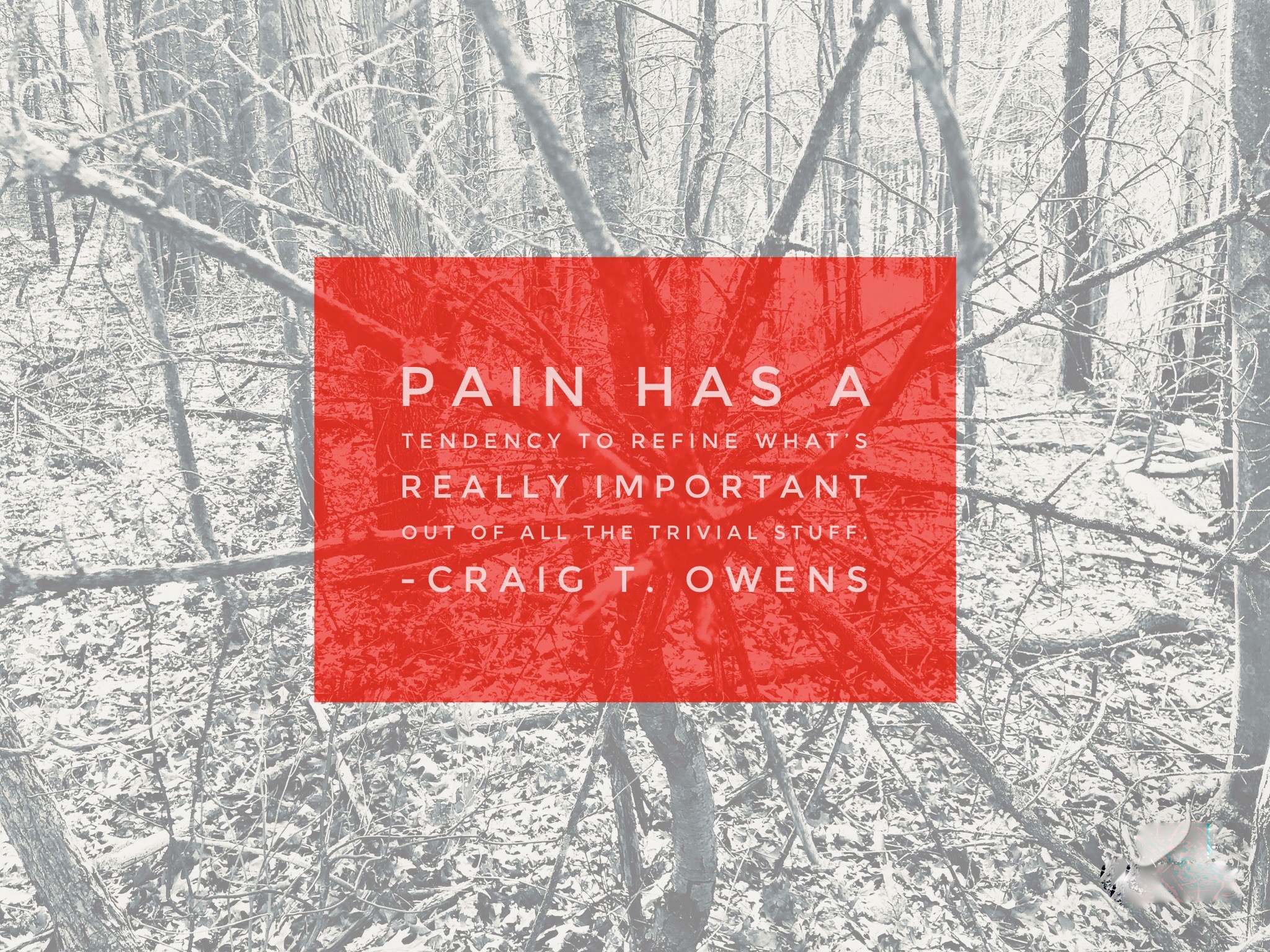
But here’s what I learned: my day wasn’t shot. My plans may not have worked out, but it was still a good day. Pain has a tendency to refine what’s really important out of all the trivial stuff.

  • A day in pain and immobility reminded me of just how blessed I am to normally have good health.
  • It prompted me to pray for others who are confined to a wheelchair or their beds.
  • It gave me greater empathy for those who live in chronic pain.
  • It made me more thankful that I have access to medicines and caregivers, things that some people have access to only rarely.
  • It let me see more clearly the love my family and friends have for me.
  • It gave me more time to pray.

Now here’s the tricky part: to live with these things on my mind even when I’m not in pain.

Here’s what C.S. Lewis wrote in The Problem Of Pain:

I am progressing along the path of life in my ordinary contentedly fallen and godless condition, absorbed in a merry meeting with my friends for the morrow or a bit of work that tickles my vanity today, a holiday or a new book, when suddenly a stab of abdominal [or back] pain that threatens serious disease, or a headline in the newspapers that threatens us all with destruction, send this whole pack of cards tumbling down. At first I am overwhelmed, and all my little happinesses look like broken toys. Then, slowly and reluctantly, bit by bit, I try to bring myself into the frame of mind that I should be in at all times. I remind myself that these toys were never intended to possess my heart, that my true good is in another world and my own real treasure is in Christ. And perhaps, by God’s grace, I succeed, and for a day or two become a creature consciously dependent on God and drawing strength from the right sources. But the moment the threat is withdrawn, my whole nature leaps back to the toys: I am even anxious, God forgive me, to banish from my mind the only thing that supported me under the threat because it is now associated with the misery of those few days. Thus the terrible necessity of tribulation is only too clear. God has had me for but forty-eight hours and then only by dint of taking everything else away from me. Let Him but sheathe that sword for a moment and I behave like a puppy when the hated bath is over—I shake myself as dry as I can and race off to reacquire my comfortable dirtiness, if not in the nearest manure heap, at least in the nearest flower bed. And that is why tribulations cannot cease until God either sees us remade or sees that our remaking is now hopeless.

With God’s help, I’m going to avoid running back to my “toys” today. I’m trying to keep the most important thing in the forefront of my thoughts today.

What lessons have you learned from pain?

You See What You’re Looking For

It’s a pretty simple concept: you only see what you want to see. For example, if you are looking for your car keys, you won’t really see anything else that you are picking up or looking behind to find your keys. Your brain is locked in on keys, so that’s all you will see.

In a well-known Bible story, Moses sends twelve men into the Promised Land to check things out. He tells them to explore the land and bring back a report. The men went to several locations, and there is no mention of who or what they saw except…

  • …in the valley of Eschol, they found grapes of extraordinary size.
  • …in Hebron, they found people of extraordinary size.

They went in looking for big things, and that’s all they saw.

With the exception of Caleb and Joshua who said, “So what? Our God is bigger than those giants,” all the other men saw defeat. In the end, all the other men saw death in the desert; only Caleb and Joshua saw God’s victory in the Promised Land.

You see what you want to see—

What do you see?

What are you looking for?

Are you looking for giants? If so, you’ll find them. And they will seem even bigger in your eyes than they really are.

Are you looking for God’s victory? If so, you’ll find Him. And His deliverance will seem even more incredible than you could have imagined!

Prayer trains your eyes to see differently. Prayer trains your brain to look for victory. Prayer keeps you alert to what God is doing.

If all you see are giants, if all you hear is bad news, if all you feel is fear, perhaps you’re looking for giants and bad news and the fearful things.

Friend, God wants you to see Him on the move. Pray!

  • Prayer changes giants to dwarfs.
  • Prayer changes defeat to victory.
  • Prayer changes gloom to sunshine.
  • Prayer changes the way you see the world.
  • Prayer changes you.

“The prayer of the morning will determine the day.” —Dietrich Bonhoeffer

Objective Beauty

Do you ever doubt Scripture? I don’t mean doubting its inerrancy, but its application to real life. You know what I mean: “Okay, that sounds interesting, but I’m not sure that’s for now or for me. C’mon, that can’t mean me!”

Here’s the verse that got me thinking: “He has made everything beautiful in its time….”

Everything?! Really? Everything?!

My viewpoint is subjective. That’s a fancy way of saying, “Things should be the way I want them to be.” I see some things as beautiful, but about other things I say, “This is a pain, or this is ugly.” But if I believe God’s Word, in God’s timing everything is beautiful.

I think the second part of the verse illuminates the problem of my subjectivity. “…He has also set eternity in the hearts of men; yet they cannot fathom what God has done from beginning to end.”

Eternity—my soul’s longing for God—is in me, yet I cannot grasp it. Not naturally, at least. God knows how everything will end beautifully because He made everything beautifully.

Even me.

My life might seem like a mess at times: ugly, scared, scarred, even worthless. But God sees beauty. And we know that in all things [even the ugly stuff] God works for the good [the beautiful] of those who love Him, who have been called according to His purpose. (Romans 8:28). God gives His beauty to replace my ashes.

With subjective thinking, this doesn’t seem very likely. It’s hard to subjectively see how God could turn my ugliness and my pain into anything beautiful.

That’s why Scripture also contains this prayer: A prayer that will change my subjectivity (seeing only my ugliness) to objectivity (now seeing God’s beauty). If you struggle to see everything as beautiful, pray this prayer right now:

When I think of all this, I fall to my knees and pray to the Father, the Creator of everything in heaven and on earth. I pray that from His glorious, unlimited resources He will empower you with inner strength through His Spirit. Then Christ will make His home in your hearts as you trust in Him. Your roots will grow down into God’s love and keep you strong. And may you have the power to understand, as all God’s people should, how wide, how long, how high, and how deep His love is. May you experience the love of Christ, though it is too great to understand fully. Then you will be made complete with all the fullness of life and power that comes from God.

Amen!