Timothy D. Padgett asks, “Is there such a thing as Judeo-Christianity?” This is an interesting read, but I especially liked this passage: “This is key. When we speak of Judeo-Christianity, we’re not talking about salvation. We are talking about philosophy, even worldview. A Christian worldview must be just that: Christian. A faithful Jew apart from Christ is no more saved than a devout Muslim or an honest atheist, and any philosophy that leaves out the Incarnation will lack its ultimate hope.”
“A human being without a friend is like a beast: for he lacks someone with whom he can share his joy in prosperity and his sadness in adversity, to whom he may unburden his mind when he is preoccupied, with whom he may talk whenever he has had a particularly sublime or illuminating insight…That person is completely alone who has no friend.” —Aelred of Rievaulx
John Stonestreet and Dr. Glenn Sunshine point out that there are some “who believe that AI is a vehicle through which trans-dimensional, non-human intelligences are communicating with us.” Their post is called The Rise of Technopaganism. Of course, this is nothing new: The apostle Paul addressed mankind creating its own god and worshiping it, just as some are now doing with AI.
“It’s better to look ahead and prepare than to look back and regret.” —Jackie Joyner-Kersee
Listen to the podcast of this post by clicking on the player below, and you can also subscribe on Apple, Spotify, or Audible.
Without a doubt, Jesus had the most robust mental health of anyone who has ever walked planet Earth! Dr. Luke, a trained physician, captures this in just one verse (Luke 2:52) where he talks about how Jesus grew in a wholly healthy way, and Luke lists Christ’s mental health as the first priority.
I’m sure there have been plenty of times when someone asks you about something you like or dislike or why you do something the way you do, you probably don’t tell them the facts but you tell them a story. We have a story for everything we like, everything we do, and everything we avoid.
It’s good to rehearse these stories and to really listen to them. If we don’t really listen to them, we cannot learn from them; if we don’t learn from them, we rob ourselves of robust mental health.
From some of our stories, there is a regret that comes from three enemies. These enemies are all tied to our stories about our past and they are would’ve, could’ve, and should’ve—“If only I would’ve…” and “Things would be different today if I could’ve…” and “I should’ve known….”
One of the ways we need to talk back to those thoughts is like this, “I only know the would’ve, could’ve, and should’ve now because I’m older and more experienced. I didn’t know those things in the past so it was impossible for me to have done something differently.” Even the apostle Paul noted, “When I was a child, I talked like a child, I thought like a child, I reasoned like a child. When I became a man, I put the ways of childhood behind me” (1 Corinthians 13:11).
If we don’t talk back to those regrets of yesterday, we will have doubts about today: Will I make another mistake today? Do I have what it takes to meet today’s challenges? What will others think of me if I mess up? If we don’t address those doubts we have today, that will cause us worry and stress about tomorrow.
Regret … doubt … worry … stress. Those don’t really sound like words that contribute to positive mental health, do they?
Here’s the thing we need to remember—Learning from our yesterdays is healthy, but trying to relive our yesterdays is both unhealthy and unproductive!
Dr. William Osler said, “If the load of tomorrow is added to that of yesterday and carried today, it will make the strongest falter.”
Four times in just ten verses, Jesus told His followers not to worry about tomorrow (Matthew 6:25-34). He ties that worry about tomorrow to having little faith. That lack of faith comes from our doubts, and those doubts come from our past regrets.
T.G.I.F.—thank God it’s Friday!—is an escapism. It’s not wanting to deal with the regrets, doubts, and worry by trying to push them to some distant time. It doesn’t allow us to really concentrate on today. The Bible constantly brings us back to the present.
Today is used 203 times in the NIV Bible
Tomorrow is mentioned 56 times
Yesterday is only used 8 times
Jesus taught us to pray, “Give us today our daily bread” (Matthew 6:11) so that we won’t let past regrets spiral downward into daily doubts and then anxiety about tomorrow. Elizabeth Elliot wisely counseled, “One reason we are so harried and hurried is that we make yesterday and tomorrow our business, when all that legitimately concerns us is today.”
Christians that want to be mentally healthy should continually replace a T.G.I.F. mindset with T.G.I.T.—thank God it’s today!
Taking a line from Joshua who said, “Choose for yourselves this day whom you will serve” (Joshua 24:15), here are four things we need to choose to remember each day.
Choose to remember that God uses all things—even our would’ve, could’ve, and should’ves—for our good and for His glory (Romans 8:28).
Choose to forget those old, self-limiting, stress-causing stories (Philippians 3:13).
Choose to believe that God is doing something new—something I never could have planned (Isaiah 43:18-19).
Choose to believe that God can help you tell a new story about your past (Genesis 41:51).
You have to choose each day to say “Thank God it’s today! Thank God that I’m not who I was yesterday! Thank God that He is using my would’ve-could’ve-should’ve moments from yesterday to prepare me for today! Thank God that He is teaching me a new story!”
If you’ve missed any of the previous messages in our series on a Christian’s mental health, you can find them all here.
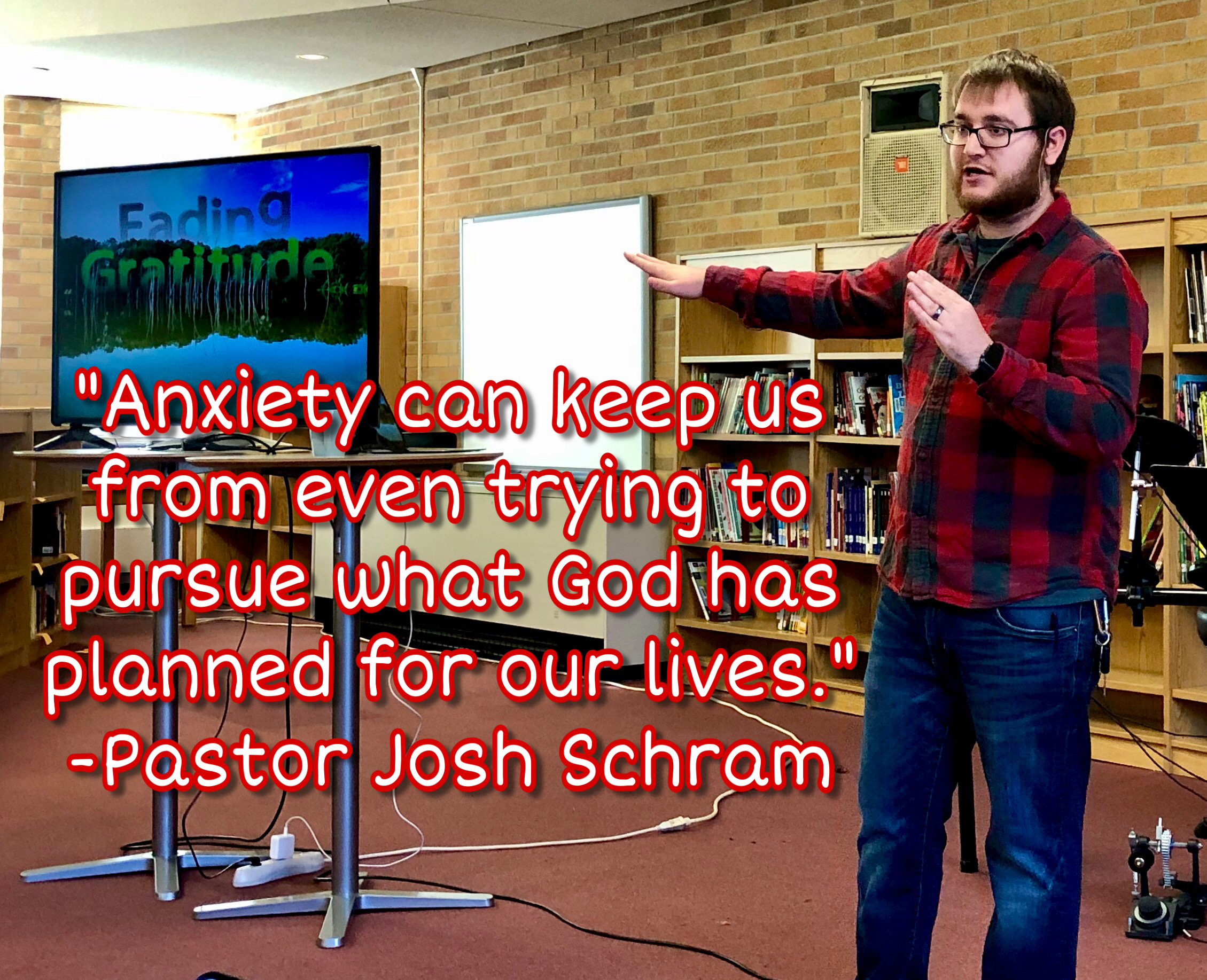
My friend Josh Schram shared a great message yesterday, wrapping up our series called Fading Gratitude.
Josh was transparent about some of the struggles he overcame during his younger years, explaining how his decision to be grateful even for those roadblocks completely changed his perspective.
When we’re not intentional, our gratitude naturally begins to fade. It’s not that we’re intentionally ungrateful, but we just merely forget to be thankful.
Our fading gratitude creates a domino effect. When gratitude fades we live with…
Anxiety can keep us from even trying to pursue what God has planned for our lives.
When a large group of people needed to be fed, a couple of Jesus’ disciples forgot about the miracles Jesus had already done in the past, and as a result, they became anxious about what to do next.
Philip replied, “Even if we worked for months, we wouldn’t have enough money to feed them!” Then Andrew, Simon Peter’s brother, spoke up. “There’s a young boy here with five barley loaves and two fish. But what good is that with this huge crowd?” (John 6:7-9)
Yet Jesus multiplied more than enough for everyone to eat AND there were more leftovers than there was food that they originally started with! “So they picked up the pieces and filled twelve baskets with scraps left by the people who had eaten from the five barley loaves” (John 6:13).
That’s why Jesus tells us, “So don’t worry about tomorrow, for tomorrow will bring its own worries. Today’s trouble is enough for today” (Matthew 6:34). When we’re grateful for what God provided yesterday, and we’re thankful for what He’s providing today, it will cut short any feelings of anxiety about what God will do again tomorrow!
“No amount of regret changes the past, no amount of anxiety changed the future, but any amount of gratitude changes the present.” —Ann Voskamp
Gratitude can radically change our perspective!
If I’m not choosing gratitude, then gratitude is fading. I can be grateful for things I originally thought were holding me back. I can give those things to Jesus—He is not only more than enough but He also gives back to me more than I gave to Him.
“Foretastes are good. Unless they become substitutes. O, don’t let all the sweet things of this season become substitutes of the final great, all-satisfying Sweetness. Let every loss and every delight send your hearts a-homing after heaven.” —John Piper
“Are you in a season of winter? A lost job… A doctor’s report… A broken marriage? Maybe you feel stuck in winter, like Christmas may never come. As scripture says, God rewards those who diligently seek Him. So just like the wise men of the Christmas story…search for the Lord. Look for Him in the midst of your darkest nights and coldest winters. Hope may seem as distant as a star, but if the Christmas story tells us anything…God is still present. God is still working. And in this very moment, God is near.” —Max Lucado
“If there had been no prophet like Nathan—no piercing, prophetic word—David could have ended up like Saul: spiritually dead, with no Holy Ghost guidance, having lost all intimacy with God. … If you are being probed by God’s Word—if His Spirit isn’t letting you sit comfortably in your sin—then you are being shown mercy. It is the deep love of God at work, wooing you out of death and into life.” —David Wilkerson
“If regrets about yesterday’s decisions and actions help you do better work today, then they’ve served a useful purpose. … Most of the time, though, we use regrets to keep us from moving forward. They paralyze us in the face of possibility. We don’t want to do something if it reminds us of that black hole we have in our past. It’s useful if you can forgive yourself, because the regrets you’re carrying around are keeping you from holding onto the possibility that you can contribute even more tomorrow.” —Seth Godin
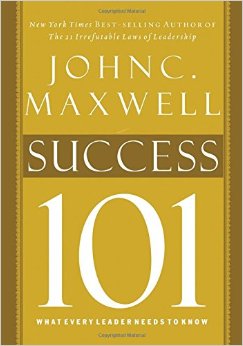
One of the things I enjoy about John Maxwell’s books is the number of other resources he employs to make his point: motivational sources, historical sources, quotes, stories, personal examples, and more. Here are some of the quotes Dr. Maxwell shared in his Success 101 book.
“Everyone has his own specific vocation or mission in life. Everyone must carry out a concrete assignment that demands fulfillment. Therein he cannot be replaced, nor can his life be repeated. Thus everyone’s task is as unique as his specific opportunity to implement it.” —Viktor Frankl
“There is no man living who isn’t capable of doing more than he thinks he can do.” —Henry Ford
“A blind man’s world is bounded by the limits of his touch; an ignorant man’s world by the limits of his knowledge; a great man’s world by the limits of his vision.” —E. Paul Hovey
“Failure is really a matter of conceit. People don’t work hard because, in their conceit, they imagine they’ll succeed without ever making an effort. Most people believe that they’ll wake up someday and find themselves rich. Actually, they’ve got it half right, because eventually they do wake up.” —Thomas Edison
“Sir, I salute you not only as a great leader of men, but as an indomitable Christian gentleman who wouldn’t give up.” —General Charles Cornwallis, when he surrendered to George Washington
“I start where the last man left off.” —Thomas Edison
“Success is a little like wrestling a gorilla. You don’t quit when you’re tired—you quit when the gorilla is tired.” —Robert Strauss
“Every successful person finds that great success lies just beyond the point when they’re convinced their idea is not going to work.” —Napoleon Hill
“The greatest mistake one can make in life is to be continually fearing you will make one.” —Elbert Hubbard
“He who makes no mistakes, makes no progress.” —Theodore Roosevelt
“Nobody whoever gave their best ever regretted it.” —George Halas
“If you do what you can, with what you have, where you are, then God won’t leave you where you are, and He will increase what you have.” —Bill Purvis
“Each time you decide to grow again, you realize you are starting at the bottom of another ladder.” —Ken Rosenthals
“Start doing what is necessary; then do what is possible; and suddenly you are doing the impossible.” —Francis of Assisi
“The only conquests which are permanent and leave no regrets are our conquests over ourselves.” —Napoleon Bonaparte
I also shared some quotes from John Maxwell himself in Success 101. You can read those by clicking here.
Today’s my birthday. It’s not really a “big deal” day for me, except I enjoy being able to get together with my family and friends.
The Bible tells us that God has set the length of our life:
You have decided the length of our lives. You know how many months we will live, and we are not given a minute longer. (Job 14:5 NLT)
I woke up this morning singing the lyrics to Mark Schultz’s song Time That Is Left:
What will you do with the time that’s left?
Will you live it all with no regret?
Will they say that you loved till your final breath?
What will you do with the time that’s left?
I want to live until I die.
Duh, right? Not really. There’s a lot of people who coast to the end, who check out long before their last day. But life is too precious to me … I have too much to do … too many to love. If God has given me a set number of days, I’m going to live everyone with excellence.
A great way to celebrate a birthday is living with no regrets!







 Craig T. Owens