Links & Quotes

link quote

Some good reading from today…

Food for thought: Worship In A Selfie World.

“The most basic and powerful way to connect to another person is to listen. Just listen. Perhaps the most important thing we ever give each other is our attention. A loving silence often has far more power to heal and to connect than the most well-intentioned words.” —Rachel Naomi Remen

Pastor Dave Barringer has some good thoughts on Successful Communication In Marriage.

Joy is distinctly a Christian word and a Christian thing. It is the reverse of happiness. Happiness is the result of what happens of an agreeable sort. Joy has its springs deep down inside. And that spring never runs dry, no matter what happens. Only Jesus gives that joy.” —S.D. Gordon

The Holy Spirit does not bring text after text until we are utterly confused; He simply brings back with the greatest of ease the words which we need in the particular circumstances we are in. Then comes in the use of the will, will I obey the word which has been brought back to our remembrance? The battle comes when we begin to debate instead of obeying.” —Oswald Chambers

Links & Quotes

link quote

Great reading (and watching) today.

[VIDEO] John Maxwell reminds us of the value of delays.

Dr. James Dobson defends his comments at the National Day of Prayer address.

[VIDEO] Dr. Brian Mattson discusses the place of the Apocrypha.

[INFOGRAPHIC] Exercise helps your memory.

“The surprise comes for many people that such a tiny little brain is able to form such a rich memory described as a cognitive map,” says co-author Randolf Menzel. Actually, the surprise for me is that many people refuse to believe this amazing little brain was created by an amazing Creator. See how bees build mental maps to get back home.

Singing Your Prayer

Be honest: have you ever crammed for an exam? You’re up late into the night “cramming” info into your brain, then chugging Coke or Mt. Dew or coffee the next morning to try to wake up.

You get to class and fly through your test, trying to get all of the information out of your brain before it evaporates. Perhaps you do well on the test, but if someone were to quiz you on the same material a week later, you’d probably recall very little of what you studied. If the teacher asks you the next school year what you remember from that exam, your mind might be blank.

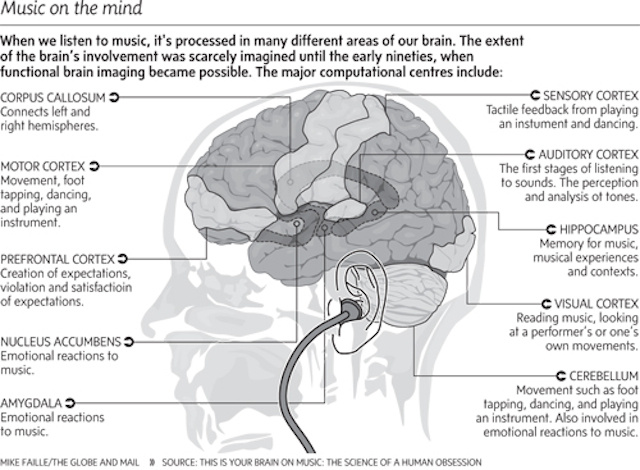
Music & the brainYears later you might be flipping through the radio dial, and a song comes on that you haven’t heard for years. You turn up the volume, and start singing along to the song, recalling that this was the very song you were listening to the night you were cramming for that exam.

Why is it that can you recall everything about this song, and very little about what you studied? The answer is that music engages the whole brain. Both the left hemisphere of your brain (which remembers facts) and the right hemisphere (which remembers music) work together as a powerful memory tool.

Did you know this can be just as powerful in your prayers?

There is a  Hebrew word (tephillah) for prayer which means a prayer set to music; a poetic prayer; a sacred song. This is the word used heavily in the first 72 psalms.

In other words, the psalmists linked words and melodies—left and right brain hemispheres—together to help our songful prayers get locked into our memory banks. The more we remember what God has done for us in answering our prayers, the more likely we are to keep on praying and keep on trusting Him in the future. 

Many times when I am reading Scripture, a song or hymn will come to my mind, and I pause to hum that melody. Maybe God will give you a new song to sing, or perhaps you will write your own personal melody as you pray. There’s no wrong way to sing your prayers.

However you do it, it’s a powerful memory tool when we sing our prayers to our Heavenly Father.

Gratitude Cancels Anxiety

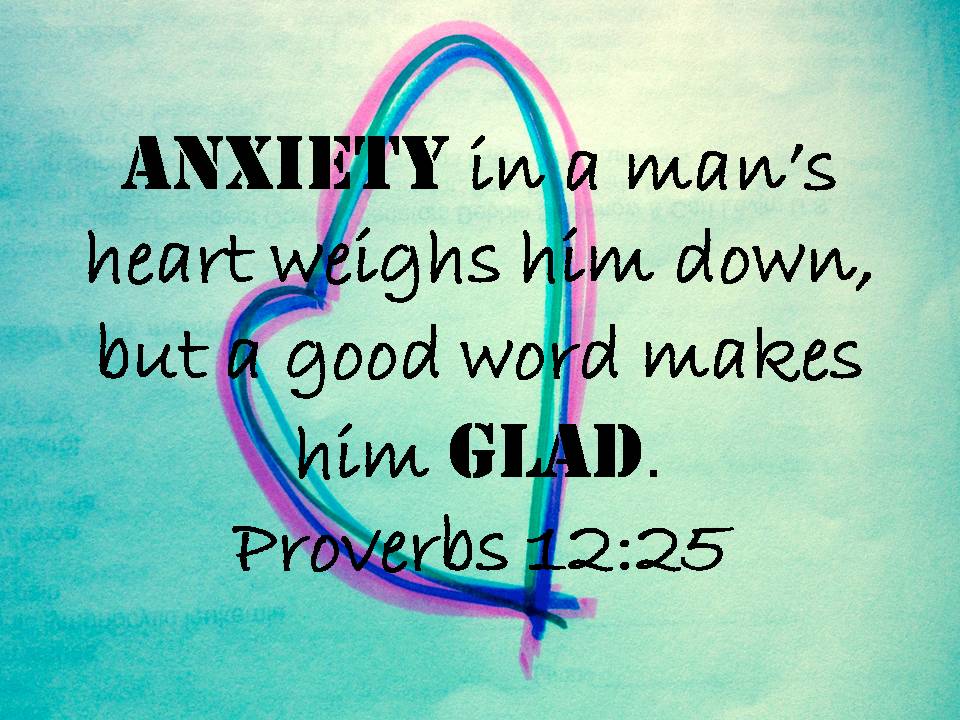
Gratitude cancels anxietyThe wise King Solomon said, “Anxiety in a man’s heart weighs him down…” (Proverbs 12:25). And now medical science proves it.

There’s the physical weight of anxiety:

  • Digestion of food is hindered
  • Sleep is disrupted
  • Short-term memory is hampered
  • Immune system is depressed
  • Heart disease risks are elevated
  • Not to mention the emotional and relational weights of anxiety

But do you know what brings an almost immediate bounce-back from these conditions? Feeling and expressing gratitude.

The feelings of gratitude…

  • Release endorphins (the feel-good hormone)
  • Make good memories easier to recall
  • Strengthen relationships
  • Improve overall physical health

The verse I quoted earlier from Proverbs was only the first half of the verse. The full verse says, “Anxiety in a man’s heart weighs him down, but a good word makes him glad.” Science tells us that it doesn’t matter if those good words are words others say to us, or words we say to ourselves, or words we say to others. Our bodies cannot tell the difference, so any grateful/thankful/positive words cancel out the heaviness of anxiety!

Try it! Keep a gratitude journal … write a letter to someone you haven’t properly thanked for their investment in your life … make it a point to compliment others … speak more positively to yourself. Those grateful words are not only the antidote to the anxiety weighing you down now but also the inoculation against future anxiety. 

We’ll be looking at more benefits of gratitude next week, as we continue our series A Grateful Heart Is A Strong Heart. Please join me!

867-5309

MeditatingI know I’m showing my age with this example: But how many of you remember the song by Tommy Tutone that contained Jenny’s phone number. That song hit #4 on the charts in 1982, and yet after all of these years if you start singing the song, people can tell you that Jenny’s number is 867-5309.

Why do we remember such trivial things?!

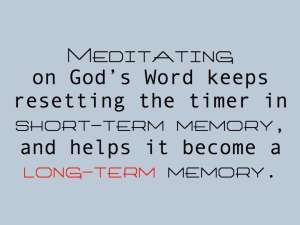
The way God designed the human brain is absolutely astounding! Electrical impulses from our five senses filter into the brain and are saved as short-term memories, with the emphasis on short. Short-term memories usually last 20-30 seconds. But we can reset the timer by repeating the information again and again.

If we repeat it enough or think about it more, our brain realizes that it has some significance to us, and begins to “solidify” the information in our intermediate memory banks. These intermediary memories last 5-8 hours.

But in order for the intermediary memories to be stored away in our long-term memory—where they can be stored indefinitely—there needs to be an added component from us. That component is emotion.

The more important the information is to us, the greater the likelihood it will be filed in the “do not delete” section of our brain.

People tell me all the time how difficult it is for them to memorize Scripture, but the keys to memorization are built into the Scripture itself.

First, you have to approach it with a passion. Oh, how I love your law! … Therefore I hate every wrong path (Psalm 119:97, 104). The “bookends” of this section show passionate emotion.

Second, you need to sing the Word. Twice the psalmist said he mediated on God’s Word all day long (vv. 97, 99). At the root of this word is to hum. Singing God’s Word attaches emotion to it, and the emotion tells your brain to move it to long-term storage.

Third, you need to realize just how important it is to have the Scripture stored away in your memory banks. In one section of the 119th Psalm we see benefits like: makes me wiser, gives me more insight, I have greater understanding, I can avoid evil paths (vv. 98-102).

C.S. Lewis commented, “All that is not eternal is eternally useless.” Jenny’s phone number won’t keep us out of trouble, or draw us closer to God, or even give us insight into helping a friend. But God’s Word will do all of those things … and so much more!

These steps will help you store and retrieve eternally useful truths, and not just fictional phone numbers! Try it and let me know how it works for you.

If you have missed any of the messages in our P119 series, you can access them all by clicking here.

Good Memory / Bad Memory

When you look back into your memories, what do you see? Do you recall the good things? The bad things? Which most readily springs to mind?

“I do not find fault with short memories, but with good memories which are treacherous towards divine things. What I complain of is that memory may be very strong concerning self-interest, grievances, and trials, and yet towards God’s mercies it may be very weak.” ―Charles Spurgeon

When one of the psalmists was downcast, his thoughts started to go back to the bad memories, but he chose to remember the good

…my soul is downcast within me; therefore I will remember You… (Psalm 42:6)

Did you catch that therefore?

This psalmist said, “As soon as I realize I am focusing on the bad, I will remember my God!”

This is why I am a big proponent of using a prayer journal: a written record of your prayers, answers to those prayers, revelations the Holy Spirit has shown you in the Scriptures, and other good memories. That way when your soul is downcast, you can remember the good things God has said and done for you.

Don’t let the bad memories trump the good things God has done for you. Remember … remember … remember!

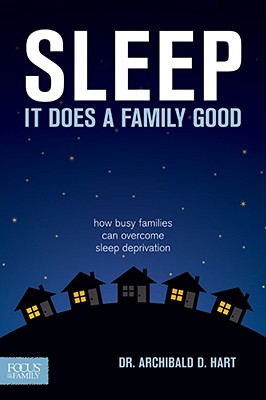
Sleep: It Does A Family Good (book review)

I was reading Dr. Archibald Hart’s book Sleep: It Does A Family Good a few nights ago in the evening, and my oldest son looked over at me and snickered. “What?” I asked.

He said, “I just think it’s kinda funny that you are reading a book about sleep just before you go to sleep!” I smiled at his sense of humor and kept on reading Dr. Hart’s fascinating book. And the more I read, the more I discovered that reading just prior to bedtime was the perfect time to read, as Dr. Hart explains that what I put into my mind just before going to sleep gets sorted and stored in my brain’s long-term memory as I sleep.

That is IF I get enough sleep. Sadly, that’s the problem with most Americans: we are chronically tired. Not getting the proper amount of sleep adversely impacts our memory storage and recall, our work/school performance, our decision-making abilities, our coping skills, not to mention our physical health. Some students have even been misdiagnosed with disorders such as ADHD when in reality they are severely sleep-deprived.

Dr. Hart diagnoses the power of sleep in three sections:

  • Why sleep is so important
  • What’s keeping us from getting enough sleep
  • How we can reap the advantages of better sleep

This is a very straightforward read, with just enough evidence to convict me that I need to work on my sleeping habits, but not so technical that the information became overwhelming. Dr. Hart has an easy-to-read style that anyone can grasp, and he includes several charts and assessments to help you personally gauge where you and your family are on the sleep spectrum. Then he offers very practical steps on how to begin to make better investments in your family’s sleep bank.

Years ago a friend said to me, “Sometimes the most spiritually healthy thing I can do is go to bed early.” It took me a while to grasp what my friend was saying, but it all became so clear when I read Dr. Hart’s book. Sleep, as it turns out, really does do a family good! I’m looking forward to seeing how things in my family improve as we all get more sleep.

I am a book reviewer for Tyndale House Publishers.