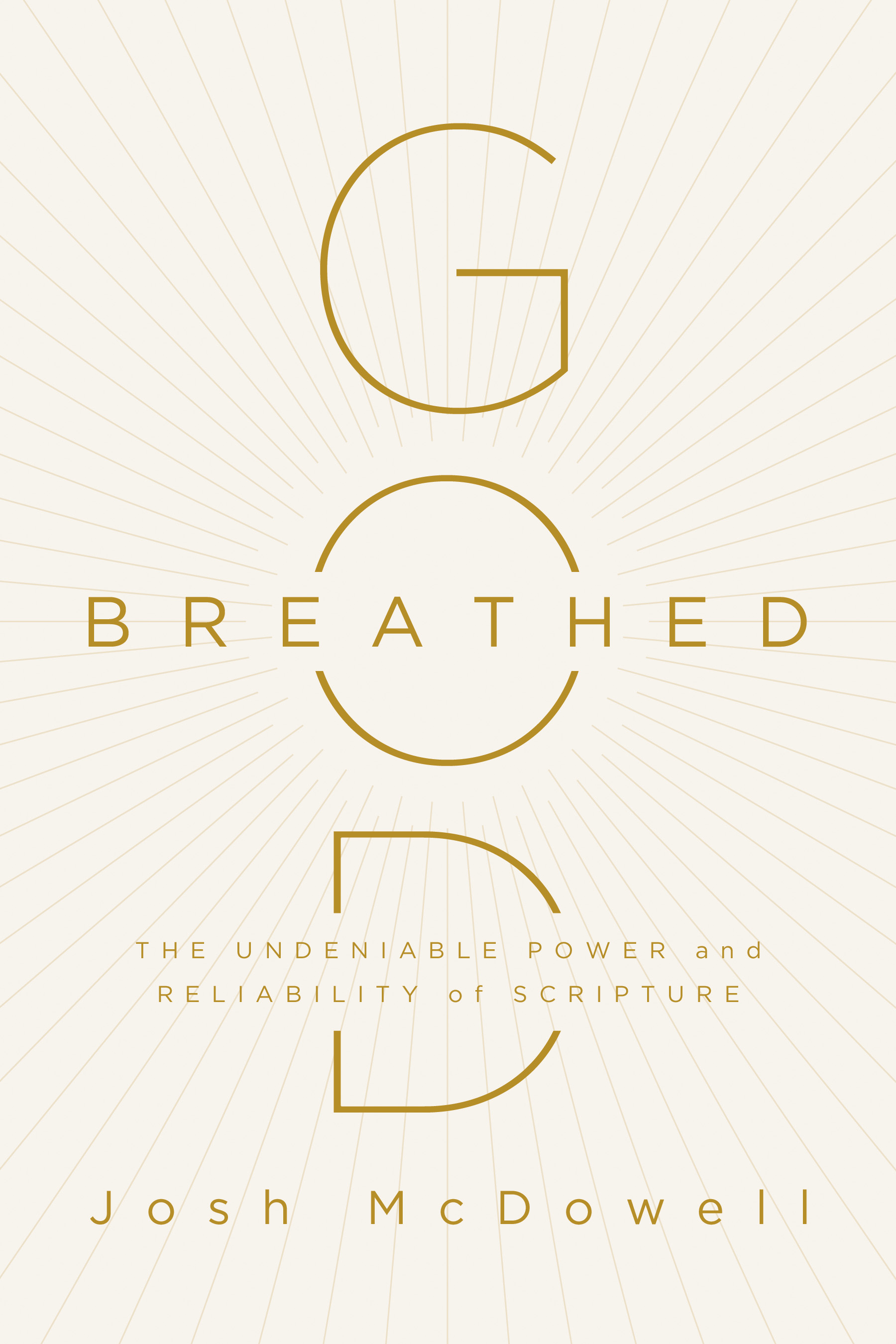
12 Quotes From “God-Breathed”

God-BreathedJosh McDowell has given us another outstanding Christian apologetic. In God-Breathed, Josh shares with us some astounding facts that show the amazing reliability of the Bible. You can read my book review of God-Breathed by clicking here. Below are some of the quotes I especially appreciated.

“The doctrines and commands of Scripture act as two guardrails to guide us down the right path of life. The teachings of Scripture (doctrine) keep us thinking and believing rightly. The instructions of Scripture (commands) keep us acting and living rightly. But without the proper context, we can miss the true purpose of Scripture, which is to guide us into keeping right thinking and right living in balance. … Scripture was given to lead us into a deeper love relationship with the One Who wrote the Book, and then also with everyone around us.” 

“The infinite God is personal. And because He is personal, we can love Him, worship Him, and please Him with our trust and obedience. Because He is personal, He can love us, rejoice with us, comfort us, and reveal Himself and His ways to us.”

“What is it that really parents our children? Is it the directives, instructions, and commands we give them? Those are behavioral guidelines, but they are not what raises our kids. It is not ‘parenting,’ as a concept, that brings up children; it is the parents themselves—relational human beings—who do the work and perform that role. That is the way God designed it. He wants kids to be brought up in loving relationships. Without relationship with another person, all attempts to instill right beliefs and right behavior will be ineffective, because they are detached from the necessary elements of personal love and care. … The Holy Spirit administers Scripture to us like a loving parent, in order to provide us with wisdom through its lessons (Proverbs 3:5), security through its boundaries (Exodus 20), caution through its warnings (Ephesians 4:17-22), and reproof through its discipline (Philippians 2:3-4).” 

“By AD 100, the apostles had died, but the Christian Church was still in its infancy, with fewer than twenty-five thousand proclaimed followers of Christ. But within the next two hundred years, the fledgling church experienced explosive multiplication of growth, to include as many as twenty million people. This means the church of Jesus Christ quadrupled every generation for five consecutive generations!”

“In AD 367, Athanasius of Alexandria compiled the first official list of books that we know today as the New Testament. There were twenty-seven books listed in all. These books were then canonized officially by the church at the councils of Hippo (AD 393) and Carthage (AD 397). Again, these councils didn’t authorize which writings were God-breathed works; rather, they recognized that these writings were authorized by God Himself.” 

“The Old Testament, comprised of thirty-nine books, was officially recognized as God-breathed Scripture as early as the fourth century BC and certainly no later than 150 BC.”

“The Bible is now the most translated book of all-time. The United Bible Society reports that, as of 2014, the Bible or portions of the Bible has been translated into 2,650 languages. Their Digital Bible Library now hosts more than 800 translations in 636 languages spoken by 4.3 billion people.” 

“Compared with other ancient writings, the Bible has more manuscript evidence to support it then the top ten pieces of classical literature combined.”

“No other work in all literature has been so carefully and accurately copied as the Old Testament.”

“Once archaeologists completed their search of the Qumran caves—eleven caves in all—almost 1,050 scrolls have been found in about 25,000 to 50,000 pieces (a number that varies depending on how the fragments are counted). Of these manuscripts, about 300 were texts from the Bible, and many of the rest had ‘direct relevance to early Judaism and emerging Christianity.’ Every book of the Old Testament was represented, except for the book of Esther, and the earliest copies dated from about 250 BC. … Once the Dead Sea Scrolls were translated and compared with modern versions of the Hebrew Bible, the text proved to be identical, word for word, in more than 95% of the cases. (The 5 percent deviation consists mainly of spelling variations. For example, of the 166 words and Isaiah 53, only seventeen letters are in question. Of those, ten are a matter of spelling, and four are stylistic differences; the remaining three letters comprise the word light, which was added to Isaiah 53:11.)”

“The writings of the most authoritative writers of the early church—the leaders scholars referred to collectively as the Apostolic Fathers—give overwhelming support to the existence of the twenty-seven authoritative books of the New Testament. Some Apostolic Fathers produced extensive, highly accurate quotes from the text of the New Testament. … Early church writers provide quotations so numerous and widespread that if no manuscripts of the New Testament were extant, ‘the New Testament could be reproduced from the writings of the early Fathers alone.’” —Norman Geisler and William Nix 

“The earliest preachers of the gospel knew the value of…first-hand testimony, and appealed to it time and again. ‘We are witnesses of these things,’ was there constant and confident assertion. And it can have been by no means so easy as some writers seem to think to invent words and deeds of Jesus in those early years, when so many of His disciples were about, who could remember what had and had not happened. … One of the strong points in the original apostolic preaching is the confident appeal to the knowledge of the hearers; they not only said, ‘We are witnesses of these things,’ but also, ‘As you yourselves also know’ (Acts 2:22). Had there been any tendency to depart from the facts in any material respect, the possible presence of hostile witnesses in the audience would have served as a further corrective.” —F.F. Bruce

Links & Quotes

link quote

“Another point is that on that view you would have to regard the accounts of the Man as being legends. Now, as a literary historian, I am perfectly convinced that whatever else the Gospels are they are not legends. I have read a great deal of legend and I am quite clear that they are not the same sort of thing. They are not artistic enough to be legends. From an imaginative point of view they are clumsy, they don’t work up to things properly. Most of the life of Jesus is totally unknown to us, as is the life of anyone else who lived at that time, and no people building up a legend would allow that to be so. Apart from bits of the Platonic dialogues, there are no conversations that I know of in ancient literature like the Fourth Gospel. There is nothing, even in modern literature, until about a hundred years ago when the realistic novel came into existence. In the story of the woman taken in adultery we are told Christ bent down and scribbled in the dust with His finger. Nothing comes of this. No one has ever based any doctrine on it. And the art of inventing little irrelevant details to make an imaginary scene more convincing is a purely modern art. Surely the only explanation of this passage is that the thing really happened? The author put it in simply because he had seen it.” ―C.S. Lewis

“It takes more than academic rigor to win the world for Christ. Correct doctrine alone isn’t enough. Proclamation and teaching aren’t enough. God must be invited to ‘confirm the Word with signs following’ (see Hebrews 2:4). In other words, the gospel must be preached with the involvement of the Holy Spirit sent down from heaven.” Read more from Jim Cymbala in his post With Signs Following.

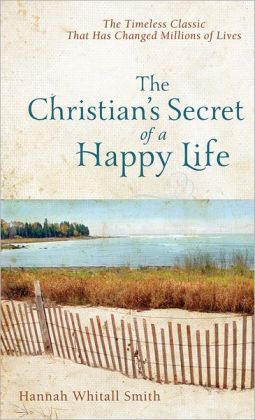
The Christian’s Secret Of A Happy Life (book review)

The Christian's SecretAlthough originally written in 1875, The Christian’s Secret Of A Happy Life by Hannah Whitall Smith is as relevant today as it was 140 years ago.

Hannah is quick to point out that happiness is not the goal for a Christian, but a closer walk with Jesus Christ is. When we are walking close with Him, happiness that comes from peace, security, and consistent growth in faith is the natural byproduct.

Hannah is a Quaker and she wrote nearly two centuries ago, so some language differences are to be expected. But I found that when the “old English” began to show up more liberally in certain passages, it was the author’s way of really getting excited about what she had to say! Other than that, the principles and the examples she uses to make her points are fairly timeless.

The book is divided into three sections, and the middle section—called Difficulties—was one of my favorites. What made it so intriguing was the practical and biblical way Hannah explained the difficulties Christians face, and the God-honoring way out of those problems.

This is an excellent devotional-style book for both new and experienced Christians.

“The Lord’s part is to do the thing entrusted to Him. He disciplines and trains by inward exercises and outward providences. He brings to bear upon us all the refining and purifying resources of His wisdom and His love. He makes everything in our lives and circumstances subservient to the one great purpose of causing us to grow in grace, and of conforming us, day by day and hour by hour, to the image of Christ.” —Hannah Whitall Smith

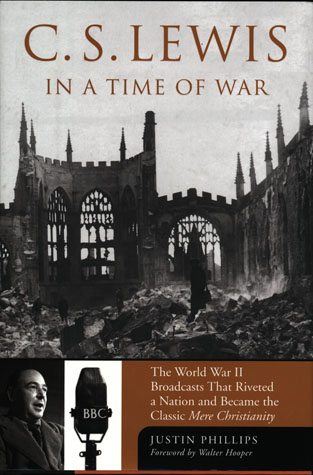
10 Quotes From “C.S. Lewis In A Time Of War”

In A Time Of WarI loved C.S. Lewis In A Time Of War by Justin Phillips! It appealed to my interests in World War II history, old-time radio, and one of my favorite authors: C.S. Lewis. You can read my book review by clicking here. Below are 10 quotes from this book which will give you a little of the flavor of this work.

“In a time of uncertainty and questioning it is the responsibility of the church—and of religious broadcasting as one of its most powerful voices—to declare the truth about God and His relation to man. It has to expound the Christian faith in terms that can be easily understood by ordinary men and women, and to examine the ways in which that faith can be applied to present-day society during these difficult times.” —James Welch, the BBC director of religious broadcasting responsible for getting C.S. Lewis on the air

“It seems to me that the New Testament, by preaching repentance and forgiveness, always assumes an audience who already believe in the law of nature and know they have disobeyed it. In modern England we cannot at present assume this, and therefore most apologetic begins a stage too far on. The first step is to create, or recover, the sense of guilt. Hence if I gave a series of talks, I should mention Christianity only at the end, and would prefer not to unmask my battery till then.” —C.S. Lewis

“Having seen more of his original manuscripts than probably anybody else, Walter Hooper observes that there is next to no evidence of rewriting or of copious changes. The manuscript of The Screwtape Letters is a case in point. There was only the one draft.” —Justin Phillips

“A charitable trust was set up called The Agape Fund, using the Greek word for love. Until his marriage in 1957, two-thirds of all Lewis’s royalties went into this fund to help those in need—normally under the cover of anonymity.” —Justin Phillips

“If the whole universe has no meaning, we should never have found out that it has no meaning.” —C.S. Lewis

“Walter Hooper had discovered a calculation made by Warnie [Lewis] in 1967, described in his diary some four years after Jack’s [C.S. Lewis] death, that by the time the typewriter was finally packed up Warnie must have written at least 12,000 letters on it on his brother’s behalf.” —Justin Phillips

“Any amount of theology can now be smuggled into people’s minds under the cover of romance without them knowing it.” —C.S. Lewis 

“But if you will go to God just as you are, fully admitting that you care about Him very little, and put yourself in His hands, if you’re even ready to be made to care and leave Him to work, He’ll do the rest.” —C.S. Lewis

“All I am in private life is a literary critic and historian, that’s my job. And I am prepared to say on that basis if anyone thinks the Gospels are either legends or novels, then that person is simply showing his incompetence as a literary critic. I’ve read a great many novels and I know a few amount about the legends that grew up among early people, and I know perfectly well the Gospels are not that kind of stuff. They are absolutely full of the sort of things that don’t come into legends. Take one simple example. The passage in which Our Lord is scribbling in the dust before He gives His answer about the woman taken in adultery. Nothing whatever comes of it, no doctrine has ever been based on it, it has no point at all; there’s no conceivable reason why anyone should ever have written it down, unless he’s seen it happening. From first to last the things strike me as records of fact. And, in my opinion, the people who think that any of the episodes in the Gospels are imaginary are the people who have no imagination themselves and have never understood what imaginative story-telling is.” —C.S. Lewis

“Numbers vary, but in the year 2000 some estimates put worldwide sales of Lewis’ books at over 200 million copies in more than thirty languages.” —Justin Phillips

Book Reviews From 2013

BookshelfHere are the books I read and reviewed in 2013. Click a title to read the review…

10 People Every Christian Should Know

A Harmony Of The Gospels

Alive To Wonder

All In

Alone

Altar Ego

Andrew Murray Daily Reader

Dear Abba

Decision Points

Did The Resurrection Happen … Really?

Draw The Circle

Fight

Firsthand

Francis

God’s Favorite Place On Earth

God’s Workmanship

Habitudes

He Shall Glorify Me

I Never Thought I’d See The Day

If Thou Wilt Be Perfect

If Ye Shall Ask

It Is Finished

Jesus Is _____.

Jesus: A Theography

Knocking At God’s Door

Love To The Uttermost

One Year Book Of Personal Prayer

Outliers

Plastic Donuts

Pouring Holy Water On Strange Fire

Promotion

Raising Your Child To Love God

Seven Men

Smith Wigglesworth On Healing

Sometimes You Win, Sometimes You Learn

Stopping Words That Hurt

The 13th Resolution

The Baptism With The Holy Spirit

The Bare Facts

The Five Levels Of Leadership

The Highest Good

The Hobbit

The Man Who Knew Too Much

The Purpose Of Christmas

The Ragamuffin Gospel

The Reagan Diaries

The Secrets Of Intercessory Prayer

Things We Couldn’t Say

Understanding Sexting

Unfinished

Unstoppable

Visioneering

Who Do You Think You Are?

You Don’t Need A Title To Be A Leader

For my book reviews of 2011 click here, and for 2012’s list click here.

The 13th Resolution (book review)

The 13th ResolutionAlthough The 13th Resolution was originally written by Charles Sheldon in 1928, it’s an excellent book to read (or re-read) if you are thinking about making New Year’s resolutions.

This book is short, but Sheldon’s writing quickly endears the Blaisdell family to us. We get to listen in as Mr. Blaisdell is reading his list of resolutions to his family. Some of the resolutions pertain just to him, and some involve the entire family. We then get to see a brief glimpse as these resolutions are put into effect in their first couple of days, but quickly the story jumps to the family gathering on New Year’s Day one year later. We hear the Blaisdells telling what changed over the past year, what resolutions stuck, and what resolutions flopped, but we are left to fill in the details of how that transpired.

You can read this book aloud to your family in less time that it would take to watch a sitcom on TV, and then see what sort of discussion it sparks in your home. Very enjoyable!