Fear God, Honor The King

Give to Caesar what belongs to Caesar, and give to God what belongs to God (Matthew 22:21).
The Bible has much to say to God-followers about how to interact with earthly governments:

  • Wise King Solomon told us to “fear the Lord and the king” and not go along with rebels against the government (Proverbs 24:21)
  • Daniel said several times that “the Most High is sovereign over all kingdoms on earth and gives them to anyone He wishes” (Daniel 4 & 5)
  • The Apostle Paul declared he was no rebel to either the civil or religious governors: “I have done nothing wrong against the Jewish law or against the temple or against Caesar” (Acts 25:8)
  • Later on, Paul reminded the church that government officials are God’s servants, and that we need to give them the respect that is owed to them (see Romans 13:1-7)
  • Peter counseled Christians: “Submit yourselves for the Lord’s sake to every human authority: whether to the emperor, as the supreme authority, or to governors … Show proper respect to everyone, love the family of believers, fear God, honor the emperor” (1 Peter 2:13-17)

But a man that exemplifies this balance between fearing God and honoring the king best is Mordecai. Mordecai was a Jew who served the Babylonian king faithfully—

  • He protected the king from would-be assassins
  • But disobeyed the king when the law of the land conflicted with God’s law
  • Then Mordecai helped the king get out of a bad law written by an evil man

A mark of a godly leader is one who knows the difference between fearing God and honoring earthly kings.

How can today’s leaders live out this principle? This is something that should lead us to prayerfully search the Scriptures, and then boldly live out what the Holy Spirit reveals to us.

This is Part 13 in my series on godly leadership. You can check out all of my posts by clicking here.
Correctly Handling Your Strong Emotions

And it grieved me bitterly… (Nehemiah 13:8).

Leaders believe so strongly in what they have been called by God to do, that opposition to God’s plan arouses very strong emotions in a leader!

When Nehemiah was angered at those who either deliberately or unintentionally sinned, his anger brought swift and decisive action—

  • He threw away people’s stuff
  • He issued explicit commands
  • He confronted other leaders
  • He issued strong threats
  • He beat people up (really!)
  • He excommunicated

Yet in all these actions he did not sin. He prayed in between many of these episodes, “God, remember what I have done. Show me mercy. Reward me for this good I have done.” And nowhere after these prayers do we see God rebuking Nehemiah for mishandling his emotional responses.

A mark of a godly leader is one who handles his strong emotions in a God-honoring way.

A leader’s prayer: Father, in my anger keep me from sin. May even my strongest of emotional responses bring glory to You.

This is Part 12 in my series on godly leadership. You can check out all of my posts by clicking here.

A Godly Leader’s Legacy

…the command of David the man of God (Nehemiah 12:24).

In Nehemiah 11-12 long lists of names and functions are listed as Jerusalem is repopulated and the temple functions reestablished.

One important aspect of worship is the temple musicians and singers who offered thanks to God. The organization of these worshipers was instituted by King David nearly 600 years earlier, so the phrase “according to the command of David” doesn’t surprise me.

But the description “the man of God” does surprise me!

Why not just “King David”? Yet 600 years after his reign David is still known as God’s man!

A mark of a godly leader is one the people still think of as “godly” long after he’s gone.

My prayer—Lord, may my legacy continue to bring You glory long after I have left the scene.

This is Part 11 in my series on godly leadership. You can check out all of my posts by clicking here.
What Does The Bible Say About Church Leaders?

God’s plan has always been for His leaders to organize and oversee His ministry.

The important thing for us to distinguish is “His.” It’s not a man or woman saying, “I will be a leader,” or even a God-appointed leader saying, “I am going to build up my ministry.”

The New Testament gives us a fourfold purpose for the Body of Christ:

  1. Mobilizing for evangelism
  2. Organizing for more meaningful ministry
  3. Making disciple-makers
  4. Caring for one another

We see God’s leaders involved in all of these aspects—

Mobilizing for evangelism—Peter pointed out the need for an apostle to be appointed to replace Judas, thus returning their ranks to the 12 apostles just as Jesus had originally said (Acts 1:15-22).

Organizing for more meaningful ministry—Everywhere Paul founded a church, he also appointed leaders to oversee and shepherd that church.

Making disciple-makers—Paul tells us that God appointed five offices of leaders in the church who had the specific task of preparing church members to do the ministry of building maturity in the church (Ephesians 4:11-16).

Caring for one another—The First Church set the pace for providing care for all who were in need, including organizing leaders to oversee specific care ministries (Acts 6:1-5).

What about a church congregation’s responsibility to their leaders? I see five areas:

  1. Hold them accountable to the Word (Acts 17:11). The Bible has to be THE standard to which leaders are held.
  2. Give them your confidence and submission after they have shown accountability to their biblical mandate (Hebrews 13:17).
  3. Pray for them (Ephesians 6:19).
  4. Pay them (1 Timothy 5:17).
  5. Be very careful about accusing them (1 Timothy 5:19).

A church and its leaders following this biblical pattern is a church that can effectively fulfill the Great Commission which Jesus gave us.

The Joy Of Understanding

Then Ezra read from the Book of the Law in the open square… (Nehemiah 8).

I love the simplicity of this! No sermon; just a straightforward reading of God’s Word. And look at how everyone responded…

  • “The ears of all the people were attentive to the Book of the Law”
  • There was a respect for the Word of God and the God of the Word—“When he opened it all the people stood up…[then] they bowed their heads and worship the Lord with their faces to the ground”
  • The religious leaders “helped the people to understand the Law”
  • “So they read distinctly from the book, in the Law of God; and they gave the sense, and helped them understand the reading”

The result—“And all the people went their way to eat and drink, to send portions [to those in need] and rejoice greatly, because they understood the words that were declared to them.

A mark of a godly leader is one who helps people make sense of God’s Word.

And when the people understand the Word, they are more likely to joyfully put it into practice.

This is Part 10 in my series on godly leadership. To read my other posts, please click here.

Ordering Your Private World (book review)

You can look all neat and tidy on the outside, you can talk a good game and even have some short-term success. But if you aren’t growing on the inside, all that good looking outside stuff will eventually come crashing down. This is exactly what Gordon MacDonald addresses in his revised and updated book Ordering Your Private World.

MacDonald shares a quote from Ezra Pound which captures the theme of this book: “If a (person) has not order within him, he cannot spread order about him.” Amen!

Here’s what I love about Gordon MacDonald’s heart. This book is a revised and updated version of his original work. The first edition sold more than a million copies! MacDonald could have sat back and collected his royalty checks, but instead, he has kept growing, kept learning, kept on ordering his own private world, and wasn’t content until he could share his ever-growing insights with a whole new generation.

MacDonald is quite candid about the collapse of his own inner world, and how he had to work to restore and rebuild that. Throughout this book you will read more of his personal stories, as well as accounts from historical people (both famous and relatively unknown), and you will learn from numerous biblical examples as well.

Ordering Your Private World will help you reassess your priorities, learn how to take control of your time, help you find the best supports for your inner world, see through a biblical lens, and learn what it truly means to take a rest.

This book will be beneficial for everyone who wants to ensure their inner world is strong enough to support their outer world, but I would especially recommend this book to those in leadership positions. Leaders tend to be much more hard-charging and results-oriented people, and as such may neglect their own inner world. But whoever you are, this book will be a valuable part of your life.

I am a Thomas Nelson book reviewer.

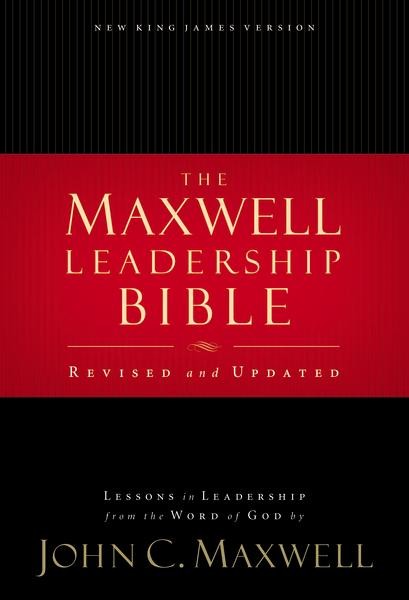
The Maxwell Leadership Bible (book review)

Hands-down the best book for any aspiring, developing, or seasoned leader is the Bible! John Maxwell is a mentor of leaders that I have come to greatly appreciate over the years of my leadership development. So having John Maxwell’s commentary accompany my daily Bible reading time has been a  huge blessing! You can find this complete leadership development package in The Maxwell Leadership Bible.

The Bible is filled with leadership principles given by God Himself. John Maxwell is helping me compile various principles throughout the entirety of the Bible into cohesive units of study.

The Bible also presents us with various people who followed or violated God’s leadership principles. We are able to see the struggles that come to those who either ignore God’s directives or don’t consistently follow through on them. And we’re able to see the legacy of success that follows those who make it a priority to consistently walk in God’s precepts. Once again, Maxwell is brilliant at identifying these leadership lessons.

Normally I post reviews after I have read an entire book, but given the fact that my Bible reading time is in-depth and time-consuming, I wanted to post a review now to encourage Christian leaders to take advantage of this wonderful resource. If you want to use the Bible to grow your leadership capacities, the commentaries and insights provided by John Maxwell will be a huge blessing to you.

P.S. I am reading The Maxwell Leadership Bible on the Kindle version. I find it very convenient to tap on the footnotes, character studies, and leadership lessons that John Maxwell has prepared, and then quickly tap back to the biblical passage right where I left off.

The Power That Comes After Delegation

I gave charge of Jerusalem to my brother Hanani, and Hananiah the leader of the citadel… (Nehemiah 7:2).

Good leaders delegate.

The project of rebuilding the walls around Jerusalem and hanging the doors had been completed, so it was time for Nehemiah to move to the next assignment God had for him.

To keep the momentum going which he had started, Nehemiah picked two trusted men:

  1. Hanani—his brother, who had previously visited Judah and brought back a faithful report about the condition of Jerusalem.
  2. Hananiah—a “man of integrity” and most importantly a man who “feared God more than most people do.”

These are good men that can carry on for Nehemiah. Nehemiah started the project, brought it to completion, and now new leaders are needed to keep the momentum going.

Notice that it is after completing the project and then delegating to new leaders that Nehemiah writes, “Then my God put it into my heart” to take on a new project (v. 5).

A mark of a godly leader is one who appropriately delegates so that he can receive God’s new assignment.

This is Part 9 in my series on godly leadership. To read my other posts, please click here.

A Leader’s Grace And Power

None of them could stand against the wisdom and the Spirit with which Stephen spoke. (Acts 6:10)

Here’s a truth we can all stand on: The man with an experience is never at the mercy of a man with an argument.

A large group of people wanted to debate with Stephen about his belief in Jesus Christ. I’m sure that these debaters had some excellent points. But they couldn’t win the debate with Stephen because he had something they didn’t have: grace and power from God that was irrefutable!

Stephen’s words were backed up and verified by a lifestyle that was undeniable—

Stephen, a man full of God’s grace and power, performed amazing miracles and signs among the people. But one day some men from the Synagogue of Freed Slaves, as it was called, started to debate with him. They were Jews from Cyrene, Alexandria, Cilicia, and the province of Asia. None of them could stand against the wisdom and the Spirit with which Stephen spoke. (Acts 6:8-10)

“Knowing that we have God’s ability in us, should give us the confidence to lead well when others don’t approve of or appreciate our leadership.” —Liz Sarno

A mark of a godly leader is one who demonstrates God’s grace and power that is within him.

This is Part 8 in my series on godly leadership. To read my other posts, please click here.

Tuning Out Enemies

“…they thought to do me harm”Nehemiah

Nehemiah had enemies on almost every side as he attempted to complete his work (the rebuilding of the wall around Jerusalem). Check out his enemies’ strategy and his response to them—

Enemy’s tactic #1—Get Nehemiah preoccupied with attending meaningless meetings.

Nehemiah’s response—“I’m doing a great work; I can’t come down. Why should the work come to a standstill just so I can come down to see you?”

Enemy’s tactic #2—Send out letters slandering Nehemiah.

Nehemiah’s response—“There is no truth in any part of your story. You are making up the whole thing.” Then he prayed, “God, give me strength.”

Enemy’s tactic #3—Try to scare Nehemiah into running away.

Nehemiah’s response—“Should someone in my position run from danger? I know that God wouldn’t like that.”

Nehemiah had a vision from God and he stayed focused on that.

  • It determined his priority
  • It set his daily agenda
  • It gave him discernment
  • It gave him courage

The result: “When all our enemies heard [that we had completed our project]…they were frightened and humiliated. They realized this work had been done with the help of our God.”

A mark of a godly leader is one so focused on God’s plan that he pays no attention to his critics or enemies.

This is Part 7 in my series on godly leadership. To read my other posts, please click here.