[6:30] Efficiency and effectiveness don’t have to compete with each other
[7:11] Quality is never an accident
[7:50] Greg shares a helpful list of three items, but to stay on track you can only pick 2-of-the-3
[8:45] What distracts us from pursuing quality?
[10:00] Both quality and quantity have their places, but the leader needs to determine which one takes the priority
[10:47] Greg shares a comical conclusion he made after overhearing a break room conversation
[12:27] Why do leaders find security in “more”?
[13:55] There is one key place where quantity should probably come first
[14:48] Numbers are easy to use to measure quantity, but quality is much harder to measure
[16:38] An important lesson for leaders
[18:14] A leader’s words need to be more qualitative than quantitative
[19:15] Our coaching huddle clients get both quantity and quality
Check out this episode and subscribe on YouTube so you can watch all of the upcoming episodes. You can also listen to our podcast on Spotify and Apple.
Listen to the podcast of this post by clicking on the player below, and you can also subscribe on Apple, Spotify, or Audible.
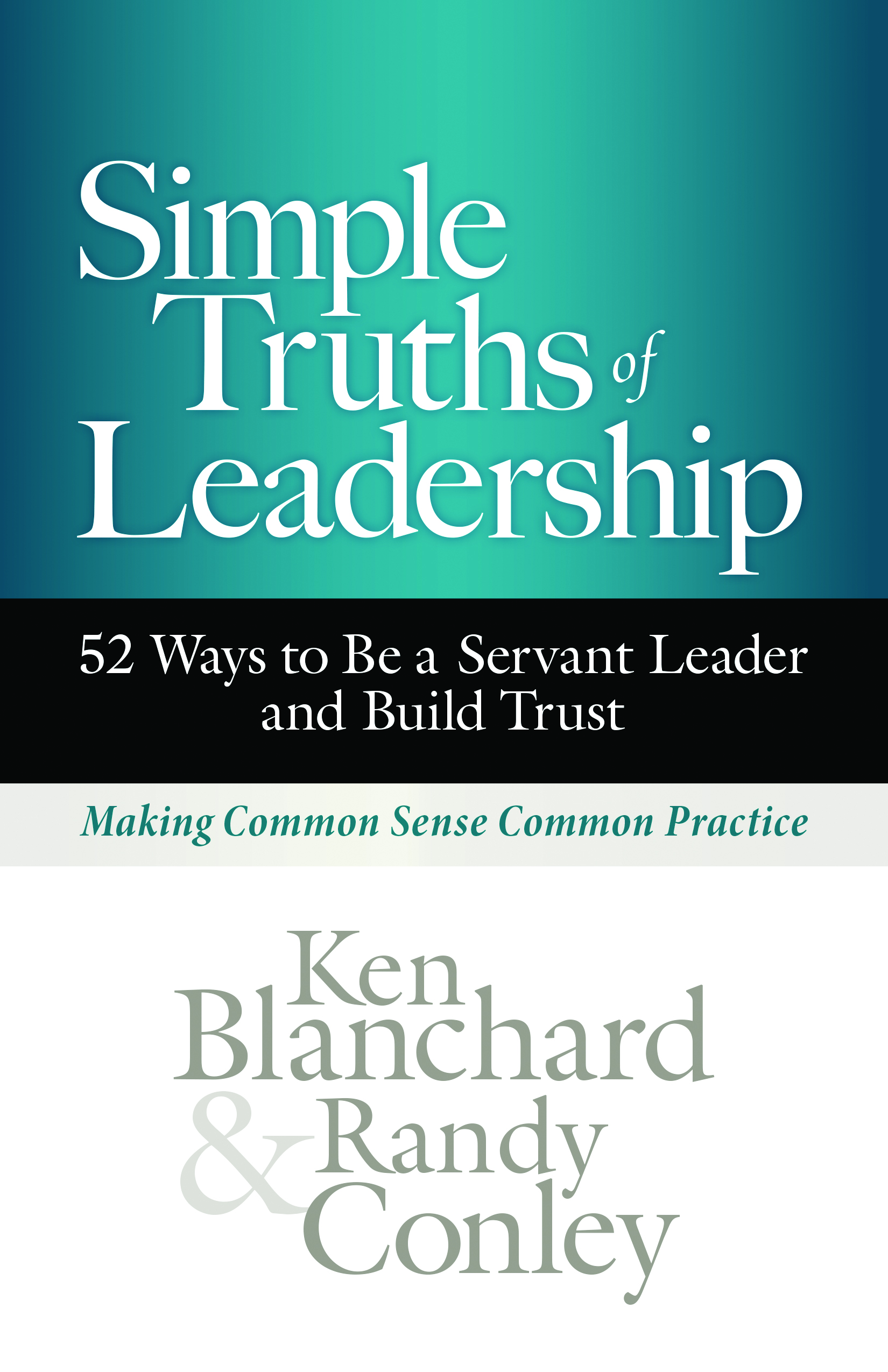
Kenneth Blanchard cranks out the leadership books! What I love about his writing style is how he makes his leadership principles so accessible in just a few words. Most of his books contain an overarching concept that’s easy to grasp and immediately applicable. But Simple Truths Of Leadership, which he co-wrote with Randy Conely, is a slight departure from this predictable style.
Simple Truths—as its title implies—still presents easy-to-grasp principles, but this book has a different feel to it. I think the best way I can describe this book is as an index to Blanchard’s earlier leadership books.
The overall emphasis of this book is servant leadership, with all of these simple truths being presented to us in 52 snippets. Each snippet gives the reader more than enough information to get to work, but then there is a reference given to a book previously written or co-written by Kenneth Blanchard to allow for a deeper study of that principle. This is why the overall feel of this book is as an index to the other books.
Whether you’ve read Kenneth Blanchard’s leadership books before, or if this is your first time picking up something he’s written, Simple Truths is a great book to add to your leadership library.
Listen to the podcast of this post by clicking on the player below, and you can also subscribe on Apple, Spotify, or Audible.
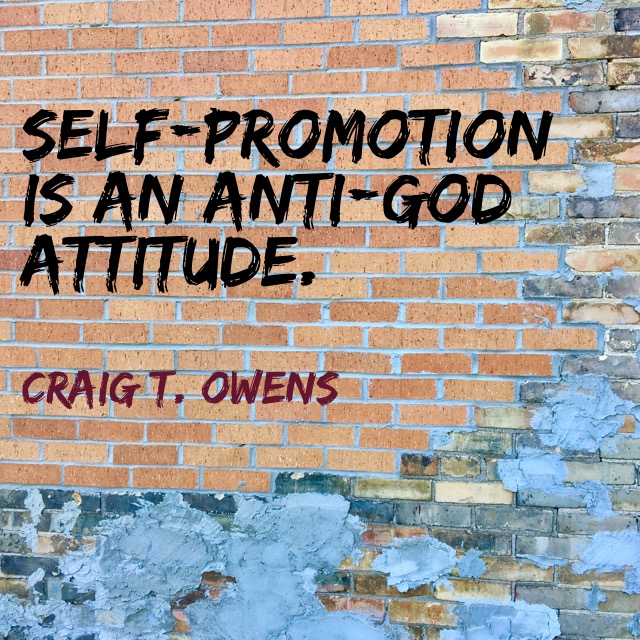
My book Shepherd Leadership: The Metrics That Really Matter opens with a chapter ‘The Wrong Ladder.’ This chapter is a reminder that we don’t have to figure out which ladder to climb in order to be successful. The last chapter of my book is entitled ‘Applause,’ which begins with the words, “Self-promotion is an anti-God attitude.”
Often we see God taking obscure people and vaulting them to a position of prominence. Sometimes they will remain in that position until the day they die, and sometimes God will remove them after a rather short period of time.
God prepares people, God promotes people, and God removes people as He sees best.
This is never more true than in the story of Daniel. “So Daniel prospered during the reign of Darius and the reign of Cyrus the Persian” (Daniel 6:28). In fact, for most of Daniel’s life, he is in a prominent leadership position. Daniel prospered, but he did so because God promoted him. Daniel never sought a position, and even if he was removed from a position, he didn’t try to retain it nor regain it.
Daniel knew God was in control, and he trusted His timing.
I’ve been sharing a series of leadership lessons from the life of Daniel with my Patreon supporters. Check out this brief clip from a lesson I entitled “No Self-Promotion.”
If you are a Christian leader, I challenge you to stop polishing up your résumé. Whether you have a résumé that looks great or not, God will still place you where He needs you, when He needs you to be there. Remember: “Self-promotion is an anti-God attitude.”
Check out this episode and subscribe on YouTube so you can watch all of the upcoming episodes. You can also listen to our podcast on Spotify and Apple.
Listen to the podcast of this post by clicking on the player below, and you can also subscribe on Apple, Spotify, or Audible.
I once knew a businessman who was one of the most silver-tongued talkers I have ever met! He could persuade just about anyone to join him in one of his “can’t miss” business ventures.
And even after they did miss (which was all of them that I was aware of) he could still convince many of his backers to continue. I never knew him to fulfill what he had promised.
Eventually, this caught up with him. And so did the law, and he ended up serving a prison term.
It has always been intriguing to me how much value we put on the words of leaders. It seems as if they can “talk a good game,” we feel a need to exalt them to a higher level. It’s not the one who gets things done, or the one who has the best ideas, or the one who can bring increased efficiency or effectiveness, but the one who can talk the most convincingly.
I think about in my own profession as a pastor. Churches will select a pastor based on how he sounds from the platform. And yet the sermon is only a tiny fraction of a pastor’s work each week.
The danger comes when the leader thinks that his highest value to the organization is the words he speaks. Inevitably, then, he will put more effort into what he says than into what he does. He will spend a lot of time figuring out the right words to say, and how to move people’s hearts.
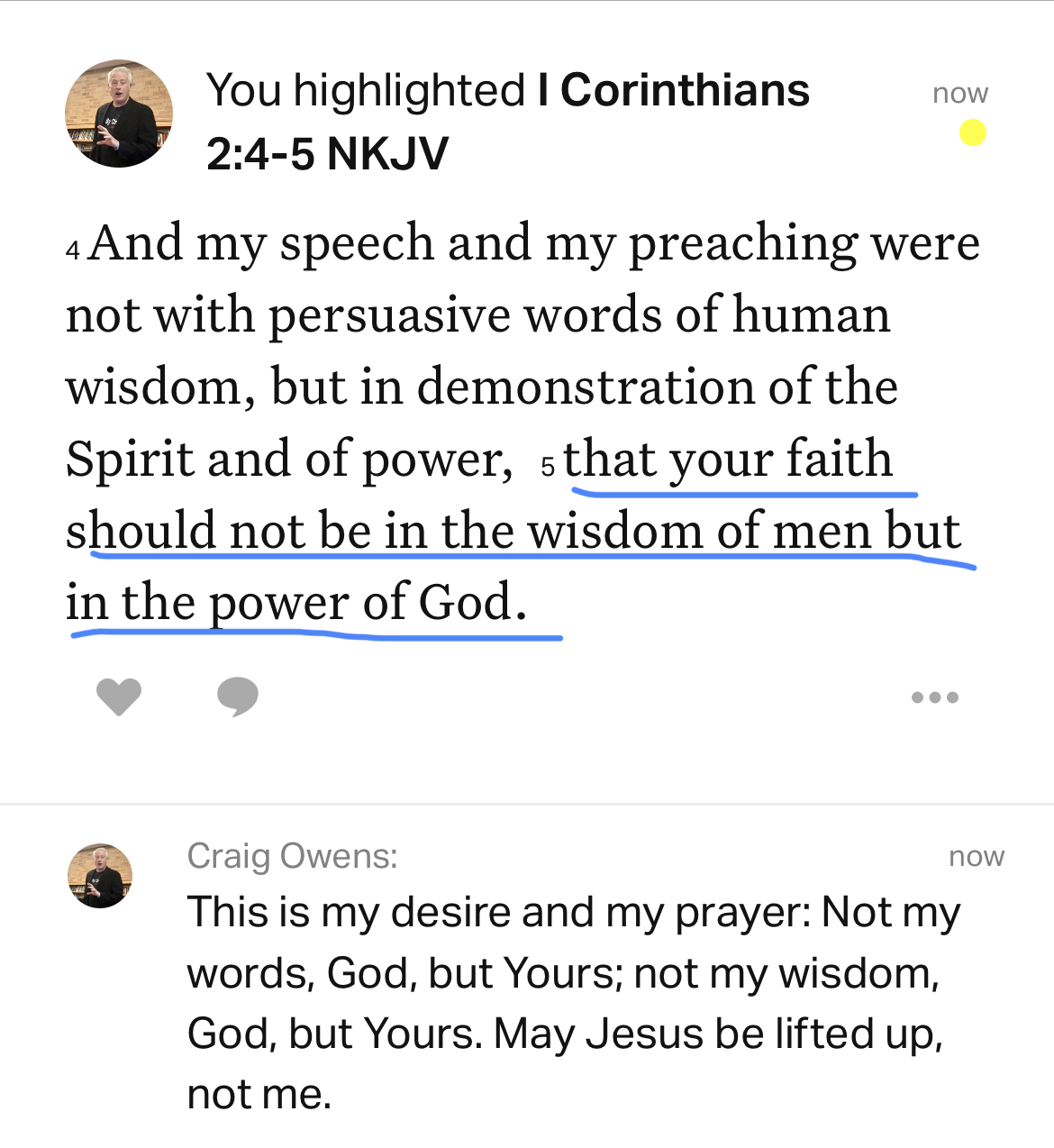
The apostle Paul told the Christians at Corinth, “My speech and my preaching were not with persuasive words of human wisdom” (1 Corinthians 2:4). And he told the Christians at Thessalonica, “For you remember what we taught you by the authority of the Lord Jesus” (1 Thessalonians 4:2), not Paul’s own authority.
I don’t want people to be impressed with me. I don’t want my authority to come from my vocabulary. I simply want to be known for speaking the Word of God, and then living a life that matches the Word of God.
As King Solomon said, “A truly wise person usesfew words” (Proverbs 17:27). The wisest words are not mine but God’s. Then “your faith [is] not in the wisdom of men but in the power of God” (1 Corinthians 2:5).
Words do have their place. But let’s always make sure that that place isn’t in place of God’s Word.
Listen to the podcast of this post by clicking on the player below, and you can also subscribe on Apple, Spotify, or Audible.
King Solomon nailed it pretty succinctly with this verse: Dead flies putrefy the perfumer’s ointment, and cause it to give off a foul odor; so does a little folly to one respected for wisdom and honor. (Ecclesiastes 10:1)
As a Christian leader, I always have mixed emotions when I hear of another prominent Christian leader who has stumbled. Part of me is angry because I know that all Christian leaders will get painted with the same brush. Another part of me is incredibly sad to hear of a brother or sister who has squandered the trust that was placed in them. Finally, part of me becomes quite self-reflective, because I don’t want to repeat their mistakes.
Tom Peters said, “There are no minor lapses of integrity.” King Solomon would agree. And so do I.
Godly leadership can be such a beautiful thing, but just a couple of dead flies can putrefy the whole thing!
Here are four things that I have seen in the lives of those leaders who haven’t finished well. These are the things all of us need to watch carefully in our own lives.
(1) They compromised in “the little things.” None of them started off by saying, “I’m going to completely ruin my reputation as a godly leader.” But they allowed themselves to indulge in things that were just “little things” in their minds. Perhaps they thought, “It won’t hurt if I indulge in this one little thing.” The apostle Paul warns us, “So, if you think you are standing firm, be careful that you don’t fall!” (1 Corinthians 10:12).
(2) Pride crept in. They thought they were better than others. Peter said it this way: “All of you, clothe yourselves with humility toward one another, because, ‘God opposes the proud but shows favor to the humble’” (1 Peter 5:5). I addressed this topic in my book Shepherd Leadership: The Metrics That Really Matter like this—
Did you catch that? God stands back from the proud person who will not admit his error nor ask for help, let alone ask for forgiveness. On the other hand, God lavishes His grace on the humble one who admits both his error and his need for help. Admission of an inappropriate action or reaction brings God’s help!
Friends, the mark of a maturing shepherd is not one who never misspeaks or never makes a mistake. No, the mark of a maturing shepherd is the one who is closing the gap between his mess up and his confession.
Pride will keep us from confessing the “little sins” and keep us from God’s help. But humility quickly admits the smallest of slip-ups and therefore receives God’s grace and help.
(3) They lowered their standards. If anything, leaders should raise their standards as they become more successful. Think of it this way: when I was young and immature, I didn’t give much thought to my diet or my exercise routine. As I became older (and hopefully more mature), I became much more tuned-in to these things. Physically, the older I get, the more I need to pay attention to my health. The same thing is true in our leadership: maturity should lead to higher standards and higher levels of scrutiny.
(4) They stopped listening to others. The combination of little compromises, pride, and lowered standards doesn’t easily invite accountability nor transparency. The track record is pretty consistent among those who have fallen short: they stopped listening to people who tried to correct them.
I want to finish well. I don’t want a leadership stumble in my life to rob God of glory, nor to cause others to stumble in their Christian walk. I am committed to living my life in a way that will allow Jesus to say to me at the end, “Well done, good and faithful servant.”
I pray that all Christian leaders will join me in this.
Check out this episode and subscribe on YouTube so you can watch all of the upcoming episodes. You can also listen to our podcast on Spotify and Apple.
Listen to the podcast of this post by clicking on the player below, and you can also subscribe on Apple, Spotify, or Audible.
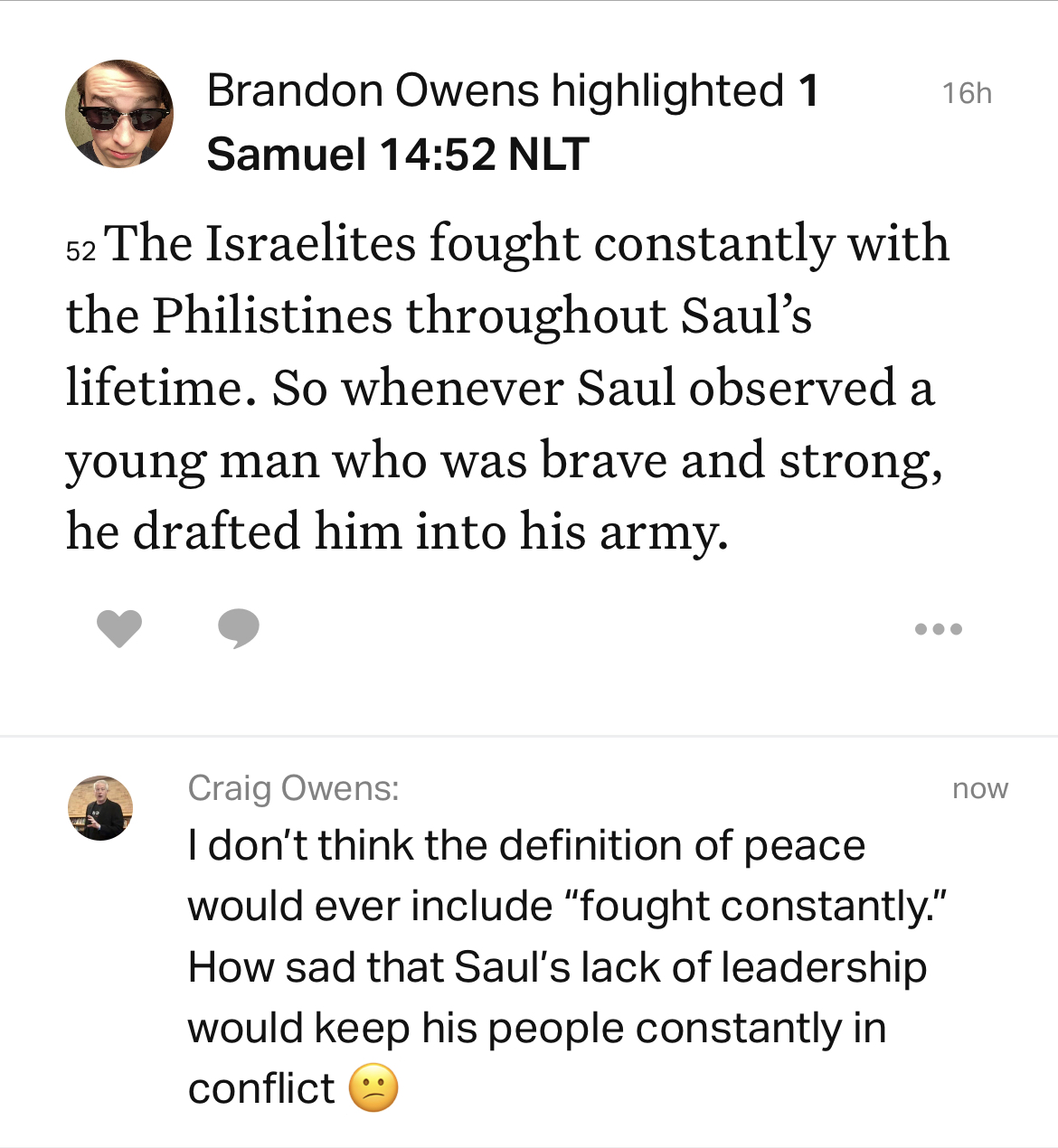
The Israelites fought constantly with the Philistines throughout Saul’s lifetime… (1 Samuel 14:52).
Have you ever worked in a hostile environment? I was involved with one organization where all of the staff members called the weekly meeting the “staff beating” instead of the staff meeting. This was largely because the senior leader started off every meeting by asking for problems that needed to be addressed, but then he “addressed” the problem by attacking the person who shared the problem.
I was reminded of this recently when I was scrolling through YouVersion and saw that my son had highlighted 1 Samuel 14:52 that said that Saul’s reign as king was noted for the constant fighting. I added the comment, “I don’t think the definition of peace would ever include ‘fought constantly.’ How sad that Saul’s lack of leadership would keep his people constantly in conflict.”
Make no mistake about it: It was his poor leadership that created this environment. We often read of his jealousy of anyone else who was successful, and we see that although he had a loyal army, he kept them bottled up.
On the other hand, consider this statement about the reign of king Asa: “In his days the land was quiet for ten years. … He had no war in those years, because the Lord had given him rest” (2 Chronicles 14:1, 6). This peace and quiet and rest is directly tied to Asa’s obedience to God’s laws.
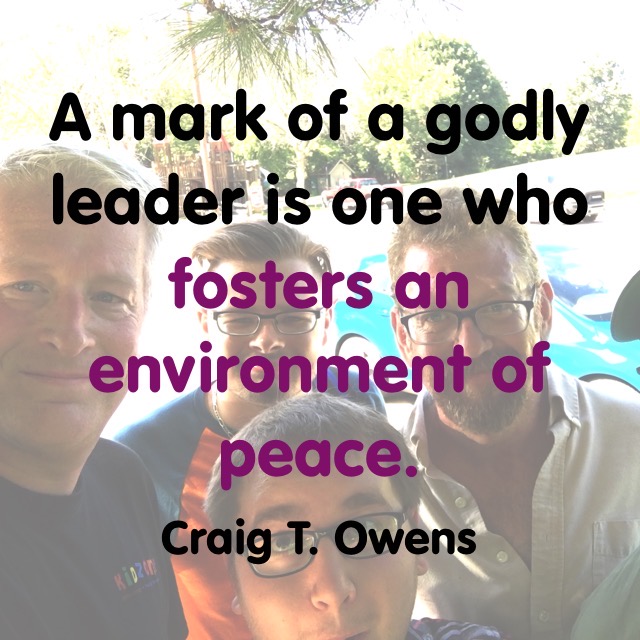
A mark of a godly leader is one whose obedience to God fosters an environment of peace for his people.
This is part 62 in my series on godly leadership. You can check out all of my posts in this series by clicking here. And I would also encourage you to check out my book Shepherd Leadership: The Metrics That Really Matter, where I outline in more detail the characteristics of godly leadership.
Listen to the podcast of this post by clicking on the player below, and you can also subscribe on Apple, Spotify, or Audible.
I had a great time on the Thriving In Ministrypodcast with Kyle Willis and Dace Clifton.
Their podcast is all about helping pastors avoid burnout. That’s definitely a message that resonates with my heart too! Long before I stepped into the pastorate, I was actively involved in encouraging pastors and helping protect them from the many slings and arrows that get thrown at them.
Pastors, we need to remain healthy. Only healthy shepherds can create a healthy environment for the sheep under their care. Jesus not only gave us the example for mental, physical, spiritual, and relational health, but the Holy Spirit wants to help us today to be that kind of wholly healthy leader.
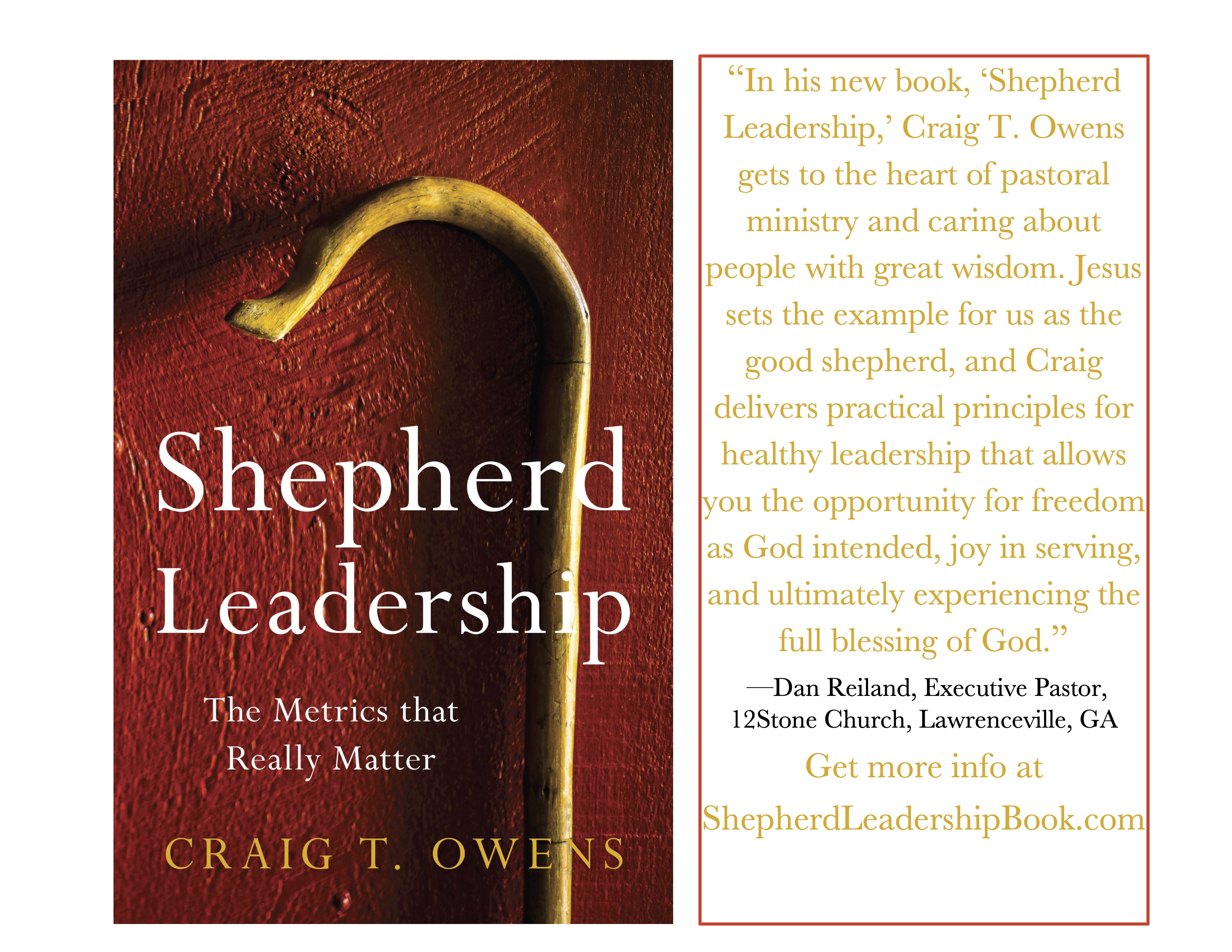
If you’re a pastor, I believe you will be energized by reading or listening to my book. Shepherd Leadership: The Metrics That Really Matter is available in print or ebook, and in audiobook through either Audible or Apple.
If you love your pastor, get a copy to give as a gift. If you believe that your pastor would benefit from reading my book, but you don’t have the funds available to purchase it at this time, please leave me a comment below and I’ll make sure I get a copy to you.
It takes everyone in the Body of Christ being actively involved for both the shepherd and sheep to remain healthy!
If you’ve missed any of the other clips I’ve shared from this interview, please check them out here:
[1:52] Does your empowerment show people you trust them?
[4:00] Craig tells a story about how the best mentors hold up a mirror.
[6:15] Do you believe you’re in-power, or do you empower?
[7:28] The guys talk about Patrick Lencioni’s leadership books.
[8:23] What is a habit that holds back a leader from empowering?
[10:27] Is your leadership trustworthy?
[12:10] Insecurity kills empowerment
[12:51] Getting Naked!!
[14:15] Are you admitting your mistakes first?
[14:50] Are you self-aware about what’s holding you back from empowering others?
[16:34] What is the difference between delegation and empowerment?
[17:45] Craig and Greg challenge leaders on examining their empowerment of others.
Check out this episode and subscribe on YouTube so you can watch all of the upcoming episodes. You can also listen to our podcast on Spotify and Apple.



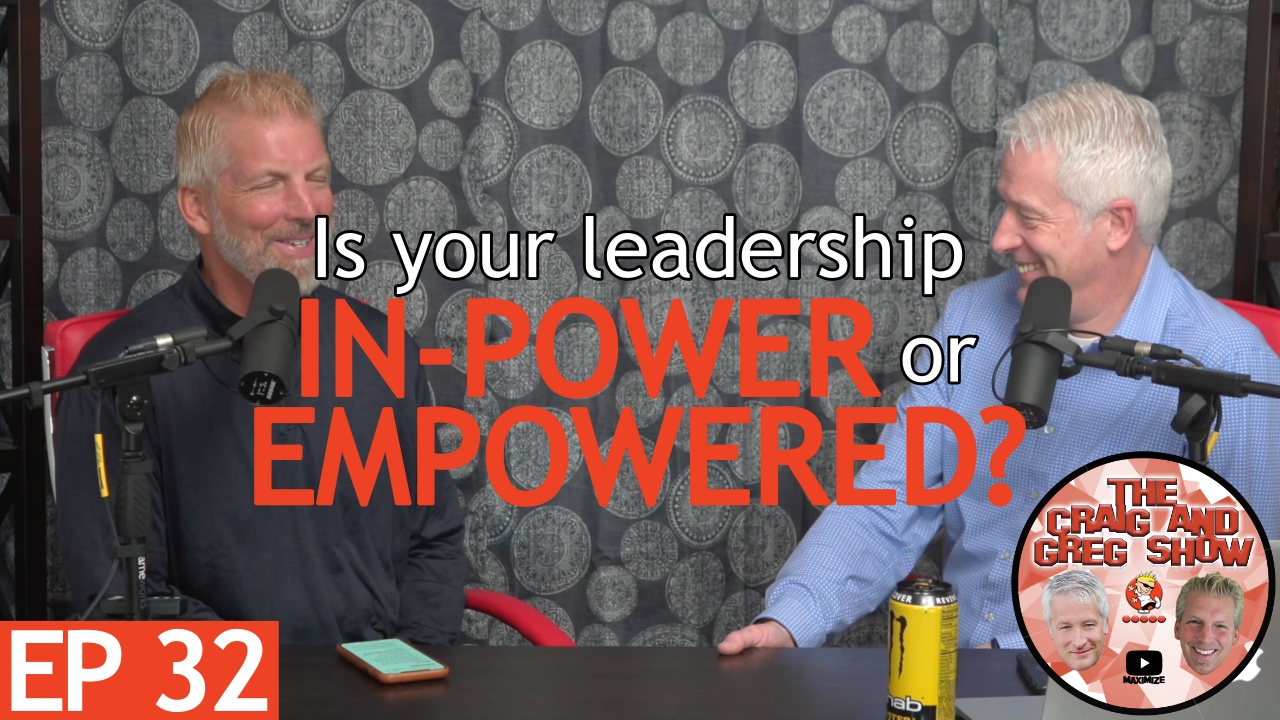
 On this episode of “The Craig And Greg Show” we talk about: