Links & Quotes

T.M. Moore wrote, “It’s not likely John the Baptist would be welcomed in many pulpits today. Even though Edwards used him as a model of ‘The True Excellency of a Gospel Minister,’ few and far between are the shepherds today who would even think of adopting his example.

“Edwards wrote, ‘He also shone bright in his conversation, and his eminent mortification and renunciation of the enjoyments of the world; his great diligence and laboriousness in his work, his impartiality in it, declaring the mind and will of God to all sorts without distinction; his great humility, rejoicing in the increase of the honour of Christ, though his honour was diminished, as the brightness of the star diminishes as the light of the sun increases; and in his faithfulness and courage, though it cost him his own life.’

“These days many pastors secure their ‘honor’ in subtle but significant ways. They go by ‘Reverend’ or ‘Doctor.’ Have reserved parking places and their name on the church sign. Adopt fashionable garb and speech. Try hard to be friends with all the right people. Such shepherds want to advance their honor; John worked to have his honor diminished, that the honor of Christ might increase.”

I share T.M.’s passion for shepherd in the Church, which is why he graciously wrote an endorsement for my book Shepherd Leadership: The Metrics That Really Matter.

Vaughn Shoemaker (1902-1991) was an American editorial cartoonist. He won the 1938 and 1947 Pulitzer Prizes for Editorial Cartooning for his work with the Chicago Daily News. He was the creator of the character, John Q. Public, and a faithful Assemblies of God layman. I am a fourth-generational Pentecostal in the Assembly of God fellowship, so I love studying more about the men and women who have made this such a robust missions-minded fellowship! Read more of this amazing man here.

Dan Reiland has an important list for leaders: 11 Leadership Mistakes To Avoid At All Costs.

This is a radical call for us to look hard at our present lives to see if they are shaped by the hope of the resurrection. Do we make decisions on the basis of gain in this world or gain in the next? Do we take risks for love’s sake that can only be explained as wise if there is a resurrection?” —John Piper

“Jesus will do the things we ask for if they make God’s greatness known. So how do we ask this way? We must ask from right relationships (Mark 11:24-25, 1 Peter 3:7), with right motives (James 4:3, Proverbs 16:2), through right living (James 5:16, Proverbs 15:29), in good faith (James 1:6-7), according to His will (1 John 5:14-15). In short, if you think Jesus would put His name on it, and it will make His Father famous, then ask and believe! But remember, we’re here for Him—He’s not here for us.” —Craig Groeschel, in Twisted 

For parents and anyone else who works with students, this is a segment from the Axis ministry’s Culture Translator newsletter:

In his book Man’s Search for Meaning, Viktor Frankl writes that “success, like happiness, cannot be pursued; it must ensue, and it only does so as the unintended side-effect of one’s personal dedication to a cause greater than oneself… Happiness must happen, and the same holds for success: you have to let it happen by not caring about it.”

An idea like that would likely seem counterintuitive to many of the students in Professor Santos’ classes—students who have been raised from young ages to pay careful and constant attention to their academic viability. Students like these grow up with a hope and an expectation that achieving perfection (whether academic, relational, spiritual, or other) will finally yield the happiness, satisfaction, and recognition they’ve been looking for. But after achieving perfection, the next source of anxiety is maintainingperfection. As Christopher Fry once put it, “What, after all is a halo? It’s only one more thing to keep clean.”

Jesus concludes Matthew 5 by saying to his hearers, “Be perfect, therefore, as your heavenly Father is perfect.” It’s a verse most Christians may not want to touch, and one that anxious overachievers might point to as justification for their continual striving. But as C.S. Lewis points out in Mere Christianity, Jesus’ words presuppose our dependence on Him. He writes, “The command Be ye perfect is not idealistic gas. Nor is it a command to do the impossible. He is going to make us into creatures that can obey that command… The process will be long and in parts very painful, but that is what we are in for. Nothing less. He meant what He said.”

In other words, our betterment is in partnership with our Creator, and happiness is merely a by-product of our total surrender. Whoever has ears, let them hear.
Judgment Must Start With The Leader

Listen to the podcast of this post by clicking on the player below, and you can also subscribe on AppleSpotify, or Audible. 

Ezekiel 9 is a sobering chapter for anyone, but especially for those in leadership. Listen to the opening verses—

Then I heard [God] call out in a loud voice, “Bring the guards of the city here, each with a weapon in his hand.” And I saw six men coming from the direction of the upper gate, which faces north, each with a deadly weapon in his hand. With them was a man clothed in linen who had a writing kit at his side. They came in and stood beside the bronze altar.

Now the glory of the God of Israel went up from above the cherubim, where it had been, and moved to the threshold of the temple. Then the LORD called to the man clothed in linen who had the writing kit at his side and said to him, “Go throughout the city of Jerusalem and put a mark on the foreheads of those who grieve and lament over all the detestable things that are done in it.”

As I listened, He said to the others, “Follow him through the city and kill, without showing pity or compassion. Slaughter old men, young men and maidens, women and children, but do not touch anyone who has the mark. Begin at My sanctuary.” (Ezekiel 9:1-6)

It is no small thing to be called a leader. God calls leaders and expects them to represent Him well in their leadership assignment. That’s why God’s judgment always starts with those who are called by God to be leaders. 

It starts with me. 

Why? Because as a leader goes, so go the people. The smallest of sins that the leader tolerates in his own life give license to the people to sin even more. So it is right that God’s judgment begins at the top. It is right that God’s judgment on leaders be even more severe (James 3:1). 

Ezekiel reports that God’s glory moved from the temple to the east gate, and then from the east gate to the mountain outside the city (9:3; 10:4, 18-19; 11:23). God was still speaking clearly and distinctly (10:5), but the leaders were so blinded by their sin that they neither noticed God’s glory moving away from them and repented of their sin, nor did they call the people to repentance. 

The only ones who were spared from God’s judgment where those who were grieving and lamenting all the sins of the city. 

If God is going to continue to use me as his leader—if He is going to give me His Word to speak to others—I must be sensitive to His searching of my heart. I must grieve over my own sin first and repent from it. Then I must be a willing servant to speak God’s Word of both judgment and salvation to whomever He sends me. 

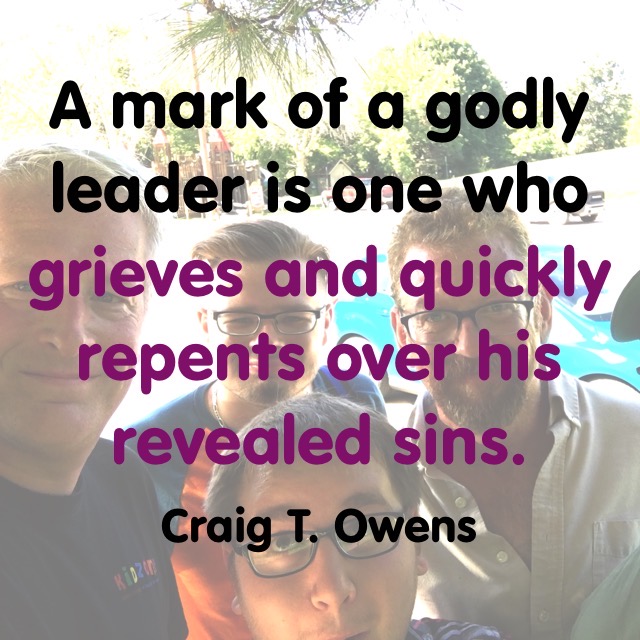
A mark of a godly leader is one who grieves and quickly repents over his revealed sins.

It starts at the top. It starts with me. Leaders must be held to the highest of standards.

I hope all godly leaders will join me in this prayer: Father God, may I be usable by You. May I be sensitive to the prompting of Your Holy Spirit, and grieve over my sins. May I be quick to repent and receive Your restoration, so that I can continue to lead other people into an intimate relationship with You. 

This is part 62 in my series on godly leadership. You can check out all of my posts in this series by clicking here.

►► Would you please prayerfully consider supporting this ministry? My Patreon supporters get behind-the-scenes access to exclusive materials. ◀︎◀︎

Links & Quotes

“If you want to make people happy, don’t be a leader. Sell ice cream.” —Steve Jobs

“Pride is the first chapter in the book of failure. Humility is the first chapter in the book of success.” —Mark Batterson

“Great shepherds seek daily to increase in the Good Shepherd and to lead the people they serve to feed on Him and grow in His salvation.” (T.M. Moore). I share T.M.’s passion for shepherd in the Church, which is why he graciously wrote an endorsement for my book Shepherd Leadership: The Metrics That Really Matter

Sobhi Malek has an excellent prayer guide which gives weekly prayer points for Muslims. Each week you will get more insight into the mindset of our Muslim friends, a prayer, and a passage of Scripture. I encourage you to subscribe to this page so you won’t miss any updates.

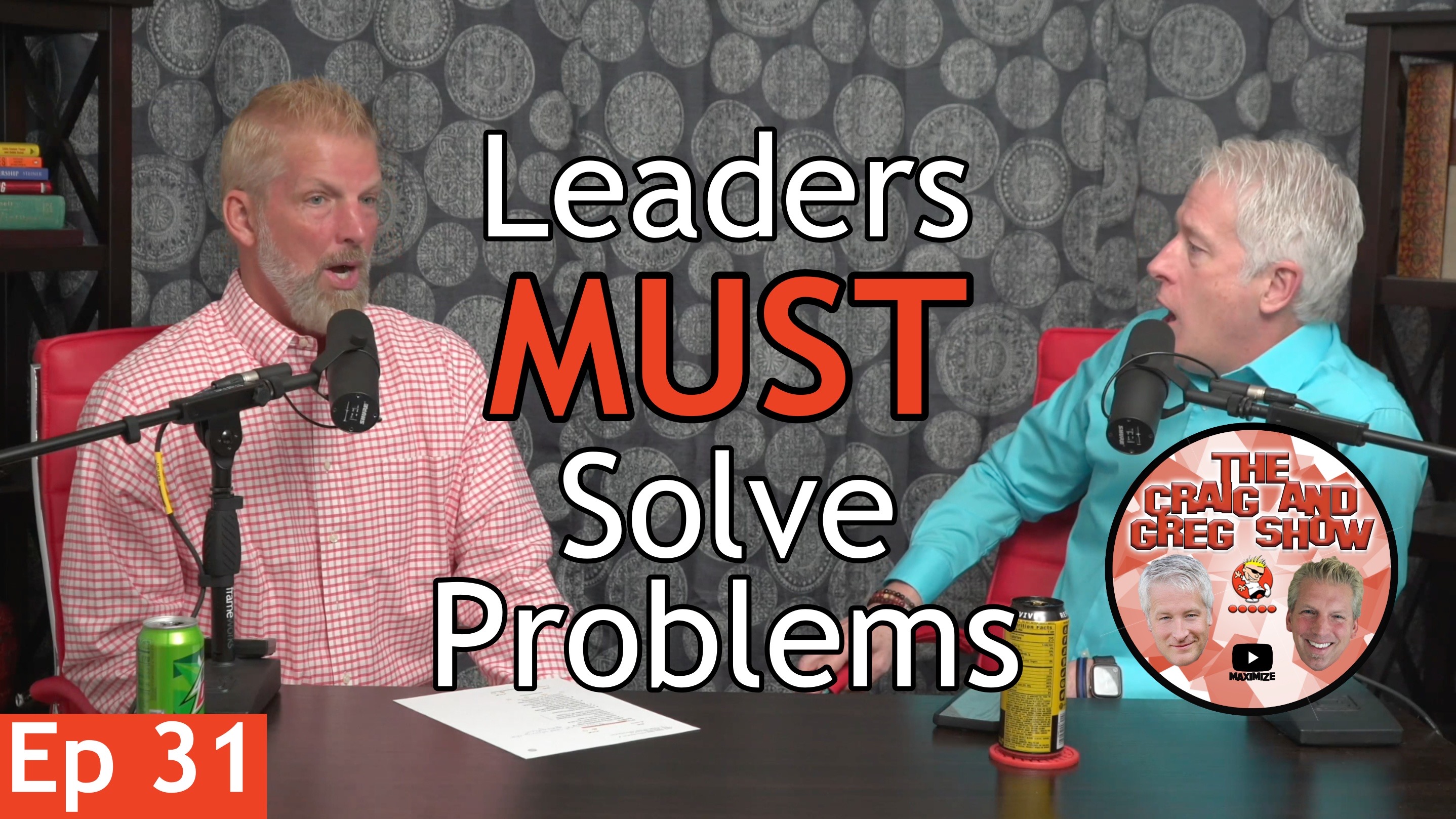
The Craig And Greg Show: The Types Of Problems Leaders Face

Listen to the audio-only version of this podcast by clicking on the player below, or scroll down to watch the video.

On this episode of “The Craig And Greg Show” we talk about: 

  • [0:54] Effective problem solving is a skill every leader should maximize
  • [1:52] Why do leaders choose to avoid problems?
  • [3:03] Greg tells a story about leadership burnout 
  • [4:46] Obvious problems are simple fixes, so don’t delay!
  • [5:57] Who can help you with your complicated problem?
  • [6:40] How should new leaders deal with problems in a transition period?
  • [8:23] What should you do about someone who’s always part of the problem?
  • [9:12] Do you have kids in your river?
  • [10:22] Are you aware of the complexities in the culture of those you lead?
  • [11:52] Leaders must address chaotic issues, no matter the cost
  • [13:16] How can leaders navigate around unchangeable facts? 
  • [14:05] Leaders should scale their response to the immediacy of the issue
  • [14:40] Is your problem obvious, complicated, chaotic, or complex?
  • [15:55] How can your changes as a leader solve problems?
  • [16:28] Do you need to move on without some people?
  • [17:20] Are you a leader of a “problem enjoyer”? 
  • [18:45] Are you asking powerful questions?
  • [20:08] How our our Coaching Huddles can help you grow

Check out this episode and subscribe on YouTube so you can watch all of the upcoming episodes. You can also listen to our podcast on Spotify and Apple.

Was Church Successful This Week?

Listen to the podcast of this post by clicking on the player below, and you can also subscribe on AppleSpotify, or Audible. 

It is quite disheartening for me to hear how many pastors contemplate their resignation on Monday morning. Just one day after pouring out their heart to their congregation, they are thinking about throwing in the towel.

I think one of the major contributing factors to this is our inaccurate measurements of success.

Far too many pastors measure success by noses and nickels: what was the attendance and what was the offering? When either of these dip, pastors tend to feel unsuccessful. 

But no where in the Bible do we see these metrics of success.

I wrote Shepherd Leadership: The Metrics That Really Matter to help ministry leaders refocus on what God calls success. If you are a pastor—or if you love your pastor—please pick up a copy today.

My book is available in print or ebook, and in audiobook through either Audible or Apple.

Links & Quotes

In 1 Timothy 3:1, Paul writes, “This is a faithful saying: If a man desires the position of a bishop [overseer], he desires a good work.” T.M. Moore commented on this verse—

“The Greek word for ‘bishop’ translates literally to ‘overseer.’ Overseers—pastors, elders, anyone in a leadership role in the congregation—is charged with watching over the souls of God’s people for good (Hebrews 13:17; Acts 20:28; 1 Thessalonians 5:12-13). While the primary duty of watching over the Lord’s flock falls on pastors and elders, all who serve with them function in a role of overseeing, that all the members of the congregation might benefit from the continuous care and shepherding of those who lead them.”

I am so grateful for T.M.’s endorsement of my book Shepherd Leadership: The Metrics That Really Matter in which I expound more on this 1 Timothy verse, and talk about how shepherd leaders should be raising up more leaders around them.

Our church purchased a building to use as our new homebase for ministry in our city. I am super excited about the possibilities!

Tiny bacteria declare loudly the genius of the Creator. This new study on the ability of bacterium to protect its own DNA from mutations is fascinating!

Dan Reiland says, “Good character takes a lifetime to build and a moment to destroy.” Dan shares 5 practices that build leadership character to last for a lifetime.

Amenhotep I was the second pharaoh of the 18th dynasty, and ruled from ca 1525-1504 BC during the time the Israelites were slaves in Egypt. Using 3-D CT scans, Amenhotep has been unwrapped for the first time in over 3000 years!

How are you supposed to follow God when obedience feels impossible? John Piper explains in this post

A Safe Place For Mistakes

Listen to the podcast of this post by clicking on the player below, and you can also subscribe on AppleSpotify, or Audible. 

Josh had just graduated from high school when I came to pastor in Cedar Springs. As I sat with this outstanding young man I asked him what he wanted to do next. 

“I’m not exactly sure,” he told me, “but I really feel like it’s something involved with ministry.” 

“Great!” I responded. “Let’s start experimenting.” 

I told Josh that our church was going to be a safe place to experiment: to plan new things, to try new things, to prayerfully evaluate the results, and then to use those results to plan new things. Josh jumped in right away, and over a short period of time we were eventually able to ascertain just how God had wired Josh for his niche of ministry. 

But this would have never happened without some missteps along the way. 

That’s okay. 

Leaders need to create an environment where it’s safe to make mistakes, because mistakes are a vital component of learning. 

My wife is a 3rd Grade teacher. A bulletin board in her classroom lovingly tells her students, “Our classroom is a safe place to make mistakes,” and then she gives them the keys to their successful learning. 

Leaders can help those around them grow through their mistakes by constantly reinforcing these six principles: 

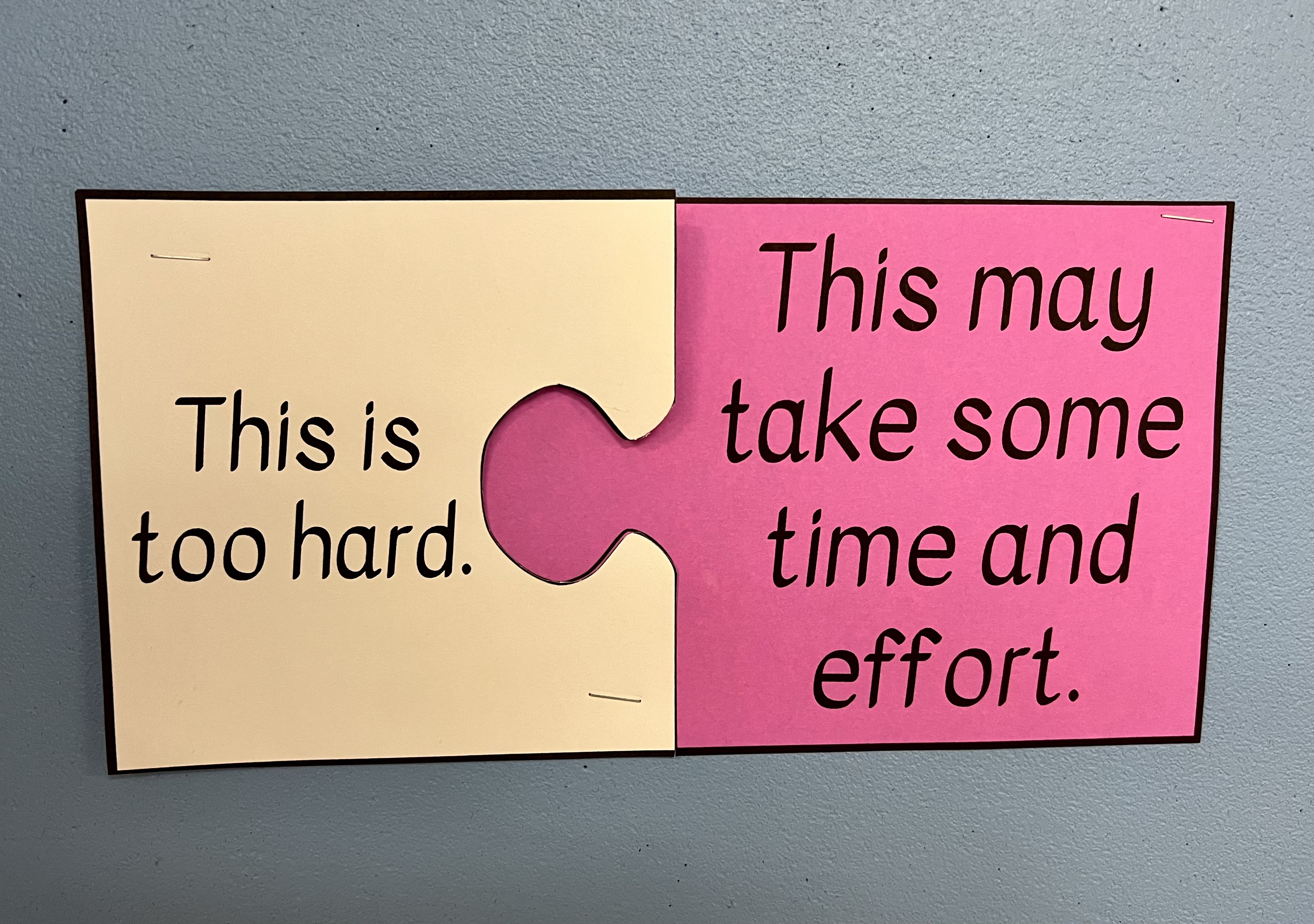
  1. When someone complains, “This is too hard,” remind them, “This may take some time and effort.” 
  2. When someone says, “I’m not good at this,” prompt them to ask, “What am I missing?” and then encourage them to add, “I’m not good at this yet.” 
  3. When someone wants to settle with, “It’s good enough,” challenge them to ask themselves, “Have I given this my best effort?” 
  4. When someone wants to throw in the towel by saying, “I made a mistake,” remind them, “I failed is not the same thing as I am a failure,” and then remind them, “Mistakes help me learn.” 
  5. When someone is exasperated and says, “I give up,” come alongside them with, “Let’s try a strategy we’ve already learned.” 
  6. When someone says, “I can’t do this,” you need to lovingly encourage them with, “You can do this!” 

These responses will help foster an abundance-mindset environment where people aren’t defeated by their mistakes, but they’re energized to reengage and try again. As the brilliant inventor Thomas Edison quipped, “I’ve had a lot of success with failure.” 

Leaders, let’s make our spaces the safest places for the mistakes that lead to discovery, growth, and success. 

►► Would you please prayerfully consider supporting this ministry? My Patreon supporters get behind-the-scenes access to exclusive materials. ◀︎◀︎

Links & Quotes

John Piper wrote to pastors, “That is the main task of preaching, and the main purpose of small groups and all the ministries of the church: helping people see the greatness of what Christ has purchased for everyone who will value it above the world. Helping people see it and savor it, so that God’s superior worth shines in their satisfaction and in the sacrifices that come from such a heart.”

“The gospel of Christ, what is it? We look at the last two words, ‘of Christ.’ Indeed, if you understand Christ, you understand the gospel. Christ is the Author of it. He, in the council chamber of eternity, proposed to become the Surety for poor fallen man! He, in the fullness of time, worked out eternal redemption for as many as His Father had given Him. He is the Author of it as its Architect and Builder. We see in Christ Jesus the Alpha and the Omega of the gospel. He has provided in the treasury of grace all that is necessary to make the gospel the gospel of our salvation. And as He is the Author of it, so He is the matter of it. It is impossible to preach the gospel without preaching the Person, the work, the office, and the character of Christ. If Christ is preached, the gospel is promulgated, and if Christ is put in the background, then there is no gospel declared.” —Charles Spurgeon

Would you prayerfully consider supporting my Patreon page at only $5 per month?

Josh McDowell addresses the question, “Did Jesus say He is God?

Marshall Seagal wrote an insightful article about patience. He notes, “Patience exists only in a world of disruption, delays, and disappointment. It grows only on the battlefield. We cannot practice patience unless our circumstances call for it—and the circumstances that call for it are the kinds of circumstances we wouldn’t choose for ourselves.”

The Biblical Archeological Report has a history of Egyptian Pharaoh Hophra that is quite fascinating. It’s always so interesting to me to watch how these archeological finds square with the historical records contained in the Bible.

3 Paradigm Shifts For Leaders

Listen to the podcast of this post by clicking on the player below, and you can also subscribe on AppleSpotify, or Audible. 

Why is it that so many people have a worst-case mindset as their guiding factor? 

As a leader responsible for programs, and large groups of people, and the financial well-being of organizations, I know that I frequently fell into this trap. When we began making plans for the future, I wanted to keep a “fallback plan” in place. I frequently found myself saying to our leadership team, “Even in the worst case scenario we can….” 

But then I realized how much vitality this was sapping from our team. 

If we as leaders want to infuse more energy and excitement in our teams it may take some paradigm shifts on our part. Here are three shifts that I have endeavored to implement in my life: 

  1. Shift scarcity to abundance. 
  2. Shift fear to hope. 
  3. Shift worst-case to best-case.

On a recent episode of our leadership podcast, my friend Greg Heeres and I discussed the limitations that come as a result of a leader’s limiting fears.

As a Christian, I believe the greatest Helper in these three paradigm shifts is the Holy Spirit. When I take time to pray about the big decisions for my personal life and for the organizations I lead, I find that His guidance helps me tap into God’s abundance, which gives me hope for the best-case scenarios to be realized. This hope in me quickly translates to hope and expectation in my team. 

Leaders, start with prayer and then try these three paradigm shifts. As the Holy Spirit transforms your heart and mind, I believe you will begin to see a greater energy and excitement in the organizations that you lead. 

Let’s stop asking, “What’s the worst thing that could happen?” and shift to asking, “What’s the best thing that could happen?” 

I would also encourage you to subscribe to The Craig And Greg Show on YouTube to hear more of our leadership-building conversations. 

►► Would you please prayerfully consider supporting this ministry? My Patreon supporters get behind-the-scenes access to exclusive materials. ◀︎◀︎

The Craig And Greg Show: A Leader’s Top Priority

Listen to the audio-only version of this podcast by clicking on the player below, or scroll down to watch the video.

On this episode of “The Craig And Greg Show” we talk about: 

  • [0:38] What are the origins of the word “priority” and why should priority be singular and not plural? 
  • [0:56] Is it true that multi-tasking increases efficiency? 
  • [2:52] Greg tells a story about shopping with his parents.
  • [3:55] Greg reminds us that the devil uses distraction as a tool.
  • [5:04] I talk about how leaders should set their first priority.
  • [6:32] Why is it so hard to invest in unavailable people?
  • [7:58] I explain how leaders can make time for their “have to” list.
  • [9:58] Greg loves “StrengthFinders” and how it helps leaders learn to work in their strength zone.
  • [10:52] We discuss the book No Is A Beautiful Word.
  • [12:42] How can leaders use the priority vs. priorities paradigm to create margin in their life?
  • [14:36] We throw out the “Not-To-Do List Challenge” for leaders.

Check out this episode and subscribe on YouTube so you can watch all of the upcoming episodes. You can also listen to our podcast on Spotify and Apple.