Outlive Your Life (book review)

When I hear “Max Lucado has a new book coming out,” I’m like a kid waiting for Christmas! And just like those kids on Christmas morning, when I received Outlive Your Life, I tore into this book, and scarcely put it down until I devoured it.

I love the concept: The impact your life makes can live on far after your physical life has ended here. To make his case, Max uses the example of Jesus’ first disciples whose dedication to spreading the Gospel of Jesus Christ has far outlived their first-century lives. Specifically, Max uses the first twelve chapters of Acts as the disciples begin this work right after Jesus has ascended back into heaven.

Max uses examples from 33 AD to show us a 2010 AD life application. What the original disciples did then, we 21st-century disciples can do now. As always, Max digs such timely truths out of the Scripture that makes it seem so relevant for today. For right now!

At the back of the book is a discussion and action guide which opens with the words, “Max wants you to do more than read about the book of Acts. He wants you to live out the twenty-ninth chapter, writing the story of the church for your generation.” I found both the discussion questions and action ideas personally challenging, and great conversation-starts for a small group or a Bible study.

It’s almost automatic that I give Max Lucado’s books an unreserved five-out-of-five stars, and this book is no exception. You’ll find so much in this book to apply to your life, your church, your ministry. And here’s another bonus: Max Lucado is giving 100% of his royalties to charities such as World Vision who are helping to make a life-changing difference in our world.

I am a Thomas Nelson book reviewer.

Others First

Listen to the podcast of this post by clicking on the player below, and you can also subscribe on AppleSpotify, or Audible.

I have a friend who has a photo album on Facebook called “Me.” The description says, “Sometimes it is just all about me.” And, sure enough, all of the pictures in that album are just her. I know her well enough to know that this is tongue-in-cheek, because she is not a self-absorbed prima donna.

Sadly, some Christian leaders exhibit the It’s-All-About-Me attitude. This really irks me, especially because we see the exact opposite characteristic in Jesus.

Let me key in on just one example from His public ministry. John the baptizer has just been martyred by King Herod. John was Jesus’ cousin. I’m not sure if you’ve ever had a loved one martyred or even murdered, but I’m sure we’ve all lost a loved one at some point. It might be a little easier to take if we saw it coming, but the sudden deaths always jar us the most. We have to have time to grieve our loss.

Jesus had all of the same emotional responses that you and I have, and He wanted some time away to grieve. He got into a boat with His disciples and headed to a remote place on the other side of the lake. Looking for a little time alone to grieve the death of His cousin, Jesus was met by a huge crowd. He would have been perfectly justified in saying, “Not today.” Or even in saying, “I’m going to let My disciples pray with you today.” Instead, Jesus put the needs of others first.

  • Jesus healed all who were sick
  • He taught them
  • Then He provided food for the nearly 10,000 people who were there
  • After the meal, Jesus sent His disciples (who also needed some grieving time) back across the lake without Him
  • Jesus stayed behind and dismissed the entire crowd. I sort of imagine Him hugging people, shaking hands, and continuing to listen to the questions and concerns of everyone

It was only after this that Jesus went up into the hills to spend some time alone in prayer.

Yes, leaders have to take care of themselves and their people. But good leaders take care of others first.

I unpack this idea in even great detail in my book Shepherd Leadership. If you want to be used as a leader, you must allow the Holy Spirit to cultivate this others-first attitude in you.

►► Would you please prayerfully consider supporting this ministry? My Patreon supporters get behind-the-scenes access to exclusive materials. ◀︎◀︎

Reaction Action

“Action has killed its thousands. Reaction its tens of thousands.” —E. Stanley Jones

  • Yes, he pulled out in front of you [action], but is tailgating him any better [reaction]?
  • Sure, she embarrassed you [action], but is slandering her any better [reaction]?
  • Yep, he lied to you [action], but is harboring a lifelong grudge any better [reaction]?
  • Okay, she tripped you [action], but is slapping her any better [reaction]?
  • That pastor betrayed your confidence [action], but is assassinating his character any better [reaction]?

“Vengeance is a passion to get even. It is a hot desire to give back as much pain as someone gave you. … The problem with revenge is that it never gets what it wants; it never evens the score. Fairness never comes. The chain reaction set off by every act of vengeance always takes its unhindered course. It ties both the injured and the injurer to an escalator of pain. Both are stuck on the escalator as long as parity is demanded, and the escalator never stops, never lets anyone off.” —Lewis Smedes

“But I tell you not to try to get even with a person who has done something to you. When someone slaps your right cheek, turn and let that person slap your other cheek.” —Jesus Christ

Thursdays With Oswald—God’s “Oughts”

Two of my favorite authors are C.S. Lewis and Oswald Chambers. Lewis helps me to see biblical truths in a way I’ve not seen them before. Chambers helps me live out those biblical truths differently than I’ve been living them before.

I’m working my way through the complete works of Oswald Chambers (or maybe I should say, his writings are working their way through me!), so I thought I’d share with you, my dear reader, what’s challenging me.

We’ll see how this goes, but on Thursdays, I’ll share with you something I’ve been reading and thinking about from the writings of Oswald Chambers. Sometimes I may just let the teacher speak for himself, and sometimes I may offer a thought or two of my own. As always, you are welcome to weigh in with your thoughts as well. I’m excited to share these lessons with you.

God’s “Oughts”

      Strictly speaking, there is no disobedience possible to an imperative law, the only alternative being destruction. In this sense the moral law is not imperative, because it can be disobeyed and immediate destruction does not follow. And yet the moral law never alters, however much men disobey it; it can be violated, but it never alters. Remember, at the back of all human morality stands God.

      The Ten Commandments were not given with any consideration for human ability or inability to keep them; they are the revelation of God’s demands made of men and women who had declared that if God would make His law known, they would keep it. …

      If the “Oughts” of the Old Testament were difficult to obey, Our Lord’s teaching is unfathomably more difficult. Remember, the commandments were given irrespective of human ability or inability to keep them; then when Jesus Christ came, instead of doing what we all too glibly say He did—put something easier before men, He made it a hundredfold more difficult, because He goes behind the law to the disposition.

      The purity God demands is impossible unless we can be re-made from within, and that is what Jesus Christ undertakes to do through the Atonement. … It is not a question of applying Jesus Christ’s principles to our actual life first of all, but of applying them to our relationship to Himself, then as we keep our souls open in relation to Him our conscience will decide how we are to act out of that relationship.

From Biblical Ethics

A growing relationship with Jesus = Greater sensitivity to my conscience and the Holy Spirit = Correct disposition to obey God’s laws.

Gettin’ Messy

In any culture where it exists, leprosy makes its victim an outcast. People might feel bad for the afflicted, but they quickly look away. No one invites the leper to dinner, few even go to visit the leper. Shunned, closeted away, quickly forgotten.

In every culture where it exists today, pain and suffering are treated almost like leprosy. We’ll talk about the problem, pray for the victims, form organizations to address the problem, and even give money to address the issue. But few people do more.

We feel safe at a distance.

We feel sanitized if we don’t have to touch the hurting.

We feel we’ve done our part if we throw a few dollars at it.

But not Jesus. He handled the hurting … literally.

A man with leprosy came and knelt in front of Jesus. He said, “Lord, You have the power to make me well, if only You wanted to.” Jesus put His hand on the man and said, “I want to! Now you are well.” At once the man’s leprosy disappeared.

Jesus put His hand on the man. He didn’t just pray. He didn’t give money. He didn’t organize a rally to address the problem of leprosy. He touched a hurting man.

He got messy.

He conveyed love to a hurting man like nothing else could have.

Robert Shuller wisely noted, “Being a Christian is offering yourself to Him. Your mind for Christ to think through; your heart for Christ to love through; your lips for Christ to speak through; your hands for Christ to touch through.”

What about it? Are you ready to convey the love of Christ by touching—literally—people’s problems? Nothing says “I love you” like the human touch.

Yummy

It’s noon, He’s hot and thirsty after a lengthy journey and some intense ministry, so Jesus sits down by a well to get a drink. He’s hungry too, so He sends His disciples into town to buy some lunch. Along comes a woman from the town, whom Jesus engages in conversation about eternal life. (It’s a really cool story—read the whole thing here.)

While this woman runs back into town to invite others to come hear what Jesus has to say, the disciples return with lunch.

“Here, Jesus,” they say, handing Him some food, “eat something.”

“No, thanks,” Jesus replies, “I’m not that hungry right now.”

The disciples start talking among themselves, “What? Where did He get food? Did someone bring Him something to eat?”

Jesus overhears them and makes this fascinating statement:

The food that keeps Me going is that I do the will of the One who sent Me, finishing the work He started.

What nourished Jesus was feeling the Father’s approval.

What energized Jesus was seeing other people begin to understand the Father’s love for them.

What motivated Jesus was to take every opportunity to tell someone else about God’s love.

Finishing the work that God started is good and good for you.

It’s yummy and it’s nourishing!

So I’m asking myself:

  • What nourishes me?
  • What energizes me?
  • What motivates me?
  • What is so fulfilling that I cannot go a day without it?

My prayer—my heart’s desire—is that the answer to all of these questions every single day is finishing the work of God in my generation.

What Are Rules For?

Listen to the podcast of this post by clicking on the player below, and you can also subscribe on AppleSpotify, or Audible. 

David is on the run from Saul. He leaves town so quickly that he didn’t have time to kiss his wife goodbye. He didn’t even have enough time to grab a weapon, a change of clothes, companions, or food. So he stops by Ahimelech’s house to see if this priest has any food.

Remember this old nursery rhyme?

Old Mother Hubbard
Went to the cupboard,
To give the poor dog a bone:
When she came there,
The cupboard was bare,
And so the poor dog had none.

That’s just about what happened here. Ahimelech said, “The only bread I have is the holy showbread.” This consecrated bread was 12 loaves laid out each Sabbath in God’s presence. When this bread was replaced each week, it became food for the priests. Ahimelech recognized he had a moral obligation to save David’s life which superseded the ceremonial rules.

Jesus used this incident as an example when the Pharisees accused Him of breaking the law concerning the Sabbath day. Jesus and His followers had been walking through a wheat field, plucking some pieces of grain on which they could munch. The rule-keeping Pharisees said this amounted to work, and a violation of Sabbath rules.

I think sometimes we get so caught up in keeping the rules (or following tradition, or preserving decorum) that we forget the meaning behind the rule. Or, more accurately, we forget God’s design behind the rule.

Every rule God gives is to keep us in a place where we can experience His presence. Rules are not life, but they are boundaries that keep us on the path to life.

Ahimelech kept David alive with showbread. Jesus and His disciples sustained themselves with wheat kernels. Jesus healed the sick on the Sabbath to bring life and wholeness.

Following rules just to follow rules misses the point. What is the point? Following God’s rules to find God’s heart is THE point.

So let me ask you: Do you get the point?

You may also want to check out series on God’s rules called The Love In The Law, or the post called Rules Are Overbearing—Love Never Is.

►► Would you please prayerfully consider supporting this ministry? My Patreon supporters get behind-the-scenes access to exclusive materials. ◀︎◀︎

The Lord’s Prayer (book review)

Yeah, yeah… you know about the Lord’s Prayer. Maybe you know it by heart. Maybe you pray this prayer every week at your church, or maybe even every day in your home. But do you really know the Lord’s Prayer? R.T. Kendall is about to take you on a journey of discovery that will energize this prayer like never before.

The Lord’s Prayer leads you through this powerful prayer phrase by phrase, petition by petition. Dr. Kendall calls this “the perfect prayer,” and after reading his insights, I think you will agree with him.

I know that anything I do or say time and time again can lose some of its meaning. The Lord’s Prayer is so well known that many of us can rattle it off from rote memory, almost in one breath, and never really comprehend what we’re actually praying. Dr. Kendall brings out such a depth of understanding in each phrase of this prayer, that I don’t think I will ever pray it the same way again.

For instance, I never realized the significance of even the order of the prayer. Jesus put the first thing first and then puts each following phrase in its perfect place as well. The way Dr. Kendall explains it brings out such a richness of understanding.

I could imagine this book being the perfect tool to help your personal prayer life go deeper. I can also see this book being used by a church’s prayer team to help energize their prayer times together. Whether personally or corporately, your prayer life will be greatly benefitted by this book.

I am a Chosen Books book reviewer.

Uncomfortably Quiet

Yesterday we dove into part two of our series The Stranglehold Of Worry by looking at anxiety. The medical dictionary defines anxiety as “worry compound by our own self-doubts about our ability to cope with worry.” Wow, talk about a double whammy!

You’re already worrying about something, and then you worry about what you’re worrying about!

Or for many people, anxiety boils down to worrying about what others are thinking about what you’re worrying about.

There’s a story in Luke 10 where Dr. Luke notices Martha’s anxiety. She is trying to be the best hostess she can for Jesus and His disciples, but it has gone beyond that. She is worrying about what Jesus thinks about her hospitality. She’s tied up in knots. What makes it even worse for Martha is that her sister (who was helping Martha get everything ready for the meal) is sitting at Jesus’ feet listening to Him speak.

Jesus tells Martha, “You are all worked up over trying to make a good impression. You are worried and upset. Look at Mary: she’s sitting quietly and listening to Me.”

Sitting quietly…

We don’t do that very well, do we? Our lives are bombarded with noise. In fact, when Jesus tells Martha she is worried, the Greek word means overly-busy. That’s how too many of us try to cope with worry, but the noise and busyness just lead to more anxiety.

We closed our service on Sunday in a very unusual, very uncomfortable way. We were silent. No music, no singing, no closing prayer. Just sitting silently at Jesus’ feet and listening to Him. It was uncomfortable but so beneficial.

Listen to King David:

I’ve cultivated a quiet heart. Like a baby content in its mother’s arms, my soul is a baby content.

It might be uncomfortable, but it is just what the Lover of your soul ordered. Find some time to switch off the radio, leave the mp3 player and cell phone behind, and get someplace where you can just sit quietly at Jesus’ feet and hear the loving words He has to say to you.

Anger That Crosses The Line

Last night in our Bible study we looked at some words that David penned when he was angry. He was on the run from his son Absalom, and it seemed like everywhere he turned people were after him, or slandering him, or just doing their best to make him miserable. Yet in two back-to-back Psalms David says, “I lay down every evening and get a great night of rest.”

His sweet sleep comes from a moment of reflection before dozing off. He says:

In your anger do not sin; when you are on your beds, search your hearts and be silent. Selah.

  • Did my anger today cross the line into sin?
  • Am I allowing the time for the Holy Spirit to search my heart?
  • When the Holy Spirit points out where my anger crossed the line, do I justify my anger, or am I silent?

How do we know if our anger has not crossed that line and become sin?

Aristotle wrote, “Anybody can become angry—that is easy; but to be angry with the right person, and to the right degree, and at the right time, and for the right purpose, and in the right way—that is not within everybody’s power and is not easy.”

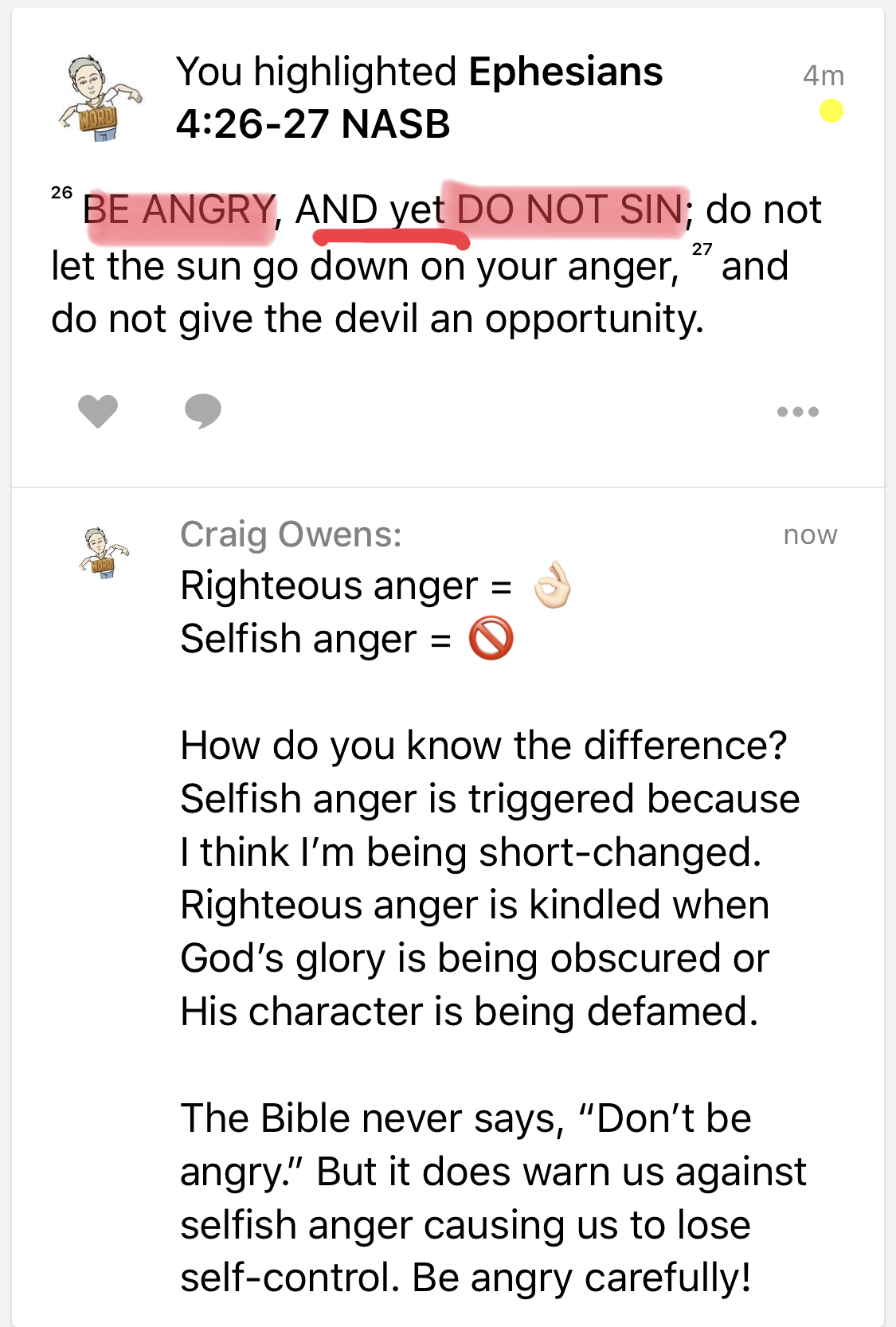
Being angry is not the issue. David said it (and Paul quoted it in Ephesians 4:26): “Be angry; just don’t sin.” God gets angry, but He does not sin. Jesus, in His public ministry, got angry, but He did not sin. We need to search our hearts to make sure our anger has not crossed the line to sin. We have to be angry in a godly way.

I see at least four ways to become angry without crossing the line into sin:

1.  Selfless Anger = anger at sin, but not angry at the sinner.

Love is not rude, it is not self-seeking, it is not easily angered, it keeps no record of wrongs. Love does not delight in evil but rejoices with the truth. (1 Corinthians 13:5, 6)

2.  Slow Anger = lengthen your fuse a bit.

Do not be quickly provoked in your spirit, for anger resides in the lap of fools. (Ecclesiastes 7:9)

My dear brothers, take note of this: Everyone should be quick to listen, slow to speak and slow to become angry, for man’s anger does not bring about the righteous life that God desires. (James 1:19, 20)

Good advice from Thomas Jefferson: “When angry, count to ten before you speak; if very angry, a hundred.”

3.  Protective Anger = when sinners entice others to join them in their sin. God is sad when people leave Him; He is angry at them when they take others with them.

But they put God to the test and rebelled against the Most High; they did not keep His statutes. Like their fathers they were disloyal and faithless, as unreliable as a faulty bow. They angered Him with their high places; they aroused His jealousy with their idols. When God heard them, He was very angry; He rejected Israel completely. (Psalm 78:56-59)

4.  Righteous Anger = against those who are keeping others from coming closer to God.

For I endure scorn for Your sake, and shame covers my face. I am a stranger to my brothers, an alien to my own mother’s sons; for zeal for Your house consumes me, and the insults of those who insult You fall on me. (Psalm 69:7-9)

This verse was recalled by Jesus’ disciples when they saw Him get angry and clear out the Temple in Jerusalem. Jesus was angry because of the religious clutter that was keeping God’s house from being a house of prayer for all nations.

I think everyone is familiar with the acrostic WWJD = What Would Jesus Do?

I’d like to propose something similar: WGGA = Would God Get Angry?

This is a great question to ask to make sure our anger does not cross that line into sin. Get angry—in a godly way—and do not sin.