When God Says “No”

Listen to the podcast of this post by clicking on the player below, and you can also subscribe on AppleSpotify, or Audible. 

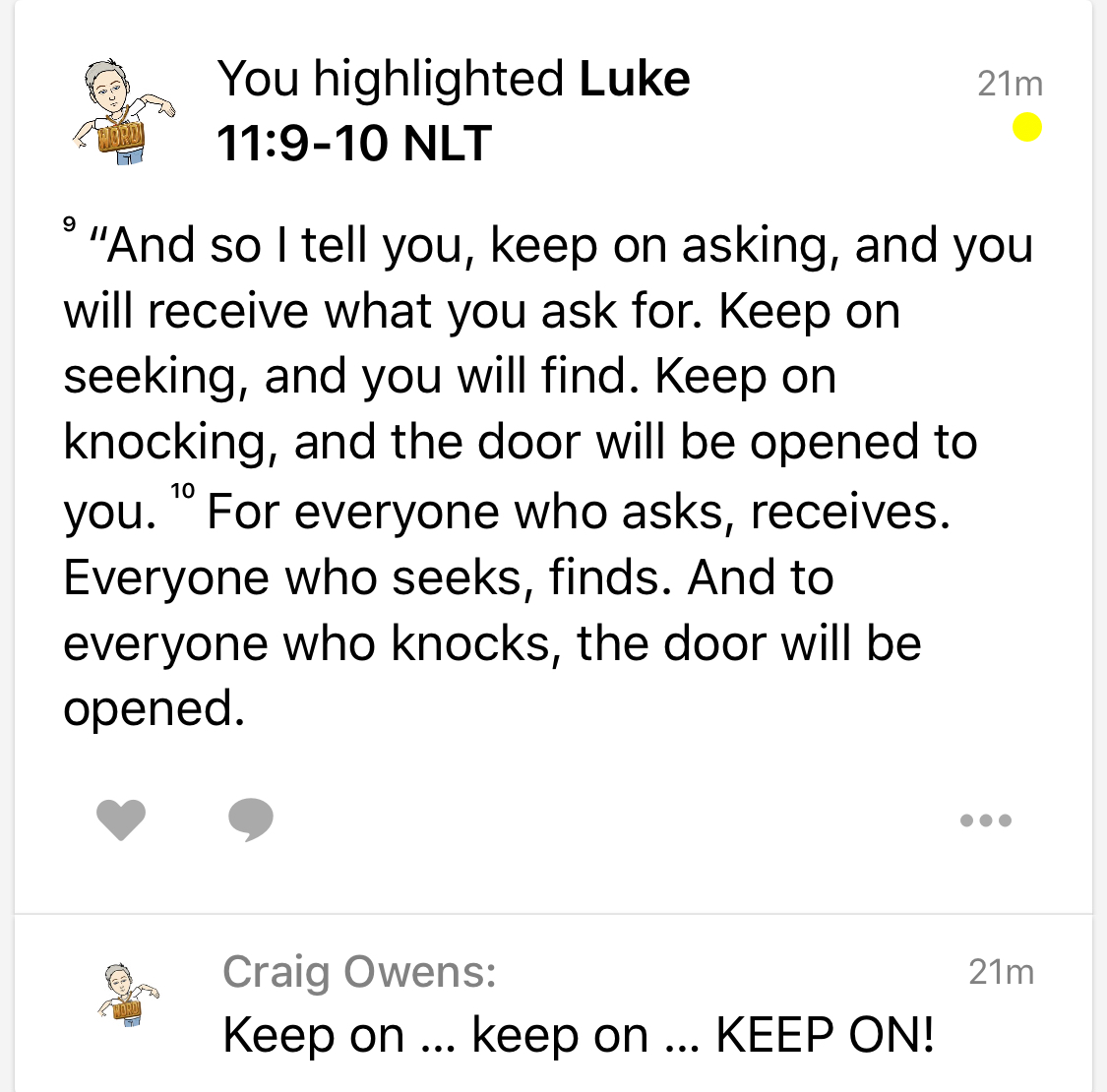
Last week I asked you to recall a time that your children were asking you for something they really, really wanted. How many times did they ask? If you said, “No” to their first request, did they immediately stop asking? Probably not. And that’s good, because Jesus tells us to keep PUSHing (Luke 11:9-10).

(Check out all of the Scriptures in this post by clicking here.)

Let’s recall the story Jesus told to illustrate the kind of importunity that God responds to. Jesus used the example of a friend going to his neighbor’s house with a request for bread. No matter how many times the neighbor said, “No,” the man continued to ask and knock (vv. 5-8). Jesus concluded by saying that the neighbor would eventually get us and give his friend “as much as he needs.”

That is the key word: needs vs. wants. 

Jesus told us “your Father knows what you need, but He wants to give us so much more than what we are asking for—He wants to give us His Kingdom (Luke 12:30-32). A need is a necessity (Psalm 34:10 AMPC; Matthew 6:8), but wants are merely selfish desires (James 4:3). 

Loving parents know the difference between needs and wants and therefore they know how to respond to the requests from their children. Jesus pointed out that if we “evil” parents know this, how much more does our all-wise, all-loving, all-knowing Heavenly Father know this (Luke 11:11-13)! 

When my kids ask me for something—when they are asking, seeking, knocking—I want to give them the best. But sometimes the best thing means I have to say, “No.” I don’t give them candy for breakfast. I don’t let them drive a car when they’re 7 years old. I don’t give them responsibilities which they are unprepared to manage. They may want all of these things, and they may even enjoy these things for a fleeting moment. But they don’t need them and the end result could be dangerous or even disastrous! 

Jesus says that we human parents even in our very limited wisdom know that giving our children their immediate wants may prevent them from receiving what they really need. My “No” may really mean a better “Yes,” if they will trust me. 

Do you know a surefire way to determine if what you are PUSHing for is a want or a need? A temper tantrum! When we start throwing a fit, it probably means we are looking for a want to be supplied, not a need. Psalm 25:9 tells us that God loves to supply the needs of the humble who say, “Father, You know best.” 

What if I changed “suffering” with “God’s loving ‘no’” in this passage—

Not only so, but we also glory in God’s loving “No,” because we know that God’s loving “No” produces perseverance4 perseverance, character; and character, hope. And hope does not put us to shame, because God’s love has been poured out into our hearts through the Holy Spirit, who has been given to us. (Romans 5:3-5)

Our hope in our heavenly Father’s best “Yes” is vital for our ongoing prayer live (Isaiah 30:18)! 

Our all-wise, all-loving Father KNOWS what is best for us. But still, Jesus directs us to continue asking, seeking, and knocking. Keep PUSHing until His best “Yes” is given, found, and opened. 

God’s loving “No” is only so that He can give you His best “Yes”! 

If you’ve missed any of the other messages in this series, you can find them all here. 

►► Would you please prayerfully consider supporting this ministry? My Patreon supporters get behind-the-scenes access to exclusive materials. ◀︎◀︎

PUSHing For God’s “Yes

Listen to the podcast of this post by clicking on the player below, and you can also subscribe on AppleSpotify, or Audible. 

Parents, I want you to think back to your children asking you for something they really wanted. How many times did they ask? How many different ways did they ask? What sort of strategies did they use? Did you ever sense any hesitation in them coming to you to make their request? 

Do you have this firmly in mind? Good, because this is how Jesus explains prayer. 

Jesus called God His Father, and when His disciples asked Him how to pray, Jesus instructed them to address God as “Father” (Luke 11:1-2). 

(Check out all of the Scriptures in this post by clicking here.)

This is so remarkable! 

  • Hindus don’t call God “father” but they flip it around by saying, “Father is like God” to teach children to respect their earthly fathers. 
  • Buddhists don’t believe in a God that anyone can worship or even have a relationship. 
  • Islam gives Allah 99 names, but not one of the names is “Father.” 
  • Jewish rabbis don’t see how anyone other than Jewish people can even think of God as their Father, but even they don’t presume to address Him that way in their prayers. 

And yet Jesus tells us to come to prayer to the Almighty Creator and Sustainer of the universe with, “Father.” There is intimacy in that title. There is an understanding of knowingness and trustworthiness in that title. There is an implied belief of perfect provision in that title. 

We looked at Luke 11:9-10 previously, and we saw especially how the Amplified Bible brings out the idea of asking again and again and again. But is this what Jesus really meant for us to do? Don’t you feel a bit like a pest asking this way? 

The disciples asked Jesus to teach them to pray (Luke 11:1-4), but then Jesus gave them an un-asked-for illustration to make His point (vv. 5-8). 

The Greek word for “boldness” in v. 8 is translated “shameless persistence” or “sheer persistence” or “shameless audacity” in various biblical translations. In the Greek, it’s a unique word (anaideia) which means without shame. 

The sleeping friend—although he was tired and the request for bread came at an inconvenient time—still wanted to honor his friend. Or more precisely, he wanted to preserve the honor of his friend. 

There’s another Greek word (hypomone) that I would define as stick-to-it-iveness. Two great examples are Bartimaeus (Mark 10:46-52) and the Syrophoenician mother (Matthew 15:21-28). 

In light the the story of the Good Samaritan in the previous chapter of Luke, I think this friend was practicing the Golden Rule: he wouldn’t want to lose standing in the community or be embarrassed by being an ill-equipped host, so he helped supply his neighbor. 

Give us each day our daily bread” (Luke 11:3) hallows God as our Father. Our Father is the Bread Supplier and He never wants His children forsaken or embarrassed—

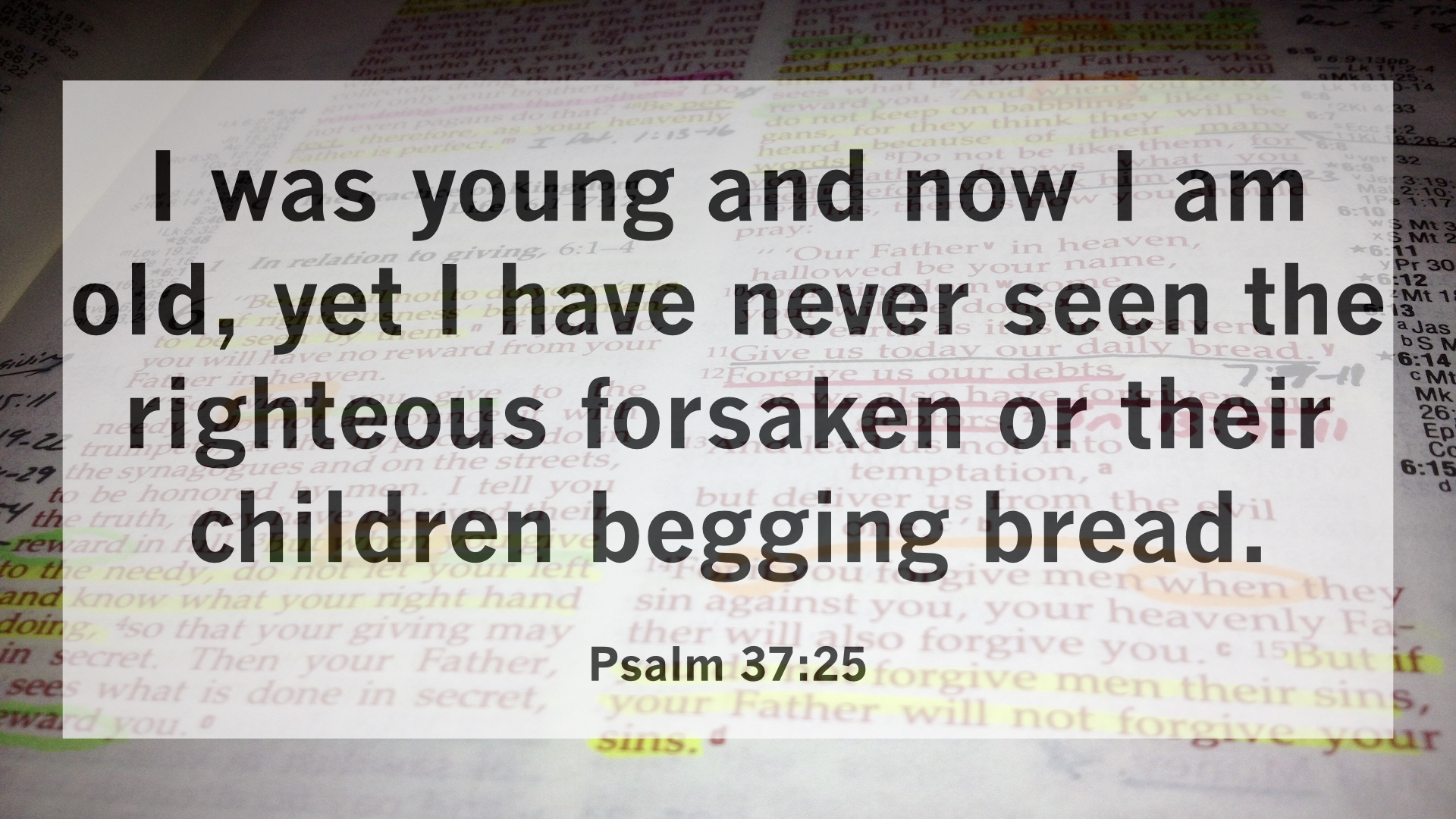
I was young and now I am old, yet I have never seen the righteous forsaken or their children begging bread. (Psalm 37:25) 

The conclusion to the instructions Jesus gives us about prayer are continual asking, persistent seeking, and audacious knocking! P.U.S.H. = pray until something happens! 

“Our giving depends much on the state of our minds at the moment. When depressed, we have no pleasure in giving; we either refuse, or we give merely to get quit of the applicant. Darkness of mind shrivels us up, makes us selfish, neglectful of others. When full of joy, giving seems our element—our joy overflows in this way; we cannot help giving; we delight in applications; we seek opportunities of giving. So with the blessed God. Being altogether happy, His delight is to give; His perfect blessedness flows out in giving. We can never come wrongly to such an infinitely happy Being.” —Horatius Bonar 

Our importunate requests are opportunities for God to show His unequaled supply to others—to exalt His name. For that request, God will “get up and give you as much as you need” (Luke 11:8). 

We are to keep on PUSHing for our Father’s “yes.” 

Check out all of the other messages in this prayer series by clicking here. 

►► Would you please prayerfully consider supporting this ministry? My Patreon supporters get behind-the-scenes access to exclusive materials. ◀︎◀︎
How Long?

Listen to the podcast of this post by clicking on the player below, and you can also subscribe on AppleSpotify, or Audible. 

Last week we saw that if we make prayer our priority, we can expect that our eyes will be opened to the answers that God has for us. Hagar and Eliezer seemed to get pretty quick answers. Nehemiah had to wait four months for the answer to his prayer. 

We saw in Psalm 5 that David laid his requests before God first thing in the morning, and then he went out of his prayer closet in expectation of an answer (Psalm 5:1-3). But how long did he wait? 

(Check out all of the Scriptures in this post by clicking here.) 

Psalm 6 may not happen historically right after Psalm 5, but listen to David’s heart, “Have mercy on me, LORD, for I am faint; heal me, LORD, for my bones are in agony. My soul is in deep anguish. How long, LORD, how long? (Psalm 6:2-3). And then again in Psalm 13:1-3, David asks, “How long?” four times in the first two verses! 

When we read the training Jesus gave His disciples about prayer in Luke 11:9-10, we see how He implores them (and us) to keep on praying. It becomes even more emphatic in the Amplified Bible—

So I say to you, ask and keep on asking and it shall be given you; seek and keep on seeking and you shall find; knock and keep on knocking and the door shall be opened to you. For everyone who asks and keeps on asking receives; and he who seeks and keeps on seeking finds; and to him who knocks and keeps on knocking, the door shall be opened. 

But once again we have to ask: how long are we to continue asking, seeking, and knocking? This is what Job asked in the middle of his trial (Job 6:8, 11-13). 

Charles Spurgeon said, “God has measured the crosses of all His children: Israel in Egypt, 430 years; Joseph in prison, 3 years; Judah in Babylon, 70 years.” That means that God knows what He is doing, God knows His timing for answering, and that our part is to simply to continue to ask, seek, and knock as we throw our total trust on Him! 

I remember my affliction and my wandering, the bitterness and the gall. I well remember them, and my soul is downcast within me. Yet this I call to mind and therefore I have hope. Because of the LORD’s great love we are not consumed, for His compassions never fail. They are new every morning; great is Your faithfulness. I say to myself, “The LORD is my portion; therefore I will wait for Him.” (Lamentations 3:19-24) 

During these times of waiting, we need to keep recalling what we know:

  1. God’s love is unfathomable—Romans 5:5, 8:38-39 
  2. God’s timing is perfect—Deuteronomy 32:4 
  3. God’s method is flawless—Romans 8:28 
  4. God’s gifts are good—Luke 11:11-13, 12:32  

In Psalms 6 & 13, David doesn’t record any answers from God, but listen to this assurance from Jesus, “Blessed are those who mourn, for they will be comforted” (Matthew 5:4). 

Jesus doesn’t tell us how or when God will bring us comfort, but He does assure us that we will be comforted! 

In a couple of the examples from David, you can see this assurance as he continues his prayers (Psalm 6:2-4, 8-10; 13:1-6). Paul also experienced this confidence (2 Corinthians 12:7-10), and so did Jesus (Matthew 26:38-39, 50-54). 

The writer of Hebrews assures us that Jesus was heard in His, “How long?” cries, and therefore He knows exactly how to intercede for us today as we lift up the same cry (Hebrews 5:7-8; 2:10, 14, 17-18)! 

How long? Quite simply stated: Until God answers or until He lifts our burden. 

In the meantime, the examples in Scripture and the assurance of Christ’s intercession for us us encourages us to…

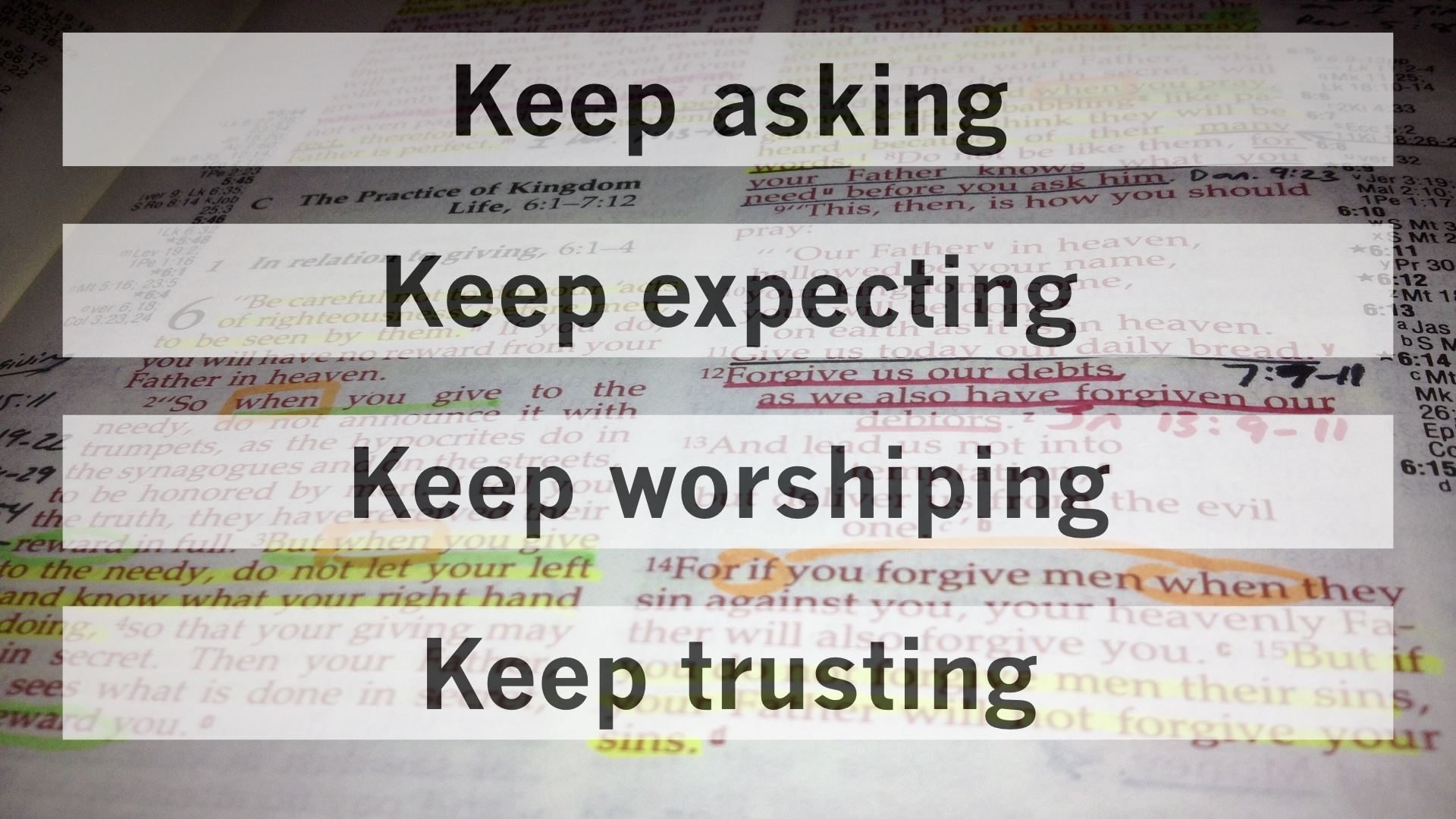
  1. Keep asking with full confidence that God hears you 
  2. Keep expecting an answer 
  3. Keep worshiping God for Who He is 
  4. Keep trusting that your Heavenly Father wants to give you the very best!  

If you have missed any of the other messages in our prayer series, you can find them all here. 

►► Would you please prayerfully consider supporting this ministry? My Patreon supporters get behind-the-scenes access to exclusive materials. ◀︎◀︎
Links & Quotes

Ken Blanchard shared a blog post based on one of the chapters in his book Simple Truths Of Leadership (which I highly recommend to leaders!). He wrote, “When you catch yourself doing things right, everything in your life will improve—especially your relationships. Why? Because it’s fun to be around people who like themselves. After all, if you’re not your own best friend, who will be? And as my dad used to say, ‘If you don’t toot your own horn, others might use it as a spittoon!’”

For all Christians, but especially for those in leadership positions, Jon Bloom shares How to Watch for Wolves: Three Signs of False Teachers.

Fight The New Drug shares the research behind 15 Basic Facts About Human Sex Trafficking.

This is a great lesson from church history on the power of importunate prayer: The Hundred-Year Prayer Meeting.

Mary Slessor set a high bar for missionaries. John Stonestreet reminds us of this amazing woman.

Thursdays With Spurgeon—Prayer Preparation And Prayer Expectation

This is a weekly series with things I’m reading and pondering from Charles Spurgeon. You can read the original seed thought here, or type “Thursdays With Spurgeon” in the search box to read more entries.

Listen to the podcast of this post by clicking on the player below, and you can also subscribe on AppleSpotify, or Audible. 

Prayer Preparation And Prayer Expectation

In the morning, Lord, You hear my voice; in the morning I lay my requests before You and wait expectantly. (Psalm 5:3) 

     Do we not miss very much of the sweetness and efficacy of prayer by a want of careful meditation before it, and hopeful expectation after it? … We too often rush into the presence of God without forethought or humility. We are like people who present themselves before a king without a petition, and what wonder is it that we often miss the end of prayer? We should be careful to keep the stream of meditation always running, for this is the water to drive the mill of prayer. … Prayer without fervency is like hunting with a dead dog, and prayer without preparation is hawking with a blind falcon. Prayer is the work of the Holy Spirit, but He works by means. God made man, but He used the dust of the earth as a material. The Holy Ghost is the Author of prayer, but He employs the thoughts of a fervent soul as the gold with which to fashion the vessel. Let our prayers and praises be not the flashes of a hot and hasty brain but the steady burning of a well-kindled fire.

From Spurgeon And The Psalms

Sadly, I think we’ve become so accustomed to instant-everything in our society that it has seriously limited our prayer life. We walk into our prayer closet without an idea of what we’re going to pray, rattle off a few requests, say “Amen,” and walk out of our prayer closet exactly the same as we walked in. 

There is certainly help for us when we are so distressed—so at our wits’ end—that we don’t even know what to pray, but this is not what David is saying in Psalm 5. David is making it a regular practice to come into God’s presence with his requests at the ready, and he is walking away from his prayer time in eager expectation of God’s soon-to-be-realized answers. 

The Amplified Bible says, “I prepare a prayer…and watch and wait for You to speak to my heart.” 

I think it is a good idea for us to:

As Spurgeon said, “Let our prayers and praises be not the flashes of a hot and hasty brain but the steady burning of a well-kindled fire.”

►► Would you please prayerfully consider supporting this ministry? My Patreon supporters get behind-the-scenes access to exclusive materials. ◀︎◀︎
Highly Esteemed

Listen to the podcast of this post by clicking on the player below, and you can also subscribe on AppleSpotify, or Audible. 

“Highly esteemed” is how two different angels addressed Daniel (Daniel 9:23, 10:11). This was a title they obviously heard from God Himself. At both instances, Daniel was in a time of intense and sustained prayer and fasting. 

While I was speaking and praying, confessing my sin and the sin of my people Israel and making request to the Lord my God for His holy hill … Gabriel, the man I had seen in the earlier vision, came to me…. (Daniel 9:20-21) 

At that time I, Daniel, mourned for three weeks. I ate no choice food; no meat or wine touched my lips; and I used no lotions at all. (Daniel 10:2-3) 

Prayer was a regular habit for Daniel and prayer was also what Daniel turned to immediately in times of trouble (Daniel 2:18, 6:10). 

We see the same thing in the lives of two notable women in the New Testament. Elizabeth is described as an upright woman who observed all of God’s commandments blamelessly. She continuously prayed that she might get pregnant, and then Gabriel came to bring the good news of her upcoming pregnancy. Elizabeth responded by saying, “The Lord has done this for me.… He has shown me His favor” (see Luke 1:5-25). 

Mary was also a righteous woman who was steeped in Scripture (as we can see in her song of praise). When Gabriel appeared to her, he called her “highly favored” (see Luke 1:26-55). 

A righteous, prayer-filled lifestyle also brings favor and esteem with earthly kings. Daniel and his friends fasted and prayed, which led to King Nebuchadnezzar’s favor directed to them (Daniel 1:11-20, 2:48-49). After three days of prayer and fasting, Queen Esther found favor in the eyes of King Xerxes, which led to the salvation of all the Jewish people (Esther 4:15—5:3). And Nehemiah’s sustained prayer over four months won the favorable reply from King Artaxerxes (see Nehemiah 1:1—2:8). 

If you want to hear deep things from God, if you want to be called “highly esteemed” by the Most High, if you want to gain favor with earthly kings, you must be committed to the sustained work of prayer and righteous living. If you would like to dig into this deeper, check out 4 Thoughts To Help Prayer Become A Daily Habit.

►► Would you please prayerfully consider supporting this ministry? My Patreon supporters get behind-the-scenes access to exclusive materials. ◀︎◀︎

Thursdays With Spurgeon—Three Keys To Effective Prayer

This is a weekly series with things I’m reading and pondering from Charles Spurgeon. You can read the original seed thought here, or type “Thursdays With Spurgeon” in the search box to read more entries.

Listen to the podcast of this post by clicking on the player below, and you can also subscribe on AppleSpotify, or Audible. 

Three Keys To Effective Prayer 

     Why is this extraordinary power of prayer given to those who abide in Christ? May what I have to say encourage you to make the glorious attempt to win this pearl of great price! Why is it, that by abiding in Christ and having His words abide in us, we get to this liberty and prevalence in prayer? … 

     I answer, first, because of the fullness of Christ. … I see clearly enough why the branch gets all it wants while it abides in the stem, since all it wants is already in the stem and is placed there for the sake of the branch. What does the branch want more than the stem can give it? If it did want more, it could not get it. For it has no other means of living but by sucking its life out of the stem. O my precious Lord, if I want anything that is not in You, I desire always to be without it. I desire to be denied a wish that wanders outside of You. But if the supply of my desire is already in You for me, why should I go elsewhere? You are my all, where else should I look? … 

     The next reason for this is the richness of the Word of God. … The best praying man is the man who is most believingly familiar with the promises of God. After all, prayer is nothing but taking God’s promises to Him and saying to Him, ‘Do as You have said.’ … If the Word of God abides in you, you are the man who can pray because you meet the great God with His own words…. 

     A man will succeed in prayer when his faith is strong. And this is the case with those who abide in Jesus. It is faith that prevails in prayer. The real eloquence of prayer is a believing desire. ‘All things are possible to him who believes’ (Mark 9:23). A man abiding in Christ, with Christ’s words abiding in him, is eminently a believer and consequently eminently successful in prayer.

 From The Secret Of Power In Prayer

God Himself has told us, “Call to Me and I will answer you and tell you great and unsearchable things you do not know” (Jeremiah 33:3). Not “I might answer you,” but “I will answer you.” 

God also tells us how to receive what we ask in prayer:

  1. Abide in Jesus. Desire nothing else but to know His heart more intimately. 
  2. Know God’s Word. The Bible isn’t just a Book to be read through, but it’s a Book to be prayed through. 
  3. Stretch your faith. A desperate father said to Jesus, “If You can, please help us.” Jesus admonished that father—and all of us too—to believe that Jesus is able to accomplish what we ask of Him. And then comes this great exclamation from that same desperate father: “I do believe; help me overcome my unbelief!” The God that wants us to have faith in Him for answered prayers is the same God Who imparts that faith to us. How? By abiding in Jesus and taking God at His Word. 

Don’t give up, my friend. Keep praying. There is no other way to learn to pray more effectively than to keep on abiding in Jesus, keep on claiming the biblical promises, and keep on stretching your faith to present your prayer request to Him again.

►► Would you please prayerfully consider supporting this ministry? My Patreon supporters get behind-the-scenes access to exclusive materials. ◀︎◀︎

A Persistent Mother

I love this mother! She exemplifies persistence and insistence in prayer.

Leaving that place, Jesus withdrew to the region of Tyre and Sidon. A Canaanite woman from that vicinity came to Him, crying out, “Lord, Son of David, have mercy on me! My daughter is suffering terribly from demon-possession.”

Jesus did not answer a word. So His disciples came to Him and urged Him, “Send her away, for she keeps crying out after us.”

He answered, “I was sent only to the lost sheep of Israel.”

The woman came and knelt before Him. “Lord, help me!” she said.

He replied, “It is not right to take the children’s bread and toss it to their dogs.”

“Yes, Lord,” she said, “but even the dogs eat the crumbs that fall from their masters’ table.”

Then Jesus answered, “Woman, you have great faith! Your request is granted.” And her daughter was healed from that hour. (Matthew 15:21-28; Mark 7:24-30)

Seeking God

…David sought the face of the Lord… (2 Samuel 21:1). 

בָּקַשׁ פָּנִים יְהֹוָה

The Hebrew phrase is baqash paniym YHWH: 

  • baqash is to ask for, beg, desire “specifically in worship or prayer.” It’s a “searching as done by touching.” 
  • paniym literally means the face, but it carries the idea of being in someone’s presence.
  • YHWH (Yahweh) is Jehovah God. 

David repeatedly asked, sought, and begged through both prayer and worship that he might be in God’s presence. “Almighty God, I want to be with You. I want to know your heart intimately. I want to see Your face. I’m not seeking help from any other source, but I am resolutely seeking You alone.” 

Perhaps Jesus had this in mind when He told us, “Keep on asking, keep on seeking, keep on knocking. You will get an answer, you will find what you’re seeking, the door to God’s presence will be opened to you. Your Father—YHWH, God Almighty—longs to reveal Himself to you.” 

Q: How long did David seek the face of the Lord? 

A: Until God spoke, until God delivered, until God opened the door. 

Q: How long am I willing to keep on seeking the face of the Lord? 

A: I hope I can say until God speaks, until God delivers, until God opens the door.

A Mother’s Thunderous Prayer

Hannah only appears in the first two chapters of 1 Samuel, but her legacy thunders through her son, and its rumblings continue to reverberate today. At first glance, it seems somewhat ironic that Hannah’s name means grace (undeserved favor) because we tend to think of a grace-filled person as quiet and unassuming. We don’t typically think of grace as thundering, but indeed it does! 

Notice 3 P’s from Hannah’s life—

  1. Hannah is grace personified. She didn’t crumble because of Peninnah’s taunts, nor did she compromise on her heart’s prayer because of Elkanah’s compliments. She never responded verbally to either Peninnah or Elkanah, but she took all her anguish to God in prayer. 
  1. Hannah is persistent in prayer. Hannah lives out the definition of importunity—unswerving, unabated, persistent prayer. The Bible tells us, “year after year…in bitterness of soul Hannah wept much and prayed to the Lord … she kept on praying to the Lord.” Notice an important contrast: Peninnah means jewels (from earth), while Hannah means grace (from God). God wants to give us answers that are eternal.  
  1. Hannah is piously reverent. Three times Hannah called herself a servant. She is respectful to the high priest Eli even when he falsely accuses her of being drunk. After Eli assures Hannah that God is going to grant her prayer request, notice her reverent actions—she broke her fast, her face was no longer downcast, she worshipped before the Lord, and she and Elkanah tried again to get pregnant.  

Hannah’s anguish drove her to God. Year after year her bitterness of soul kept her in God’s presence. And after God answered her prayer, her rejoicing continued to keep her in God’s presence. She was importunate in prayer.

But also notice that God was silent while Hannah prayed year after year. Oswald Chambers says, “God’s silences are His answers. … Some prayers are followed by silence because they are wrong [this wasn’t Hannah’s case], others because they are bigger than we can understand.” 

God was going to give Hannah a son, but the time wasn’t right yet. God needed a strong man in a dark time, and it wasn’t dark enough yet. 

Israel had to sink into even deeper darkness. While Samuel was still a young man, the Israelite army was defeated, Eli and his two sons all died, and the ark of the covenant of the Lord was captured. This prompted Eli’s daughter-in-law to name her son Ichabod—God’s glory has departed. 

This darkness allows Samuel to lead the people into a revival and then on to victory (1 Samuel 7:3-10). But notice how God responded to Samuel’s revival prayer—the Lord thundered with a loud thunder against the Philistines and threw them into such a panic that they were routed before the Israelites. 

God’s response was a fulfillment of Hannah’s prayer. After God answered her and gave her a son, Hannah’s song of rejoicing foretold God’s response that was coming years later in Samuel’s revival—“It is not by strength that one prevails; those who oppose the Lord will be broken. The Most High WILL thunder from heaven…. 

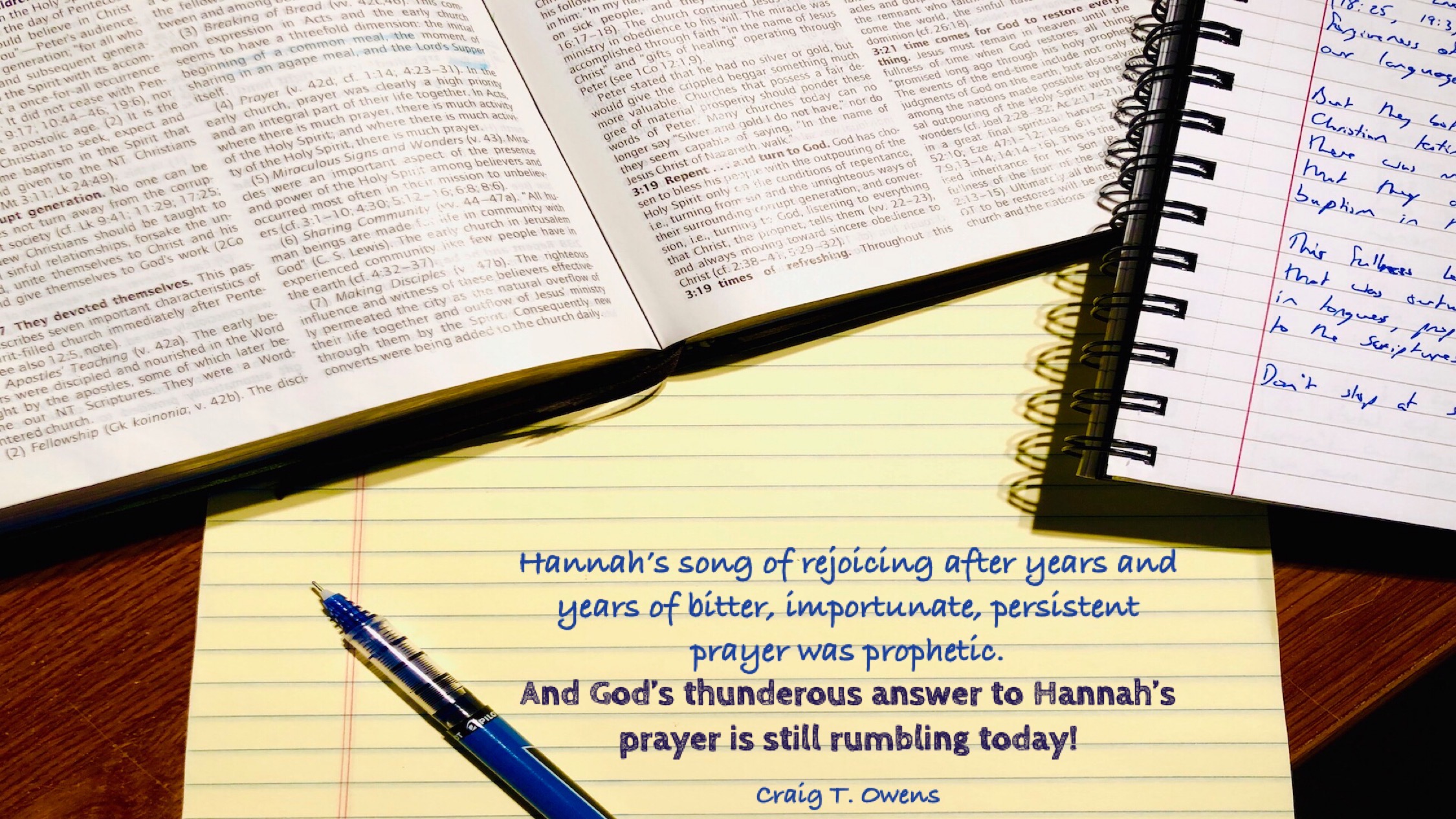
Hannah’s song of rejoicing after years and years of bitter, importunate, persistent prayer was prophetic—and God’s thunderous answer to Hannah’s prayer is still rumbling today! 

Moms, don’t stop praying! God wants to answer your prayer. The Holy Spirit will help you pray (Romans 8:26). God’s timing IS coming. He will thunder His thunder in answer to your persistent prayer! 

If you have missed any of the posts in our We Are: Pentecostal series, please click here to access them.