Stand-Up Christians

Listen to the podcast of this post by clicking on the player below, and you can also subscribe on AppleSpotify, or Audible. 

“I’ve searched all the parks in all the cities and found no statues of committees.” —G.K. Chesterton 

It’s true that no statues have been erected to committees or groups, but groups of people have been allowed to stand up because just one strong leader stood up for them. And history has shown that there never has been a greater servant leader—lifting and rescuing more people than we can count—than Jesus of Nazareth. 

Before He ascended back to heaven Jesus said to His followers, “As the Father has sent Me, I am sending you” (John 20:21). He has called us to stand up as His representatives in the world. Jesus didn’t send His followers out under their own power, but He directed them to first be empowered by the Holy Spirit (Acts 1:7-8). 

Last week I shared how Hannah’s persistence in prayer led to a revival in Israel. Hannah’s physical barrenness was a picture of Israel’s spiritual barrenness. When Hannah prayed, we read a key phrase: Hannah stood up (1 Samuel 1:9). She was really saying, “God do something IN me that will turn people to You!” 

And God literally did something IN her: she became pregnant, and the son that came from her was the spiritual leader Israel needed. 

New Testament Christians can have a new life conceived IN them when they are baptized IN the Holy Spirit. They can then spiritually give birth to a revival, just as surely as Hannah’s son Samuel led a revival in Israel! Being baptized IN the Holy Spirit empowers us to be stand-up Christians.  

Consider the disciple Peter. On the night Jesus was arrested, Peter couldn’t stand up for Jesus, even though it was just two little servant girls who confronted him. Then Pentecost Sunday came, Peter was baptized IN the Holy Spirit, and this Spirit-empowered man now became a stand-up Christian (Matthew 26:69-72; Acts 2:1-4, 14). 

As Aimee Semple McPherson noted, “The Holy Spirit, when He endues you with power, puts a real ‘stand up for Jesus spirit’ within you, and removes your cowardice.” 

Peter not only stood up before a questioning crowd, he stood up to the same religious leaders who had Jesus crucified, and he stood up for the Gentiles who became Christians (Acts 4:5-10; 15:6-11).

In Peter’s first letter to the Church, he explained how Spirit-baptized Christians could…

  • stand up joyfully in trials (1:6-9; 4:7, 12-19) 
  • stand up for holiness in a wicked culture (1:13-16; 2:11-12)
  • stand up to be able to submit to and serve those in civic government positions (2:13-17)
  • stand up to serve your employer (2:18)
  • stand up like Jesus did to the people who revile and slander you (2:19-25)
  • stand up for your spouse’s salvation (3:1-7) 
  • stand up for your Church family (3:8-12) 
  • stand up to fear (3:13-14) 
  • stand up to give testimony to your faith in Jesus (3:15-17)
  • stand up to live counter-culturally (4:1-6)
  • stand up for the shepherds and the sheep in God’s family (5:1-5)
  • stand up to anxiety (5:6-7)
  • stand up against the devil’s growling (5:8-11) 
  • stand up for Jesus until the very end of life or until Jesus returns (5:12-14) 

All of this from a man who couldn’t stand up to a little servant girl! 

That’s why I’ve said it before and I’ll keep on saying it—Don’t stop at salvation! There is SO MUCH MORE for those who will receive the baptism IN the Holy Spirit. If you want to stand up for Jesus and stand up for others who are being pushed around by the devil, you must be empowered with the stand-up-for-Jesus spirit that only comes from the Holy Spirit. 

Will you let the Holy Spirit put that stand-up spirit in you?

If you have missed any of the other messages in this series, please click here to access them.

►► Would you please prayerfully consider supporting this ministry? My Patreon supporters get behind-the-scenes access to exclusive materials. ◀︎◀︎

The Holy Spirit On And In

I’m in a series right now at Calvary Assembly of God called We Are: Pentecostal. This is the second time we have rejoined this series because, quite honestly, there is just way too much for me to cover effectively! 

I have pointed out how most people in the Old Testament had the Spirit of God come ON them, but in the New Testament, the Holy Spirit comes IN Christians. And I’ve made the case that IN > ON (read more about that by clicking here). 

The Infographic Bible has a wonderful graphic depicting the On/In nature of the Spirit in the two Testaments—


And if you would like to see a short video where I try to illustrate the difference between on and in, please check this out. 

A Mother’s Thunderous Prayer

Hannah only appears in the first two chapters of 1 Samuel, but her legacy thunders through her son, and its rumblings continue to reverberate today. At first glance, it seems somewhat ironic that Hannah’s name means grace (undeserved favor) because we tend to think of a grace-filled person as quiet and unassuming. We don’t typically think of grace as thundering, but indeed it does! 

Notice 3 P’s from Hannah’s life—

  1. Hannah is grace personified. She didn’t crumble because of Peninnah’s taunts, nor did she compromise on her heart’s prayer because of Elkanah’s compliments. She never responded verbally to either Peninnah or Elkanah, but she took all her anguish to God in prayer. 
  1. Hannah is persistent in prayer. Hannah lives out the definition of importunity—unswerving, unabated, persistent prayer. The Bible tells us, “year after year…in bitterness of soul Hannah wept much and prayed to the Lord … she kept on praying to the Lord.” Notice an important contrast: Peninnah means jewels (from earth), while Hannah means grace (from God). God wants to give us answers that are eternal.  
  1. Hannah is piously reverent. Three times Hannah called herself a servant. She is respectful to the high priest Eli even when he falsely accuses her of being drunk. After Eli assures Hannah that God is going to grant her prayer request, notice her reverent actions—she broke her fast, her face was no longer downcast, she worshipped before the Lord, and she and Elkanah tried again to get pregnant.  

Hannah’s anguish drove her to God. Year after year her bitterness of soul kept her in God’s presence. And after God answered her prayer, her rejoicing continued to keep her in God’s presence. She was importunate in prayer.

But also notice that God was silent while Hannah prayed year after year. Oswald Chambers says, “God’s silences are His answers. … Some prayers are followed by silence because they are wrong [this wasn’t Hannah’s case], others because they are bigger than we can understand.” 

God was going to give Hannah a son, but the time wasn’t right yet. God needed a strong man in a dark time, and it wasn’t dark enough yet. 

Israel had to sink into even deeper darkness. While Samuel was still a young man, the Israelite army was defeated, Eli and his two sons all died, and the ark of the covenant of the Lord was captured. This prompted Eli’s daughter-in-law to name her son Ichabod—God’s glory has departed. 

This darkness allows Samuel to lead the people into a revival and then on to victory (1 Samuel 7:3-10). But notice how God responded to Samuel’s revival prayer—the Lord thundered with a loud thunder against the Philistines and threw them into such a panic that they were routed before the Israelites. 

God’s response was a fulfillment of Hannah’s prayer. After God answered her and gave her a son, Hannah’s song of rejoicing foretold God’s response that was coming years later in Samuel’s revival—“It is not by strength that one prevails; those who oppose the Lord will be broken. The Most High WILL thunder from heaven…. 

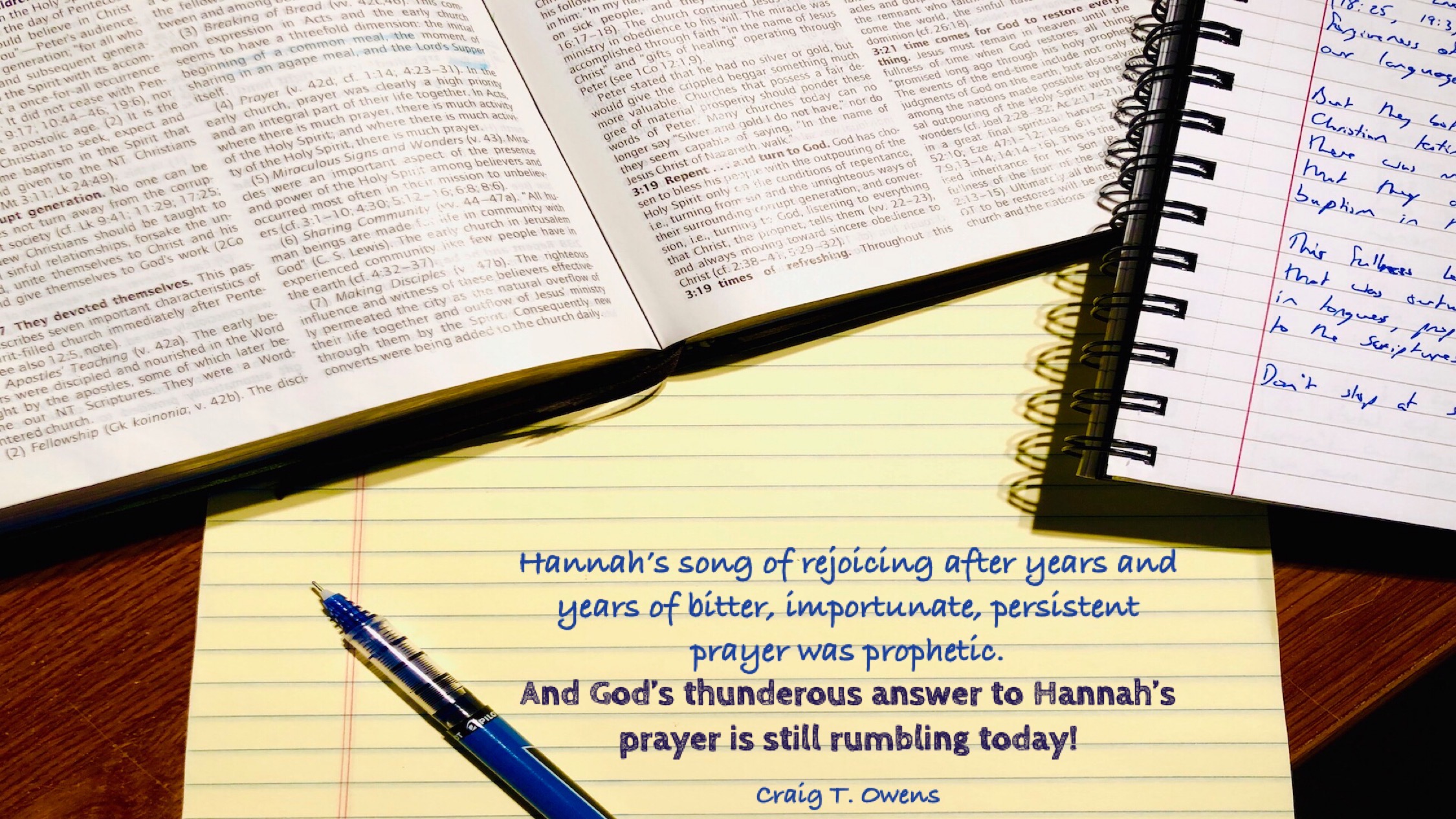
Hannah’s song of rejoicing after years and years of bitter, importunate, persistent prayer was prophetic—and God’s thunderous answer to Hannah’s prayer is still rumbling today! 

Moms, don’t stop praying! God wants to answer your prayer. The Holy Spirit will help you pray (Romans 8:26). God’s timing IS coming. He will thunder His thunder in answer to your persistent prayer! 

If you have missed any of the posts in our We Are: Pentecostal series, please click here to access them.

A Graphical Look At Ephesians 2

Ephesians 2:11-21

11 Therefore, remember that formerly you who are Gentiles by birth and called “uncircumcised” by those who call themselves “the circumcision” (which is done in the body by human hands)—12 remember that at that time you were separate from Christ, excluded from citizenship in Israel and foreigners to the covenants of the promise, without hope and without God in the world. 13 But now in Christ Jesus you who once were far away have been brought near by the blood of Christ.

14 For He Himself is our peace, who has made the two groups one and has destroyed the barrier, the dividing wall of hostility, 15 by setting aside in His flesh the law with its commands and regulations. His purpose was to create in Himself one new humanity out of the two, thus making peace, 16 and in one body to reconcile both of them to God through the Cross, by which He put to death their hostility. 17 He came and preached peace to you who were far away and peace to those who were near. 18 For through Him we both have access to the Father by one Spirit.

19 Consequently, you are no longer foreigners and strangers, but fellow citizens with God’s people and also members of His household, 20 built on the foundation of the apostles and prophets, with Christ Jesus Himself as the chief cornerstone.21 In Him the whole building is joined together and rises to become a holy temple in the Lord.


In > On

When it comes to the Holy Spirit’s involvement in a Christian’s life: In > On.

Sometimes, instead of referring to the two major divisions of the Bible as Old Testament and New Testament, I prefer to use First Testament and Second Testament. This helps me remember that “Old” doesn’t mean outdated, and “New” doesn’t mean forgetting what came before it.

B.B. Warfield had a great analogy. He imagined the First Testament to be a perfectly-constructed mansion. Only the finest materials had been used, and the mansion had been constructed by the best craftsmen being overseen by the world’s premier Architect. The only problem was this mansion had no lights. With the appearing of Jesus in the Second Testament, finally the lights are turned on. Jesus reveals the beauty that was already there! 

In the First Testament, we frequently read that the Holy Spirit comes ON people, usually for leadership functions. We see this phrase with Moses and his co-leaders, several of the judges, Israel’s first two kings, and many of the prophets (see Numbers 11:25; Judges 3:10, 6:34, 11:29, 15:14; 1 Samuel 11:6, 16:13; 2 Kings 2:15). 

However, there is one leader in the First Testament about which we notice the Spirit came IN him. Twice Ezekiel says this (2:2, 3:24). This was hinting at a to-be-fulfilled promise in the Second Testament (36:25-27). 

The Holy Spirit being IN God’s people—which makes them God’s leaders—is described by Jesus in Acts 1:5. Many translations render this verse, “You will be baptized with the Holy Spirit.” But the NIV footnote and The Message both say “in the Holy Spirit.” Indeed, the Greek word means “by, with, or in.” But in context to being baptized (which means immersed, submerged, cleansed, overwhelmed), I think the best word is: baptized IN the Holy Spirit.  

Let me say it again: When it comes to the Holy Spirit’s involvement in a Christian’s life: In > On. 

“You hardly need to pray to have the Spirit poured out, for that has been done. What you need is a baptism of the Holy Spirit; to go down personally into that glorious flood that has been poured forth. Oh, to be immersed in the Holy Spirit and into fire—covered with His holy influence—plunged into the Godhead’s deepest sea and lost in His immensity! Here is our life and power.” —Charles Spurgeon 

Jesus wants all of His followers to be baptized IN the Holy Spirit. So He told us to keep on asking, keep on seeking, keep on knocking, keep on waiting for God’s promised infilling (Luke 11:9-13; Acts 1:4-8). 

Don’t stop at salvation—with just the Holy Spirit deposited in you—press on to be submerged deep into the Holy Spirit. 

If you missed the first couple of posts in this series, check out Where’s God Today? and The Holy Spirit Keeps Christians “Oscar Mike.” 

The Holy Spirit Keeps Christians “Oscar Mike”

Military squads dispatched to achieve an objective will receive a briefing, be given the resources they need to complete the mission, and then they will launch out to complete the task. They will report back to HQ: “We are Oscar Mike”—which means “we are on the move” or “we are on mission.”  

Jesus was always Oscar Mike while He was on earth, and He has also called His followers to remain Oscar Mike with the objective He has given us. 

Christians need to remember that our mission isn’t a destination and it’s not a one-time accomplishment. Without the Holy Spirit’s help, this is a difficult concept to keep in mind. 

Jesus told His disciples that He must go to Jerusalem, which they probably interpreted as the place where He would say, “Mission accomplished.” They were thinking in terms of Jesus reestablishing Israel as God’s HQ. So we can understand how baffled they were when Jesus said, “We are going up to Jerusalem, and everything that is written by the prophets about the Son of Man will be fulfilled. He will be delivered over to the Gentiles. They will mock Him, insult Him and spit on Him; they will flog Him and kill Him.” In fact, Luke records, “The disciples did not understand any of this. Its meaning was hidden from them, and they did not know what He was talking about.” 

They obviously became more confused when a blind beggar stopped Jesus, and when Jesus stopped to eat at the house of a notorious tax collector. Jesus sensed their misunderstanding so “He went on to tell them a parable, because He was near Jerusalem and the people thought that the kingdom of God was going to appear at once.” 

Christ’s parable challenged His followers to stay Oscar Mike. He explained how they were to keep on investing in people. This is exactly what Jesus was doing: using the proper verb tenses, Jesus explained that “the Son of Man came to keep on seeking and to keep on saving the lost”(see Luke 18:31-19:13).

Don’t get so focused on the destination that you lose sight of the mission. 

Earth is not the Christian’s home. We are just passing through and we must remain Oscar Mike as we do. 

Jesus said that being baptized in the Holy Spirit would help us stay Oscar Mike because the Holy Spirit will give us…

  1. … vital information  
  2. … ongoing communication
  3. … real-life application of God’s Word to our circumstances

(check out John 16:12-13; 1 Corinthians 2:10, 16; Isaiah 30:21; Romans 8:26-27; Acts 10:9-15, 28; 15:28)

If Jesus was so reliant on the Holy Spirit while He was on earth, what would make us think that we should be any less reliant?

You and I need the Holy Spirit! 

Stay on mission until God calls you home. Then you can say with the apostle Paul, “I have fought the good fight, I have finished the race, I have kept the faith. Now there is in store for me the crown of righteousness, which the Lord, the righteous Judge, will award to me on that day—and not only to me, but also to all who have longed for His appearing” (2 Timothy 4:7-8). 

Join me this Sunday as we continue to learn what it means to be a Pentecostal Christian. 

We Are: Pentecostal

Pentecost for over 1500 years was a celebration in Jerusalem that brought in Jews from all over the world. But on the Day of Pentecost that came just ten days after Jesus ascended back into heaven, the meaning of Pentecost was forever changed! 

Followers of Jesus—now empowered by an infilling of the Holy Spirit—began to take the good news of Jesus all over the world. These Spirit-filled Christians preached the Gospel and won converts to Christ even among hostile crowds, performed miracles and wonders, stood up to pagan priests and persecuting governmental leaders, and established a whole new way of living as Christ-followers. 

We, too, can be Pentecostal followers of Jesus Christ today. We can experience an anointing and an empowering in our lives that turns ordinary Christianity into extraordinary Christianity! 

Please join me this Sunday as we continue a series of messages we started last year called We Are: Pentecostal. You can check out what I taught in this series in 2019 by clicking here. And our current messages include:

Where’s God Today?

Transitions are always hard things. We are leaving the known for the unknown. Even if the known is unhealthy or painful, it’s still hard to go to the unknown. 

Why are these transitions so difficult? Perhaps it’s because I’ve learned how to cope with the known, or I’ve gotten used to this “normal” life, or even I’ve simply learned to navigate any dysfunctional areas.

But is that really living? Am I managing my life or is God? When I’m against transitions, aren’t I really saying that I’ve put God’s plan for my life in my box?

Those questions trigger even more questions in my mind: Where’s God in all of this? Why can’t He just make my known better? Why is He leading me (or maybe even pushing me) into this unknown? 

Jesus didn’t endure the unimaginable horrors of the Cross just so you could cope with life. Jesus came to bring us abundant life—not a barely-getting-by life or just a coping life!

How does He bring us into this abundant life? By leading us through transitions. And where is He in all our transitions? Closer than you think! 

Moses sang a song to conclude his sermon in Deuteronomy. In that song, he mentions God taking care of His people the way an eagle cares for its eaglets.

Adults eagles build their extremely large nests in the highest point they can find. Their nests are made of massive branches. In fact, they build some of the largest nests of all birds, and build them in the most inaccessible of places. Before their eggs are laid, the adult eagles will soften their nest with feathers pulled from their own body. From the time the eggs are laid until the eaglets leave the nest, they are never without a parent present—while one parent hunts, the other watches. 

Eaglets first test their stumpy wings by jumping around in the nest, mimicking their parents. Eventually they will start “branching”—jumping to nearby branches—and then “fledging”—taking their first short flights from the nest. All under the watchful eye of the parents. Finally, the adult eagles will “stir up” their nest by blowing away all of the comforts of their plucked feathers, encouraging the eaglets to soar. 

Moses said that this is how God cares for His children. First by shielding and guarding us, and then by stirring up our nest and encouraging us to soar! 

Much like when Jesus ascended back to Heaven. He was going to physically leave His disciples, but He knew He had adequately trained his “eaglets” to soar without Him with them in bodily form. 

But Jesus never leaves us spiritually. He said that His ascension back to heaven would allow for the Holy Spirit to be resident in each of His followers (see John 16:7-15). It is the Holy Spirit that continues to guide us, teach us, empower us, correct us, and lead us to SOAR into abundant, God-honoring, Christlike living. 

There are many, many times of transition as we soar, but He never leaves us. The Holy Spirit is our constant Counselor. God shows His love for us by caring for us. God also shows His love for us by making us uncomfortable with the status quo. 

May the times of transition cause us to rely even more on the very present help of the Holy Spirit.

Continue to follow along with me in a new series of posts looking at how the Holy Spirit helps us to soar!

Thursdays With Spurgeon—God With Us

This is a weekly series with things I’m reading and pondering from Charles Spurgeon. You can read the original seed thought here, or type “Thursdays With Spurgeon” in the search box to read more entries.

God With Us

     ‘And you shall call His name Immanuel.’ …

     This is His name, ‘God with us.’ … He has not lost that name. Jesus had that name on earth, and He has it now in heaven! He is now ‘God with us.’ Believer, He is God with you to protect you! You are not alone, because the Savior is with you! … 

     But if you would know this name most sweetly, you must know it by the teaching of the Holy Spirit. … Unless the Holy Spirit takes the things of Christ and applies them to our heart, it is not ‘God with us.’ Otherwise, God is a consuming fire. …

     Immanuel—it is wisdom’s mystery, ‘God with us.’ Just look at it and wonder. Angels desire to see it. The plumb line of reason cannot reach halfway into its depth. The eagle wings of science cannot fly so high, and the piercing eyes of the vulture of research cannot see it! ‘God with us.’  It is hell’s terror! satan trembles at the sound of it. His legions fly apace; the black-winged dragon of the pit quails before it! Let satan come to you suddenly and do you but whisper that word, ‘God with us,’ and back he falls, confounded and confused! satan trembles when he hears that name, ‘God with us.’ It is the laborer’s strength. How could he preach the gospel, how could he bend his knees in prayer, how could the missionary go into foreign lands, how could the martyr stand at the stake, how could the confessor acknowledge his Master, how could men labor if that one word were taken away? ‘God with us’ is the sufferer’s comfort, it is the balm of his woe, it is the alleviation of his misery, it is the sleep that God gives to His beloved, it is the rest after exertion and toil.

     Ah, and to finish, ‘God with us’ is eternity’s sonnet, it is heaven’s hallelujah, it is the shout of the glorified, it is the song of the redeemed, it is the chorus of angels, and it is the everlasting oratorio of the great orchestra of the sky! ‘God with us!’

From The Birth Of Christ

Jesus is—always was and always will be—God with us! 

Do you know Jesus personally? He wants you to know Him. He came to earth so that you could know Him. His heart’s desire is to be with you today and have you with Him forever! 

If you have questions about this, please send me a message and let’s chat.


Handling Personal Attacks

So the people grumbled against Moses … The people gathered in opposition to Moses and Aaron (Exodus 15:24; Numbers 20:2). 

People with limited vision have limited faith too. As a result, they frequently grumble when things don’t go their way. Ironically, their grumbling is almost always directed at the leader who does have far-reaching vision and God-honoring faith! 

For most of his tenure as leader, Moses handled the grumbling of the people well. Sometimes, though, the complaints seemed more personal:

  • …in opposition to Moses and Aaron
  • …they quarreled with Moses
  • …“Why did you…?” 

These complaints may seem like a personal attack, but in the end, we find out that these attacks weren’t really against Moses at all—“the Israelites quarreled with the Lord” (Numbers 20:13). 

God tried to help Moses and Aaron see that this was not a personal attack on them. He instructed them to “speak to that rock” so that water would be provided for the grumbling people. But sadly, Moses and Aaron missed this point. They said to the Israelites, “must we bring you water out of this rock?” And then in total frustration with the quarrelsome Israelites, Moses “struck the rock” instead of speaking to it.

Moses made himself the focal point, not God. God responded: “you did not trust in Me enough to honor Me as holy in the sight of the Israelites” (v. 12).

A mark of a godly leader is one who doesn’t take personal attacks personally.

Previously, Moses responded to the grumblers better—

  • He “cried out to the Lord” and received directions
  • He obeyed God’s directions to the letter
  • He reminded the people that their grumbling was really “against the Lord” (Exodus 16:6-8)
  • He humbled himself before the people and pleaded with them not to rebel against God
  • He humbled himself before God and interceded for the people

If God has called you to lead, people will bring their quarrels and complaints to you. It will feel like a personal attack, but it’s not. When attacked or when people grumble, you need to humble yourself before the Holy Spirit and ask, “Did I do something wrong?” and then listen attentively for His answer.

If the answer is yes: repent, ask forgiveness, make things right.

If the answer is no: don’t take it personally, stay humble before God and the people, and obey the specific directions God will give you. Don’t get frustrated and cut short your tenure as a leader.

This is part 44 in my series on godly leadership. You can check out all of my posts in this series by clicking here.