Listen to the podcast of this post by clicking on the player below, and you can also subscribe on Apple, Spotify, or Audible.
Every organization has a culture and has some sacred cows.
I define culture as the unwritten rules that everyone who’s been around for a while knows, but seldom thinks to share with any newcomers. Those newcomers usually don’t know they have broken one of those unwritten rules until they actually break one of those rules!
Sacred cows are the untouchable things in every organization. Those things that have always been in place and can never be changed or removed.
But what if you’re the new leader coming into an organization? How do you navigate the new culture? How do you keep from messing with those sacred cows? Greg and I discussed this on a recent episode of our leadership podcast.
Check out the full episode this clip came from by clicking here.
Listen to the audio-only version of this podcast by clicking on the player below, or scroll down to watch the video.
Recently Greg got a call from an educational institute asking him for advice on how to help their athletes “toughen up.” Unfortunately, they’re not alone, it seems like resilience is in increasingly shorter supply across the board these days. As a leader, it is your job to help instill grit into your team. Not tearing them down, but showing them that you view them with more potential.
[17:54] Data from the Mayo Clinic that encourages us to develop grit.
[19:34] What happens to reach that have teammates who don’t show stick-to-it-iveness?
[21:04] A leadership separator is action over feelings.
[24:00] The wrong and right ways to handle disappointments.
[25:53] We can help coach you to bring out the resilience in yourself and your team.
Check out this episode and subscribe on YouTube so you can watch all of the upcoming episodes. You can also listen to our podcast on Spotify and Apple.
“Courage is the mastery of fear, not the absence of fear.” —Mark Twain
“A good man leaves an inheritance to his children’s children…” (Proverbs 13:22). In his excellent book Proverbs: Amplified and Applied, my cousin Dick Brogden uses our grandfather as an example of the principle in this verse: “Good has multi-generational implications. My grandfather was an incredibly generous man, and his children, grandchildren, and great-grandchildren have reaped the benefit. I am convinced that one of the reasons my family is so generously provided for is because our ancestor repeatedly gave significant financial gifts to his church, the Billy Graham Association, and missionaries around the world. Contrary to Shakespeare’s pessimism in the mouth of Mark Antony, the good that men do does indeed live after them, it is not interred with their bones.”
Self-care is vital. Without taking care of yourself first, how will you have any strength to take care of others? To Write Love On Her Arms has a helpful list of self-care items you can do in just 20 minutes per day.
“Knowledge follows understanding. We invert it and think that if we know facts, we are wise. In reality, it is only the wise who can rightly interpret the facts. … There is a posture of humility before God that opens the lowly to the understanding of God. This spirit of understanding becomes the filter with which we sift facts. Facts sifted by understanding lead us to accurate knowledge. Scoffers reject the reality that they need God’s help and God’s Spirit to understand facts. They foolishly think that true knowledge can be gained outside divinely enabled understanding. They have earned their PhD in ultimate idiocy.” —Dick Brogden, in ‘Proverbs: Amplified and Applied’ commenting on Proverbs 14:6
Listen to the podcast of this post by clicking on the player below, and you can also subscribe on Apple, Spotify, or Audible.
If you’ve been promoted to a new position, be very aware of how you arrive. If you come in overly confident, you could alienate your new teammates before you even get a chance to get started with them. We have an idea that will help you arrive well and make great connections right from the beginning.
Check out this full conversation on The Craig And Greg Show by clicking here.
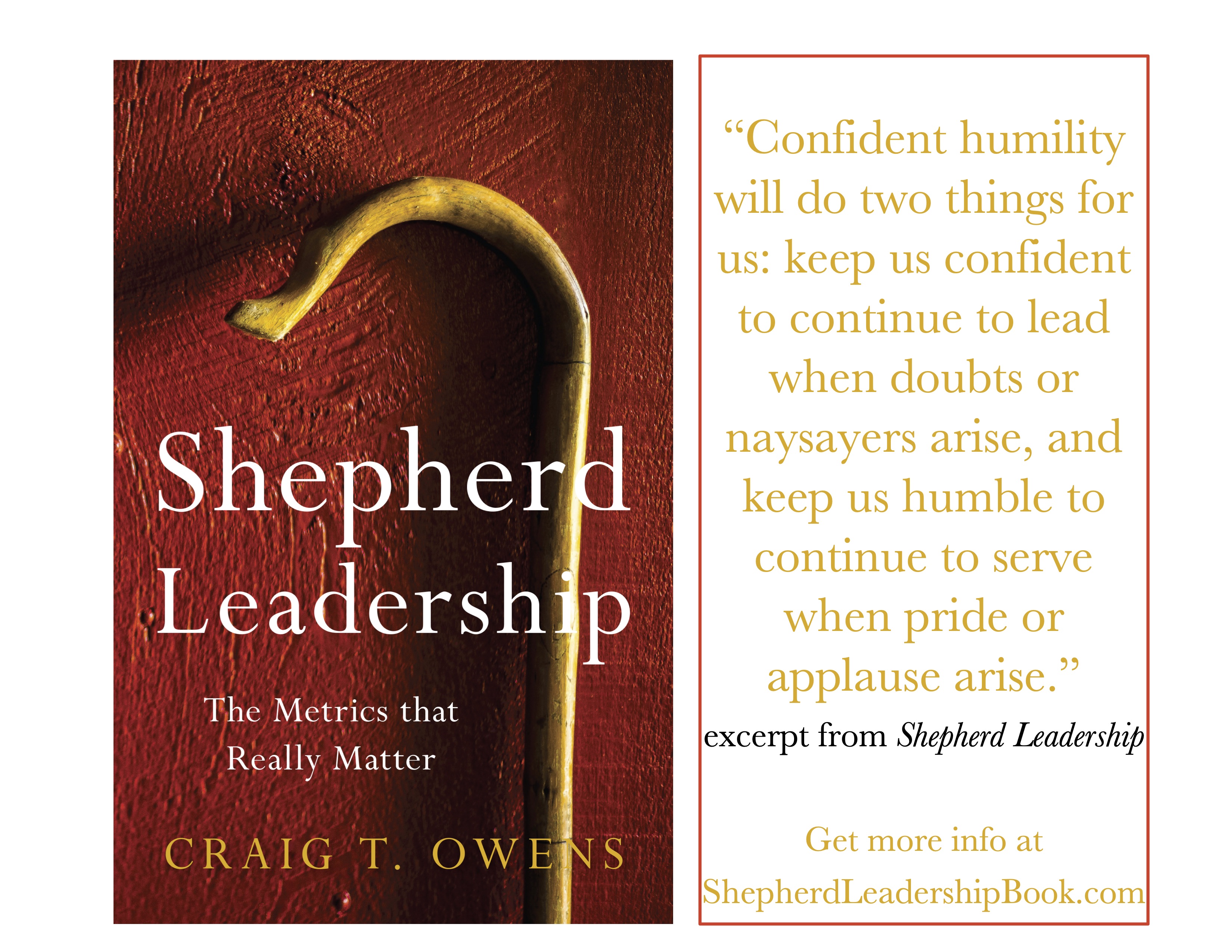
Shepherd Leadership: The Metrics That Really Matter is available in print or ebook, and in audiobook through either Audible or Apple.
Leaders always go first. I want to develop myself so that I have something to give to other emerging leaders around me. If I’m not growing, I’m not going to be able to help others. Check out this full conversation Greg and I had our on leadership podcast The Craig And Greg Show. And be sure to check out all of my videos on my YouTube channel.
“The important thing is not to stop questioning. Curiosity has its own reason for existing. One cannot help but be in awe when he contemplates the mysteries of eternity, of life, of the marvelous structure of reality. It is enough if one tries merely to comprehend a little of this mystery every day. Never lose a holy curiosity.” —Albert Einstein
This is sort of gross, but kind of cool at the same time. “A new study in the journal Scientific Reports concludes that 12 severed hands discovered in 2011 at Tell el-Dab’a (the site of the ancient Hyksos capital of Avaris) constitute the first bioarchaeological evidence of the gruesome ‘trophy taking’ practice of amputating the right hands of defeated enemies.” Read more about this find here. This is a corroboration of the ‘trophy taking’ David performed for King Saul in the Bible.
The more scientists learn about Creation, the more in awe of our Creator I am! Recently, researchers have discovered even more happening inside our cells that keep everything operating optimally. And then there’s this: “Besides the origin of the eye, Darwin had a problem with the origin of flowering plants (angiosperms—plants that produce seeds within an enclosure, i.e., a fruiting plant), known as Darwin’s abominable mystery. The biblical model of origins maintains that the first forms of life created by God were land plants on Day 3 of the creation week. Land plants were fully-formed and functional—‘in the beginning.’”
Dan Reiland encourages leaders to look at their weaknesses differently. “The chinks in your armor allow you to develop empathy and compassion. They give you insight to human nature. They help you genuinely connect with people. Without these things it’s difficult to lead with God’s heart.”
I am a proud member of the Assembly of God fellowship, so I especially loved reading this report on Breakpoint:
“According to recent research by pastor Ryan Burge of eight major Protestant denominations, only the Assemblies of God has seen a steady increase in church membership since 1987. Each of the others, mostly denominations that are fully progressive theologically and culturally, are experiencing steady decline.
“Denominations like The Episcopal Church, Evangelical Lutheran Church in America, and the Presbyterian Church (USA) began long ago to move away from orthodoxy and capitulate to new ideas about sex, gender, and marriage. On the other hand, the Assemblies of God (AG) remained committed to orthodoxy on matters of Scriptural authority, the Deity of Christ, the Resurrection, and on sexual matters. It supports the protection of life at all stages, marriage between one man and one woman, and it insists that the body determines identity as male and female.
“Christians are constantly pressured, within the Church and without, to evolve on these issues or, we are told, we will die out. It seems however, that biblical orthodoxy draws people in. Maybe because it provides an anchor in confusing times.”
Listen to the audio-only version of this podcast by clicking on the player below, or scroll down to watch the video.
Accepting a new position is a very exciting experience! Whether it’s a promotion in your current organization or an opportunity elsewhere, it’s very tempting to want to immediately throw your full attention into the next project. In this episode, Greg and I discuss the necessity of maintaining a balance between that excitement and recognizing that the people on your team now still need your leadership. This might create more work for you in the short term, but the long-term benefits of transitioning well will be huge for you!
[0:33] Any fresh starts for leaders have to be handled thoughtfully.
[2:44] Leaders of integrity give their best effort all the way to the end.
[4:08] How can we maintain a humble attitude when we have been selected to be promoted to a new position?
[6:08] There are different things to keep in mind when moving to a new position in the same organization vs. moving to a new organization.
[8:02] Both of us share stories about friends who benefitted by leaving their old organizations well, and they identify what the true litmus test for leaving well is.
[10:14] Greg also has a negative example to share.
[11:03] How do senior leaders handle coworkers who leave poorly?
[13:06] How do we keep ourselves from being distracted by our new position while we attempt to finish well in our old position?
[16:15] How do we arrive well in our new position?
[18:35] We need to always keep in mind that we are leaving or joining a team of many—we aren’t a team of one.
[22:57] Finishing well is a compliment to the organization you are leaving, and beginning well is a compliment to the organization you are joining.
Check out this episode and subscribe on YouTube so you can watch all of the upcoming episodes. You can also listen to our podcast on Spotify and Apple.
Listen to the audio-only version of this podcast by clicking on the player below, or scroll down to watch the video.
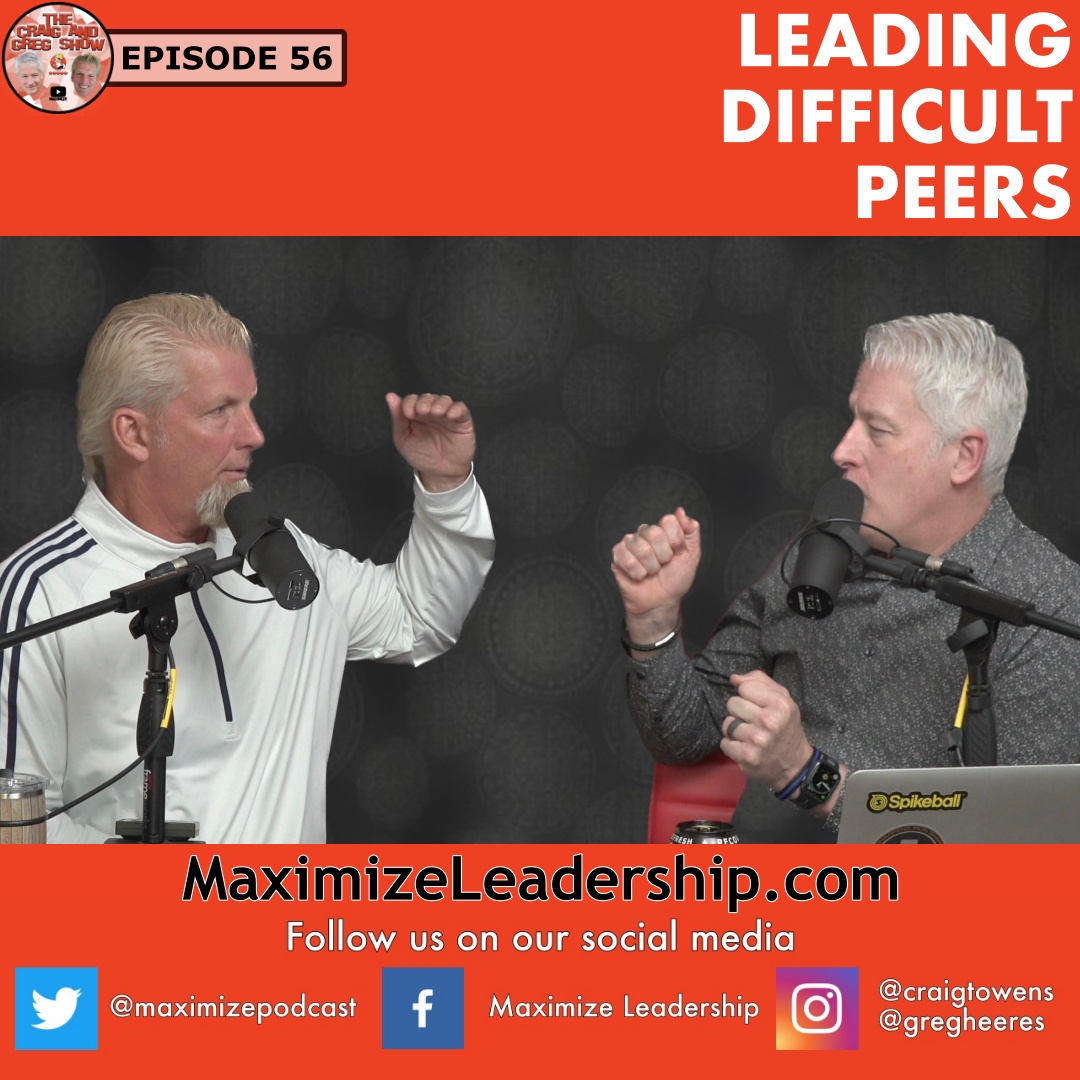
No need to call anyone out, but when I say “difficult peer” at least one person probably comes to mind right away, right? So what’s the solution: ignore them, scream, tear your hair out? Greg and I think there’s a better solution. In this episode, we walk through how we’ve dealt with difficult peers in the past and give actionable advice on how your leadership and coaching can help them improve.
[0:16] We are continuing our series about leading difficult people from wherever you are in your organization.
[1:24] Our goal as leaders should be to figure out why a particular peer is so difficult to work with.
[2:00] A warning about the least productive thing you can do when you are frustrated with a coworker.
[3:44] A great example from Jesus for those striving to be servant leaders.
[5:17] Some questions to ask ourselves to determine if our difficult teammates are coachable.
[7:31] We need to learn the best ways to communicate with our teammates.
[9:18] Where does mistrust play a role in these difficult situations?
[13:13] Leaders at every level need to learn the art of diplomacy.
[15:02] Where does defeatism come into play?
[17:03] A shepherd’s heart must be cultivated for us to lead well—especially leading difficult peers.
[18:45] “When you’re ready” is a great posture for a leader, but it must be lived out.
Check out this episode and subscribe on YouTube so you can watch all of the upcoming episodes. You can also listen to our podcast on Spotify and Apple.
Listen to the audio-only version of this podcast by clicking on the player below, or scroll down to watch the video.
I am not a very good golfer, so when Greg and I hit the course together Greg is generous enough to give me a mulligan—sometimes a lot of them! In the same way, we as leaders need to be willing to give our team members chances to learn from and improve upon their mistakes. In this episode, we discuss how embracing a “mulligan culture” in your organization helps everyone grow and thrive.
[0:22] I explain what Greg gives me that is a huge blessing
[1:25] Leaders need to be gracious.
[2:56] What is the goal of mulligans?
[4:10] Mulligans can cost our business something. How do we calculate that?
[7:18] Success usually goes up with the mulligan attempt.
[9:54] Expect greater success in the second chances.
[11:04] Mulligans need to be given in a safe environment.
[13:06] Second chances and comeback stories are inspiring!
[14:31] Remember that people are the focal point of our mulligans.
[14:55] Greg shares about an unusual phobia with which many people struggle.
[16:50] An important reminder seasoned leaders need to share with emerging leaders.
[18:22] High-performing leaders make it look easy because of the mulligans other people gave them along the way.
Check out this episode and subscribe on YouTube so you can watch all of the upcoming episodes. You can also listen to our podcast on Spotify and Apple.
Listen to the audio-only version of this podcast by clicking on the player below, or scroll down to watch the video.
As a leader, you will have to deal with very emotional situations from time to time. While you may not always have control over when these situations arise, you do have the ability to control your reaction to them. In this episode of The Craig and Greg Show, we discuss emotional regulation and how keeping your emotions managed can be a powerful tool for leaders.
[0:34] Well-regulated emotions are powerful.
[0:55] How do we keep emotions in check?
[2:52] Greg thinks of emotional regulation as a throttle.
[3:31] What are the messes created by unregulated emotion?
[5:59] The triggers of emotional response.
[8:35] We can’t control situations, but we can control our responses.
[9:06] The four categories of regulation.
[10:52] What should you look for to help you be more self-aware?
[13:25] Don’t give up how you feel.
[14:12] Self-awareness doesn’t come from a book, it takes practice and reflection.
[16:10] Slow down!
[16:40] Dis-regulated emotions hurt your ability to influence.
[19:05] How to improve your emotional regulation skills.
[22:48] I discuss the difference between responding and reacting.
[24:02] Greg says people are sensitive and the damage done can be lasting.
[25:27] Greg shares an insightful quote from Viktor Frankl.
[26:45] We would love to coach you if you need help with emotional regulation.
Check out this episode and subscribe on YouTube so you can watch all of the upcoming episodes. You can also listen to our podcast on Spotify and Apple.



 Every organization has a culture and has some sacred cows.







 Craig T. Owens