Listen to the podcast of this post by clicking on the player below, and you can also subscribe on Apple, Spotify, or Audible.
I am thrilled to introduce Greg Heeres to you! He’s not only a great friend and my podcast partner on The Craig And Greg Show, but he is also a published author. We chatted recently about why he wrote “Sage Advice” and how it can benefit every reader.
Listen to the podcast of this post by clicking on the player below, and you can also subscribe on Apple, Spotify, or Audible.
It is important for leaders to use the right words to encourage their teammates. The most memorable, motivating, and beautiful word a leader can use is their teammates’ names.
Listen to the audio-only version of this podcast by clicking on the player below, or scroll down to watch the video.
Words are incredibly powerful! With our tongues, we can elevate others to amazing heights, or tear them down completely. In this episode, Greg and I discuss how, as leaders, it is critical that we are mindful of our everyday words so that we ensure we are taking our team in the right direction.
[0:20] Sometimes leaders can forget how powerful their words can be.
[1:00] Words need to be used strategically and carefully.
[2:05] “Words of affirmation” is one of the love languages, but everyone needs to hear words that affirm and encourage them.
[3:40] Some of the most meaningful words are our apologies and requests for forgiveness. When we do this well, it opens up the door for deeper communication.
[6:00] Leaders should be able to see a visible and immediate difference in their teammates when they are speaking the correct words to them. If not, we need to quickly adjust our words.
[6:50] People don’t care how much their leader knows (or says) until they know how much their leader cares about them.
[8:25] Negative words can sour relationships.
[9:08] Leaders need to pay close attention to what words work best with each teammate.
[10:15] What is the difference between efficient communication and effective communication?
[12:40] We share some insights from two noteworthy books: Leadership Jazz by Max DePree and Ten Powerful Phrases for Positive People by Rich DeVos.
[15:00] One of the most beautiful words anyone will ever hear a leader speak is their teammate’s name.
[19:02] Handwritten notes go the extra mile, but we need to slow down to think about who needs to hear an affirming word from us.
[21:20] Greg shares a memorable quote about the long-term results of our words.
[22:07] A good coach can give you more impactful insights than someone close to you.
Check out this episode and subscribe on YouTube so you can watch all of the upcoming episodes. You can also listen to our podcast on Spotify and Apple.
Listen to the podcast of this post by clicking on the player below, and you can also subscribe on Apple, Spotify, or Audible.
I have to be honest with you right up front: It’s nearly impossible for me to be unbiased in this book review. Sage Advice is written by my longtime friend and podcast partner Greg Heeres, and I couldn’t be any more proud of him!
In the 30+ years that I have known Greg, he has become one of my closest confidants. Next to my wife, Greg probably knows more about me than anyone else, and the same can be said for how well I know him. Several years ago, during one of our many heart-storming sessions, he shared a story about something his grandma said to him.
“I love that story,” I told him. “If you’ve got more like that, you should write them down.”
Thankfully, he did!
In fact, he wrote down twenty memorable stories from his grandparents and parents. Each story is intertwined with a practical leadership lesson for all of us. The subtitle of the book is: Listen to wisdom or learn the hard way.
Whether you had parents and grandparents that invested in your life or not, all of us can learn sound wisdom from our elders—from those who have “been there, done that” and care about us enough to share their hard-won wisdom.
Each chapter not only contains the sage advice from Greg’s elders and his leadership lessons that we can all apply, but he also shares interviews with other leaders who have learned the same lesson that each chapter is presenting.
Sage Advice is a delightful read. You will enjoy Greg’s storytelling so much that you may not even realize the leadership lessons that are seeping into your mind. You can pick up a copy of Sage Advice by clicking here.
Some of our best lessons are learned in difficult places, so let’s not be too quick to rush in and soften the blow for someone who has taken a tumble.Check out the full conversation I had with my podcast partner Greg. And be sure to check out all of my videos on my YouTube channel.
“A champion is one who gets up when he can’t.” —Jack Dempsey
Once again, archeological finds in Israel confirm the historicity of the biblical accounts of the kings of Judah and Israel. John Stonestreet shares some of the most recent finds. Jewish archeologist Nelson Gluek states, “It may be stated categorically that no archaeological discovery has ever controverted a biblical reference.”
“The reward for work well done is the opportunity to do more.” —Jonas Salk
Scott Hubbard writes, “Stepping into leadership means stepping into mistakes, regrets, and many small but stinging failures. And surviving in leadership, I am learning, means stepping upward on those mistakes—owning them, learning from them, and having the stability in Christ to keep leading after them.” Read more about how leaders can fail well.
J. Warner Wallace addresses the claim that all religions are true or are essentially the same.
“The Scriptures represent the Holy Spirit, not only as moving, and occasionally influencing, the saints, but as dwelling in them as His temple, His proper abode, and everlasting dwelling-place. And He is represented as being there so united to the faculties of the soul, that He becomes there a principle or spring of a new nature and life.” —Jonathan Edwards
Listen to the audio-only version of this podcast by clicking on the player below, or scroll down to watch the video.
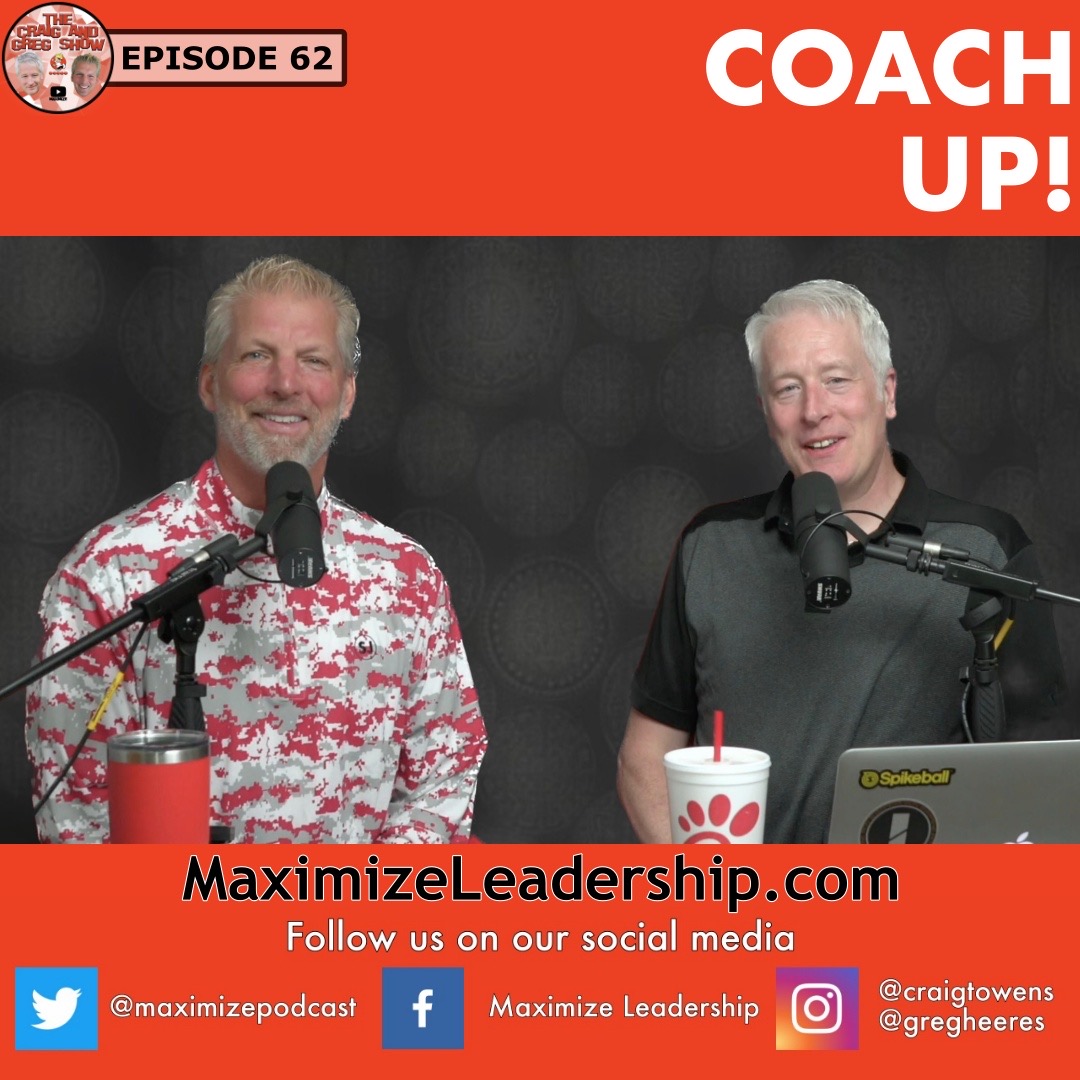
There seems to be a belief among some leaders that the louder they yell, the better they’re understood. No need to call anyone out, but we’re sure someone just came to mind. When you received that kind of coaching, did you receive it well? Of course not! Coaching should be focused on correcting and improving for the next time, not berating for things in the past. So tune in, and learn more about how you can coach up.
[0:18] Leadership ideas can come from all over the place.
[1:34] We need to focus on the “up” in our coaching, not just yelling at our teammates.
[3:15] We should coach up with questions instead of statements.
[4:55] The instructions we give before “the game” pay huge dividends in the heat of the moment.
[6:42] Treat mistakes as coaching opportunities.
[7:50] When leaders are coaching up their teammates, they need to focus on tone and timing.
[10:38] We share some additional thoughts about seeing the potential for coaching in our teammates’ mistakes.
[12:27] Every person learns differently so every teammate needs to be coached differently too.
[13:21] I share a memorable story from my time working with the Guys With Ties group.
[16:03] Greg shares an encouraging quote.
[18:03] Coaching takes place outside of the spotlight, so we need to learn the right timing for our coaching.
[22:08] Leaders can’t be the armchair quarterback, but they must trust their teammates who were closer to the action.
[23:59] Coaching up will eliminate most of our HR problems.
Check out this episode and subscribe on YouTube so you can watch all of the upcoming episodes. You can also listen to our podcast on Spotify and Apple.
Listen to the audio-only version of this podcast by clicking on the player below, or scroll down to watch the video.
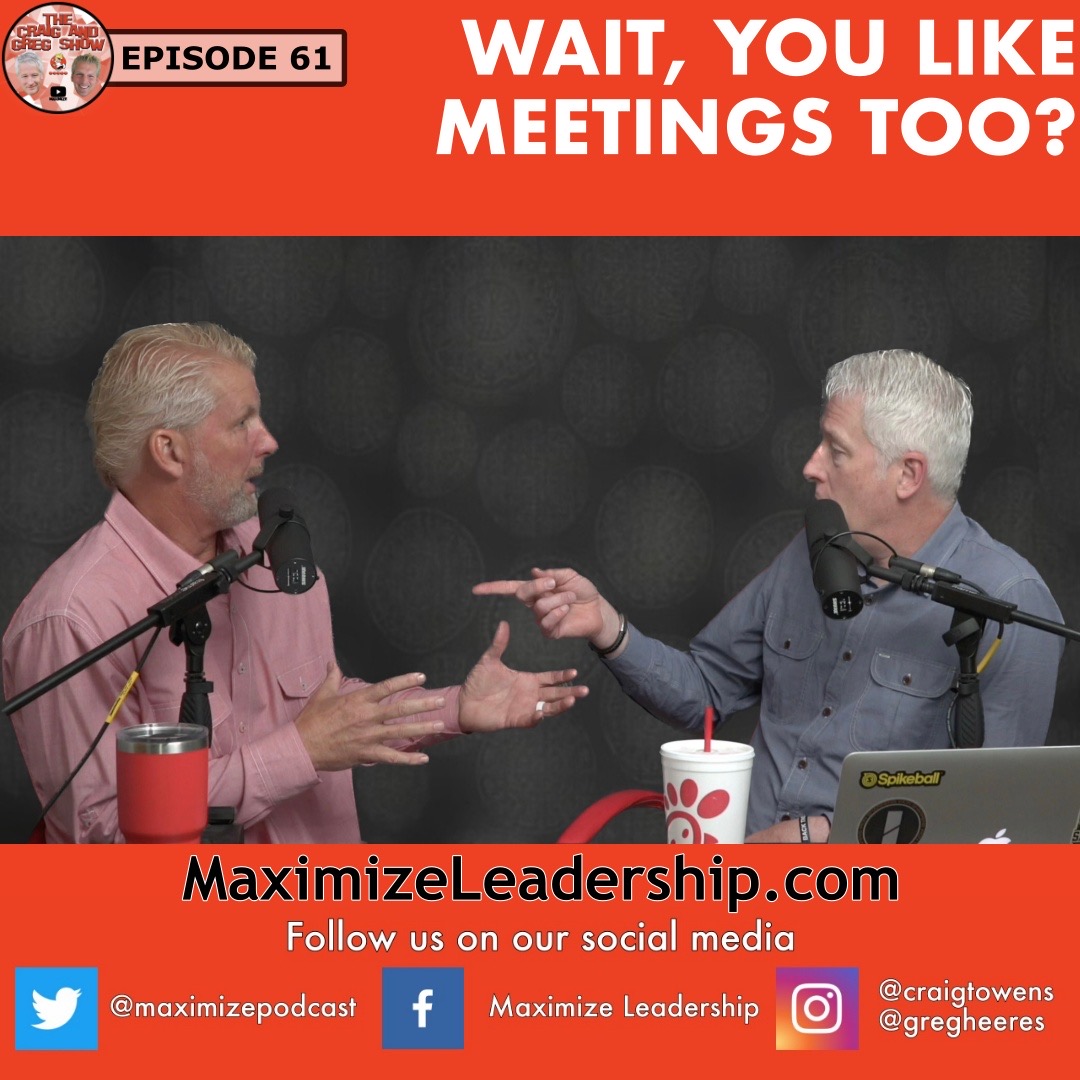
Too often we fall into the trap of seeing meetings as perfunctory, tedious, and downright boring to attend. In this episode, Greg and I are here to tell you, we like meetings! If managed correctly, meetings can be an impactful leadership tool that helps grow and bond your team. So set aside any of your preconceived notions, and let us tell you why they think you should embrace opportunities for meetings.
[0:57] We’re robbing ourselves when we just try to “get through” a meeting.
[2:33] Leaders help everyone learn during the meetings.
[4:00] Don’t spring brand new information on your team at the meeting, but help them prepare to contribute ahead of time.
[5:40] There is a value in getting our teams together.
[7:50] Sometimes the best leadership move is to cancel a meeting.
[9:28] How can leaders make meetings more efficient?
[10:42] A leader’s attendance signals the value of the meeting.
[11:23] Greg has a sarcastic quote that makes a great point about meetings.
[12:57] Not every meeting needs to involve every team member.
[14:36] Leaders need to set expectations before the meeting starts.
[16:37] How insecure leaders sabotage meetings.
[19:01] Be conscious of the workloads of those who are invited to your meetings.
[21:47] How do leaders keep people on-topic during meetings?
Check out this episode and subscribe on YouTube so you can watch all of the upcoming episodes. You can also listen to our podcast on Spotify and Apple.
Never forget that we live among giants. Greg and I would like to encourage you to honor those who gave their lives so we could enjoy the freedom that we have today 🇺🇸 And be sure to check out all of my videos on my YouTube channel.
I am always fascinated by the latest discoveries that scientists are making. Especially when the complexities show the intimate involvement of a loving, all-wise Creator! The Institute for Creation Research reported a new discovery: “Who isn’t curious, at some level at least, about how human brains process all the complicated inputs and outputs that our daily lives require? Neurobiologists take that curiosity to the top floor. Their recent discovery of a new function for certain neurons has suddenly added a new dimension to these tiny processors along with a new take on how they came to be in the first place.”
“All life is an experiment. The more experiments you make, the better.” —Ralph Waldo Emerson
Listen to the audio-only version of this podcast by clicking on the player below, or scroll down to watch the video.
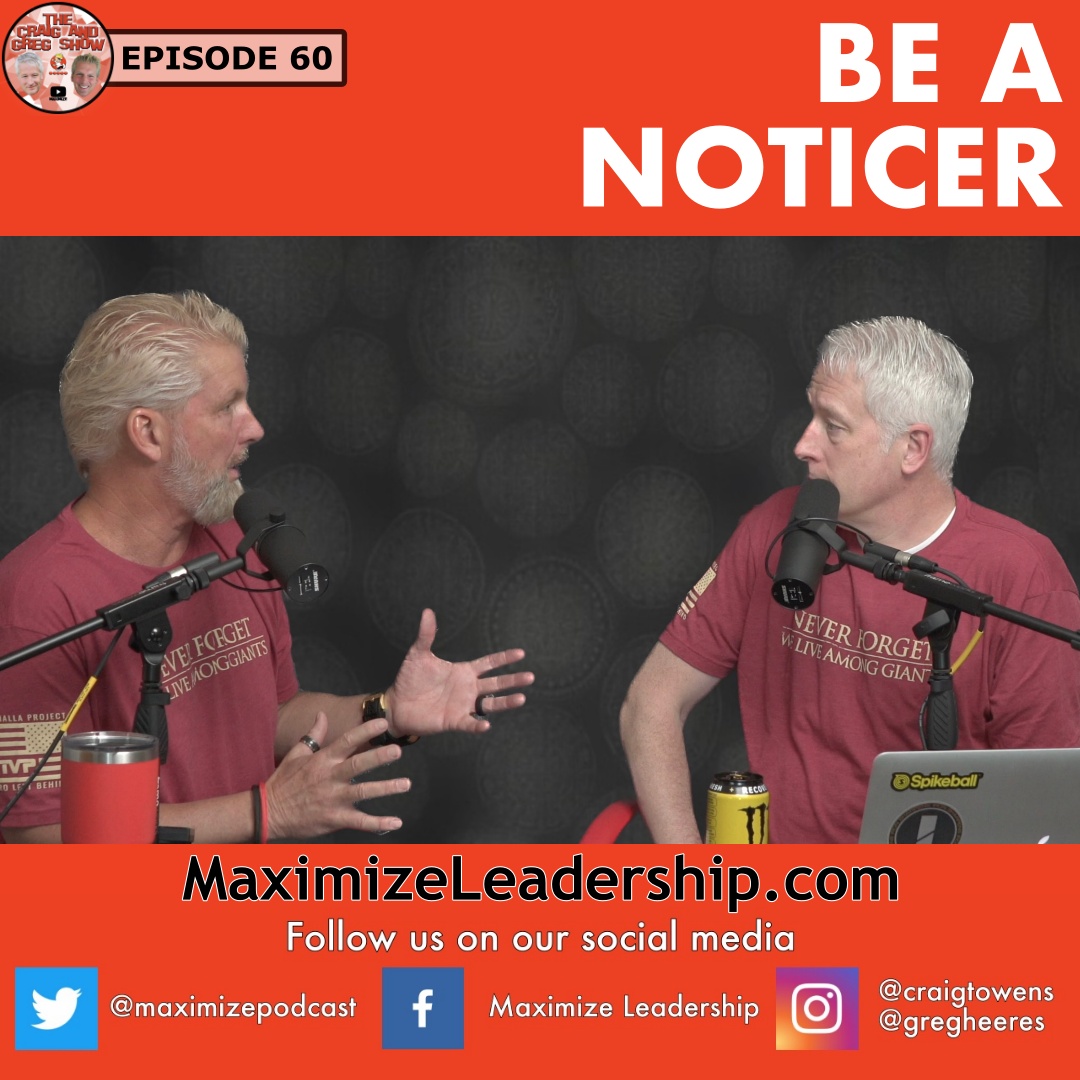
When was the last time you noticed your team? Not just on a surface level like saying hello in the hallway, but really truly paying attention to what’s going on with your team. Noticing is easy to do, but it does require you to spend time doing it. It’s impossible to see what your team is doing locked inside your office, so get out there and notice!
[0:17] Kids on the playground demonstrate an important leadership attribute.
[1:43] Leaders sometimes get too engaged in their work—how do we keep this from happening?
[3:48] People are dying to be noticed!
[6:17] What happens when we do or don’t notice the uniqueness of our teammates?
[9:54] Leaders need to know the difference between windows and mirrors.
[13:25] How our teams reciprocate for their leaders who notice them.
[14:45] There are some huge and lasting benefits when leaders create a culture of curiosity.
[17:11] Greg challenges leaders to learn a leadership lesson from Jesus.
[19:20] We need to build noticing into our weekly schedules.
[21:07] One group that all of should notice and celebrate: Our veterans and the family members of fallen vets.
Check out this episode and subscribe on YouTube so you can watch all of the upcoming episodes. You can also listen to our podcast on Spotify and Apple.
T.M. Moore has a regular series of posts for pastors. This week he shared this, “In his training manual for pastors, Gregory the Great wrote, ‘There are some who investigate spiritual precepts with cunning care, but what they penetrate with their understanding they trample on in their lives: all at once they are teaching the things which not by practice but by study they have learnt; and what in words they preach by their manners they impugn. Whence it comes to pass that when the shepherd walks through steep places, the flock follows to the precipice’ (The Book of Pastoral Rule).” If you are a pastor, I encourage you to check out the Pastor To Pastor posts on The Fellowship Of Ailbe.
On May 22, A.D. 337, Emperor Constantine died. John Stonestreet wrote, “Many Christians think that Constantine was perhaps the worst thing to happen to the Church. They believe he made Christianity the imperial religion, thus leading the Church to compromise with pagan culture, marrying it to state power, and derailing the spread of the Gospel. The Church, they argue, was better off as a persecuted minority.” Please check out this post co-written by Dr. Glenn Sunshine that gives some better historical perspective than perhaps what you have heard previously.
One of the most powerful missions sermons I have heard was preached by Dick Brogden:
An important warning from Axis—What it is: The Surgeon General has issued a warning on the dangers of social media for teenagers. Why the alarm bell is reaching a fever pitch: People have been wary of social media’s impact on developing brains for two decades—so why are highly-visible tone setters, like the Surgeon General and the American Psychological Association, issuing big, sweeping statements now? Part of it could be because we are getting more quality data on how social media shapes a young person’s brain. One newer study that’s been getting some buzz suggests that individuals who received their first smartphone at a later age have better mental health as young adults. Several big bills that aim to protect minors online will be voted on this year as tech giants face increased scrutiny over their safeguards (or lack thereof), for younger users. Kids growing up even a decade from now may encounter a completely different digital landscape when it’s their turn to learn about online literacy.