Listen to the podcast of this post by clicking on the player below, and you can also subscribe on Apple, Spotify, or Audible.
Jesus hung on the Cross for about 6 hours. He was mostly silent during this time—His seven statements from the Cross would have taken less than a minute to say them all back-to-back.
He hung silently and thoughtfully. I know He was thoughtful because John records, “Later, knowing that all was now completed, and so that the Scriptures would be fulfilled, Jesus said, ‘I am thirsty’” (John 19:28).
Movie directors will often show a flashback scene where their character looks back to remember what came before. I think during this silent time on the Cross, Jesus reviewed His public ministry. He reviewed every jot and tittle of every promise His Father had made, and He knew that each and every one had been completed.
This culminating event on the Cross was the fulfillment of the big picture that God had been painting all along. The system of sacrifices centered in the tabernacle or the temple had been trying to show us something.
There were daily sacrifices and annual sacrifices; there were sacrifices for willful sins and sacrifices for unintentional sins; there were sacrifices for priests and for laypeople. Day after day, week after week, month after month, year after year, decade after decade, century after century these sacrifices continued, never feeling like the work was finished.
These practices were only a shadow, but a shadow that foretells the Reality—
The law is only a shadow of the good things that are coming—not the realities themselves. For this reason it can never, by the same sacrifices repeated endlessly year after year, make perfect those who draw near to worship. … The reality, however, is found in Christ. (Hebrews 10:1; Colossians 2:17)
Jesus knew that He had come as the Reality (John 13:1), but before this final event on the Cross that would fully reveal the Reality, Jesus had one last thing to do: He wanted to share a final meal with His friends (Luke 22:7-15).
Jesus said that eagerly desired to eat the Passover meal with them. This Passover remembrance looked backwards to the deliverance from Egypt and was celebrated year after year, decade after decade, century after century.
The events were so long ago that they may have seemed like fading shadows to those who were celebrating this meal over a millennia after the fact. Jesus brought Reality.
Jesus knew He was the most powerful Person on earth, but He also knew that He had come to serve (Mark 10:45; John 13:3-5). To demonstrate His servanthood…
He washed the feet of His betrayer
He washed the feet that would run away from Him in terror
He prepared them for what was coming
Peter boldly declared that he would never run away, and Matthew and Mark record that all of the other disciples declared the same thing—(Luke 22:33; Matthew 26:35; Mark 14:31). But Jesus knew the prophecy that said, “I will strike the Shepherd, and the sheep of the flock will be scattered (Matthew 26:31).
So Jesus prepared them by praying for them, and He prepared them by showing them the Reality of all those daily, weekly, monthly, annual, and Passover sacrifices (Luke 22:17-20, 31-32).
Jesus was the completion of this sacrifices (Hebrews 7:26-28, 9:11-14)!
The prophecy God gave in Jeremiah was completed in Christ’s broken body and spilled blood on the Cross—“For I will forgive their wickedness and will remember their sins no more” (Jeremiah 31:31-34; Hebrews 8:12).
The purpose of this Last Supper—this meal that completes so many jots and tittles—is to remember. The devil wants you to remember what YOU did. Jesus wants you to remember what HE did.
Good Friday and the celebration of Communion helps us remember correctly that Jesus paid in-full the penalty for our sins, so now our forgiven sins are forgotten sins. The moment we sin, there is already the remedy for our sins that has been paid for. We repent, ask forgiveness, and receive His immediate cleaning.
Such amazing love!
If you have missed any of the messages in this series looking at some of the jots and tittles of prophecy that are fulfilled in Jesus, you can check them all out by clicking here.
Listen to the podcast of this post by clicking on the player below, and you can also subscribe on Apple, Spotify, or Audible.
I would like to make a case for you to really slow down this week.
Check out this episode of The Podcast.
Here are some helpful resources from this episode:
I have two series of messages focusing on the Passion Week that will help you go deeper in your Bible study time: Christ’s Passionate Journey (which I mentioned in this podcast) and Bold Claims.
Listen to the podcast of this post by clicking on the player below, and you can also subscribe on Apple, Spotify, or Audible.
I’ve noticed over the years that some people get quite nervous—even fearful—with the thought of God coming close to then. Some people have told me, “I can’t go to church—the roof will fall in on me!”
If I’m honest, I had a time in my life when I feared God’s approach. I didn’t want to pray, “God, use me however You want to” because I just knew He was going to send me somewhere I didn’t want to go, or ask me to give up something that was special to me.
But from the the birth of Jesus until His ascension, the consistent message is: Fear not! and Rejoice!
Matthew 21:4 says that Christ’s arrival on a donkey was “to fulfill” another one of the jots and tittles. And John adds, “Jesus found a young donkey and sat upon it, as it is written, ‘Do not be afraid, O Daughter of Zion; see, your King is coming, seated on a donkey’s colt’” (John 12:14-15).
Typically, conquerors came with a show of overwhelming force, not a show of humility. But Jesus came to Jerusalem with the same message repeated at His birth, “Fear not.”
This is elaborated on in the original prophecy found in Zechariah 9:9-14, where the opening word is, “Rejoice!” We rejoice because He is coming to take away the instruments of war that the occupying forces used to keep the citizens in bondage. He is coming to bring freedom He is coming to announce hope and restoration.
With all of these jot-and-tittle prophecies, we have been asking three questions.
(1) What did it mean then? Quite simply, on that first Palm Sunday it meant that this was not the time for judgment.
(2) What does it mean now? Since the final judgment has not taken place, it must mean it still is not a time of judgment, but a time of favor. God is still drawing people to Himself by His kindness (Romans 2:4).
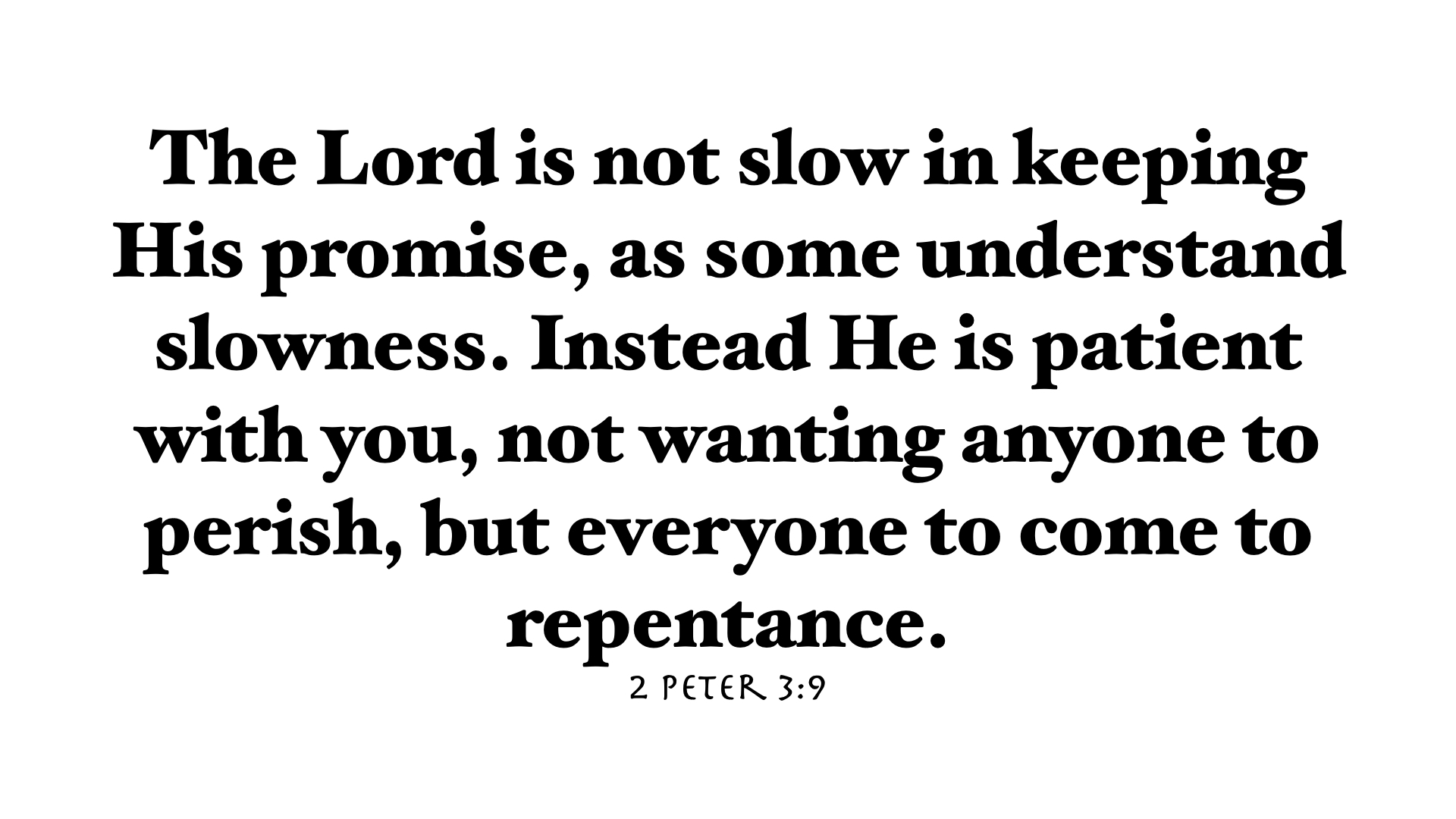
Zechariah 9:14 makes it clear that there will be a day of judgment. And Peter says that God’s not being slow about this, but He is demonstrating His patience so that none will have to perish without Him (2 Peter 3:9-10).
(3) What does it mean for me? It means that I don’t have to fear the approach of God.
First, there is no fear when God calls me to stand before Him because my sins have been forgiven (Romans 8:1).
Second, there is no fear when God asks me to give something to Him because God has equipped me ahead of time to respond obediently. When Jesus sent His disciples ahead of Him to bring back the donkey that He would ride into Jerusalem, Jesus must have already informed the donkey’s owners that this would be coming. The disciples were simply to say, “The Master needs the donkey now.”
God has already prepared me to say, “Yes” to whatever He calls me to do (Psalm 139:16).
Finally, there is no fear when God asks me to give something to Him because I’m only giving back to Him what is already His. You and I are just stewards of what God has given us. When the disciples talked to the steward of the donkey, they assured him, “The Lord needs it and will send it back here shortly” (Mark 3:11). And the prophecy in Zechariah, God says, “Now I announce that I will restore twice as much to you” (Zechariah 9:12). Maybe not here on earth, but the rewards in Heaven will be incalculable for His faithful servants!
Those who know Jesus as their Master can live as fearless stewards.
We don’t fear the requests of our King, but we rejoice to allow Him access. We don’t fear the approach of our Judge, but we rejoice to stand before Him forgiven and rejoicing!
Listen to the podcast of this post by clicking on the player below, and you can also subscribe on Apple, Spotify, or Audible.
The men who were guarding Jesus mocked Him and beat Him. They blindfolded Him and hit Him again and then demanded, “Prophesy! Who hit You?” And it wasn’t just the physical abuse, but they heaped mocking insult upon mocking insult upon Jesus (Luke 22:64-65).
All four of the Gospel writers recount how Jesus responded to both the physical and verbal abuse:
To the false charges before the Sanhedrin, Jesus remained silent (Matthew 26:57-63)
To the spitting and hitting by the members of the Sanhedrin, Jesus remained silent (Matthew 26:67-68)
To the physical abuse of the guards, along with their mocking insults, Jesus remained silent (Mark 14:65; Luke 22:64-65)
To the mocking He endured before King Herod, Jesus remained silent (Luke 23:9-11)
To the false charges announced to Governor Pilate, Jesus remained silent (Matthew 27:12-14)
To the insults and mocking thrown His way as He hung on the Cross, Jesus remained silent (Matthew 27:38-44; Mark 15:29-32; Luke 23:35-36)
His only verbal response was after being slapped in the face by one of the officials in the Sanhedrin. Jesus said, “If I said something wrong, testify as to what is wrong. But if I spoke the truth, why did you strike Me?” (John 18:22-23).
These are what we call an ad hominem attack. That is attacking the person, instead of confronting the ideas or arguments the person is presenting.
The self-control of Jesus here is absolutely astounding! Peter records, “When they held their insults [and their fists and their spit] at Him, He did not retaliate; when He suffered, He made no threats. Instead, He entrusted Himself to Him who judges justly” (1 Peter 2:23).
Even as His trial got underway, Luke records, “the council of the elders of the people…met together, and Jesus was led before them” (Luke 22:66).
Dr. Henry Halley points out that extra-biblical sources have told us that this trial violated at least four of the Sanhedrin’s own rules:
Meeting on the morning of a festival
Meeting in Caiaphas’ personal residence
Trying a defendant without defense
Passing the verdict of a death sentence in one day instead of two days
I would add a fifth rule which is found in Scripture: At least two witnesses need to be in agreement with their testimony for there to be a death sentence (Deuteronomy 17:6, 19:5; Mark 14:55-59).
When the Sanhedrin then hauled Jesus before Pontius Pilate, even their charges made before the governor in Luke 23:1-2 were flimsy at best:
Subversion—there is no proof for this
Opposing taxes to Rome—this was false (see Luke 20:20-25)
Jesus was a rival to the Roman throne—not true
And still Jesus remained almost completely silent! He only spoke when asked a direct question, but He remained silent throughout the false accusations, the verbal taunts, and the physical abuse.
When I am treated unfairly, when the rules are bent against me, when false charges are lodged against me, I get angry! I want to defend myself! I want to put my accusers or abusers in their place!
Could Jesus have prevented His arrest? Yes (Matthew 26:53)!
Could Jesus have defended Himself before the Sanhedrin, Pilate, and King Herod? Yes!
Could Jesus have come down from the Cross to prove His power? Yes!
But Jesus wasn’t trying to win a momentary argument; He was winning souls for eternity!
Jesus came not to be served, but to serve, and to give His life as a ransom for many (Mark 10:45). So, “for the joy set before Him He endured the Cross, scorning its shame, and sat down at the right hand of the throne of God.”
When anger boils up because of the mistreatment we are enduring, we must “consider Him who endured such opposition from sinners, so that you will not grow weary and lose heart” (Hebrews 12:2-3).
Like Jesus, let’s not try to win just a momentary argument that may result in the loss of a soul for all of eternity. There is a time to speak and there is a time for silence. As we keep our eyes on Jesus, we will know what time it is.
Listen to the podcast of this post by clicking on the player below, and you can also subscribe on Apple, Spotify, or Audible.
One of the most effective leadership tools is, sadly, one of the tools that is used the least by most leaders. Let’s figure out how to make it work for you.
Listen to the podcast of this post by clicking on the player below, and you can also subscribe on Apple, Spotify, or Audible.
“Who gave You this authority,” the chief priests twice demanded of Jesus in Luke 20:1-8.
Worldly minded people are always looking for a résumé of accomplishments or the stamp of approval from a superior, so they can demand the unquestioned loyalty from those who report to them. In other words, they are looking for authority from their position that allows them to prove to others that they are in charge.
The “chief priests and the teachers of the law, together with the elders” (v. 1) had earned their positions, or so they thought. They are, therefore, asking Jesus to, “Prove it!” They want to know why Jesus gets to say and do the things He says and does.
Jesus had every right to flex on them! But He knew that His words and deeds spoke for themselves. He “knew that the Father had put all things under His power” (John 13:3) so there was nothing for Him to prove to anyone.
In my book When Sheep Bite, I have a chapter about sheep questioning the authority of their shepherd. In that chapter I wrote—
When our conversation with criticizing sheep hasn’t gone well, and when those unhealthy sheep begin to gossip and then slander, it’s inevitable that they will eventually began to question your authority as a shepherd. Perhaps they think you’re too young and naive, or too old and out of touch. They may question your motives, or the vision you’ve imparted for the church, or your ability to follow through on what you have already shared. Whatever the case, these biting sheep seem to be implying that they know better than you do how this pasture should be run. During times like these, it is tempting to want to “prove” that we are qualified, that we do know what we’re doing, and that we can indeed successfully pursue the vision we’ve articulated for them. Once again, it’s natural to want to say, “I’ll show you just how qualified I am!”
Before we respond, we need to recognize the source of our authority. … Far greater than positional authority is moral authority. This is authority that comes not merely from a title or position, but from who conferred that title or position on the leader. If God has called us and appointed us to this pasture, that is all the authority we need.
Jesus didn’t answer the “Prove it!” demand, but went right on teaching and serving. We need to remember that there is only One to whom we must give an answer. There is only One who can say to us either, “Depart for Me,” or “Well done, good and faithful servant!”
A mark of a godly leader is one who is quietly confident of his moral authority.
As a result, that leader no longer feels the need to prove anything.
This is part 78 in my series on godly leadership. You can check out all of my posts in this series by clicking here.
Listen to the podcast of this post by clicking on the player below, and you can also subscribe on Apple, Spotify, or Audible.
A large crowd surrounded Jesus. “He welcomed them and spoke to them about the kingdom of God, and healed those who needed healing. Late in the afternoon the Twelve came to Him and said, ‘Send the crowd away so they can go to the surrounding villages and countryside and find food and lodging, because we are in a remote place here.’ He replied, ‘You give them something to eat’” (Luke 9:11-13).
Why did the crowds seek out Jesus? They came to Him because they knew He had wisdom, healing, and food for them. As disciples of Jesus, we never know when people will be around us that are in need. In fact, the closer we walk with Jesus, the more needy people will begin to gravitate toward us.
Jesus never intends that we simply give them a verbal blessing like, “Go, be filled and be warm” (James 2:16).
Jesus wants us to give them something substantial.
This means we need to both prepare and stock up ahead of time (be proactive) and we need to be sensitive to the prompting of the Holy Spirit in each encounter we have with a needy person (be reactive).
Jesus also instructed us to have available both old and new treasures to share with people around us (Matthew 13:52). The old speaks to being proactive, and the new is reactive to each thing that we are learning and experiencing.
That means I also want to leave every person better than they were before we crossed paths.
In order to do this, I have to have something substantial—something eternally significant—to give to them. When needy people show up, it is too late for me to prepare.
I want to be always ready. That means I need to be always abiding with my Savior. I need to be learning at the feet of Jesus, filled with the power of the Holy Spirit, and saturated in the love of God, so that I always have something good to give.
Jesus, when you tell me, “Give them something to eat,” I want to give them You. Help me to proactively prepare so that I am ready to react in a way that glorifies You every single time.
Listen to the podcast of this post by clicking on the player below, and you can also subscribe on Apple, Spotify, or Audible.
Can we trust our Bibles? There are some things that skeptics point to that we need to be able to defend—even in this model prayer that we have been studying. We come to the last verse of this prayer, which many of you probably learned or heard as, “For Yours is the kingdom and the power and the glory forever. Amen.” Yet some Bibles have a footnote here that notes that this doxology is not seen in all biblical manuscripts.
We don’t have the autographs (original writings) but we have manuscripts (copied by a trained scribe from the autograph, and then copied from by yet another reliable scribe, and so forth). The oldest calfskin manuscript we have goes back to 1500 BC, and the oldest papyrus manuscript goes back to 2400 BC.
The scribes were incredibly talented and disciplined men. They became a recognized group called the Sopherim (scribes) in about 500 BC. By AD 100, the Talmudic scribes eclipsed them, and then the Masoretic scribes—the most stringent scribes of all—dominated from AD 500-900.
Let’s turn our attention first to the manuscripts that compromise what we call the Old Testament. What did Jesus—and others that lived in His time—call those 39 books of the Old Testament? They were called Scripture. Those books were not in doubt even before Jesus was on earth.
Dr. Peter Flint notes, “The biblical Dead Sea Scrolls are up to 1,250 years older than the traditional Hebrew Bible, the Masoretic text. We have been using a one-thousand-year-old manuscript to make our Bibles. We’ve now got scrolls going back to 250 BC. … Our conclusion is simply this—the scrolls confirm the accuracy of the biblical text by 99 percent.”
In the New Testament era, the disciples of Jesus went out in pairs. Their oral transmission of the news of Jesus and the quoting of Scripture was verified by their traveling partners. Even for those who happened to be by themselves (e.g. Philip in Samaria), there was always follow up by other church leaders.
So the New Testament epistles were written to verify the spoken words—James was the earliest (probably AD 45). The number of manuscripts we have of these New Testament words are simply astounding!
After the canon of the New Testament was completed, the church fathers quoted so much of the New Testament in their letters and books that we could completely reconstruct those 27 books just from their writings.
With this many manuscripts in existence, is it likely that there would variations in manuscripts? Yes. But none of the variations ever discovered have been fundamental enough to change anything in the meaning. Josh McDowell states, “Compared with other ancient writings, the Bible has more manuscript evidence to support it than the top ten pieces of classical literature combined.”
So how do we handle these places where scholarly footnotes tell us of a discrepancy in the existing manuscripts?
Get the context—does this fit with what is happening around it?
Is there corroboration—can we cross-reference it from elsewhere in the Bible?
In the conclusion of the powerful model prayer Jesus has given us, the closing words appear to be a doxology. But I think we can trust this because for three main reasons:
This doxology seems to come full circle with how the prayer begins in: Our Father in heaven, hallowed be Your name, Your kingdom come, Your will be done, on earth as it is in heaven (vv. 9-10).
These words are found almost verbatim in the words of David: Yours, Lord, is the greatness and the power and the glory and the majesty and the splendor, for everything in heaven and earth is Yours. Yours, Lord, is the kingdom; You are exalted as head over all (1 Chronicles 29:11).
As we have noted throughout this prayer series, the focus of this prayer is two-fold: It is both an acknowledgement of the awesome, praiseworthy glory of our God, and it is a petition for our lives to be empowered to help others see our glorious God and Savior for themselves.
For these reasons, this doxology, I believe, is an indispensable part of this majestic prayer.