8 Quotes From “The Mathematical Proof For Christianity”

The Mathematical Proof For ChristianityDan Delzell uses not only math, but many other sciences as well to give some great conversation-starters. Check out my full review of his book by clicking here.

“I live in Nebraska where I serve as a pastor. Imagine someone covering this entire state in silver dollars 6 feet deep. Then mark one coin and bury it anywhere across the state. Next, blindfold a man and have him choose one coin. The odds that he would choose the marked coin are the same odds as getting 8 prophecies all fulfilled in one man. God fulfilled about 300 prophecies in the Person of Jesus Christ. … There is no way one man could have fulfilled all 8 of these prophecies unless God was making it happen. Who else controls history? Who else could give us such irrefutable proof for Christianity? The odds are one in one hundred quadrillion. Here is what that number looks like: 1 in 100,000,000,000,000,000. (This mathematical proof was calculated by Professor Peter Stoner.)”

“What if jurors were presented with 300 pieces of evidence that all pointed to the same person, just like the 300 biblical prophecies all point to Christ. And so you see, you really can come face to face with reality, logic, reason, facts, evidence, and mathematical certainty before you decide whether to accept or reject the Bible.”

“The excessive skepticism shown toward the Bible by important historical schools of the eighteenth and nineteenth centuries, certain phases of which still appear periodically, has been progressively discredited. Discovery after discovery has established the accuracy of innumerable details, and has brought increased recognition to the value of the Bible as a source of history.” —William Albright, biblical and archeological scholar who mastered more than 26 ancient and modern languages 

“The order is for Christianity is: (1) Evidence; (2) Faith; and then (3) Assurance. Christianity stands upon evidence. It is personally received through faith that Jesus died for your sins on the Cross. It brings comforting assurance to those who have stepped out in faith to trust Christ. You will never have the assurance of salvation until you take a step of faith based on the evidence.”

“Jesus didn’t come here to merely provide man with one more option.”

“It may be stated categorically that no archeological discovery has ever controverted a single biblical reference. Scores of archeological findings have been made which confirm in clear outline or in exact detail historical statements in the Bible.” —Nelson Glueck, Jewish archeologist

“Archeological work has unquestionably strengthened confidence in the reliability of the scriptural record.” —Millar Burrows, University of Yale archeologist

“In addressing the manuscript evidence for the New Testament, John Warwick Montgomery correctly states that ‘to be skeptical of the resultant text of the New Testament books is to allow all of classical antiquity to slip into obscurity, for no documents of the ancient period are as well attested bibliographically as the New Testament.’”

Thursdays With Oswald—The New Life In Me

Oswald ChambersThis is a weekly series with things I’m reading and pondering from Oswald Chambers. You can read the original seed thought here, or type “Thursdays With Oswald” in the search box to read more entries.

The New Life In Me

     Oswald Chambers points out several things which affirms that one has experienced the new birth of salvation.

     “If Christ is formed in us, the great characteristic is that we know Him and perceive Him for ourselves. We do not need anyone to tell us about Him now, He is our Lord and Master.” 

     “Where do we go in a crisis? If we are born from above and Jesus Christ is Lord and Master, we will go direct as a homing pigeon to Him.” 

     “When Christ is formed in us, we are a satisfaction to our Lord and Master wherever He places us. The point of importance is to know that we are just exactly where He has engineered our circumstances. There is no ‘foreign field’ to our Lord.” 

     “Another evidence of new birth is that we see the rule of God. We no longer see the haphazard of chance for fate, but by the experience of new birth we are in able to see the rule of God everywhere. … We all see the common occurrences of our daily life, but who amongst us can perceive the arm of the Lord behind them? The saint recognizes in all the ordinary circumstances of his life the hand of God and the rule of God, and Jesus says we cannot do that unless we are born from above. … Nothing happens by chance to a saint, no matter how haphazard it seems. It is the order of God.” 

     “Do we seek to stop sinning, or have we stopped sinning? We are always inclined to make theoretical what God makes practical. Learned divines and others talk about the sin question, and make it a doctrinal matter of dispute. In the Bible it is never, Should a Christian sin? The Bible puts it emphatically: A Christian must not sin. … 

     “When we are born into the new realm the life of God is born in us, and the life of God in us cannot sin (1 John 3:9). That does not mean that we cannot sin; it means that if we obey the life of God in us, we need not sin. God never takes away our power to disobey; if He did, our obedience would be of no value, for we should cease to be morally responsible. By regeneration God puts in us the power not to sin.” 

From The Psychology Of Redemption

As you read through this list, what do you think? Are you trying to be a Christian, or are you letting this new birth simply do its work in you?

3 Possibilities For An Empty Tomb

3 possibilitiesLast week we explored the validity of the evidence for the accuracy of the biblical accounts for the life of Jesus (you can check that out here). You might be one who says, “Okay, I think Jesus was a good Man, but I think it’s a bit of a stretch to believe that anyone could be raised from the dead after three days.” I think that’s a reasonable thing to explore…

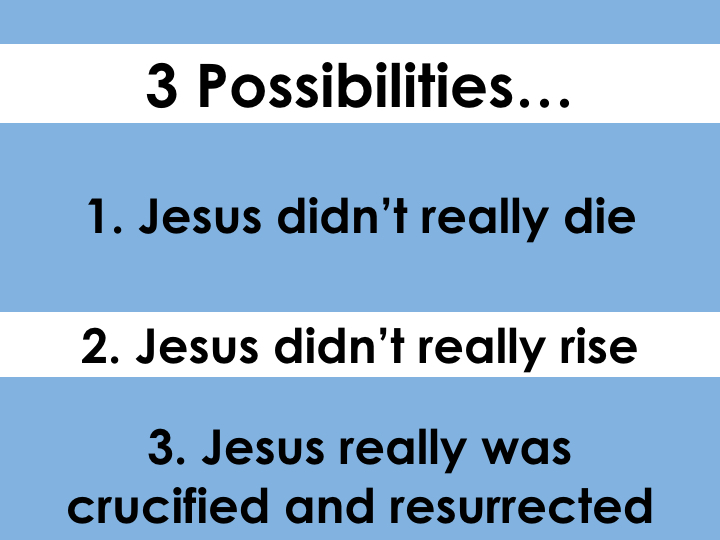
If the tomb where Jesus was placed is really empty, then there are only three possibilities for us to consider.

(1) Jesus didn’t really die.

  • It’s hard to imagine anyone could go through the intense torture Jesus did prior to His crucifixion unscathed.
  • The crucifixion process itself is one of the most gruesome forms of execution man has ever invented.
  • As a result, forensic science shows that Jesus most likely died of a heart attack. The mention in John 19:34 of the blood and water that flowed from Christ’s body is an indication of the cardiac distress His body experienced.
  • Men who were followers of Jesus handled His dead body, and undoubtedly would have checked for any signs life (John 19:38-40).
  • A Roman centurion reported to the Roman governor Pilate that Jesus had in fact died (Mark 15:43-45).
  • Extra-biblical historians, many of whom were unfriendly to Jews and Christians, reported Christ’s death as an historical fact.

(2) Jesus didn’t really rise.

  • Some have claimed that Christ’s followers “saw” Jesus only in a grief-induced hallucination. The problem is, Jesus appeared to individuals, small groups, and large groups multiple times and in multiple settings over the course of 40 days (1 Corinthians 15:3-8).
  • At least one of Christ’s closest followers said he wouldn’t be convinced by verbal testimony alone, but needed to touch Christ’s body for Himself (John 20:24-28).
  • The disciples were afraid and lacked any military training that would have allowed them to get past the trained soldiers guarding the tomb (Matthew 27:62-66; 28:11-15).

(3) Jesus really did die on a Cross and was raised back to life.

Arthur Conan Doyle’s Sherlock Holmes rightly said, “When you have eliminated the impossible, whatever remains, however improbable, must be the truth.”

Real-life cold-case detective J. Warner Wallace explains how detectives use abductive reasoning to examine all of the evidence and infer to the most reasonable explanation from that. As a result, Detective Wallace says about this third explanation:

“The last explanation (although it is a miraculous, supernatural explanation) suffers from the least number of liabilities and deficiencies. If we simply enter into the investigation without a pre-existing bias against anything supernatural, the final explanation accounts for all of the evidence without any difficulty. The final explanation accounts for the evidence most simply and most exhaustively, and it is logically consistent…. The final explanation is also superior to all other accounts (given that it does not suffer from all the problems we see with the other explanations).” —J. Warner Wallace, Alive

The truth is Jesus loved you so much that He had to die for you. He had to pay the penalty for your sins. And God loved His Son so much, that He raised Him back to life. Jesus can live in you now, and you can live with Him forever, if you will simply believe what He did for you on Calvary.

Jesus left an empty tomb behind to show how powerful His love and life is!

Did Jesus Rise From The Dead?

Alive (book review)

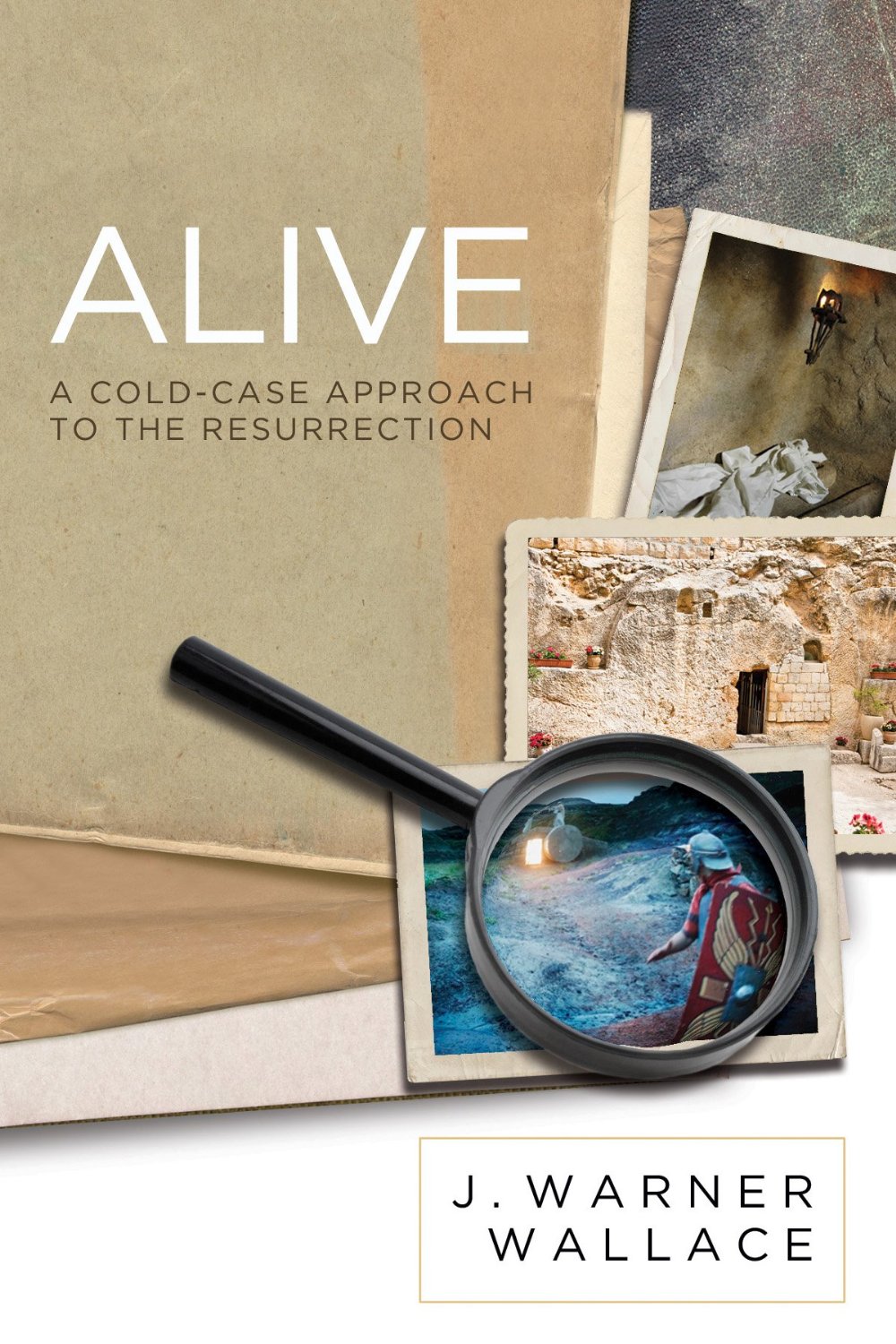
AliveI love the detective-like approach that cold-case detective J. Warner Wallace brings to Christian apologetics! Wallace presents reasonable evidence to lead to a reasonable faith in the biblical claims about Jesus. A quick read to prepare you for Good Friday and Resurrection Sunday is Alive

The material in this short 48-page booklet is taken from Wallace’s book Cold-Case Christianity, and is a just-the-facts look at the resurrection account of Jesus Christ. This booklet will prepare you to give a good answer to anyone who asks you about your faith.

These booklets are sold in a 10-pack, so buy a pack and pass them out to your friends who want to learn how to defend their Christian faith, or give one to a friend or coworker who is still skeptical about the accounts in the Bible surrounding Christ’s death and resurrection. All who read Alive will learn something they didn’t know before.

A great read!

4 Ways To Evaluate Biblical Evidence

Reliability of the GospelsTo be honest, if someone hasn’t heard the biblical account of the life of Jesus Christ before, it can sound quite fantastic! Jesus was born of a virgin, lived a sinless life, performed miracles no one had seen before, died a horrific martyr’s death, was raised back to life three days later, and then ascended back into heaven until He returns to Earth again.

But as fantastic as this sounds, there is still enough evidence to reasonably believe it’s all true. An unreasonable faith believes in something in spite of the evidence; a blind faith believes in something without any evidence; and reasonable faith believes in something because of the evidence.

The Bible gives us eyewitness testimony about the life of Jesus which we can matter-of-factly evaluate. 

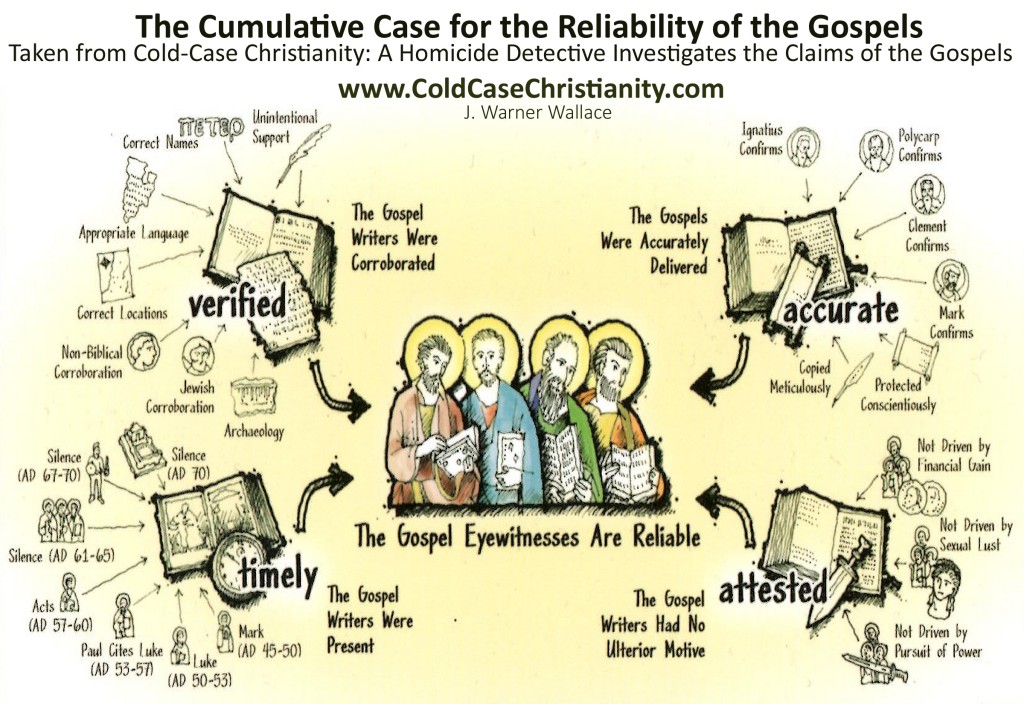
In a modern-day court of law, eyewitness testimony is evaluated on…

  • …the determination that the witnesses were actually present.
  • …the ability to corroborate their testimony.
  • …the consistency of their testimony over time.
  • …any biases they have that would cause them to exaggerate or misrepresent their testimony.

Let’s consider the testimony of the four Gospel writers: Matthew, Mark, Luke and John.

(1) Were The Eyewitnesses Present?

  • Luke is considered a credible historian, even by modern standards. He wrote the book of Acts following the ascension of Jesus into Heaven. Because he did not mention three major events in Jewish history (the Jewish uprising, the Roman siege of Jerusalem in response to that uprising, and the Roman destruction of the temple), we can determine that Acts was written before 61 AD.
  • Luke wrote the Gospel that bears his name before he wrote Acts. The Apostle Paul referenced portions of Luke’s Gospel in letters we can date by Paul’s Roman imprisonment, which means Luke was written prior to 53-57 AD.
  • Luke uses the Gospel of Mark as one of his references, which means Mark was probably written in 45-50 AD, just 10-15 years after the events of Christ’s life.
  • Mark was closely associated with the Apostle Peter, who was most assuredly Mark’s “source” in writing his Gospel, and Peter was one of the original twelve apostles called by Jesus.
  • Matthew and John were both apostles of Jesus, living and working closely with Jesus for over three years.

(2) Is Their Testimony Corroborated?

  • Archeological finds continually demonstrate the accuracy of the people, titles, places and details the Gospel writers mention.
  • Outside—or extra-biblical—sources like Josephus (a Jewish historian who wanted to preserve the purity of Judaism), Tacitus (a Roman historian), and Mara Bar-Serapion (a Syrian historian)—all who wrote between 40-70 AD—affirm things like where Jesus lived, the miracles He performed, the manner of His death, His resurrection, and the changed lives of people who believed in Jesus Christ.
  • In addition, Paul wrote of the “five hundred of the brothers” who were also eyewitnesses to the resurrected Christ (1 Corinthians 15:3-8).

(3) Has Their Testimony Remain Unchanged Over Time?

  • The history and accuracy of the scribes had already been demonstrated in the preservation and transmission of the Old Testament over a period of 1400 years.
  • These same scribal techniques were not only used in the transmission of the New Testament, but in subsequent years the Masoretic scribes became even more meticulous in the techniques they used.
  • The “chain of custody” of evidence can be absolutely traced from the Gospel authors, to their students, and to the writings of the Church Fathers.
  • In fact into the third-century AD, the writings of the Church Fathers contain so many direct quotations from the New Testament, that we can almost completely reconstruct the New Testament from their writings.

(4) Is Their Testimony Unbiased?

  • These eyewitnesses didn’t gain anything financially by their testimony. In fact, many of them lost or gave up all their possessions to tell others about Jesus.
  • They didn’t gain political power or influence that could save their own lives. All of the original apostles (except John) died a gruesome martyrs’ death.
  • In short, they had nothing to gain by making up and reporting a false story about Jesus.

All of these points make it reasonable to believe the evidence presented in the Bible about Jesus Christ is true. Check out this video where I elaborate a little more on each of these points—

If you live in the Cedar Springs area and don’t have a home church, I would love for you to visit with us Easter Sunday morning at 10:30am. We’ll be examining the evidence for Christ’s resurrection from the dead. Click here to get more details.

Why The Cross?

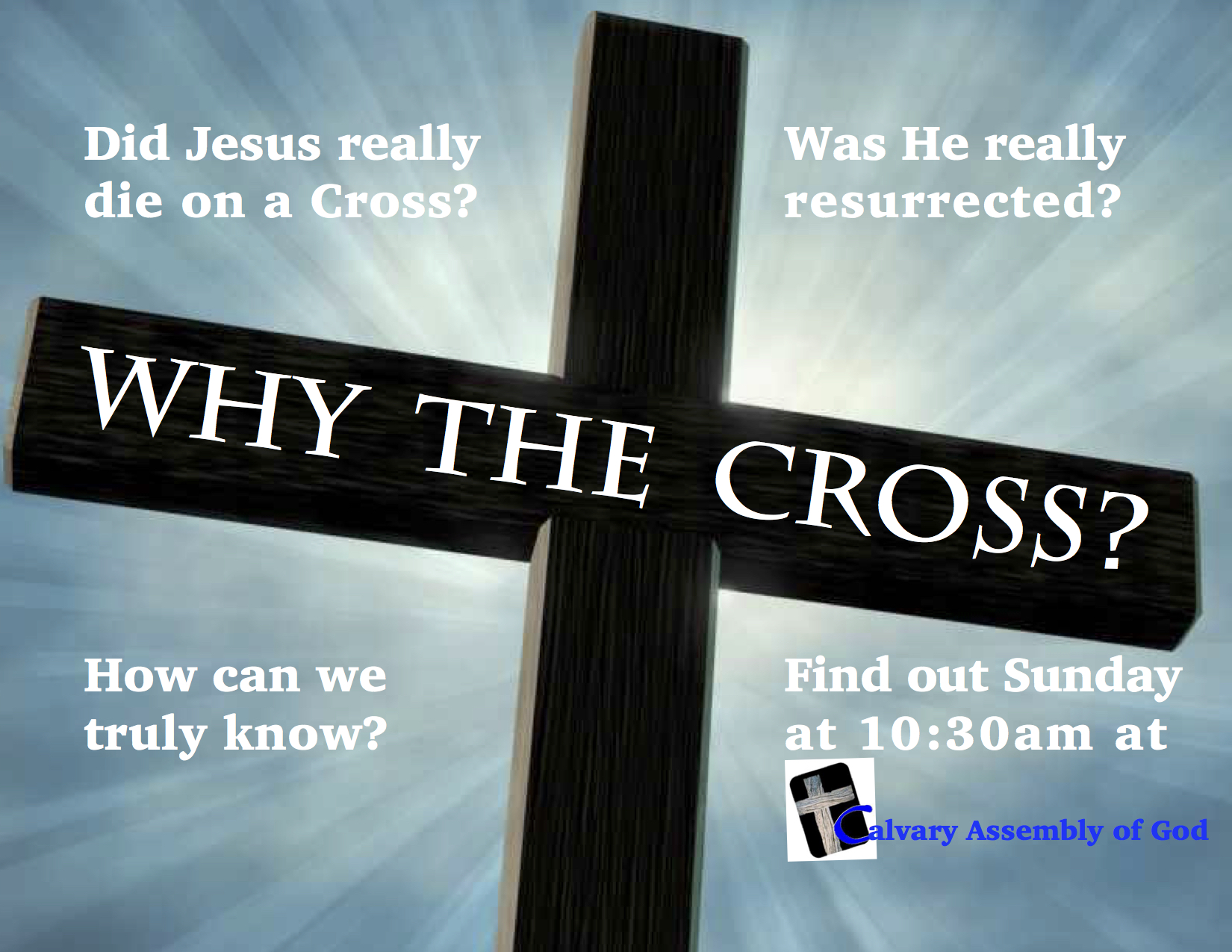
Why The CrossCrucifixion seems so extreme (click here to read The Horrors of Crucifixion)! Why would God allow His Son to go through this?

But perhaps we should back up a step or two. Before asking why the Cross maybe there are some other questions we should explore. Questions like…

  • Did Jesus actually die?
  • Is the account true that Jesus came back to life?
  • How can we know for sure?
  • Is this just too fantastic to believe? Or is the evidence reasonable?

These are questions we must all wrestle with, especially those who call themselves Christians. After all, Christian means a follower of Jesus Christ who believes that Jesus in fact died on a Cross and was raised back to life three days later.

Join me this Sunday was we explore the reliability of the evidence. Then on Easter Sunday morning we will consider the claims that Jesus died and came back to life, as well as the claims that this is all make-believe stuff.

You won’t want to miss this! Click here to find a map to our meeting place. If you cannot join us in person, we will be broadcasting live on Periscope (click here to find the account to follow to be notified when the broadcast begins).

12 Quotes From “In Light Of Genetics”

Dr. John SanfordDr. John Sanford’s ebook In Light Of Genetics is fascinating reading. It’s a bit technical in certain places, but I think Dr. Sanford does a good job making the genetic concepts accessible to almost anyone. Check out my book review by clicking here. Below are some quotes from this work.

“Forensic evidence is never conclusive, and so scientific claims about the distant past must always contain an element of belief. The direction of genetic change is down, not up. Humanity is devolving due to mutation.”

“We feel biological similarities between different kinds of life are better explained by a Common Designer than by common descent.”

“We are unique and alone now in the world. There is no other animal species that truly resembles our own. A physical and mental chasm separates us from all other living creatures. There is no other bipedal mammal. No other mammal controls and uses fire, writes books, travels in space, paints portraits, or prays. This not a question of degrees. It is all or nothing; there is no semi-bipedal animal, none that makes only small fires, writes only short sentences, builds only rudimentary spaceships, draws just a little bit, or prays just occasionally.” —Juan Arsuaga, writing in The Neanderthal’s Necklace

“Man is a singular creature. He has a set of gifts which make him unique among the animals: so that, unlike them, he is not a figure in the landscape—he is a shaper of the landscape.” —Jacob Bronowski

“From a genetic point of view, the genes that enable our unique capabilities, gifts, and talents (i.e., science, art, love, relation to God) could not arise by any series of random mutations filtered by natural selection—not in any amount of time. There is no credible mechanism that could lead to spontaneous origin of mind, consciousness, intelligence, soul, or spirit. Indeed, while these human traits are found within a biological context (i.e., within an animal-like body/brain), they clearly transcend mere biology. We are exquisitely programmed to be more than animals, and our bodies are well-designed vessels that house our immaterial being: mind, soul, and spirit.”

“Leading human geneticists agree that in mankind deleterious (bad) mutations are accumulating faster than they are being selected away, and so the human genome is degenerating. … The data are highly consistent. The coefficient of determination (matching the curve to the data) is very high: 0.96. Due to the consistency of the decay rate, we can also rule out the idea that there were hundreds (or thousands) of missing generations that were not recorded. We conclude that the genealogical record must either be complete or very nearly complete. This validation of the genealogical record very powerfully points to the historicity and reliability of the book of Genesis.”

“Mounting evidence shows that natural selection is not a creative force, but is a stabilizing force that helps preserve the various kinds of life (i.e., it culls out the most dysfunctional individuals). It is very clear that natural selection cannot create our genome, let alone our mind and soul. At best, natural selection can only slow down the rate of genetic degeneration. … Because of the great abundance of deleterious mutations and the extreme rarity of beneficial mutations, it is not possible for mankind to achieve a net gain of genetic information.”

“Our latest numerical simulations show that in the type of pre-human population that supposedly gave rise to modern man, billions of years would be required just to create and establish a new genetic text string as small as six or seven letters, such as ‘GTCGCT’ or ‘GAGTTCA.’ Yet such a string would be just a drop in the ocean of new information needed to transform an ape into a man.”

“In the biblical model, humanity begins with Adam and Eve, who descendants rapidly multiply, and then, went through a one-generation bottleneck at the time of the Flood, then the population once again rapidly increased, followed by rapid divergence at the Tower of Babel event, creating today’s people groups.”

“If Adam’s genome was intelligently designed, it would obviously have had a great number of designed genetic variants. Otherwise all people would essentially be clones of Adam and Eve, which would be bad design, for many obvious reasons. … Even though many mutations have accumulated in the genome during human history, it is reasonable to conclude that most observable human genetic variation was created by God. The biblical perspective has unique explanatory power in terms of giving a credible explanation for the amazing range of human traits and abilities. There is no single ‘superior genotype.’ We all have unique sets of gifts and talents, which very reasonably reflect good design, and for which we can give thanks to God.”

“We have statistically analyzed over 800 human mitochondrial sequences and have been able to reconstruct and publish a very close approximation of Eve’s mitochondrial sequence. We found that the average human being is only about 22 mutations removed from the Eve sequence, although some individuals are as much as 100 mutations removed from Eve. Can we account for this amount of mutation in a biblical timeframe? Easily. The most recent estimate of the mutation rate in human mitochondria is about 0.5 per generation. Thus, even for the most mutated sequences, it would only require 200 generations (less than 6,000 years) to accumulate 100 mutations.”

“Now, by God’s grace, we do not have to choose between faith in God’s Word vs. faith in science, we can embrace both. There is now very strong genetic evidence that strongly supports Scripture and refutes evolution.”

Links & Quotes

link quote

“The job isn’t to catch up to the status quo; the job is to invent the status quo.” —Seth Godin

Check this out: just 2 verses of Scripture, but 22 verified historical confirmations!

J. Warner Wallace explains why we should trust a courtroom over a laboratory when evaluating the truthfulness of historical events.

Seth Godin tells us how to win an argument with a scientist.

I know you read this from me (a lot!), but I love what the folks at The Overview Bible Project do. Check out this overview of the Gospel of John.

[VIDEO] John Maxwell on the power of implementation—

[VIDEO] Dr. Bobby Conway answers a tough question: what is habitual sin?

Links & Quotes

link quote

Who are the happiest people in the world? These precious people!

“The sense of ownership in general is always to be encouraged. The humans are always putting up claims to ownership which sound equally funny in Heaven and in Hell and we must keep them doing so.” —C.S. Lewis, in The Screwtape Letters

“There are ten thousand actions good in themselves, which it might not be right for me to choose as my vocation in life. … Our prayer should be, ‘Show me what Thou wouldst have me to do’—have me to do in particular; not what is generally right, but what is particularly right for me to do.” ―Charles Spurgeon

J. Warner Wallace gives an important reminder to Christian apologists: The Evidence For Christianity Doesn’t “Tell” Us Anything.

[VIDEO] Here is another helpful reminder for Christian apologists on textual variants―