Weigh The Options

Cross-bearersThe message Jesus had to deliver to the church at Smyrna (Revelation 2:8-11), was a heavy message. It’s a message I believe Christ is still speaking to the church today. In essence Jesus said, “I know how hard it’s been for you as a Christian. You’ve stood tall so far, but brace yourselves because more persecution is coming.”

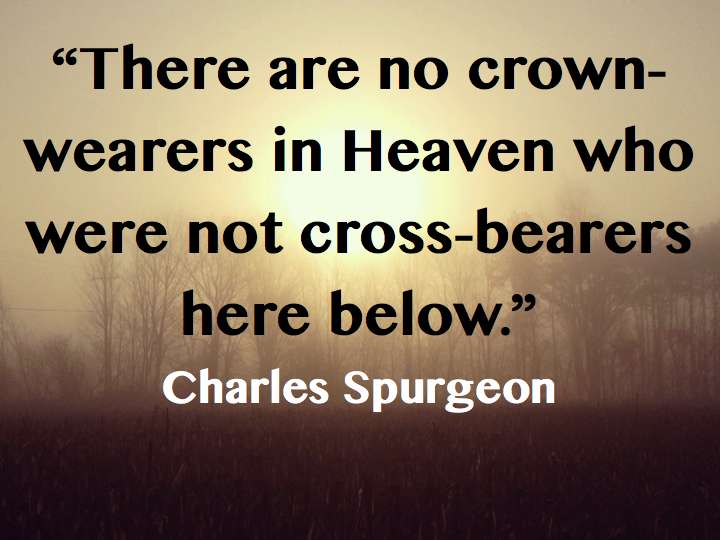
Charles Spurgeon said, “There are no crown-wearers in Heaven who were not cross-bearers here below.” How true!

But I love the message from Jesus to us: “Yes,” He says, “things are hard, but weigh those things against the rewards I have for you! Hang in there! You will bring Me glory and you will earn the very highest rewards I can give!”

I tried to illustrate Christ’s message this way—

I will be continuing my series on The 7-Star Church next Sunday. If you are in the Cedar Springs area, I would love to have you join us!

The Returning King

Listen to the podcast of this post by clicking on the player below, and you can also subscribe on AppleSpotify, or Audible.

John opens the book of Revelation with this greeting: Grace and peace to you from Him who is, and who was, AND WHO IS TO COME… (Revelation 1:4). This is so significant because of the other descriptive phrases John uses for Jesus:

  • Jesus was pre-existent before creation (John 1:1).
  • John was witness to everything Jesus did during His public ministry, including all of the claims Jesus made about Himself (1 John 1:1).
  • And now John says not only has Jesus existed before time existed, not only is He alive now, but He is coming back again!

This is what makes the resurrection of Jesus so important. Jesus Himself told us exactly what was going to happen with His death by crucifixion and His resurrection three days later. The fact that these statements all turned out to be true gives us greater assurance that His promise that He is coming back is also true.

In His very first sermon, Jesus quoted from Isaiah about how He would conduct His earthly ministry (see Isaiah 61:1-2 and Luke 4:18-19). But when He quotes the passage from Isaiah, He leaves off a phrase “and a day of vengeance of our God.” God’s wrath against sin is being held back for now, but the day of judgment is coming.

John says Jesus is the One Who is to come, and records later on how Jesus will come—

     I saw Heaven standing open and there before me was a white horse, whose rider is called Faithful and True. With justice He judges and wages war. His eyes are like blazing fire, and on His head are many crowns. He has a name written on Him that no one knows but He Himself. He is dressed in a robe dipped in blood, and His name is the Word of God. The armies of Heaven were following Him, riding on white horses and dressed in fine linen, white and clean. Coming out of His mouth is a sharp sword with which to strike down the nations. “He will rule them with an iron scepter.” He treads the winepress of the fury of the wrath of God Almighty. (Revelation 19:11-15)

God made Jesus to be sin for us. He suffered and died to pay the penalty for our sins, and those who are still found in their sins—unforgiven, without placing their faith in Jesus Christ’s sacrificial death and resurrection—must face the wrath of God.

Jesus is not only our Risen Savior, but He is the soon-returning King and Judge. 

Three times the last book of the Bible records Jesus Himself saying, “I am coming soon!” This isn’t a scare tactic, it’s real. As certainly as Jesus rose from the grave, He is returning soon.

Are you ready for His return? Are you telling others that Jesus is our soon-returning King? I hope you know what it means to have Jesus as your Lord and Savior, and I hope you are telling as many other people as you can about our soon coming King!

If you have missed any of the messages in this series called Who Is Jesus?, you can find them all here.

►► Would you please prayerfully consider supporting this ministry? My Patreon supporters get behind-the-scenes access to exclusive materials. ◀︎◀︎

At Last!

Jesus is our atonementThe Day of Atonement was a very special day for the Jewish people. It was called by some the Sabbath’s Sabbath, as it was the most holy day of the year. It was the day everyone looked forward to, because finally they could have forgiveness for their sins.

The word atonement in the Hebrew meant that a payment was made that was equivalent to the offense that was committed. The offense was huge: Sin was open rebellion against Almighty God, it was to spit in the face of our Heavenly Father, it was to slap away His hands that were reaching out to embrace us. Nothing short of a death could atone for that sort of offense!

So the high priest would go through an elaborate ceremony of washing himself and putting on special garments that were only to be worn on this Day of Atonement. Because the high priest was also a sinner himself, his first sacrifice was a bull. The blood from this sacrifice was taken by the high priest into the Most Holy Place of the temple to cover his own sins, before he could even approach God to ask for the forgiveness of the sins of anyone else.

After having completed this step, the high priest could then proceed. He would sacrifice a goat as a sin offering for the people. As he did with the bull’s blood, he would take the goat’s blood back into the Most Holy Place to ask God to show mercy toward people who had sinned, to turn away His holy wrath against their rebellion. Then the priest would lay his hands on a second goat, one that was still alive, and confess all of the sins of the people. This goat (called the scapegoat) was then taken out into the desert. This symbolized the removal of the people’s guilt, making it possible for them to be in relationship with God once again.

This was repeated year after year after year. It was repeated because the people continued to sin. It was repeated because these rituals were only a shadow of what God really wanted to accomplish. David wrote about the futility of these sacrifices—

Sacrifice and offering You did not desire—but a body You have given me—burnt offerings and sin offerings You did not require. Then I said, “Here I am, I have come—it is written about me in the scroll. I desire to do Your will, my God; Your law is within my heart.” (Psalm 40:6-8)

A beautiful thing happened through the ministry of Jesus on earth. Jesus came to be both the perfect high priest (one without sin, who did not need to purify Himself), and the perfect sacrifice. Jesus is called the once for all sacrifice of atonement for us, as He embodied the cry David made nearly 1000 years earlier. Hebrews 10:5-7 says that the words uttered by David prophetically were repeated by Jesus: “Here I am, I have come—it is written about me in the scroll. I desire to do Your will, my God; Your law is within my heart. I will be the once for all sacrifice.”

When Jesus told us the the new covenant was in His shed blood on Calvary’s Cross, He was saying that no longer would we have to wait until the Day of Atonement to find forgiveness; no longer would we have to wait upon an imperfect earthly priest to offer a sacrifice for us; no longer would we have to carry around the guilt of our sin and feel separated from God’s presence while waiting for a special ceremony. AT LAST! We can have immediate forgiveness, eternal redemption, and an everlasting relationship with God because of what Jesus did for us once for all!

As you celebrate Holy Week, be thrilled with the truth that Jesus’ death on the Cross makes it possible for you to have complete atonement. Our Savior has redeemed us AT LAST!

If you have missed any of the messages in this series called Who Is Jesus?, you can find them all here.

God Chose You

Listen to the podcast of this post by clicking on the player below, and you can also subscribe on AppleSpotify, or Audible.

Sometimes life is hard and we can lose sight of a very important fact. Through the trials, and the testings, and the difficult situations, and the valleys, and the times we’re tempted to throw in the towel, you must remember this one fact…

God chose to give you birth (see James 1:18).

You are not an accident.

You are not an after-thought.

You are not an unintended consequence.

God chose to give you birth.

He planned for you to be here.

Therefore He pours out His lavish gifts, including the greatest gift of all—eternal life.

Think about it: What greater proof is there that God chose you than He sent His Son to earth to make it possible for you to live with Him forever! 

Let those words sink in—GOD WANTS YOU WITH HIM FOREVER!

God chose to give you birth, and to give you a second birth—eternal life.

For God so loved you, that He gave His One and Only Son as a sacrifice for your sins. If you believe that, you will spend eternity with Him! 

God chose you!

►► Would you please prayerfully consider supporting this ministry? My Patreon supporters get behind-the-scenes access to exclusive materials. Like some exclusive quotes from a book I just reviewed. ◀︎◀︎

The End?

Listen to the podcast of this post by clicking on the player below, and you can also subscribe on AppleSpotify, or Audible.

When Jesus was arrested, almost all of His disciples ran away. Peter, however, stayed somewhat close to Jesus, but not for the reason I originally thought.

Meanwhile, Peter followed Him at a distance and came to the high priest’s courtyard. He went in and sat with the guards and waited to see how it would all end. (Matthew 26:58 NLT)

Peter waited to see how it would all end.

Peter thought, “This is the end, roll the credits, turn out the lights, we can all go home now.”

When we think we can figure out how it will all end, our faith is too small. It’s not our story—it’s HIS story. And God’s story never ends for those who love Him. Their story is a perpetual, never-ending love story that gets better and better as eternity rolls on!!

Don’t put a period where God hasn’t put one. Don’t look for how it’s going to end. If you are a follower of God, you have His eternal life. That means the story never ends. It goes on and on and on and on….

Trust in the Lord always, for the Lord God is the eternal Rock. (Isaiah 26:4)

►► Would you please prayerfully consider supporting this ministry? My Patreon supporters get behind-the-scenes access to exclusive materials. Like this exceptional Bible study tool to help with Creation apologetics. ◀︎◀︎

Free To Be A Slave

I just love the oxymorons in the Bible! Without the spiritual component, these statements appear to make no sense at all. But through the lens of God’s Word, they are energizing!

Like this one: I can be free to be a slave.

Usually we think of freedom in terms of, “I’m free to do whatever I want to do.” In the natural this is freedom; but in the spiritual it’s slavery.

Think of it this way. When I say, “I’m free to do whatever I want to do,” I’m saying that I am in charge. But I am sinful … selfish … envious … short-sighted … petty … vengeful … and a whole laundry list of other nasty things. So when I want to do what I want to do—when I think I’m free to control my own life—I’m still a slave. A slave to sin.

There’s a price for this “freedom” to be my own boss. The price is death (see Romans 6:23).

But because of what Jesus did for me on the Cross, I don’t have to have this “freedom” that leads to death. I can be free to be a slave. Check this out:

But now you are free from the power of sin and have become slaves of God. Now you do those things that lead to holiness and result in eternal life. (Romans 6:22)

I have a choice to make:

  1. I can choose to call my own shots (so-called “freedom”), and have to pay the penalty of death; or,
  2. I can choose to be a slave of God, and receive His gifts of holiness and eternal life.

I’m choosing option #2!

How about you?

A Tale Of Two Funerals

I was involved in two funerals in the last three days, and they couldn’t have been more different.

At both funerals people said goodbye in their own way.

At both funerals family members cried.

At both funerals there was singing.

At both funerals the life of the deceased was celebrated.

At both funerals loved ones grieved.

The huge difference was how they grieved.

The Apostle Paul wrote, “Brothers and sisters, we want you to know about those Christians who have died so you will not be sad, as others who have no hope” (1 Thessalonians 4:13).

Paul says that we are sad, we grieve, but we grieve differently when we have hope. What hope? The hope of life after death. The hope that only belief in Jesus can bring. Jesus said, “I am the resurrection and the life. Anyone who believes in Me will live, even after dying. Everyone who lives in Me and believes in Me will never ever die” (John 11:25-26).

At Thursday’s funeral the family grieved deeply because they had no hope of life after death, no assurance, only wishful thinking.

At today’s funeral it was a joy to grieve with a family because they had such solid hope! They have an absolute, unshakable assurance that their loved one has life after death. And that makes all the difference in the world in how they will grieve.