Thursdays With Spurgeon—Proof Of God’s Love

This is a weekly series with things I’m reading and pondering from Charles Spurgeon. You can read the original seed thought here, or type “Thursdays With Spurgeon” in the search box to read more entries.

Listen to the podcast of this post by clicking on the player below, and you can also subscribe on AppleSpotify, or Audible. 

Proof Of God’s Love

I have written for him the great things of My law, but they were considered a strange thing. (Hosea 8:12) 

     It is no mean proof of His goodness, that He stoops to, rebuke His erring creatures. It is a great argument of His gracious disposition, that He bows His head to notice terrestrial affairs. … He might dwell alone, far, far above this world, up in the seventh heaven, and look down with calm and silent indifference upon all the doings of His creatures. He might do as the heathens supposed their Jove did, sit in perpetual silence, sometimes nodding his awful head to make the Fates move as he pleased. But Jove never thought of the little things of earth, disposing of them as beneath his notice, engrossed within his own being, swallowed up within himself, living alone and retired. … 

     We see from our text that God looks upon man, for He says of Ephraim, ‘I have written for him the great things of My law, but they were considered a strange thing.’ But see how when He observes the sin of man He does not dash him away and spurn him with His foot? He does not shake him by the neck over the gulf of hell until his brain does reel and then drop him forever. But rather, He comes down from heaven to plead with His creatures. He argues with them, He puts Himself, as it were, upon a level with the sinner, states His grievances, and pleads His claim.

From The Bible

In my sermon this last Sunday I was leading my congregation through Psalm 89. I noted that there were two important blessings that Ethan the Ezrahite tells us of: 

  1. The blessing of God’s favor on our obedience 
  2. The blessing of God’s discipline on our disobedience

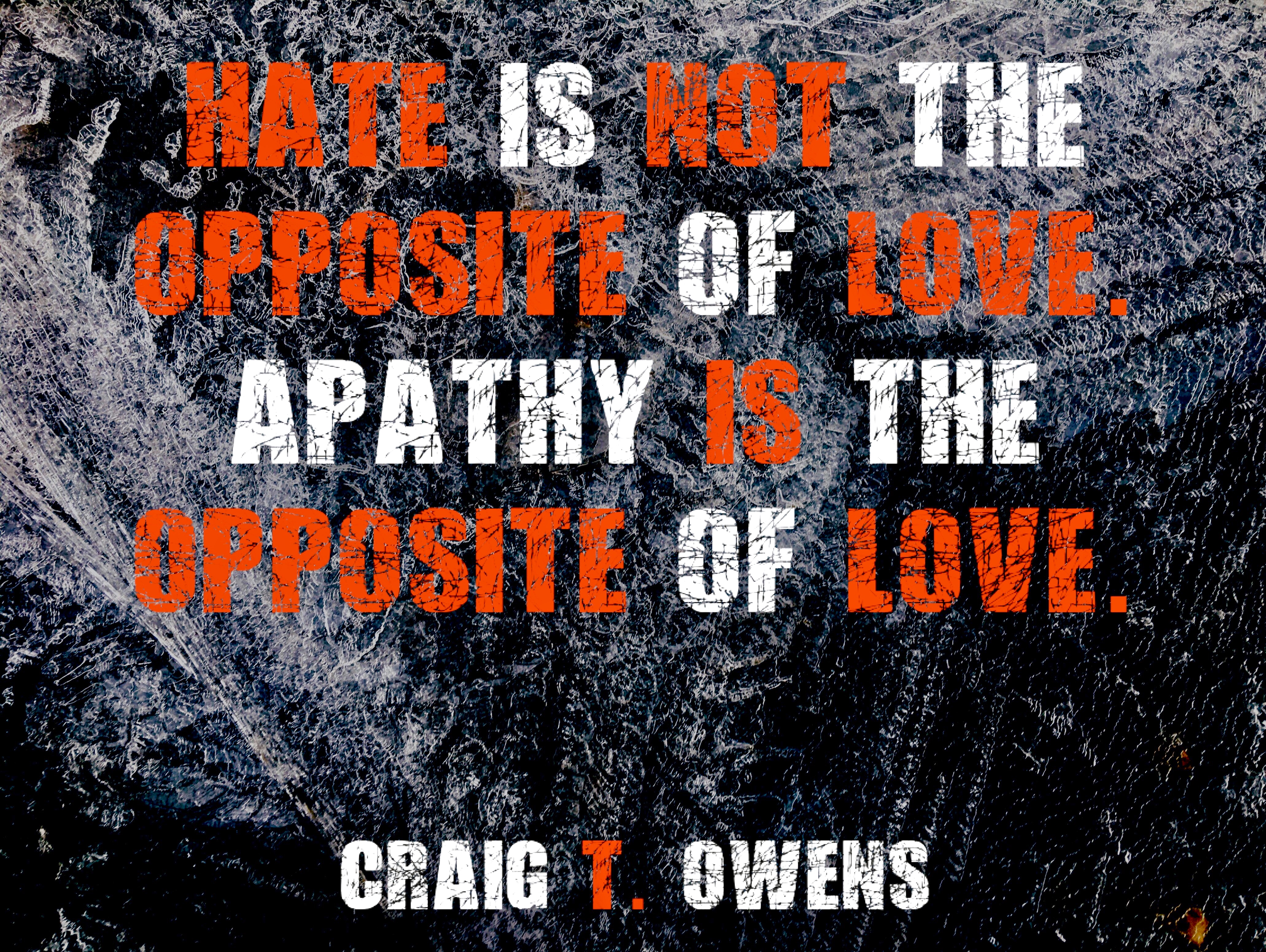
Yes, the fact that God disciplines us—that He “stoops to rebuke His erring creatures”—is positive proof of His immense, unending love for us. The opposite of love is not hate but apathy. If God didn’t love us, He wouldn’t personally involve Himself in our lives because neither our obedience or disobedience would mean a thing to Him. 

Consider this passage—

In all their affliction He was afflicted,
and the Angel of His Presence saved them;
in His love and in His pity He redeemed them;
and He bore them and carried them
all the days of old.
But they rebelled and grieved His Holy Spirit;
so He turned Himself against them as an enemy,
and He fought against them
. (Isaiah 63:9-10)

In His love, God both carries us in our adversity AND turns to confront us in our waywardness. BOTH of these actions are proof of His love. My friend, wherever you are and whatever you may be facing, be assured of God’s unquenchable love for you!

►► Would you please prayerfully consider supporting this ministry? My Patreon supporters get behind-the-scenes access to exclusive materials. ◀︎◀︎
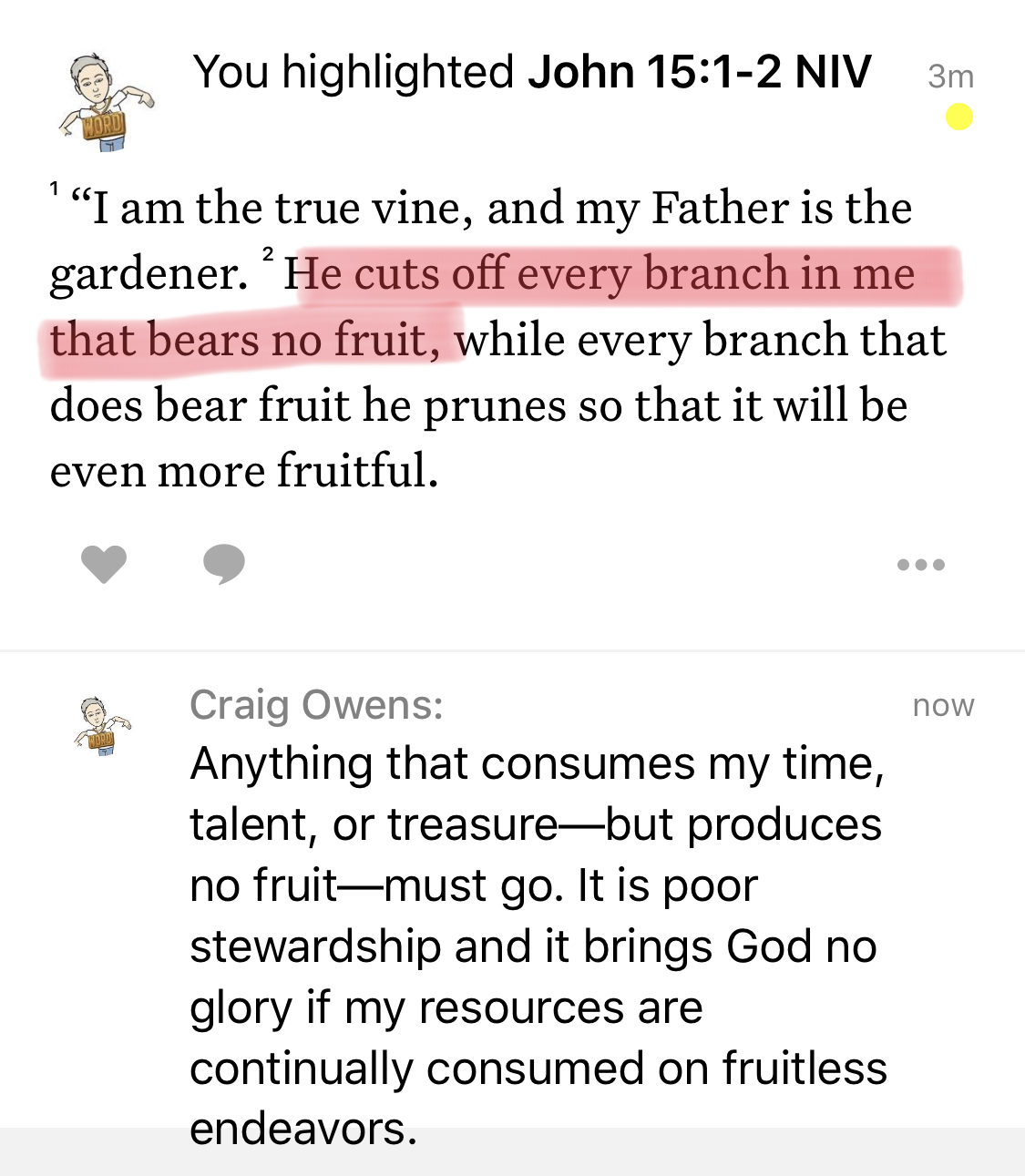
Thursdays With Spurgeon—How Pruning Helps Prayer

This is a weekly series with things I’m reading and pondering from Charles Spurgeon. You can read the original seed thought here, or type “Thursdays With Spurgeon” in the search box to read more entries.

Listen to the podcast of this post by clicking on the player below, and you can also subscribe on AppleSpotify, or Audible. 

How Pruning Helps Prayer 

If you remain in Me and My words remain in you, ask whatever you wish, and it will be done for you. (John 15:7)

     How is this privilege of mighty prayerfulness to be obtained? The answer is, ‘If you abide in Me and My words abide in you.’ … Beloved, the first line tells us that we are to abide in Christ Jesus our Lord. … 

     As if to help us understand this, our gracious Lord has given us a delightful parable. Let us look through this discourse of the vine and its branches. Jesus says, ‘Every branch in Me…that bears fruit He prunes’ (John 15:2). Take care that you abide in Christ when you are being purged. ‘Oh,’ says one, ‘I thought I was a Christian. But alas! I have more troubles than ever. Men ridicule me, the devil tempts me, and my business affairs go wrong.’ Brother, if you are to have power in prayer, you must take care that you abide in Christ when the sharp knife is cutting everything away. …  

     Take care, also, that when the purging operation has been carried out you still cleave to your Lord. … When you see the work of the Spirit increasing in you, do not let the devil tempt. He will try to get you to boast that now you are somebody; you need not come to Jesus as a poor sinner and rest in His precious blood alone for salvation. Abide still in Jesus. … Your work for Christ must be Christ’s work in you or else it will be good for nothing.

 From The Secret Of Power In Prayer

Our Heavenly Father wants us to be fruitful because that brings Him glory and lifts Jesus up for others to see. 

We have to commit to abiding in Jesus despite the pruning process. It’s helpful to remember that the reason the Husbandman prunes us is because He has seen fruitfulness in us, but He wants us to be even more fruitful. When we stay in the process during the uncomfortable—and sometimes painful—pruning, more fruit will begin to appear in our lives. 

It’s at this point that we have to guard against pride. The devil loves for me to get proud of “my accomplishments.” But I have to remind myself that apart from the Vine I am worse than fruitless; I’m just a dead branch only fit for the fire. I’ve learned that there is a danger in success, so I must constantly choose humility over pride, and abiding over self-sustaining. 

As we abide, our prayers take on an ever-increasing vitality so that conversation with our Lord becomes as natural as breathing. I hope none of us will ever settle for anything less than this intimate, ongoing communion with our Master!

►► Would you please prayerfully consider supporting this ministry? My Patreon supporters get behind-the-scenes access to exclusive materials. ◀︎◀︎

The Value Of Journaling

Listen to the podcast of this post by clicking on the player below, and you can also subscribe on AppleSpotify, or Audible. 

Do you keep a journal? I’m not talking about a diary of your daily events, but a journal of your ongoing dialogue with God. This is a discipline I began over 25 years ago, and it’s been immensely helpful to me. 

Every time you read the history of Israel in the Old Testament, you are really reading a written history—a journal—of what God did for His people.

In Luke 1:46-55, we read Mary’s song about the soon-to-be-born Jesus that someone journaled to record for posterity. The same thing is true for Zechariah’s song about his son John in Luke 1:67-79. I am sure that many people found great comfort in reading and recalling these songs, perhaps even Jesus Himself and John the Baptist. 

Even Jesus told His disciple John to journal the words He spoke to him about events still to come (Revelation 1:11, 19; 2:1, 8, 12, 18; 3:1, 7, 14; 14:13; 19:9; 21:5). 

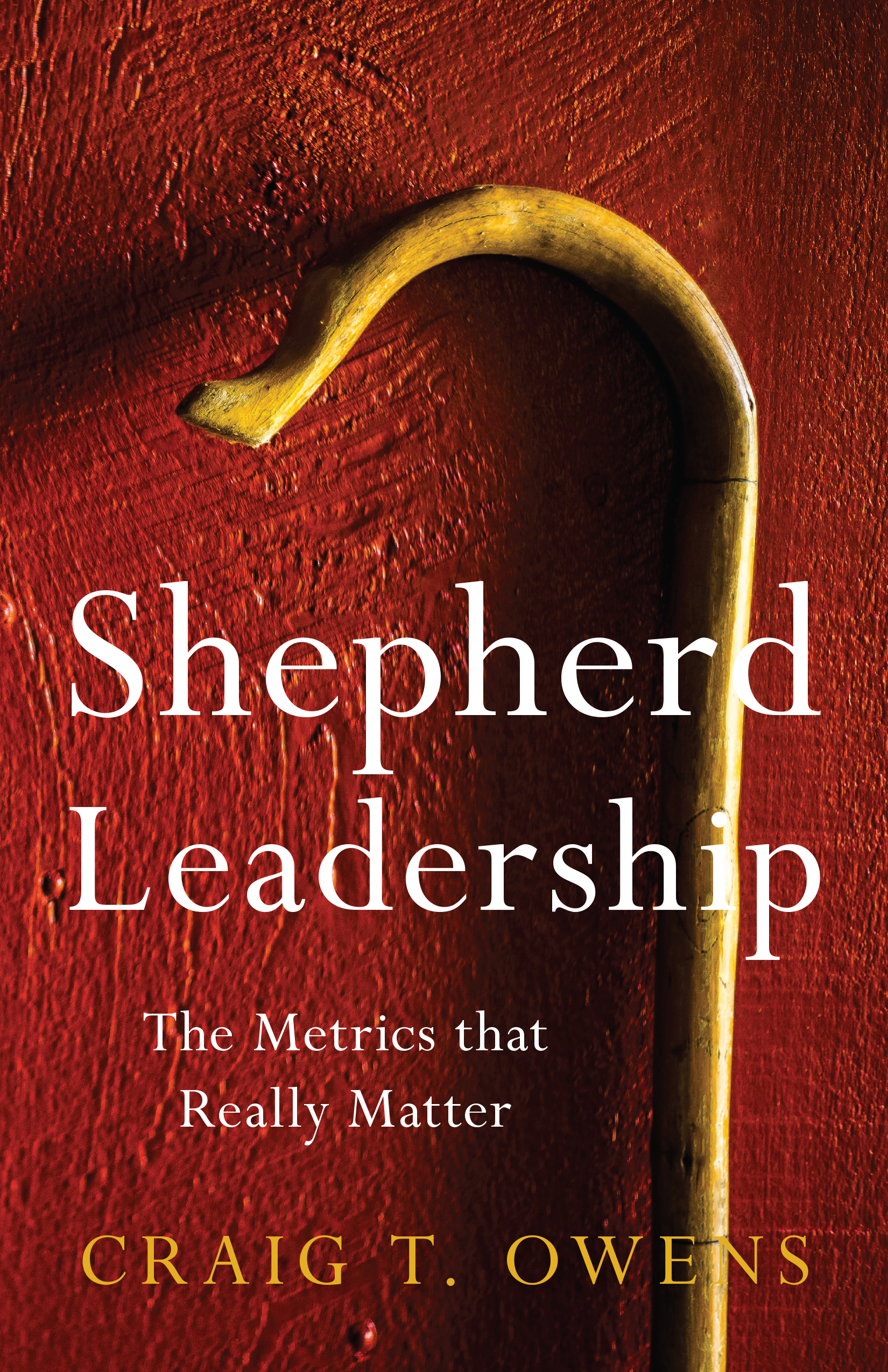
Journaling has helped me at so many crucial points in my life. Especially when I needed to look back to be reminded of something God had spoken to me. I shared one example of this in my book Shepherd Leadership: The Metrics That Really Matter

       The board was making a major decision. They were considering a change in their leadership to one who had completely different credentials and training from all of their previous leaders. Because this change would be so momentous, the board interviewed me for more than four hours. When they finally felt they had deliberated long enough, they asked me to leave the room while they prayed and voted. I stepped out into the lobby for just a couple of minutes when the door opened again and they asked me to step back inside. 

       “Well, Craig,” the spokesman began, “we prayed and we feel you are the one God has selected for this position.” I told them I would be happy to accept their offer. After they prayed over me, I began to pack up my things to head home. 

       “Hold on a minute,” one of the board members said to me, “we’re about to discuss the budget, and we think it would be good for you to be a part of this discussion.” I agreed and resumed my seat at the table. 

       I was handed both the year-to-date financial report and the projected income and expenses for the remaining quarter of the year. “As you can see,” the treasurer began, “we are projecting a $70,000 loss for this year.” Then he turned to me and asked, “What are you going to do about that?” 

       I gulped, tried not to show that my stomach was doing flips, and said, “Honestly, I don’t know.” I paused, and since no one else said anything, I continued, “But I’ll let you know what we come up with.” 

       All the way home, I kept thinking, “What have I gotten myself into? I’m walking away from a successful business to oversee an organization that’s going to go bankrupt before I even get started?!” But then I began to remind myself of something else: God chose me. 

       When I returned home, I immediately went to my journal. I flipped to the page where I had written down all of the reasons why I had concluded that God chose me for this position. I looked at the way God had spoken to me and to my wife, and the way friends who knew nothing about this decision spoke a confirming word to me. I looked at the pages where I had written down the vision I believed God had given me for this new organization, and how the board chairman’s handwritten vision for the organization matched mine thought-for-thought. Looking at these words—at the specific dates and ways God had spoken, and confirmed, and re-confirmed His direction—gave me the confidence to step into this assignment, even when facing such a huge financial mountain. (excerpt from chapter 5 “A Humble Leader’s Attitude Adjustment”) 

If you haven’t journaled in the past, I encourage you to begin this spiritual discipline today. I can tell you from both what I read in the Bible and my own personal experience how valuable this will be for you. 

►► Would you please prayerfully consider supporting this ministry? ◀︎◀︎

12 Quotes From “The Art Of War”

Sun Tzu wrote in China in the fifth century BC to help military leaders hone their warcraft, but you might be surprised at the truths you can apply to your life today. Check out my full book review by clicking here. 

“Hence to fight and conquer in all your battles is not supreme excellence; supreme excellence consists in breaking the enemy’s resistance without fighting.” 

“Thus we may know that there are five essentials for victory: (1) He will win who knows when to fight and when not to fight. (2) He will win who knows how to handle both superior and inferior forces. (3) He will win whose army is animated by the same spirit throughout all its ranks. (4) He will win who, prepared himself, waits to take the enemy unprepared. (5) He will win who has military capacity and is not interfered with by the sovereign.” 

“Hence the saying: If you know the enemy and know yourself, you need not fear the result of a hundred battles. If you know yourself but not the enemy, for every victory gained you will also suffer a defeat. If you know neither the enemy nor yourself, you will succumb in every battle.” 

“The good fighters of old first put themselves beyond the possibility of defeat, and then waited for an opportunity of defeating the enemy. To secure ourselves against defeat lies in our own hands, but the opportunity of defeating the enemy is provided by the enemy himself.” 

“That general is skillful in attack whose opponent does not know what to defend; and he is skillful in defense whose opponent does not know what to attack.” 

“Disciplined and calm, to await the appearance of disorder and hubbub amongst the enemy—this is the art of retaining self-possession. To be near the goal while the enemy is still far from it, to wait at ease while the enemy is toiling and struggling, to be well-fed while the enemy is famished—this is the art of husbanding one’s strength.” 

“Do not linger in dangerously isolated positions. … If, on the other hand, in the midst of difficulties we are always ready to seize an advantage, we may extricate ourselves from misfortune.” 

“The art of war teaches us to rely not on the likelihood of the enemy’s not coming, but on our own readiness to receive him; not on the chance of his not attacking, but rather on the fact that we have made our position unassailable. There are five dangerous faults which may affect a general: (1) Recklessness, which leads to destruction; (2) cowardice, which leads to capture; (3) a hasty temper, which can be provoked by insults; (4) a delicacy of honor which is sensitive to shame; (5) over-solicitude for his men, which exposes him to worry and trouble.” 

He who exercises no forethought but makes light of his opponents is sure to be captured by them.” 

“Regard your soldiers as your children, and they will follow you into the deepest valleys; look upon them as your own beloved sons, and they will stand by you even unto death. … If, however, you are indulgent, but unable to make your authority felt; kind-hearted, but unable to enforce your commands; and incapable, moreover, of quelling disorder: then your soldiers must be likened to spoilt children; they are useless for any practical purpose.” 

“Carefully study the well-being of your men, and do not overtax them. Concentrate your energy and hoard your strength.” 

“Keep your army continually on the move.”

God Is Preparing You To Be A Blessing

“God can never make me wine if I object to the fingers He uses to crush me with. … God puts us through discipline, not for our own sake, for the sake of His purpose and His call. Never debate about anything God is putting you through, and never try to find out why you are going through it. Keep right with God and let Him do what He likes in your circumstances, and you will find He is producing the kind of bread and wine that will be a benefit to others.” —Oswald Chamber, So Send I You

Thursdays With Oswald—Philanthropy, Prayer, And Penance

Oswald ChambersThis is a weekly series with things I’m reading and pondering from Oswald Chambers. You can read the original seed thought here, or type “Thursdays With Oswald” in the search box to read more entries.

Philanthropy, Prayer, And Penance 

     In chapter Matthew 5, our Lord demands that our disposition be right with Him in our ordinary natural life lived to men; in chapter 6, He deals with the domain of our life lived to God before men. The main idea in the region of religion is: Your eyes on God, not on men. …  

     Briefly summed up these verses [6:1-4] mean: Have no other motive in giving than to please God. In modern philanthropy we are ‘egged on’ with other motives—It will do them good; they need the help; they deserve it. Jesus Christ never brings out that aspect in His teaching; He allows no other motive in the giving than to please God. … It is a very penetrating thing to ask ourselves this question—“What was my motive in doing that kind act?” … 

     But when you give it to the needy, do not let your left hand know what your right hand is doing.” That means do good until it is an unconscious habit of the life and you do not know you are doing it…. 

     Have no other motive in prayer than to know Him [6:5-15]. … Call a halt one moment and ask yourself—“Why do I pray? What is my motive? Is it because I have a personal secret relationship to God known to no one but myself?” … 

     It is impossible to live the life of a disciple without definite times of secret prayer. You will find that the place to enter in is in your business, as you walk along the streets, in the ordinary ways of life, when no one dreams you are praying, and the reward comes openly, a revival here, a blessing there. …  

     In verse 8 Jesus goes to the root of all prayer—“Your Father knows what you need before you ask Him.” Common sense says, “Then why ask Him?” Prayer is not getting things from God, that is a most initial stage; prayer is getting into perfect communion with God; I tell him what I know He knows in order that I may get to know it as He does. …  

     Penance [6:16-18] means putting ourselves into a straitjacket for the sake of disciplining our spiritual character. Physical sloth will upset spiritual devotion quicker than anything else. If the devil cannot get at us by enticing to sin, he will get at us by sleeping-sickness spiritually…. Penance means doing a hardship to the body for the sake of developing the spiritual life. … Jeremy Taylor said that men hang out the sign of the devil; to prove there is an angel within; that is, they wear sad countenances and look tremendously severe in order to prove they are holy. 

From Studies In The Sermon On The Mount

Good questions from Oswald Chambers:

  • Philanthropy—What was my motive in doing that kind act?
  • Prayer—Why do I pray? What is my motive? Is it because I have a personal secret relationship to God known to no one but myself?
  • Penance—Am I “hanging out a sign” just to let other people know that I’m discipling myself? 

Thursdays With Oswald—Difficult Times Reveal Our Habits

Oswald ChambersThis is a weekly series with things I’m reading and pondering from Oswald Chambers. You can read the original seed thought here, or type “Thursdays With Oswald” in the search box to read more entries.

Difficult Times Reveal Our Habits 

     Practice means continually doing that which no one sees or knows but ourselves. Habit is the result of practice, by continually doing a thing it becomes second nature. The difference between men is not a difference of personal power, but that some men are disciplined and others are not. The difference is not the degree of mental power but the degree of mental discipline. If we have taught ourselves how to think, we will have mental power plus the discipline of having it under control. Beware of impulse. Impulsiveness is the characteristic of a child, but it ought not to be the characteristic of a man, it means he has not disciplined himself. Undeterred impulse is undisciplined power.

     Every habit is purely mechanical, and whenever we form a habit it makes a material difference in the brain. The material of the brain alters very slowly, but it does alter, and by repeatedly doing a thing a groove is formed in the material of the brain so that it becomes easier to do it again, until at last we become unconscious of doing it. When we are regenerated we can reform by the power and presence of God every habit that is not in accordance with His life. … We have to learn to form habits according to the dictates of the Spirit of God. The power and the practice must go together. … If we keep practicing, what we practice becomes our second nature, and in a crisis we will find that not only does God’s grace stand by us, but our own nature also. The practicing is ours not God’s and the crisis reveals whether or not we have been practicing. [See Matthew 5:31-37.]

From Studies In The Sermon On The Mount

All of us have blind spots. These are typically habits that we have left in place, unchallenged and unchanged. That “groove” in our brain is operating on auto-pilot, but those blind-spot habits aren’t serving us well. 

The role of the Holy Spirit in the life of a Christian is to help us notice these habits in which we are unconsciously incompetent. But once the Spirit of God points these out, then we must practice, and practice, and practice until the new healthy habit has overwritten the old groove of the unhealthy habit. 

Then we will find, as Chambers points out, that in a time of crisis “not only does God’s grace stand by us, but our own nature also.” 

Times of difficulty will reveal habits—both the unhealthy and the healthy. The question then becomes: what are you going to do about the unhealthy habits? 

Saturday In The Proverbs—How Does That Taste? (Proverbs 12)

[Each chapter in the Book of Proverbs contains thoughts that fit into a theme; they are not just random thoughts gathered together. In this “Saturday In The Proverbs” series, I will share a theme that I see in each chapter. But the cool thing about God’s Word is that you may see an entirely different theme. That’s great! If you do, I would love for you to share it in the comments below.]

Whoever loves instruction loves knowledge, but he who hates correction is stupid (Proverbs 12:1).

What comes from our lips is either a healthy feast or it is nauseating junk food. But what comes from our lips is based on what we put in—garbage in, garbage out.

The only way to fix this is by gaining godly knowledge and listening to godly correction.

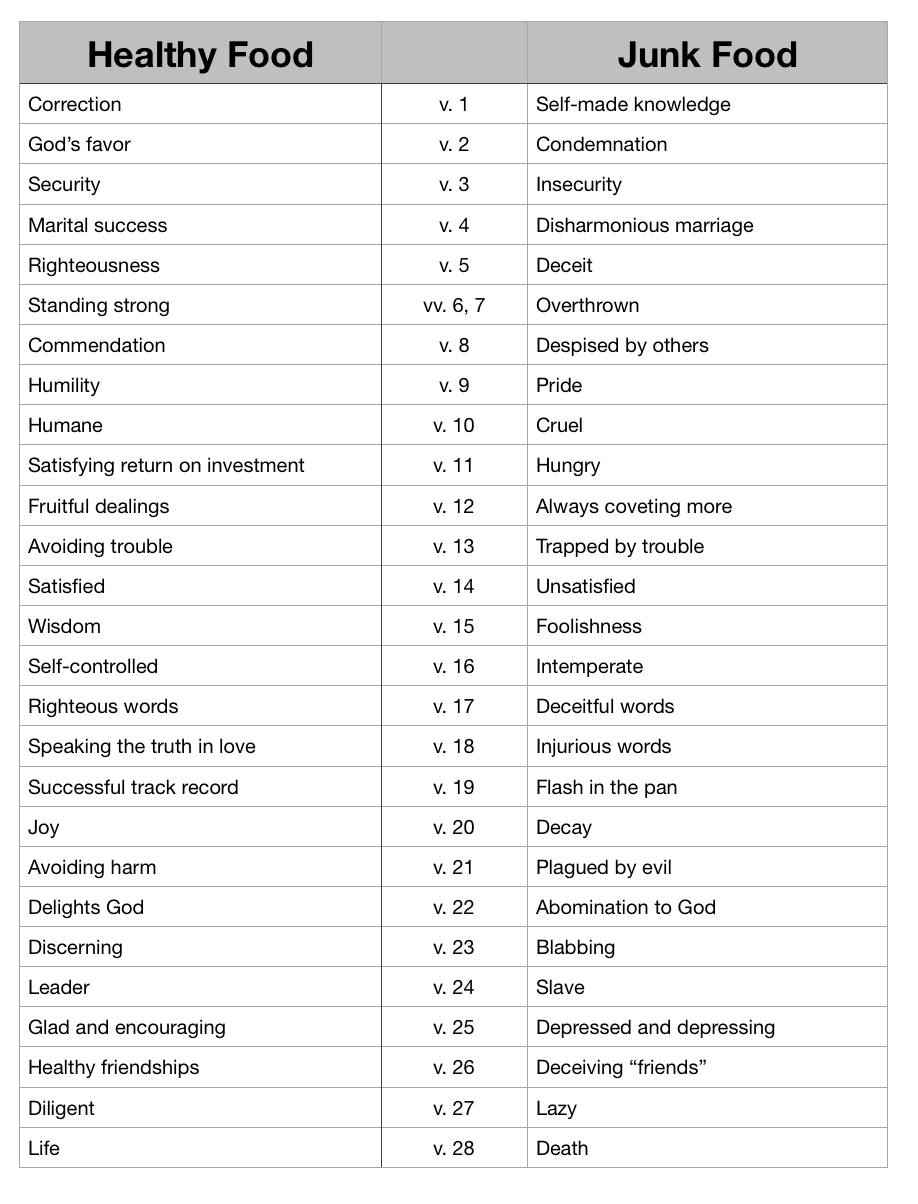
Here is a side-by-side comparison of healthy food and junk food that Solomon lists for us in Proverbs 12:

(click on the image to see a larger view or click here to download a PDF → Proverbs 12 – how does that taste)

8 Quotes From “10 Commitments For Dads”

Dad, your involvement in the life of your kids and grandkids is vital! Please check out my review of 10 Commitments For Dads and then get a copy for yourself.

“Studies show that even until your child reaches 25 years of age, the greatest influence on his or her behavior will be the loving, close relationship with you, the father.”

“What our kids need to see is that our rules are out of a heart of love and are actually good for them, just as the instructions and commands that come from God. We as dads need to learn how to place God’s truth and family rules squarely within the context of our loving relationships. … The truth is, God designed us to follow the rules because of the relationship. There are do’s and don’ts in life, but they are there to provide for our well-being and protect us from harm. That’s what a person within a loving relationship wants to do—protect those they love and provide for their best.”

“God disciplines us with a purpose—it is to lead us to become more like Him. … When we hold our kids accountable for their benefit, not ours, it too fulfills their sense of purpose and reinforces their sense of responsibility.”

“Tell your kids repeatedly that because God’s nature is holy He will never asked them to do anything that would not be right and good for them. It is out of this pure goodness that He wants to protect them from those things that would harm them and provide for their very best. It is from His holy nature of goodness that He gives unselfishly and makes the security, happiness, and welfare of your kids as important as His own.”

“God has uniquely shaped and molded you and your kids to bring honor to Him. It is only proper and right to love what He has done. Teaching your kids to love what He has uniquely designed isn’t being self-centered. We need to be proud of Him for what He has created and humbly celebrate our uniqueness for His glory, ‘For everything comes from Him and exists by His power and is intended for His glory. All glory to Him for ever! Amen’ (Romans 11:36).” 

“What our kids hear and see in today’s culture is rarely a representation of healthy love. Selfish, lustful, and even abusive behavior is passed off as a love relationship. That is why, in a real sense, we must redefine to our kids what such a relationship actually is from a biblical perspective.”

“The best sex education is 30 seconds here, one minute there, 10 seconds here, two minutes in 45 seconds there, and so on, starting as young as possible. When something comes up, step in, addressed it, and step back. Don’t make a big deal out of it.” 

“Because true love’s priority is to protect and provide for the one being loved, God’s kind of love will not do things that are harmful to the security, happiness, and welfare of another person.”

I will be sharing more quotes from 10 Commitments soon. You can subscribe to my blog to be notified as soon as they quotes are shared. You can also follow me on Twitter and Tumblr to see the healthy quotes I share every day.

9 Quotes From “Chase The Lion”

chase-the-lionI loved Chase The Lion by Mark Batterson! Before even reading the first chapter, I was already captured by the Lion Chaser’s Manifesto, and the book only got better from there. Please check out my review of this amazing book, and then check out the first batch of quotes below.

“At the end of our lives, our greatest regrets will be the God-ordained opportunities we left on the table, the God-given passions we didn’t pursue, and the God-sized dreams we didn’t go after because we let fear dictate our decisions.”

“It’s not just our sin that we need to repent of. It’s our small dreams. The size of your dream may be the most accurate measure of the size of your God. Is He bigger than your biggest problem, your worst failure, your greatest mistake? Is He able to do immeasurably more than all you can ask or imagine? A God-sized dream will always be beyond your ability, beyond your resources. Unless God does it, it cannot be done! But that’s how God gets the glory. If your dream doesn’t scare you, it’s too small. It also falls short of God’s glory by not giving Him an opportunity to show up and show off His power.”

“We don’t die when our hearts stop beating. We die when our hearts stop skipping a beat in pursuit of our dreams. We die when our hearts stop breaking for the things that break the heart of God.”

“Impossible odds set the stage for God’s greatest miracles! And apparently God loves long shots. Isn’t that why He removed 9,700 soldiers from Gideon’s army? Isn’t that why He let the fiery furnace be heated seven times hotter? Isn’t that why He didn’t show up until Lazarus was four days dead? … We tend to avoid situation where the odds are against us, but when we do, we rob God of the opportunity to do something supernatural.”

“Get into God’s Word, and God’s dream will get into you.”

“When we fail to take action, we forfeit the future. Make no mistake: just as inaction is an action, indecision is a decision.”

“One misstep can end a dream journey. That doesn’t mean you operate in a spirit of fear. It does mean you operate in a spirit of focus!”

“In my humble opinion, no one is a natural. Sure, some people are more naturally gifted than others. But unless that giftedness is coupled with a complementary work ethic, it’ll only result in wasted potential.”

“I don’t believe our greatest shortcoming is not feeling bad enough about what we’ve done wrong. I think our greatest shortcoming is not feeling good enough about what God has done right. When we undercelebrate, we fall short of the glory of God!”

In the very near future I will be sharing more quotes from this book. To make sure you see them, put your email address in the box to the right and click “Sign me up.” I’ll make sure you’re the first to know when new content is posted.

Also be sure to follow me on Twitter and Tumblr, where daily I share quotes from Mark Batterson and other inspirational authors.