Stick With Your Commitment

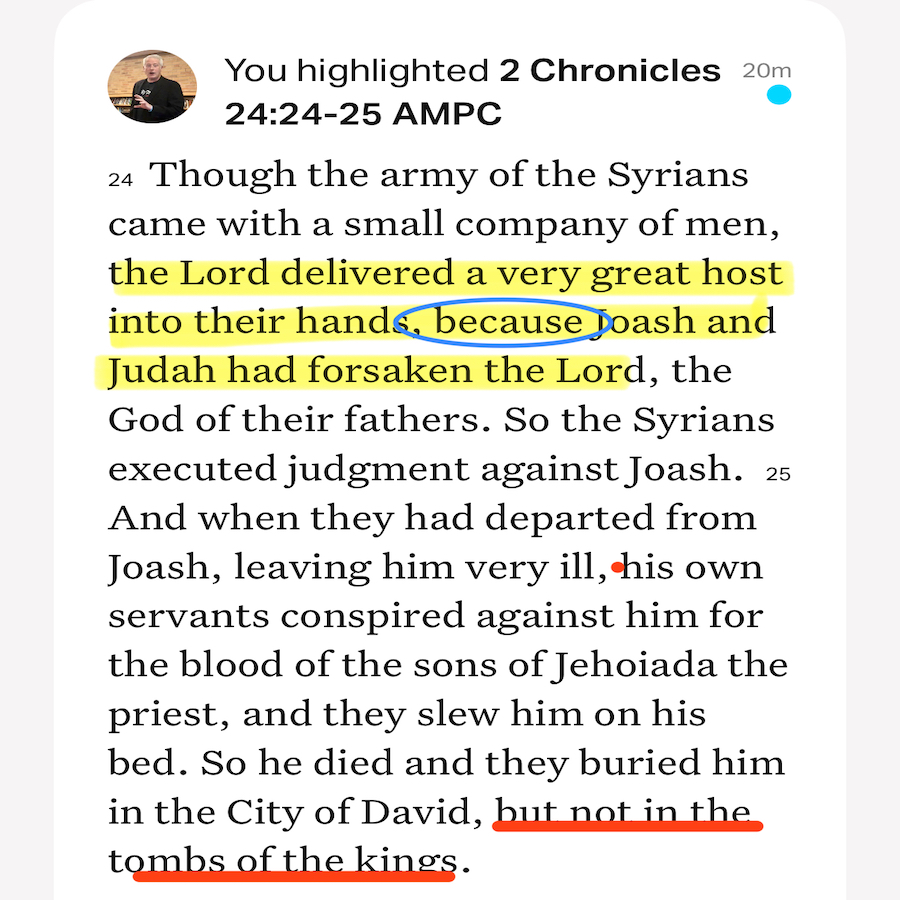
Though the army of the Syrians came with a small company of men, the Lord delivered a very great host into their hands, because Joash and Judah had forsaken the Lord, the God of their fathers. So the Syrians executed judgment against Joash. And when they had departed from Joash, leaving him very ill, his own servants conspired against him for the blood of the sons of Jehoiada the priest, and they slew him on his bed. So he died and they buried him in the City of David, but not in the tombs of the kings. (2 Chronicles 24:24-25 AMPC)

Joash started well when he listened to the godly counsel of Jehoiada. But he made a 180-degree turn when he listened to ungodly counselors. Joash, it seems, couldn’t commit to a godly or ungodly lifestyle on his own; instead, he lived as those around him did—always giving in to the loudest voice at that particular moment. 

We are prone to follow the voices around us, too, which is why Paul urges us to make a commitment to follow God regardless of how others are living:

I appeal to you therefore, brethren, and beg of you in view of all the mercies of God, to make a decisive dedication of your bodies—presenting all your members and faculties—as a living sacrifice…. Do not be conformed to this world (this age)—fashioned after and adapted to its external, superficial customs—but be transformed (changed) by the entire renewal of your mind…. (Romans 12:1-2 AMPC). 

A life fully committed to living God’s precepts is red hot in its passions—“Let your love be sincere (a real thing); hate what is evil—loathe all ungodliness, turn in horror from wickedness—but hold fast to that which is good” (Romans 12:9 AMPC). 

Related posts: 

Commit To Overcoming

Listen to the podcast of this post by clicking on the player below, and you can also subscribe on AppleSpotify, or Audible. 

How do leaders make sure that obstacles to their personal or organizational growth don’t become permanent? 

This clip is from a lengthy conversation Greg and I had about leaders being like gardeners. You can check it out here. The main point is this: The seeds have what they need to grow, so the gardener-leader simply has to remove the obstacles to growth. 

You may also want to check out a couple of related posts:

►► Would you please prayerfully consider supporting this ministry? My Patreon supporters get behind-the-scenes access to exclusive materials. ◀︎◀︎
Links & Quotes

My courage and my success are directly tied to my obedience of God’s Word. The life of Joshua is just one example. Check out this full message here. I have lots of new content every week, which you can check out on my YouTube channel.

Donald Fairbairn, Professor of Early Christianity at Gordon-Conwell Theological Seminary, presents a brief history of the great Persian persecution of the 4th-century Christians.

“Christ is more of an Artist than the artists. He works in the living spirit and the living flesh; He makes men instead of statues.” —Vincent van Gogh

Bryan Windel echoes something I’ve frequently said on this blog, “The Bible is rooted in real history. This is why archaeology is such a valuable tool; it helps us uncover the biblical world and provides us with important background knowledge about the people, places, and events described in the text.” Bryan was a part of a dig at Shiloh (where Joshua and Samuel play key roles) and he shares some of his observations and discoveries.

“I trained four years to run nine seconds, and people give up when they don’t see results in two months.” —Usain Bolt

“Those who have turned the tide of history have turned it by means of prayer. This should be the motto of every follower of Jesus Christ. Never stop praying, no matter how dark and hopeless it may seem.” —Billy Graham

I love these stories of hope from To Write Love On Her Arms. They have lots of great words of encouragement for you to share with others.

“The year was 1932. The world’s economic and political systems were groaning under the weight of an economic depression.” Against this backdrop, Myer Pearlman wrote to Christians about how they should live in those times. His message is just as relevant for us today.

Fight The New Drug shares six ways porn has lied to you about sex.

Humility Is A Daily Choice

Listen to the podcast of this post by clicking on the player below, and you can also subscribe on AppleSpotify, or Audible.

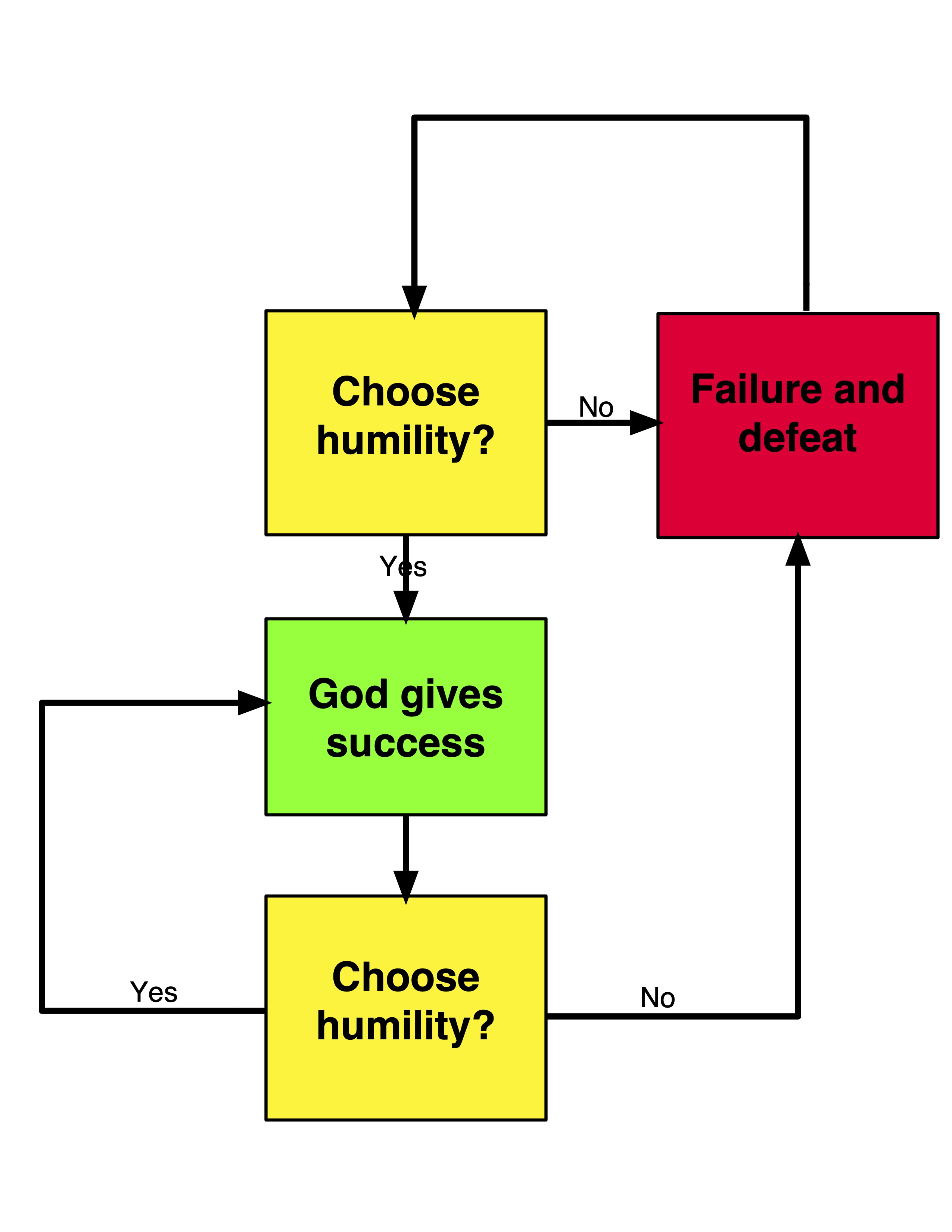
…As long as Uzziah sought the Lord, God gave him success. … But after Uzziah became powerful, his pride led to his downfall… (2 Chronicles 26:5, 16). 

Success makes me more vulnerable to pride. Success can distract from the very One who gave me success. I am in danger of losing God’s blessings in the very moment I am enjoying God’s blessings. 

Humility has to be an ongoing choice. That choice becomes harder as the successes become bigger or more frequent. But choosing pride in “my accomplishments” will undo all the previous successes. 

The only way to keep these blessings is two words: IF ONLY. If only I will continue to remain humble before God and obedient to Him. 

Uzziah, sadly, didn’t make that choice. His pride in God’s success led to his downfall. 

His son Jotham learned this lesson. Jotham grew powerful because he walked steadfastly before the Lord his God (27:6). 

I like the KJV of this verse that says, “Jotham grew powerful because he prepared his ways before the Lord his God.” 

Jotham was keenly aware that everything he did was seen by God. He was determined that everything he did would be pleasing in God’s sight. The word “before” in verse 6 means “in front” of or even “before the face.” Jotham didn’t live as though he might face God at the end of his life, but as though he was facing God at every moment of his life. 

Notice two phrases in this sentence—grew powerful and walked steadfastly. They are directly tied to each other: Jotham became powerful only because he was determined to live righteously and humbly in God’s sight. The more powerful he became, the more he increased his commitment to live humbly before God’s face. 

He did what was right in the eyes of the Lord, just as his father Uzziah had done, BUT unlike him he did not enter the temple of the Lord (v. 2). 

Jotham humbly prepared his ways before the Lord, and when God made him powerful Jotham re-committed to stay humble. Great choice! 

I’ll say it again: The only way to keep God’s blessings on my initial humble choice is to continue to choose humility at every moment of success. 

►► Would you please prayerfully consider supporting this ministry? My Patreon supporters get behind-the-scenes access to exclusive materials. ◀︎◀︎

God Is Obsessed With You

“This week, these worries, this world, may leave you feeling a bit depressed,

but you have a God who is obsessed with you.

His love for you is oceanic,

His welcome of you is enthusiastic,

His purpose through you is cosmic,

His commitment to you is astronomic, and

His hope in you is meteoric.”

—Ann Voskamp, in The Way Of Abundance

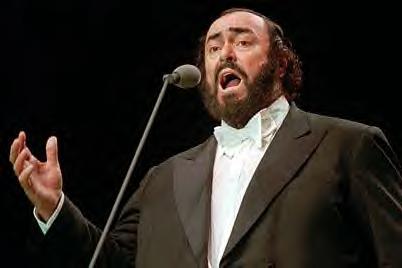
Luciano Pavarotti On Commitment

“When I was a boy, my father, a baker, introduced me to the wonders of song. He urged me to work very hard to develop my voice. Arrigo Pola, a professional tenor in my hometown of Modena, Italy, took me as a pupil. I also enrolled in a teachers college. On graduating, I asked my father, ‘Shall I be a teacher or a singer?’  

“‘Luciano,’ my father replied, ‘if you try to sit on two chairs, you will fall between them. For life, you must choose one chair.’  

“I chose one. It took seven years of study and frustration before I made my first professional appearance. It took another seven to reach the Metropolitan Opera. And now I think whether it’s laying bricks, writing a book—whatever we choose—we should give ourselves to it. Commitment, that’s the key. Choose one chair.” —Luciano Pavarotti (emphasis added)

A Warrior For God’s Favor

I love this guy! 

Caleb is a dog. I’m not kidding: his name literally means dog. To be more specific his name actually means a rabid dog. What?! Yeah, but it totally fits his life. 

Caleb first shows up on the scene when the Israelites are getting ready to explore Canaan for the first time. They have just been delivered from Egypt and in about two months have arrived at the border of their promised land. Moses wants to send a representative from each tribe to scout out the land. 

So the first thing we learn about Caleb is that he is a leader of the largest, most powerful tribe in Israel (Numbers 13:1-3, 6). 

After scouting the land for 40 days, these men come back with a report for everyone. Halfway through their report, Caleb interrupts everyone—“We should go take the land right now, for we can certainly do it!” (13:30). Caleb was outspoken for God’s favor. He firmly believed that God was for them. 

Unfortunately, nearly all the other scouts (except Joshua) disagreed with Caleb. They warned that there were giants in the land that would eat them for lunch. In essence, the same people who had seen God deliver them from the Egyptians and part the Red Sea for them now thought that God wasn’t able to defeat giants. This vocal majority turned the entire nation against Moses and wanted to return to Egypt! 

So God promised that none of the adults would enter the promised land, with only two exceptions: Joshua and Caleb. God pointed out that Caleb “has a different spirit and follows Me wholeheartedly” (Numbers 14:24). This is where we first learn that Caleb is rabid. The term rabid means zealous, intense, fanatical, inspired. Caleb is a man who is focused—intensely, wholeheartedly focused—on God. In fact, this word wholehearted is used about Caleb three more times (see Joshua 14: 8, 9, 14). 

Along with the rest of the Israelite community, Caleb wandered in the wilderness for 40 years. He never thought God had forgotten him; he never lost his intense wholeheartedness; he stayed rabid the whole time. He had a trust in God that never diminished. His motto might have been: “God said it; I believe it.” 

After 40 years in the wilderness, and then five more years fighting to claim their promised land, Caleb was still raring to go. He told Joshua, “I am still just as strong as I was 45 years ago. I’m 85 years old and still ready to take on giants. Let me at ‘em!” And he did it! Caleb drove out three giants in order to claim his territory (Judges 1:20).

But Caleb wasn’t done yet. He then used God’s favor to be a blessing to others. The Apostle Paul tell something that Caleb lived out: God will generously provide all you need. Then you will always have everything you need AND plenty left over to share with others (2 Corinthians 9:8). Without a word of complaint, Caleb gladly accepted not only the responsibility of letting the Levities live in the town he had conquered, but he also took on the added duties of making that city of Hebron a “city of refuge.” In this city, Caleb would keep anyone safe from those seeking their lives until a proper trial could be held. 

Caleb was successful for nearly 90 years because he was convinced that God was for him.

Nothing could distract him from wholeheartedly clinging to God’s favor! 

Caleb was a warrior for God’s favor, and he was a successful warrior because of God’s favor. The same can be said of you IF you will decide to cling to God’s favor wholeheartedly.

Saturday In The Proverbs—5 Important Self-Examination Questions (Proverbs 6)

[Each chapter in the Book of Proverbs contains thoughts that fit into a theme; they are not just random thoughts gathered together. In this “Saturday In The Proverbs” series, I will share a theme that I see in each chapter. But the cool thing about God’s Word is that you may see an entirely different theme. That’s great! If you do, I would love for you to share it in the comments below.]

If… (Proverbs 6:1).

This collection of proverbs prompts quite a bit of self-examination. 

  1. Have I made commitments that are going to entrap me (vv. 1-2)? If so, I should plead for mercy to get out of them (vv. 3-5). 
  2. Am I less-than-diligent in my work—what Solomon calls a sluggard? Consider the diligence and initiative of the ant (vv. 6-8), and then consider the outcome if I don’t make better decisions with my time and my work ethic (vv. 9-11). 
  3. Am I a person of integrity, or am I a fast-talking, double-dealer (vv. 12-14)? I better consider the “therefore” (v. 15)! 
  4. Is my heart pure? Consider that an evil heart is at the heart of what God hates—shedding innocent blood, doing evil, lying, pride (vv. 16-19). Do I want God’s anger directed at me?
  5. Do my eyes stray toward women who aren’t my wife (v. 25)? God’s wisdom can keep me pure (vv. 20-24), but I also need to consider the devastating consequences of continuing in this immorality (vv. 26-35). 

Are you willing to honestly ask yourself these questions in the presence of God’s Holy Spirit?

You should—because your life may be at stake! 

Religious Boredom

“Those Christians who belong to the evangelical wing of the church (which I firmly believe is the only one that even approximates New Testament Christianity) have over the last half-century shown an increasing impatience with things invisible and eternal and have demanded and got a host of things visible and temporal to satisfy their fleshly appetites. Without Biblical authority, or any other right under the sun, carnal religious leaders have introduced a host of attractions that serve no purpose except to provide entertainment for the retarded saints.

“It is now common practice in most evangelical churches to offer the people, especially the young people, a maximum of entertainment and a minimum of serious instruction. It is scarcely possible in most places to get anyone to attend a meeting where the only attraction is God. One can only conclude that God’s professed children are bored with Him, for they must be wooed to meeting with a stick of striped candy in the form of religious movies, games and refreshments. …

“Any objection to the carryings on of our present golden-calf Christianity is met with the triumphant reply, ‘But we are winning them!’ And winning them to what? To true discipleship? To cross-carrying? To self-denial? To separation from the world? To crucifixion of the flesh? To holy living? To nobility of character? To a despising of the world’s treasures? To hard self-discipline? To love for God? To total committal to Christ? Of course the answer to all these questions is no.

“We are paying a frightful price for our religious boredom. And that at the moment of the world’s mortal peril.”

—A.W. Tozer, in Man—The Dwelling Place Of God

Saturday In The Psalms—Joy In The Desert

A psalm of David when he was in the wilderness of Judah (preface to Psalm 63).

Being in a desert place, you would expect David to say things like, “my soul thirsts,” “my flesh longs,” and “I am in a dry and thirsty land where there is no water.”

But what’s unexpected is what David found that satisfied. Not food and water, but “my soul thirsts for You,” “my flesh longs for You,” and “O God, You are my God.”

David knew that when outward conditions were at their worst, his focus needed to be at its best—and it needed to be on God. So David made the following commitments:

  • Early will I seek You
  • I have looked for You
  • I remember You on my bed
  • I meditate on You in the night watches
  • My lips shall praise You
  • My soul follows close behind You
  • I shall rejoice in God

Because of these commitments, David could reach the following conclusions:

  • Your lovingkindness is better than life
  • My soul is satisfied
  • I will rejoice in the shadow of Your wings
  • Your right hand upholds me

David found joy in the desert by changing his focal point!

I can reach the same conclusions that David reached, IF I am willing to make the same commitments David made.

In the desert places, I must deliberately and continually turn my eyes and thoughts FROM the desert TO God’s goodness.