
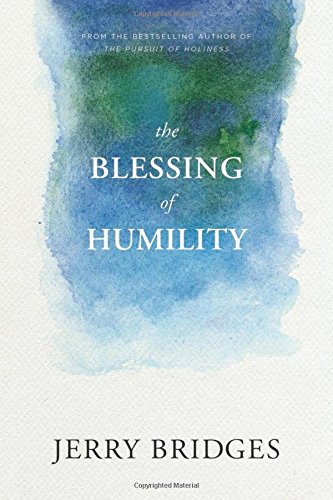
7 Quotes On Hungering & Thirsting From “The Blessing Of Humility”

The Blessing Of HumilityAs I stated in my review of Jerry Bridges’ book The Blessing Of Humility, reading through these thoughts slowly—Beatitude by Beatitude—would bring about the most life-changing impact. In that spirit, I will be sharing some noteworthy quotes one Beatitude at a time. Here are some quotes on blessed are those who hunger and thirst for righteousness (Matthew 5:6)…

“To hunger and thirst for righteousness, then, indicates a strong overwhelming desire for righteousness. … Righteousness denotes the state of being right. Biblically, it means perfect according to God’s law in every way: thought, word, deed, and even motive.”

“At the moment we trusted Christ as Savior, we were justified—declared by God to be righteous. You will never be more or less righteous before God any day of your life than you were the moment you trusted Christ as your Savior. This raises another question: Why should I hunger and thirst for that which I already have? The answer is that the more we grow and mature in the Christian life, the more sensitive we become to the sin and failure we see in our lives. It is not that we necessarily sin more but rather that we become more aware of and mourn over the sin that is already there. As that happens, we hunger more and more after the righteousness we have only in Christ.”

“There is a legitimate sense in which we are to hunger and thirst for that perfect righteousness we already have in Christ. This should be a continual daily attitude of all growing Christians because we continue to sin every day.”

“There is a second righteousness that we should hunger and thirst for: the experiential righteousness we are to pursue every day. God has inextricably linked together the righteousness we have in Christ and the righteousness we should pursue. He does not give one without the other. Therefore, whoever hungers and thirsts after the righteousness we have in Christ will also hunger and thirst to be righteous in his or her daily experience.” [See 2 Timothy 2:2; 1 Peter 2:24; 1 John 3:10]

“It is clear from Scripture, then, that we are to pursue an experiential righteousness. But what will cause us to hunger and thirst for it? The answer is twofold. First, as we have already observed, the new nature is inclined by the Holy Spirit to pursue righteousness. … The second motivation is gratitude for the righteousness we have in Christ.”

“There will be no growth in experiential righteousness apart from a regular intake of the Word of God.”

“We are absolutely dependent on the Holy Spirit to work in us Himself and to enable us to work. We cannot make one inch of progress toward experiential righteousness without His divine enablement.”

I have previously shared quotes on:

Quotes on the remaining Beatitudes will be posted next week so stay tuned. Even better: subscribe to my blog, and you’ll receive the new quotes directly in your email inbox.
6 Quotes On Meekness From “The Blessing Of Humility”

The Blessing Of HumilityAs I stated in my review of Jerry Bridges’ book The Blessing Of Humility, reading through these thoughts slowly—Beatitude by Beatitude—would bring about the most life-changing impact. In that spirit, I will be sharing some noteworthy quotes one Beatitude at a time. Here are some quotes on blessed are the meek (Matthew 5:5)…

“Meekness is not being timid, spineless, unassertive, and easily dominated. It is not a natural niceness. In fact, it has nothing to do with one’s personality or temperament.”

“There is then a twofold expression of meekness: first toward God and then toward other people. Meekness toward God involves: (1) responsiveness to His Word; (2) submission to His Providence.”

“As I reflect on our evangelical community to the extent I am aware of it, it seems we are more knowers of the Word than doers of the word. … Instead we too often use the Scriptures not as a means of judging ourselves but as a means of judging others, especially those whose sins are more flagrant than ours. The meek person, in contrast, searches the Scriptures (or listens to it taught) not to judge others but to allow the Holy Spirit to judge him or her. In fact, the meek person earnestly desires the Spirit to use His Word to effect a deep change in his or her inner being.”

“Thomas Watson wrote that meekness toward other people consists of three things: the bearing of injuries, the forgiving of injuries, and the returning of good for evil.”

“Because we have been forgiven so much, we have an obligation to forgive those who sin against us. Yet our motive for forgiving should not be our obligation but the realization of how much we have been forgiven.”

“Meekness towards man means bearing patiently with the hurtful actions of others and dealing gently with their failures, not only in the assurance that all of these are under God’s providential control, but in the knowledge that, left to ourselves, we have no claim to be any stronger than the weakest of our friends or any better than the worst of our enemies.” —John Blanchard

I have previously shared quotes on:

Quotes on the next Beatitude will be posted soon. Stay tuned…

6 Quotes On Mourning From “The Blessing Of Humility”

The Blessing Of HumilityAs I stated in my review of Jerry Bridges’ book The Blessing Of Humility, reading through these thoughts slowly—Beatitude by Beatitude—would bring about the most life-changing impact. In that spirit, I will be sharing some noteworthy quotes one Beatitude at a time. Here are some quotes on blessed are those who mourn (Matthew 5:4)…

“The word that Jesus used in this Beatitude is the strongest word in the Greek language for mourning. It is the word for Jacob’s morning over what he thought was the death of Joseph (Genesis 37:35). … Jesus uses this word to show the intensity of mourning He blesses here. He is, however, actually talking about mourning not over death but over our sin.”

“To be ‘poor in spirit’ is to be convicted of one’s sin, whereas to ‘mourn’ is to be contrite for it.” —John Blanchard

“King David committed two sins: first adultery, and then (essentially) murder to try to cover up his adultery. God sent the prophet Nathan to confront him, and in his skillful accusation of David, Nathan twice used the word despised (2 Samuel 12:7-11). First, David despised the Word of the Lord—that is, he despised the law of God (verse 9). In so doing, he also despised the Person of God (verse 10). Why is this true? Despising the law of God is not only an expression of rebellion. It is also a despising of His very character, since His law is a reflection of His character. This is true not only of such heinous sins as adultery and murder, but also of our more refined sins: pride, selfishness, gossip, and the like. So let us pray that God will indeed allow us to see our sin as rebellion against the rule of God—a despising of God’s law and even of His character.”

“Failure to see our sin as primarily against God is, I believe, the reason we experience so little heartfelt grief over it. … But be it ever so small in our own eyes, whenever we sin we also break God’s law. And Scripture says, ‘Whoever keeps the whole law but fails in one point has become accountable for all of it’ (James 2:10). God’s law is seamless, one complete whole. So when we break any of it, we break the whole law.”

“Is mourning over sin just for those first coming to Christ? No, Jesus’ words are in the present active tense. We could literally translate them as ‘blessed are those who continue to mourn.’ He is pronouncing a blessing on those whose attitude toward their sin is characterized by mourning. One mark of a growing Christian, then, is a growing sense of his or her sin, and an attitude of mourning over it.”

“So mourning over our sin is truly a display of humility in action. We cannot be proud and mourn over sin at the same time. We cannot be judgmental toward other believers, or even toward unbelievers, if we are truly contrite and brokenhearted over our own sin.”

I just shared quotes on blessed are the poor in spirit. Quotes on the next Beatitude will be posted soon. Stay tuned…

6 Quotes On Being Poor In Spirit From “The Blessing Of Humility”

The Blessing Of HumilityAs I stated in my review of Jerry Bridges’ book The Blessing Of Humility, reading through these thoughts slowly—Beatitude by Beatitude—would bring about the most life-changing impact. In that spirit, I will be sharing some noteworthy quotes one Beatitude at a time. Here are some quotes on blessed are the poor in spirit (Matthew 5:3)…

“The Greek word that Jesus used for ‘poor’ is the word ptochos. It is used to describe not ordinary poverty but abject poverty. Ptochos is not like my parents struggling to make ends meet [during the Great Depression]. Rather it describes a person who is completely destitute and helpless to do anything about it.”

Spirit refers to one’s inner being, our self-awareness. Specifically here it means how we evaluate ourselves with regard to our own spiritual condition. This abject poverty of spirit comes from our awareness of our own dreadfully sinful condition.”

“In the Beatitudes Jesus is talking about the character traits of those already in the kingdom. And He says we should be poor in spirit. It should be the ongoing daily attitude of one who is growing spiritually. Believers who are growing continue to see more sin in their lives. It is not that they are sinning more; rather they are becoming more aware of and more sensitive to the sin that has been there all along. … And it is the realization that even the sins, which seems so minor in our eyes, would bring us under the wrath of God, were it not for the atoning blood of Christ shed for us on the Cross, that should cause us to be poor in spirit.”

“Those who are poor in spirit…see Christ’s blood and righteousness as their hope not only for eternity but for God’s favor each day. They groan over their sin and earnestly pursue holiness but they do not trust in their holiness. Instead they say, ‘We are unworthy servants; we have only done what was our duty’ (Luke 17:10).”

“The person who is poor in spirit has a deep, awe-filled reverence for God and His Word.”

“We live in a culture that promotes self-esteem. And I am concerned that this attitude has permeated the body of Christ. We see ourselves as better than we are. We look at sinful society around us, and we can be like the Pharisee who prayed, ‘God, I think You that I am not like other men’ (Luke 18:11).”

Quotes on the next Beatitude will be posted soon. Stay tuned…

The Blessing Of Humility (book review)

The Blessing Of HumilityIt’s not very often that someone would describe humility as a “blessing,” but Jerry Bridges solidly makes the case that Jesus taught and exemplified humility as one of the greatest blessings of all. As with every other Jerry Bridges book I have read, The Blessing Of Humility is a paradigm-changer.

Bridges introduces the topic of his book like this: “The character trait of humility is the second-most frequently taught trait in the New Testament, second only to love. At one time I counted fifty instances of love taught, either by precept or example, in the New Testament; I counted forty instances of humility. I regard these two traits as the foundational stones of Christian character. All other character traits, in one way or another, are built upon love and humility” (emphasis mine).

The longest recorded sermon from Jesus in the gospels is the Sermon on the Mount (Matthew 5-7). This sermon begins as Jesus is addressing His followers, and He lists eight “blessed are” statements which we now call The Beatitudes. Jerry Bridges believes that each of the Beatitudes point us to the lovingly humble lifestyle that should characterize all Christians. So one-by-one, Bridges unpacks each Beatitude, showing us how Jesus lived it out, and how His followers can too.

In fact, Bridges says, “Our guide will be Jesus Himself, Who began His longest recorded sermon with a litany of countercultural blessings known to us as the Beatitudes. Taken together, they offer a portrait of humility in action, something which God commands and which God promises to bless.”

This book isn’t very long, and probably could be read through quite quickly. However, if you will read this book slowly, allowing time to “soak in” each Beatitude and its implications for your life, I believe your spiritual heart will be unalterably changed.

I am a Tyndale book reviewer.

20 More Useful Maxims

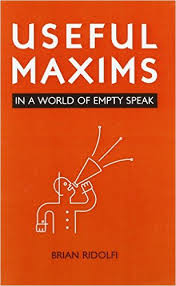
Useful MaximsFor anyone who would like to get your message to “stick” with others—like parents, pastors, teachers, coaches, mentors—I highly recommend Useful Maxims by Brian Ridolfi. You can read my book review to get more background info on this innovative book.

I previously shared 20 useful maxims from Brian’s book, and now here is my next set of 20…

  1. Strong men do not always lift weak men, but weak men always bring down strong men. The lowest common denominator dominates.
  2. You cannot force someone to be tolerant without being intolerant toward their intolerance.
  3. Offending the truth for the sake of the offended is most offensive.
  4. Just fitting in fits in with just giving in.
  5. Prayer is a slayer. To not pray is to become prey.
  6. People aligned with good are maligned by evil.
  7. There is little success when little is involved.
  8. Better to make the last move than to make the first one.
  9. Smart men run from danger; wise men avoid it altogether. Better to prevent than to lament.
  10. Your life becomes a job whenever a job becomes your life.
  11. Those with no time to spare have no time to care.
  12. Wisdom becomes foolishness when foolishness becomes wisdom.
  13. A Christian without a Bible is like a knight without a sword.
  14. Relativists believe in relativism until they or their loved ones are victims.
  15. Vinegar is not bitter to those who have not tasted honey.
  16. Questions cannot be answered if answers cannot be questioned.
  17. Sound wisdom sounds odd in a world deaf to God.
  18. Bad entertainment entertains bad behavior.
  19. Good guys look bad when bad guys look good.
  20. To help the helpers is to help the helpless.

To read some of the other quotes from Useful Maxims that I am sharing, be sure to follow me on Twitter and on Tumblr.

20 Useful Maxims

Useful MaximsI thoroughly enjoyed reading Useful Maxims by Brian Ridolfi (check out my review of his book by clicking here). Here are 20 of Brian’s useful maxims that caught my highlighter.

  1. Going to church is good; going to God is better.
  2. Progress is not good if you are progressing in the wrong direction.
  3. Good demeanor does not validate bad behavior.
  4. Broken commandments break down integrity.
  5. The Bible’s meaning is not hidden from men; men hide from its meaning.
  6. Actions are better indicators of character than rhetoric.
  7. The indifferent make no difference.
  8. Remaining weak takes strength. It takes power not to use power.
  9. Great men step in when everyone else steps out.
  10. Moral arguments which are entirely material are entirely immaterial.
  11. Peacemakers and saltshakers dispense enrichment.
  12. A grudge will keep you deep in sludge. Points of contention are points of retention.
  13. Revenge is hard to reverse.
  14. Never put faith in people who have no faith.
  15. Everything goes when anything goes.
  16. Your sin is not just your problem.
  17. Parental neglect prompts government parenting.
  18. Where no one fears God, everyone fears man.
  19. The right battle is lost with the wrong weapon.
  20. Insecurity secures instability.

Watch for more maxims soon. Or follow me on Twitter and Tumblr to read some of Brian Ridolfi’s maxims.

Useful Maxims (book review)

Useful MaximsKing Solomon had his maxims—Wounds from a friend can be trusted, but an enemy multiplies kisses. Benjamin Franklin had his maxims—A stitch in time saves nine. And now Brian Ridolfi gives us a book of fresh Useful Maxims.

Maxims are short, catchy, and very memorable; a brief, succinct statement that captures profound wisdom in a way that’s easy to recall at the appropriate time. Parents, teachers, pastors, and coaches have all sought ways to get their message across to their young charges, and have those messages come back to the forefront of their mind at crucial moments. This is where an appropriate maxim can be so helpful.

Useful Maxims is organized in broad chapter headings, and then the individual maxims are grouped together in various sub-headings throughout each chapter. Most of them are short—He who exalts himself halts himself—but occasionally Brian shares a short parable along with its memorable meaning.

If you are involved with instructing others, and want to find a way to have your point “stick” in their memory, Useful Maxims will become an invaluable, go-to tool for your lesson plans.

7 Quotes From “Hope … The Best Of All Things”

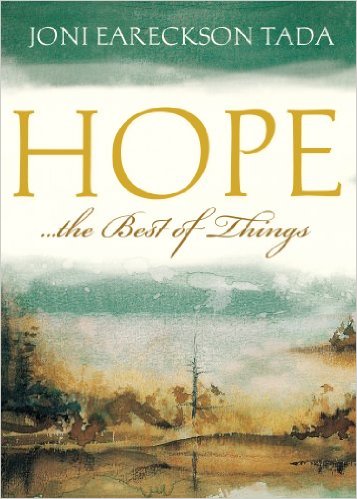
HopeJoni Eareckson Tada knows what it is to battle darkness and depression. And she also know the power of hope in those dark places. Hope … The Best Of All Things is an encouraging book for anyone going through a difficult place (please check out my book review here).

Here are some of the quotes from Hope which especially stood out to me.

“People are angry; cynicism and despair are on the rise, and the nightly news reminds us we are only one terrorist plot away from another national nightmare. Oh, how we need to grasp the soul-settling hope found in the pages of God’s Word—not only grasp it, but allow the hope of God to fill and overflow our hearts, transforming us into people who are confident and at peace with themselves, their God, and their circumstances.”

“For me, suffering is still that jackhammer breaking apart my rocks of resistance every day. It’s still the chisel that God is using to chip away at my self-sufficiency and my self-motivation and my self-consumption. Suffering is still that sheepdog snapping and barking at my heels, driving me down the road to Calvary where otherwise I do not want to go. My human nature, my flesh, does not want to endure hardship like a good soldier (2 Timothy 2:3) or follow Christ’s example (1 Peter 2:21) or welcome a trial as friend. No, my flesh does not want to rejoice in suffering (Romans 5:3) or be holy as He is holy (1 Peter 1:15). But it is at Calvary, at the Cross, where I meet suffering on God’s terms.”

“Do you know who the truly handicapped people are? They are the ones—and many of them are Christians—who hear the alarm clock go off at seven-thirty in the morning, throw back the covers, jump out of bed, take a quick shower, choke down breakfast, and zoom out the front door. They do all this on automatic pilot without stopping once to acknowledge their Creator, their great God Who gives them life and strength each day. Christian, if you live that way, do you know that James 4:6 says God opposes you? ‘God opposes the proud, but gives grace to the humble.’”

“Take up your cross daily and follow the Lord Jesus (Luke 9:23). I must qualify that statement. Please know that when I take up my cross every day I am not talking about my wheelchair. My wheelchair is not my cross to bear. Neither is your cane or walker your cross. Neither is your dead-end job or your irksome in-laws. Your cross to bear is not your migraine headaches, not your sinus infection, not your stiff joints. That is not your cross to bear. My cross is not my wheelchair; it is my attitude. Your cross is your attitude about your dead-end job and your in-laws. It is your attitude about your aches and pains. Any complaints, any grumblings, any disputings or murmurings, any anxieties, any worries, any resentments or anything that hints of a raging torrent of bitterness—these are the things God calls me to die to daily.”

“You see, we are to God the fragrance of Christ. The world can’t see Jesus endure suffering with grace because He’s not here on earth, but you and I are. And we can fill up in our flesh what is lacking in His afflictions (Colossians 1:24), and in so doing become that sweet fragrance, that perfume, that aroma of Christ to God.”

“God mandates that we go out into the streets and the alleys and the highways and the byways. He mandates that we find the poor, the blind, the disabled, and the lame, and help them get busy living, because misery might love company, but joy craves a crowd. And the Father and the Son and the Holy Spirit crave a crowd of joy, joy spilling over and splashing and filling the hearts of thirsty people in this world who are absolutely dehydrated from a lack of hope.”

“The hope we wait for is our only hope, the blessed hope, the glorious appearing of our great God and Savior, Jesus Christ (Titus 2:13). It is Jesus for Whom we have prevailed through all of this suffering, and, oh, for the sweetness of melding one heart into His in that intimacy that is so precious. … Our hope is for the Desire of the nations. Our hope is the Healer of broken hearts, the Friend of sinners, the God of all encouragement, the Father of all comfort, the Lord of all hope. And it is my prayer that the eyes of your heart might be enlightened so that you might know this hope to which He has called you.”

Hope… The Best Of All Things (book review)

HopeHow could any of us go on without hope? Perhaps you are in a difficult place right now, with problems weighing down heavily on you. Would you like some hope in this dark time? Joni Eareckson-Tada has some encouraging words for you in her book Hope… The Best Of All Things.

Joni knows a thing or two about hope. After suffering an accident as a teenager that left her a quadriplegic, she struggled with the loss of hope. But in that dark place, God met with her in a powerful way, and now Joni travels the world to minister to those in deepest hopelessness.

Hope is a short book, but it’s packed with new perspectives for those battling depression and darkness. Joni will share with you some of her own experiences—as well as the experiences and insights of others—to give your soul the oxygen it needs: a fresh breath of hope!

Whether you are going through a battle, or you know someone who is, Hope will be a welcome light for a dark place.