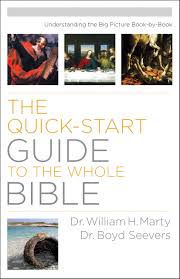
Zig Ziglar once quipped, “Every day I read the newspaper and I read my Bible. That way I know what both sides are up to!” I couldn’t agree more. Everything I read gets filtered through the Bible, but the Bible is a huge volume and one could lose sight of the big picture while trying to read through it. This is where The Quick-Start Guide To The Whole Bible by Drs. William Marty and Boyd Seevers become a valuable resource.
The book is laid out in the same order as the 66 books of the Bible, and each chapter follows the same sequence. For each book you will learn (1) the setting, (2) the summary, and (3) the significance. With each chapter only being a few pages long, it’s a great introduction before reading a book of the Bible.
In the setting you will be reminded of the events occurring in history at the time of the book, which helps give perspective to what you will be reading in the Bible. In the summary you will notice the overarching themes to look for while you read. And in the significance you will discover how this book of the Bible fits into the overall big picture of the whole of Scripture.
Keep this book close to your Bible, and read the corresponding chapter before you begin reading a new book in your Bible. I think you will get so much more out of your Bible reading time by doing this.
This past week I’ve had two conversations that seemed like contradicting thoughts about the Bible, but they’re really exactly the same.
Conversation #1—Since Jesus Christ set us free from the law, there is no longer any need for us to read or study the Old Testament.
Conversation #2—The New Testament is a perversion of the Old Testament, so we should ignore it and stick with the “original” Scripture.
One thing that has helped me see the Scripture in a more correct light is a thought I picked up from Leonard Sweet and Frank Viola in their book Jesus: A Theography. Instead of the titles we’ve given the two divisions of the Bible, it will be better to call them the First and Second Testaments. “Old” and “New” have a tendency to make us think out-dated and updated; First and Second remind us that they go together.
Hosea is one of the first prophets in the First Testament whose words were put into writing. It’s interesting to note how many of the themes from the Pentateuch, Joshua and Judges are linked to Israel’s condition in the last few years before the northern tribes went into exile.
“Hosea’s allusions to Genesis through Judges are highly significant. First, they help to establish the fact that these books had already been written by the time of Hosea, in the eighth century B.C. (Many scholars consider these books to be from the sixth century B.C. and even later.) Second, Hosea’s construal of these books helps us to understand early Biblical interpretation, which in turn gives us a better understanding of how the [Second] Testament interprets the [First].” —Archeological Study Bible
When we move into the Second Testament, we see over 850 First Testament passages are quoted, sometimes entire paragraphs. In every instance, the Second Testament authors see the fulfillment of the First Testament in the life of Jesus Christ.
In fact, Jesus Himself quoted from 22 books of the First Testament, even on the day of His resurrection He explained to them what was said in all the Scriptures concerning Himself (Luke 24:27), and He said He would open our minds so that we too could understand all the Scriptures (Luke 24:45-47).
Finally there is the issue of fulfilled prophesy. Not only were First Testament prophesies fulfilled during the First Testament time, but even more were fulfilled during the Second Testament. In Jesus Christ alone about 200 such prophesies were fulfilled.
Both Testaments are equally important, and equally valuable. In fact, either Testament without the other robs God of His glory and robs us of seeing His fullness.
“Let there be a method in our giving, so that the poor may not go away empty nor the subsistence of the needy be done away and become the spoil of the dishonest.” —Ambrose
“Passion for the glory of the Lord is the key to making a difference all out of proportion to who we are. It is not the prerogative of old or young, intelligent or simple, men or women. This passion can flame up in the heart of any saint. Do we want it enough to seek it?” —John Piper
“Of one thing we are very sure. There will be a full restoration of the apostolic gifts and the full power of Pentecost before the coming of the Lord….” Read more of this quote from Dr. Charles S. Price from over 75 years ago.
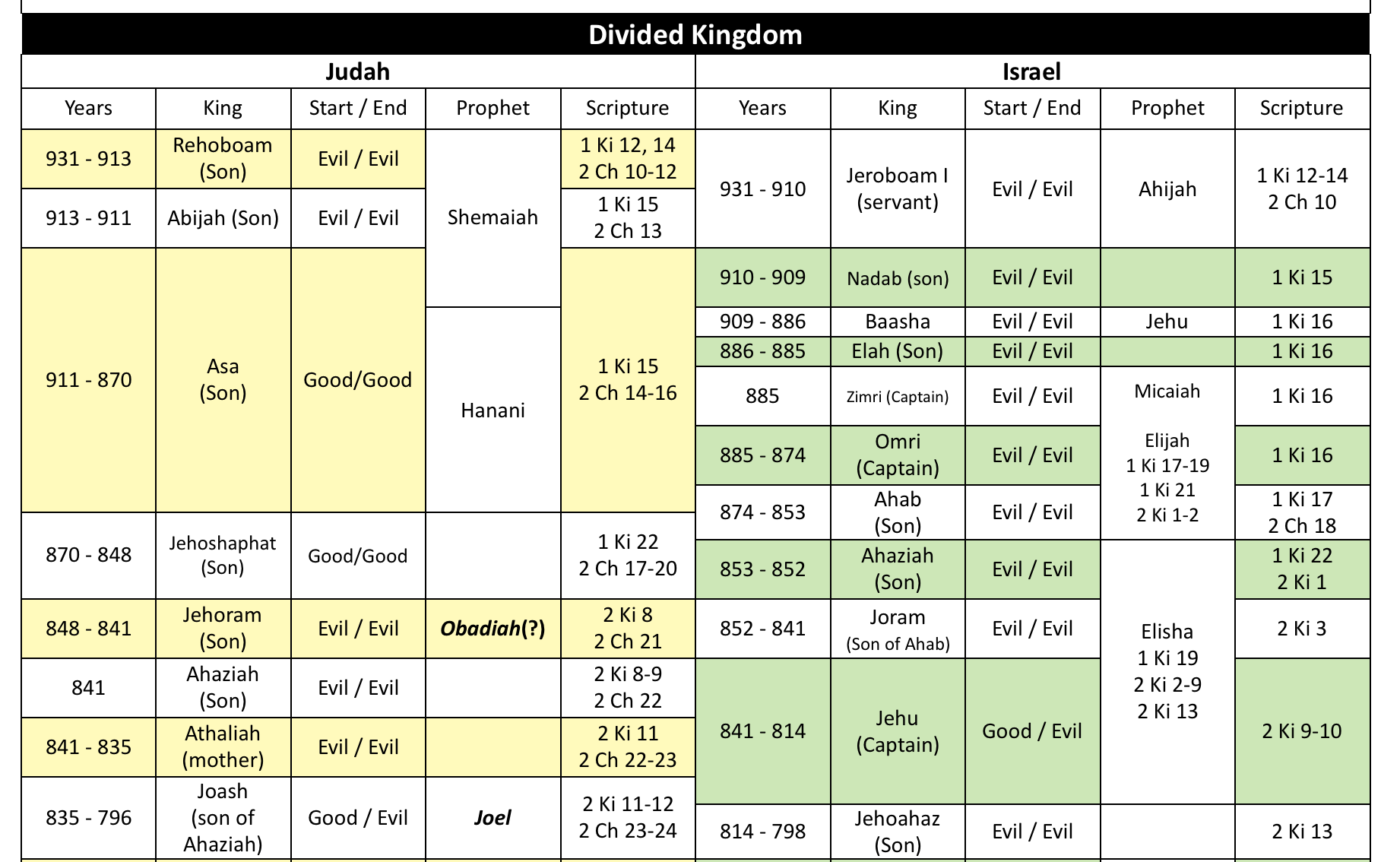
On the Biblegateway website, Jacob Edson has taken my chart and added even more details and cross-references to related Scriptures for each of the kings on this chart.
One challenging point in history is the divided kingdoms of Israel (the 10 northern tribes) and Judah (the 2 southern tribes). What makes it challenging when reading straight through the Bible is the history is covered in 1 and 2 Kings and then again in 1 and 2 Chronicles. In the midst of these kingdoms, several prophets are sent by God. Some of these prophets only have their words recorded in Kings or Chronicles, while others have their words recorded elsewhere in the Bible (usually the book name is the prophet’s name).
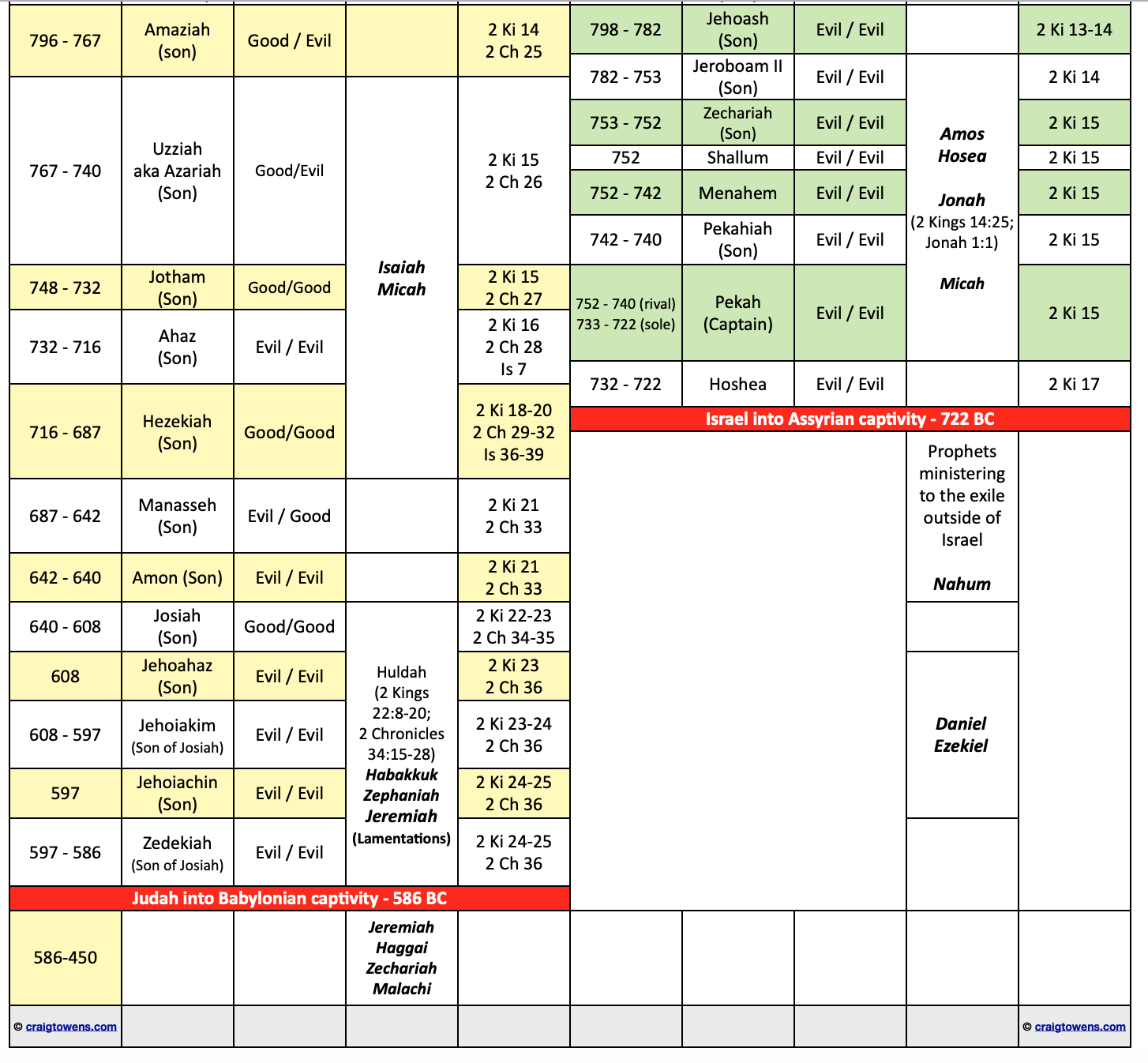
In trying to keep all of these people and messages clear in my mind, I have put together a list of all the kings and prophets during the period of the divided kingdom (roughly 931-586 BC).
You can click the picture above to get a larger view, or you can download a PDF copy by clicking here → Kings of Israel & Judah ←
I am not a biblical scholar, nor do I have a history degree. This is just a chart I put together to help me in my Bible reading, and I thought it might help someone else too. I would welcome any corrections or clarifications that anyone would offer on this humble work.
Not all of these updates are reflected in the screenshots on this page, but they are all in the PDF version.
**UPDATE 1: several people pointed out some tweaks I needed to make to this chart, and I am grateful for the input! This is the revised copy as of August 28, 2017.
**UPDATE #2: a few more tweaks … this is the revised version as of July 31, 2014.
**UPDATE #3: I have posted a chart zooming in on the chronology of the Old Testament prophets which I recreated from the Archeological Study Bible. You can read it and download it by clicking here.
A couple of notes:
Prophets who also have their words recorded in a book that bears their name are listed in bold italics.
The “start / finish” designation for each of the reign of the kings is clearly my subjective opinion.
Sometimes you will see dates for two kings’ reigns that overlap. These are where there was a co-regency (that is a father and son ruling simultaneously).
The prophets that are listed under the Israel side after Israel had gone into captivity are the prophets that God was using to speak to the Israelites in exile.
**UPDATE #4: I continue to do more research and get feedback from people far wiser than me. The latest version is dated August 28, 2017.
**UPDATE #5:The original chart stopped when Israel and Judah went into captivity. I have now added another line to show the prophets who continued to prophesy to both the exiles in Babylon, as well as to those who returned to Israel later.
**UPDATE #6: Scholars are unsure of the date of Obadiah. We know that it took place after invaders had caused problems in Judah (Obadiah 11)—and Edom responded in a way that angered God. Some scholars place this date after Nebuchadnezzar’s conquest of Judah in 586 BC, but since post-exilic prophets always named Nebuchadnezzar or Babylon, I think it’s more likely to have occurred during the reign of Jehoram around 840 BC (see also 2 Chronicles 21:8-10). Added Huldah as a prophetess during the reign of Judah’s King Josiah.
**UPDATE #7: Thanks to Anthony Wimmer, this chart is now available in French → Rois d’Israel & Juda
**UPDATE 8: I am always appreciative of the interaction with those who have downloaded my chart and are digging into the dates. After a few conversations, I have modified the chart slightly on the lower right quadrant of the last page to show those prophets who were ministering to the Israelites who were in captivity.
“There is, hidden or flaunted, a sword between the sexes till an entire marriage reconciles them. It is arrogance in us to call frankness, fairness, and chivalry ‘masculine’ when we see them in a woman; it is arrogance in them to describe a man’s sensitiveness or tact or tenderness as ‘feminine.’ But also what poor, warped fragments of humanity most mere men and mere women must be to make the implications of that arrogance plausible. Marriage heals this. Jointly the two become fully human. ‘In the image of God created He them.’ Thus, by a paradox, this carnival of sexuality leads us out beyond our sexes.” —C.S. Lewis
“The highest kind of liberality is, to redeem captives, to save them from the hands of their enemies, to snatch men from death, and, most of all, women from shame, to restore children to their parents, parents to their children, and to give back a citizen to his country.” —Ambrose
John Piper says, “We are supposed to let our light shine before others that they give glory to our Father. But in my experience shining with supernatural, divine light from another world is the very essence of non-regular.” Read the rest of his post: I Do Not Aspire To Be A “Regular Guy.”
It nauseates me when I think that my tax dollars are funding this sort of irresponsible, atrocious behavior at Planned Parenthood! Read more about the latest lawsuit against Planned Parenthood.
“Why do we take a railway guide and arrange for a particular journey? … Well, one has confidence in the reliability of these official publications. As a rule we are not put to shame! Now, just as we use a railway guide we must use our Bible. We must depend on God’s Word just as we depend on man’s word, only remembering that though man may not be able to carry out his promise, God will always fulfill what He has said.” —Hudson Taylor
“Distractions must be conquered or they will conquer us. So let us cultivate simplicity; let us want fewer things; let us walk in the Spirit; let us fill our minds with the Word of God and our hearts with praise. In that way we can live in peace even in such a distraught world as this.” —A.W. Tozer
“If indeed the name of the eternal God is named upon us, we are secure; for, as of old, a Roman had but to say Romanus sum, I am a Roman, and he could claim the protection of all the legions of the vast empire; so everyone who is a man of God has omnipotence as his guardian, and God will sooner empty heaven of angels then leave a saint without defense. Be braver than lions for the right, for God is with you.” —Charles Spurgeon
“How one learns to be thankful for each day on which one can still do something.” —Karl Barth
“Better have God and no other friend then all the patrons on the earth and no God.” —Charles Spurgeon
Thought-provoking questions: “Dear Christian, are you still on fire for Jesus? Are you in love with Him as passionately as when you first got saved? Or have you lost interest in His concerns, forsaking all ministry? Do you have too much else going on in your life? If so, the Lord says to you, ‘I have something against you—you have left your first love!’” —David Wilkerson
I don’t think anyone would mind having his or her name inserted in any of the following compliments:
___________ is a righteous person.
___________ is blameless before God.
God looks favorably on ___________.
___________ walks with God.
Pretty nice pedigree, huh?
This is the description of Noah in the Bible. I especially love the phrase “walks with God.” It’s only used of two people in the Bible: Noah and Enoch. But it’s even more encouraging to me when I read it about Noah’s life.
Noah is the first in Adam’s family line to be born after Adam died. That’s significant because all of his ancestors (including Enoch) would have been able to get a first-hand account from Adam himself about what it was like to be in the Garden of Eden. All of Noah’s ancestors could have heard right from Adam’s mouth what it was like to visit with God personally each evening, to talk to Him face-to-face. And they could have heard firsthand how devastatingly painful it was to lose that intimate fellowship because of sin.
Since Noah was the first person in this family tree to hear about this secondhand, he’sthe first person to walk with Godby faith. Which is the exact same way we walk with God today:
Faith is being sure of what we hope for and certain of what wedo not see (Hebrews 11:1).
You too can insert your name in this blank: “___________ walks with God.”
How do you do this? Pray this:
“God, I want to walk with You. I knowit’s impossible to please You except by faith. I want to get closer to You. So I believe that You exist and that You care enough to respond to me when I seek You and love You with all of my heart, soul, mind, and strength.”
Let’s enourage one another to walk in this way every single day.
How in the world am I going to link these three thoughts? I think I can do it, but first, a little historical background…
Have you ever noticed in the Bible how much the Jews disliked the Samaritans? In fact, it was said that if a Jew had to even say the word Samaritan he would immediately spit to get that vile word out of his mouth. Where did this come from?
After King Solomon’s death, the nation of Israel was split in two. Judah and Benjamin in the southern half of the country went by the name “Judah” and had their capital in Jerusalem. The northern ten tribes went by the name “Israel” and had Samaria as their capital. The northern kingdom—the Samaritans—became more and more godless, turning to false idol worship.
The Samaritans would make deals and alliances with any surrounding country and their false deities to save their necks from other invaders. In effect, they made a deal with the devil.
Pat Robertson made a foolish comment that the earthquake in Haiti was because the Haitian people had “made a deal with the devil” to kick the French out of their country.
Did the Haitians make such a deal? Did the Samaritans? It’s very likely.
Yet when Jesus was asked to explain what it meant to love one’s neighbor, whom did He use as an example? A Samaritan!
Demonic deal or not, God desperately loves the Haitian people. Jesus died to bring Haitians into a personal relationship with Himself. God grieves over the devastation in that country.
Mr. Robertson, now is not the time for judgmental statements. You are not the one who should be making such statements. Now is the time for compassion. Can you imagine Jesus saying to the woman at the well, “Since you live in a country where your ancestors made a deal with the devil, you’re disqualified. I have living water to give, but you’re not getting any of it because you are under a curse”? I can’t imagine that.
If you’d like to show compassion to these precious people, can I recommend making a donation to a wonderful organization called Convoy of Hope? Please keep praying for the Haitians.
Listen to the podcast of this post by clicking on the player below, and you can also subscribe on Apple, Spotify, or Audible.
Disclaimer: My aggregate soap opera viewing time for my entire life is about 52 minutes, but I still think I know what I’m talking about <grin!>.
Soap operas are usually pretty predictable. If you’ve watched them for even a short time it’s not hard to figure out who’s who and what’s what. In fact, the plot lines are typically so predictable that you can stop watching a particular soap opera for months—or even years—and when you tune in again it will only take a day or so to once again know who’s who and what’s what.
One of the main reasons for this is the simplicity of the plot lines. There are three types of characters: good guys, bad guys, and wishy-washyguys that are swayed by the good guys or bad guys.
We applaud when the good guys win and the bad guys get what’s coming to them. We groan when the good guys get unfairly treated and the bad guys seem to get away with their badness. If we could give advice to the soap opera characters it would be pretty straightforward: “If you’re a good guy, we’ll cheer for you!”
But here’s the problem: it’s becoming harder and harder to tell the difference between the good guys and bad guys. It seems like more of them fall into the wishy-washy category. Over time, the characters have become mostly good but can be swayed to take revenge or cut corners. Or they’re mostly bad but still have a soft place in their heart to help the little orphan child.
There are very few really good guys left.
There’s a drift from good to mostly good. But mostly good is only one step away from mostly bad. And only one more step from mostly bad to just-plain-bad.
I’ve been reading through the soap opera history of the kings of Israel and Judah. Like our modern soap operas there are three types of kings: (a) the good kings did what was right in God’s eyes; (b) the bad kings did what was evil in the God’s eyes; and (c) the wishy-washy kings usually did what was right but had a “however” attached to their reign.
Unfortunately, most of the good kings tended to drift from good to mostly good, and eventually to mostly bad. The drift continued each generation toward mostly bad until God was hard-pressed to find any king who wasn’t bad. How sad: God’s blessing was right there for any good king to claim, but they kept drifting away!
Drifting happens so easily, which is why we have to be so diligent.
You’re blessed when you stay on course, walking steadily on the road revealed by GOD. You’re blessed when you follow His directions, doing your best to find Him. That’s right—you don’t go off on your own; you walk straight along the road He set. You, GOD, prescribed the right way to live; now You expect us to live it. Oh, that my steps might be steady, keeping to the course You set; then I’d never have any regrets in comparing my life with Your counsel. I thank You for speaking straight from Your heart; I learn the pattern of Your righteous ways. (Psalm 119:1-7, The Message paraphrase)
Just like those soap opera characters or soap opera kings, we can get some pretty straightforward advice from the Bible: “If you stay on course, walk straight along the road God set for you, He will bless your life.”
Don’t drift.
Don’t settle for mostly good.
Don’t assume you’re doing right in God’s eyes; KNOW that you’re doing right in God’s eyesby following His Word.



 Zig Ziglar once quipped, “Every day I read the newspaper and I read my Bible. That way I know what both sides are up to!” I couldn’t agree more. Everything I read gets filtered through the Bible, but the Bible is a huge volume and one could lose sight of the big picture while trying to read through it. This is where The Quick-Start Guide To The Whole Bible by Drs. William Marty and Boyd Seevers become a valuable resource.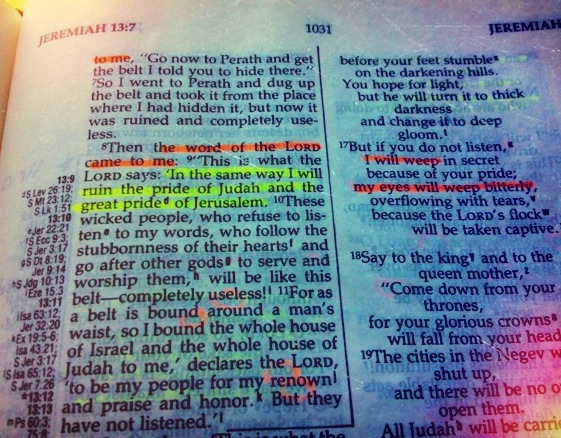





 Craig T. Owens