Listen to the podcast of this post by clicking on the player below, and you can also subscribe on Apple, Spotify, or Audible.
Colossians 3 is a catalog of heart changes that reveal themselves as behavior changes. Intermingled in these instructions Paul gives some summary “whatever you do” mile markers.
Whatever virtues the Holy Spirit is developing in my life, my motivation for sticking with the sanctification process must be love. Love for God and love for those around me must be my motivator. And over all these virtues put on love, which binds them all together in perfect unity (Colossians 3:14).
Whatever behaviors the Holy Spirit is prompting me to add, or change, or remove from my life, I must be able to say “yes” to each item on this list:
Am I doing what Jesus would do?
Am I thankful that I am doing what I am doing?
Am I doing what I am doing wholeheartedly?
And whatever you do, whether in word or deed, do it all in the name of the Lord Jesus, giving thanks to God the Father through Him (Colossians 3:17).
One attitude check—am I operating in love?—and the three behavior checks listed above, should be something I regularly review. I want to make sure that whatever I do, I am working at it with all my heart, as working for the Lord, not for men (see Colossians 3:23).
It’s wonderful to make changes in my life, but I have to make sure that whatever I am changing is supported by the right attitude and pursuing the right goal, so that Jesus is glorified in my life.
Listen to the podcast of this post by clicking on the player below, and you can also subscribe on Apple, Spotify, or Audible.
In The Matrix, Neo is fascinated by a young man who appears to be bending spoons simply by looking at them. Neo sits down on the floor across from this young man and takes a spoon in his hand. Although young, this boy gives sage counsel to Neo, “Don’t try to bend the spoon, for that is impossible. Instead remember that there is no spoon. That way you will see that it is not the spoon the bends, but you are the one who bends.”
There is a nugget of truth here for anyone who has ever been face-to-face with an impossible situation. The God who does the “impossible” has offered us the means to see His omnipotence at work—He has told us that we can bring our impossibles to Him in prayer. Prayer changes things!
In God’s perfect will, sometimes the impossible is done before our very eyes, and sometimes we see that it is not the situation that bends, but it is we who bend, becoming more godly, wise, and mature because of what God has imparted to us. Heartfelt prayer is never a meaningless exercise. Without exception, something is changed with every single prayer we offer to God.
There are many of us who have experienced a miraculous answer to prayer. We prayed to God in a bitter season of our life and experienced His sweetness come to our rescue. These answered prayers are testimonies of God’s love and power.
Think about people you know who are struggling with the bitterness of life. I wonder: do they know that there is a sweetness that only God can bring? Brian Ridolfi noted, “Vinegar is not bitter to those who have not tasted honey.” Peter told us we are to crave more and more of God’s sweetness “now that you have tasted that the Lord is good” (1 Peter 2:2-3). This isn’t primarily for us, but it is to us and through us so that a watching world can recognize their bitterness as contrasted to the sweetness in our Savior.
One of the things prayer changes is my attitude about the things of God. When I say “attitude” I am referring to how an airplane pilot defines this term: The nose of the plane in relation to the horizon. If the attitude of the plane is up, the plane and all of its passengers are climbing.
There is a man we meet in the Gospels whose name means “whom God enlightens.” The answer to prayer he received was an attitude-changer for him, everyone around him, and his family. Check out his story in Luke 8:40-56.
Jairus is called “a ruler of the synagogue.” He is the final authority on what happens in his synagogue. He came and “fell at [Jesus’] feet, pleading with Him” [pleaded earnestly—Mark 5:23], which sounds like a posture of intense prayer to me!
We don’t know how long the journey was to Jairus’ home, but it was made longer by “the crowds [that] almost crushed [Jesus].” It was made even longer by an interruption of yet another healing (vv. 43-48). During this delay, there is not a word of protest from Jairus as he is clinging to his faith in Jesus.
Jairus gets the news, “Your daughter is dead.”
Jesus reignited Jairus’ faith with the words, “Don’t be afraid; just believe, and she will be healed.” Matthew 9:18 records Jairus’ renewed faith-filled prayer as he acknowledges, “My daughter has died.”
The family and friends gathered at Jairus’ house were “wailing and mourning.” The AMPC says, Jesus saw “the tumult and the people weeping and wailing loudly” (Mark 5:38). Why? Because they knew she was dead—this was now an impossible situation.
But let me ask you: Is it possible that Jesus allowed this delay so that the little girl would become beyond all human hope? I think it is. Jesus was going to do something that absolutely no one could take any credit for. Jesus said, “Stop wailing. She is not dead but asleep.” They laughed at Him!
The Greek word for “wail” (alaladzo) has an interesting root word (alala) which means the cry of soldiers running to the battlefield. And then when those soldiers return victoriously, they have a total change in their attitude so alaladzo is now a joy-filled shout (Psalm 47:1; 66:1-3).
(1) Jairus had an attitude change.I believe became a Christ-follower in the truest sense of the word. Why do I think this? Because we know his name. There are four “synagogue rulers” described in the New Testament: three that become Christians we know by name (Crispus [Acts 18:8], Sosthenes [Acts 18:17], Jairus) and one who remains anonymous because he was bitter that Jesus healed someone on a Sabbath (Luke 13:14).
(2) The scorning mourners who knew the girl was dead had an attitude change. They spread the laughter everywhere (Matthew 9:26).
(3) What about us? An encounter with Jesus changes us (Romans 12:2; 2 Corinthians 3:18). In order to “taste and see” how good God is, we must be people who are consistently prayerful and expectant of His wonder-working power. Let’s change our wailing into a battlecry, our mourning into praise, so that God can chance our tears into laughter!
A world steeped in bitterness needs to see the sweetness of our God—Come and see what God has done, His awesome deeds for mankind! (Psalm 66:5).
Keep up with all of the messages in this prayer series by clicking here.
The crucible for silver and the furnace for gold, but people are tested by their praise. (Proverbs 27:21)
The Message paraphrase says you can tell what’s in someone’s heart by how they react when they are praised—“The purity of human hearts is tested by giving them a little fame.”
The Amplified Bible says you can tell what’s in someone’s heart by listening to what they praise—“A man is judged by what he praises and of what he boasts.”
These are two sides of the same coin, and both are equally true. How we handle praise and what we praise both reveal what’s inside our heart. Both of these are responses to which we shouldpay careful attention.
Listen to the podcast of this post by clicking on the player below, and you can also subscribe on Apple, Spotify, or Audible.
The second-to-last book of the New Testament is a short letter to the Church in which Jude felt urged by the Holy Spirit to challenge Christians to “contend for the faith that was once for all entrusted to the saints.” Does contend mean Christians are supposed to be combative about sharing their faith? We can learn a lot from the way Jude opens this letter.
First, let’s look at who wrote this book.
The names of the brothers of Jesus are listed twice (Mark 6:3; Matthew 13:55), and Jude is either the youngest or second youngest of these male siblings. He was a part of the family delegation that went to bring Jesus home because they thought He was out of His mind (Mark 3:21, 31). Later on, Jude would also mockingly taunt Jesus (John 7:5).
James is the oldest brother after Jesus. When Paul writes that Jesus appeared to James after the resurrection (1 Corinthians 15:7), it’s possible that it means Jesus appeared to all of his brothers, because Paul also mentions that the brothers of Jesus had become evangelists (9:5). It’s not surprising that Jude calls himself a brother of James, but it is quite shocking that he calls himself a servant of Jesus Christ.
In fact, he calls Jesus:
our only Sovereign and Lord (v. 4)
the One who gives us eternal life (v. 21)
the only One who is our entrance into Heaven (vv. 24- 25)
We need to adopt this servant’s mindset as we interact with others.
Second, let’s notice who Jude’s audience is.
Jude writes to people who are called, sanctified, preserved (NKJV).
called = invited to the banquet
sanctified = hagiazo = holy ones or saints
preserved / kept = carefully attended to
Finally, let’s consider how Jude expects saints to be living each day.
Jude says in verse 2 that we are to live…
mercifully = not wanting people to get the punishment they deserve
peacefully = having our soul so secure that we fear nothing from God
lovingly = agape love like Jesus (John 3:16, 13:1) and like us (13:35, 15:9)
And all of these things are to be in abundance—ever multiplying!
After all of this, we are now in a place to consider how to live contending for the faith (v. 3).
We are servants of Jesus, called to His banquet, set apart and preserved for His glory; we are intimately aware of His mercy, peace, and love, which we want others to know for themselves.
Before we learn how to contend, let’s ask the Holy Spirit to check our attitude to ensure we indeed have the attitude of a secure servant.
Listen to the podcast of this post by clicking on the player below, and you can also subscribe on Apple, Spotify, or Audible.
We had our final service of the summer joining with Hillcrest Community Church in Morley Park. Pastor Caleb Claybaugh shared a message that challenged me.
He started out with a simple question: Why do we do ministry? “Because the Bible says so” is a good start but it’s not enough. It’s not just doing but having the right attitude.
God is more interested in the attitude of our hearts than He is the actions of our hands.
First, we have to love others as Jesus loved: So now I am giving you a new commandment: Love each other. Just as I have loved you, you should love each other. Your love for one another will prove to the world that you are My disciples (John 13:34-35 NLT).
When people hurt, Jesus hurts. When Jesus saw her weeping and saw the other people wailing with her, a deep anger welled up within Him, and He was deeply troubled. … Then Jesus wept (John 11:33, 35 NLT). So, too, when we see people hurting, we should hurt with them, and our pain should move us to action—When [Jesus] saw the crowds, He had compassion on them because they were confused and helpless, like sheep without a shepherd (Matthew 9:36 NLT).
Christ’s compassion prompted Him to preach the Good News and to heal the sick (v. 35). And then Jesus prayed that more of us would be involved in this type of compassion-driven ministry (vv. 37-38).
Although this was a word Peter spoke to pastors, it’s a good challenge for all of us about checking out attitude: Care for the flock that God has entrusted to you. Watch over it willingly, not grudgingly—not for what you will get out of it, but because you are eager to serve God (1 Peter 5:2 NLT).
May our prayer be for God to give us both the heart of compassion that Jesus has, and also the hands of compassion that meet the needs of hurting people.
Listen to the podcast of this post by clicking on the player below, and you can also subscribe on Apple, Spotify, or Audible.
Godly leaders should be secure enough to think of themselves as servants and stewards—nothing more, nothing less. And people in the church should look on their leaders as servants and stewards—nothing more, nothing less.
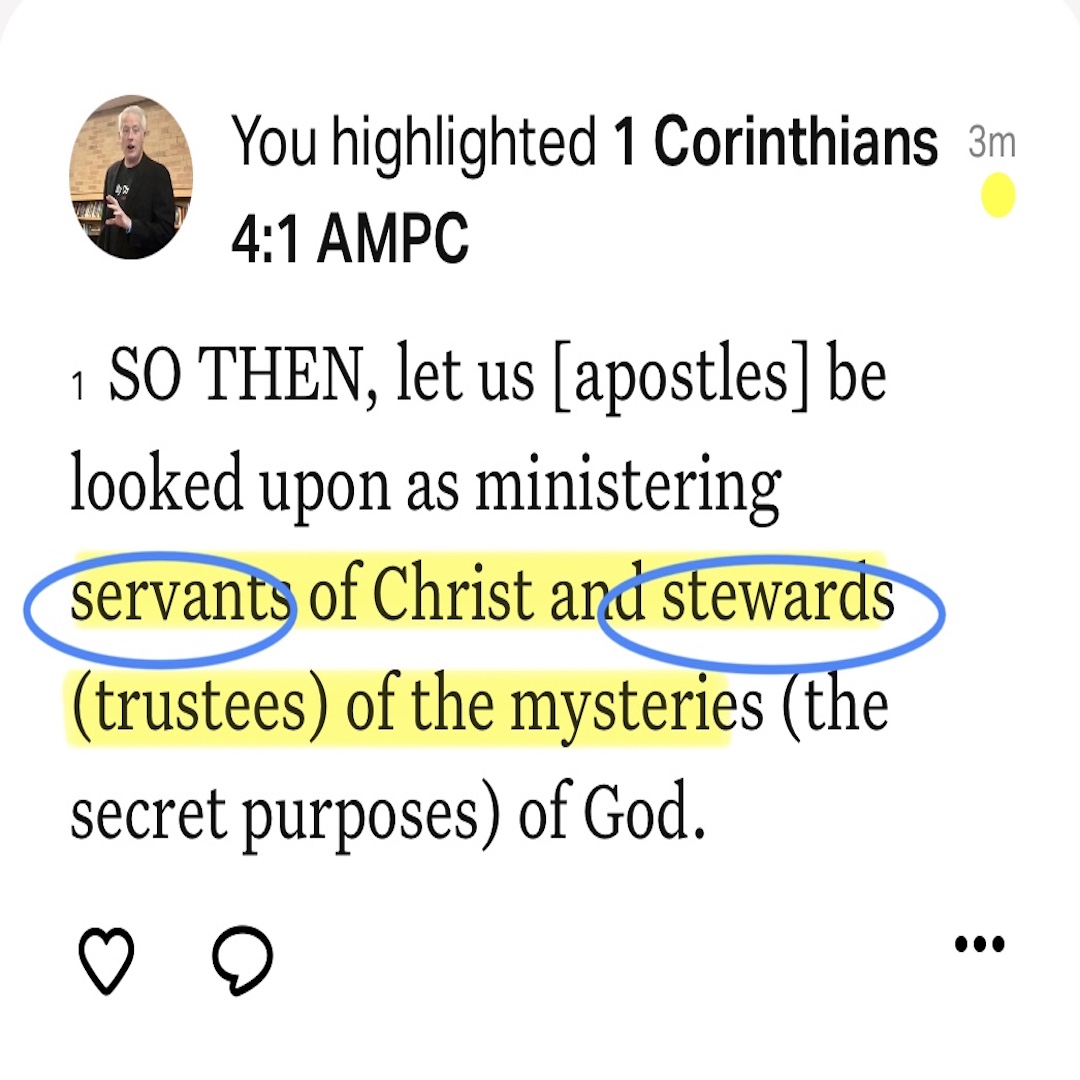
So then, let us apostles be looked upon as ministering servants of Christ and stewards (trustees) of the mysteries (the secret purposes) of God. (1 Corinthians 4:1 AMPC)
Q: How do I know if I am a servant?
A: People treat me like one.
Q: How do I know I have a servant’s attitude?
A: I don’t mind being treated like a servant.
Paul lived this out—Now, brothers and sisters, I have applied these things to myself and Apollos for your benefit, so that you may learn from us the meaning of the saying, “Do not go beyond what is written.” Then you will not be puffed up in being a follower of one of us over against the other(1 Corinthians 4:6).
I closed the chapter ‘Secure to Serve’ in my book Shepherd Leadership like this—
God wants to use you as a leader. He has called you to great things. Just remember that He does the calling and the equipping so that you can serve and shepherd others. It may be a prominent, noticeable position, or it may be an obscure position unseen by very many. It may be a position God keeps you in until the day He calls you home, or it may be a temporary position. A humbly confident leader doesn’t fight to climb a ladder nor strive to keep a position on a higher rung of the ladder. The shepherd leader is confident to serve where God places him, and humble enough to be moved, or even removed, as God sees best. But most of all, a secure shepherd leader knows that God’s desire for His leader in any position is a heart to serve others.
Listen to the podcast of this post by clicking on the player below, and you can also subscribe on Apple, Spotify, or Audible.
In March 1966, at the height of Beatlemania, John Lennon was quoted—
“Christianity will go. It will vanish and shrink. I needn’t argue about that; I’m right and I will be proved right. We’re more popular than Jesus now; I don’t know which will go first—rock ’n’ roll or Christianity. Jesus was all right but His disciples were thick and ordinary. It’s them twisting it that ruins it for me.”
Maureen Cleave, the reporter who included this quote in her article about the Beatles, tried to clarify that John was talking specifically about the Church of England, especially when John mentions the disciples of Jesus twisting the words and example of Jesus as it is recorded for us in the New Testament.
But I wonder if the same argument could be made today about the “stars” in the evangelical movement? Many of those who claim to be preachers of the Gospel have both an online and in-person following that rivals that of the Beatles of the 1960s. Their gatherings are rock concert-esque, with their fans spending lavishly on their books, videos, and seminars.
But here’s my question: Are these “rock star preachers” making Jesus famous or themselves famous?
How would John the Baptist’s words sound coming out of the mouths of these mega-stars: “[Jesus] must increase, but I must decrease. He must grow more prominent; I must grow less so” (John 3:30 AMPC)?
Before John was born, the angel Gabriel told Zechariah that John “will be great in the eyes of the Lord” (Luke 1:15).
Notice: “Great in the eyes of the Lord” is so infinitely better than “great in the eyes of the world”!
John’s whole life was one of confident humility (or humble confidence). He spoke God’s Word confidently, but wasn’t seeking the praise of men nor intimidated by the criticism of men. As a result, God’s Spirit remained on him in an unmistakable way.
God will use anyone in the way that He used John, if they will only have the same attitude John had: “I must decrease and Jesus must increase.”
May I suggest this attitude-adjusting prayer for everyone who has been called by God to herald the Good News about Jesus—
Heavenly Father, as I preach today may all eyes move past me and turn to Jesus. “He must increase, but I must decrease. He must grow more prominent; I must grow less so.” Thank You for this opportunity You have given me today to point people to You. May I only be seen as great in Your eyes, but may the world view me only as Your humble servant.
Listen to the podcast of this post by clicking on the player below, and you can also subscribe on Apple, Spotify, or Audible.
As both a consultant and in one-on-one conversations with colleagues, I have lost count of how many times I’ve heard leaders tell me how incompetent their teammates are. When I have gently asked how they could help their teammates improve, the response is usually something like, “I think they are giving me all they have right now.”
There is an age-old leadership principle that goes something like this—
A poor leader doesn’t believe his people can achieve more than they already are, so he stops training them and stops expecting great things from them. His people soon discover the level of performance their leader will settle for, and then gravitate to that level.
The leader then assumes that’s all that his people are capable of achieving, so he accepts it as fact and quits challenging his people to get better.
So both reinforce what the other believes, and the vicious downward cycle continues.
How sad!
But I have found that exemplary leaders believe the best is still to come. They challenge their teammates to strive for greatness. They take time to train, resource, and encourage them to strive for the next level. They don’t beat them up or give up on them when they stumble, but they treat stumbles as learning opportunities. They always believe their teammates can achieve more.
If you were on a team with a leader like that, wouldn’t you want to live up to those expectations? Of course you would! So instead of the vicious downward cycle I just outlined, an environment like this creates a virtuous cycle that keeps pulling people upward.
The apostle Paul talked in virtuous terms about his teammates. He wrote publicly about Timothy (I have no one else like him—Philippians 2:20), Epaphroditus (my brother, co-worker and fellow soldier—Philippians 2:25), Mark (he is helpful to me in my ministry—2 Timothy 4:11), and Luke (the beloved physician and faithful comrade—Colossians 4:14), to name just a few.
Even when he had to speak a challenging, correcting word to the saints in Corinth, he still believed the best for them—
I am not sorry that I sent that severe letter to you, though I was sorry at first, for I know it was painful to you for a little while. Now I am glad I sent it, not because it hurt you, but because the pain caused you to repent and change your ways. … I am very happy now because I have complete confidence in you. (2 Corinthians 7:8-9, 16 NLT)
I love that phrase: I have complete confidence in you!
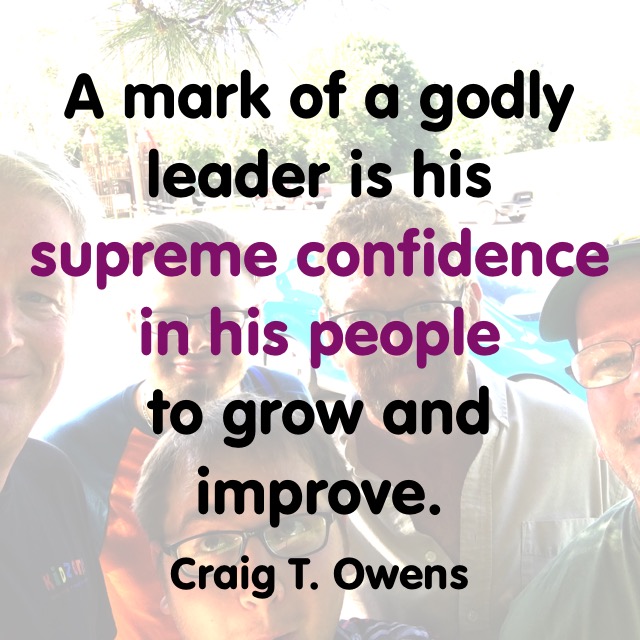
A mark of a godly leader is his supreme confidence in his people to grow and improve.
If you feel like your teammates just aren’t measuring up, can I suggest that you take a look in the mirror? It may be that your expectations of them are too low, that your attitude toward them has been squelched, and that your words and actions are perpetuating a downward cycle.
By changing your attitude toward your teammates, you can put the brakes on that downward pull, and begin a brand new virtuous cycle that pulls your entire team—and your whole organization—up to heights where they have never gone before!
This is part 82 in my series on godly leadership. You can check out all of my posts in this series by clicking here.
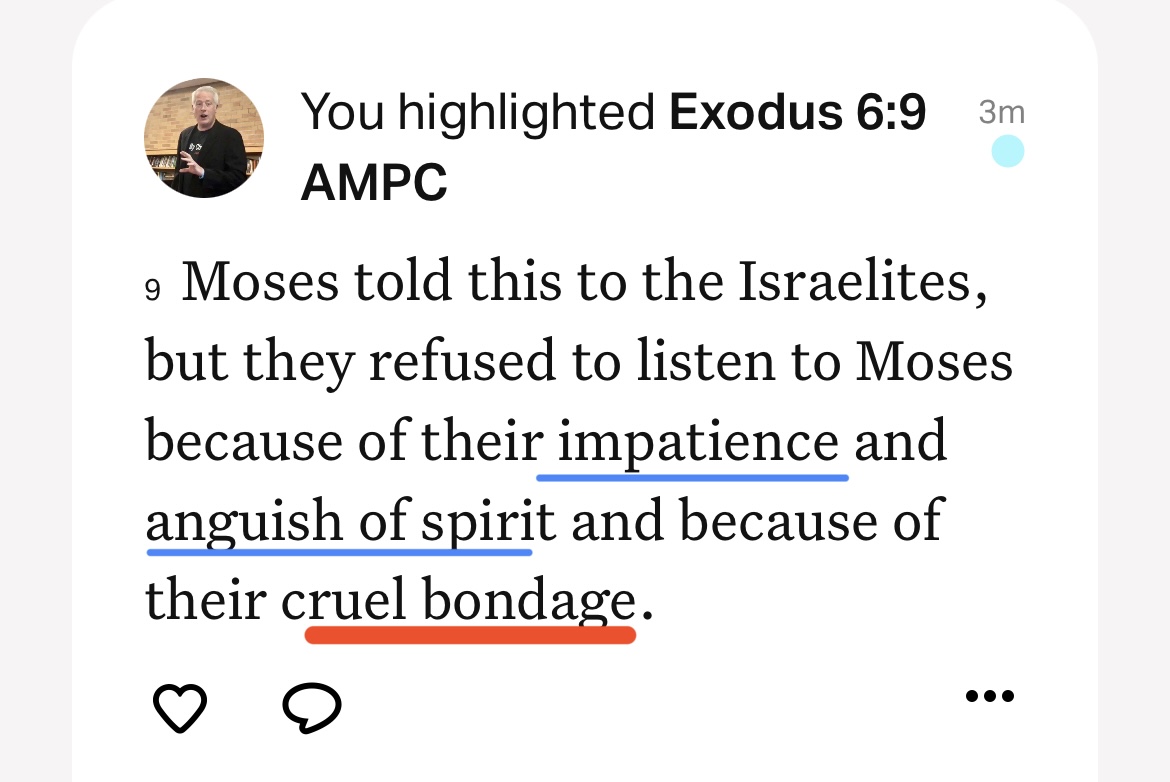
And I will take you to Me for a people, and I will be to you a God; and you shall know that it is I, the Lord your God, Who brings you out from under the burdens of the Egyptians. And I will bring you into the land concerning which I lifted up My hand and swore that I would give it to Abraham, Isaac, and Jacob; and I will give it to you for a heritage. I am the Lord [you have the pledge of My changeless omnipotence and faithfulness]. Moses told this to the Israelites, but they refused to listen to Moses because of their impatience and anguish of spirit and because of their cruel bondage. (Exodus 6:7-9)
We may not be able to do anything about our external circumstances (“cruel bondage”), but can make sure that we are addressing what we can control. Both “impatience and anguish of spirit” are internal attitudes that we can change.
If we don’t remove these impediments, we will not be able to hear the message God is trying to speak to give us encouragement.
Listen to the podcast of this post by clicking on the player below, and you can also subscribe on Apple, Spotify, or Audible.
Paul’s first visit to Philippi didn’t go so well!
It started off with some success—Lydia and her household accepted Jesus as their Messiah, and a demon-possessed girl was set free—but then things turned sour very quickly! Paul and Silas were falsely accused of subverting Roman law, and without any sort of trial they were beaten and thrown into prison.
Even after the local magistrates realized their mistake in mistreating Roman citizens in this way, they simply asked Paul and Silas to leave town. You can read this story in Acts 16:11-40.
But there were seeds planted in this city. Not just Lydia’s family, but the jailer’s family as well, became followers of Jesus. And what about the girl set free from demonic oppression? I have a hunch she joined with the Christians in praising God too! This group of believers then became the first financial supporters of Paul’s missionary work.
Paul knew that his brief imprisonment in Philippi had resulted in a thriving group of believers. And now as he writes a letter to these saints from a Roman jail, he is once again starting to see what God is going to do through this hardship—
Now I want you to know, brothers and sisters, that my circumstances have turned out for the greater progress of the gospel, so that my imprisonment in the cause of Christ has become well known throughout the praetorian guard and to everyone else, and that most of the brothers and sisters, trusting in the Lord because of my imprisonment, have far more courage to speak the word of God without fear. (Philippians 1:12-14)
Paul was not embittered by his imprisonment, but he was rejoicing in all of the good things God was accomplishing because of his imprisonment.
✅ An attitude of thankfulness allows our eyes to stay open to God’s blessings even in hardships.
❌ A grumbling attitude prevents us from acknowledging what God is doing.
Paul’s trust in God’s provision gave him an attitude of gratitude in a difficult place, and he now encourages his friends to adopt this same mindset. In the next chapter, he writes—
Finally, my brothers and sisters, rejoice in the Lord. To write the same things again is no trouble for me, and it is a safeguard for you. (Philippians 3:1)
Paul knew that in a heart full of gratitude there is no room for grumbling. That’s why always rejoicing in the Lord is “a safeguard” for Christians. Rejoicing in God’s character and God’s blessings keeps our mind on Him, making it very difficult for any temptation to ambush us.
Let’s proactively keep a heart full of gratitude so that no grumbling can seep in. But if we do find ourselves in a dark place that may prompt us to grumble, let’s react quickly to turn any complaints into praying and singing hymns to God, just as Paul and Silas had done in the Philippian jail, and undoubtedly as they were also doing now in their Roman jail.



 Colossians 3 is a catalog of heart changes that reveal themselves as behavior changes. Intermingled in these instructions Paul gives some summary “whatever you do” mile markers.












 Craig T. Owens