Grumbling People

Listen to the podcast of this post by clicking on the player below, and you can also subscribe on AppleSpotify, or Audible

The Israelites were barely out of Egypt, freed from 400 years of captivity, and they begin grumbling against Moses, their God-appointed leader—

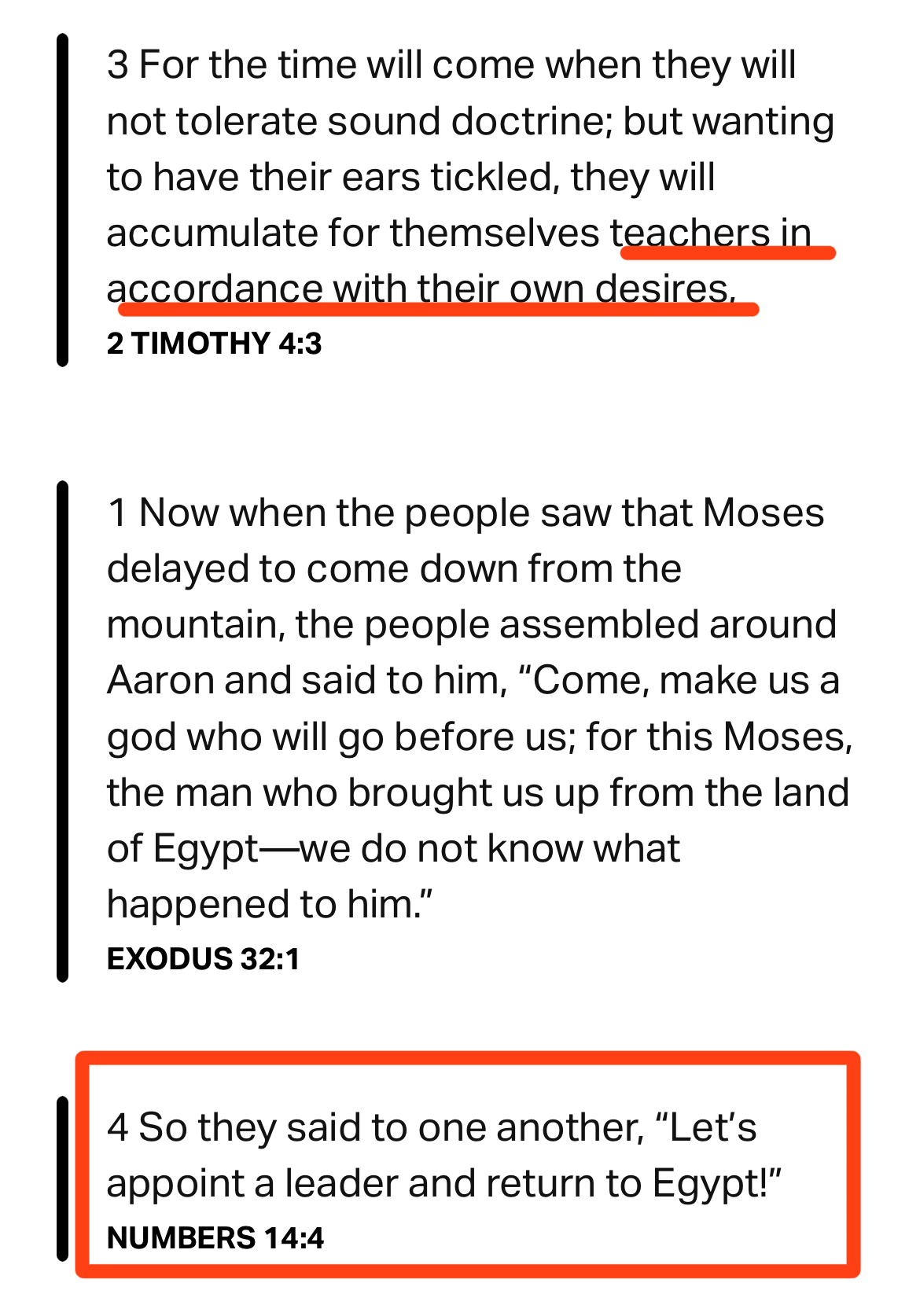
     Now when the people saw that Moses delayed to come down from the mountain, the people assembled around Aaron and said to him, “Come, make us a god who will go before us; for this Moses, the man who brought us up from the land of Egypt—we do not know what happened to him.” (Exodus 32:1)

Then later, on the borders of their promised land, they were again doubtful that Moses truly had heard from God. “So they said to one another, ‘Let’s appoint a leader and return to Egypt!’” (Numbers 14:4). 

Have you ever wondered why these disgruntled people didn’t just leave on their own? If they truly thought that going to their Promised Land was impossible, why not just pack up their possessions and leave? 

Instead, they said, “We need a leader to help us leave.” In reality, they are really saying, “We need a leader that will help us do what we want to do.” 

Human nature is always looking for someone to validate their evil desires—to assure them that they are okay. 

Except they’re not okay. They are rebelling against God!

⛔️ There is a warning here for all of us. When we are looking for a leader to validate our feelings instead of looking to God for an unchangeable, objective standard to obey, we are in a dangerous place! 

Paul warned his friend Timothy, ”For the time will come when they will not tolerate sound doctrine; but wanting to have their ears tickled, they will accumulate for themselves teachers in accordance with their own desires” (2 Timothy 4:3). 

⛔️ There is also a warning here for leaders. Watch out when people come to you, asking you to lead or teach in a way that sanctions the way they want to live. You are in a dangerous place if you give in to the rabble’s demands! 

Paul also warned Timothy, “Be diligent to present yourself approved to God as a worker who does not need to be ashamed, accurately handling the word of truth” (2 Timothy 2:15). 

Leaders, always remember that it doesn’t matter how many people follow you or tell you how wonderful you are. The only thing that matters is hearing the Judge say to you either, “Depart from Me, I never knew you” or “Well done, good and faithful servant!” (see Matthew 7:21-23; 25:14-23). 

Godly leaders don’t live for the momentary approval of fickle people, but they live focused on the eternal pleasure that only comes when they stay singularly attuned to our unchangeable God. 

If you are a leader, you may also want to check out these two related posts: 

►► Would you please prayerfully consider supporting this ministry? My Patreon supporters get behind-the-scenes access to exclusive materials. ◀︎◀︎

Links & Quotes

Leaders need to give others confidence to try something new. We need to help people get moving so that we can coach what they are doing. For more great leadership insights, check out The Craig and Greg Show.

I have lots of new content every week, which you can check out on my YouTube channel.

A couple of thought-worthy quotes for pastors. First from David Mathis: “Pastors, observe that in and of itself, mocking is no clear reflection of the faithfulness or fruitfulness of preaching Christ. Wise preachers do not take mocking as an indicator of failure, nor as an indicator of success. Twice in Athens some mock Paul, which may seem like a failure compared to his homiletic triumphs elsewhere. However, others say, ‘We will hear you again.’ And then, in the end: ‘some men joined him and believed’ [Acts 17:32-34]. … How foolish it would be to distract ourselves with the mockers. Or to call special attention to the mocking as some great badge of our own faithfulness. Rather, we have the example of Paul at Mars Hill, who, so far as we can tell, wholly overlooks, with a holy disregard, these mockers and concerns himself instead with those asking honest questions.”

…and then one from John Piper: “Preaching is a happy business. Because even if the text is a hard word that devastates the hearers, the preacher connects the hard word with the gracious word and the hopeful word, and he catches them as they fall. So, in the end, all preaching is a happy business.

“A people that values its privileges above its principles soon loses both.” —Dwight D. Eisenhower

“For condemnation to work, we must say to God what the devil has said to us and believe it. If I want to stand before God with excuses that make what He said to me void, I’ll have to quote the devil to God. Does that sound like a good thing to do? God’s will for me is not to condemn me, but to liberate me from everything that holds me back from being what He created me to be through an ongoing relationship. To accomplish that, I need to do the opposite of what I used to do when I walked in condemnation. Instead of quoting to God what the devil is saying, I quote to the devil what God has said.” —Jim Wiegand, in Recruiting To Releasing 

Thinking about “how Martin Luther, a professor at Wittenberg University, helped to spark the 16th century Protestant Reformation,” J. Calvin Holsinger conceived the idea of preparing missionaries to US colleges and universities—a ministry called Chi Alpha.

Another great story from the “Here We Stand” series of biographies of notable people during the Reformation. “An attendant asked [King Henry VIII] whom he wished to have at his bedside. The king asked for Thomas [Cranmer]. By the time Cranmer arrived, King Henry was unable to speak. Foxe tells the story. ‘Then the archbishop, exhorting him to put his trust in Christ, and to call upon His mercy, desired him though he could not speak, yet to give some token with his eyes or with his hand, that he trusted in the Lord. Then the king, holding him with his hand, did wring his hand in his as hard as he could (Foxe’s Book of Martyrs, 748).’ The scene sweetly punctuates the most important friendship in the English Reformation. Whatever King Henry believed when he squeezed Cranmer’s hand that day, God used the bond between them to break England free from Roman Catholicism and to recover the one true gospel.”

The ICR reports, “Genesis claims that people in the pre-Flood world routinely attained 900-year lifespans. The best-known example is Methuselah, who had the longest recorded lifespan of 969 years (Genesis 5:27). Skeptics dismiss these great ages as fanciful legends, but recent fossil data are providing unexpected, albeit indirect, corroboration of the Bible’s testimony.” Check out this full report.

“In my experience, each failure contains the seeds of your next success—if you are willing to learn from it.” —Paul Allen, cofounder of Microsoft

A Leader Even Without The Title

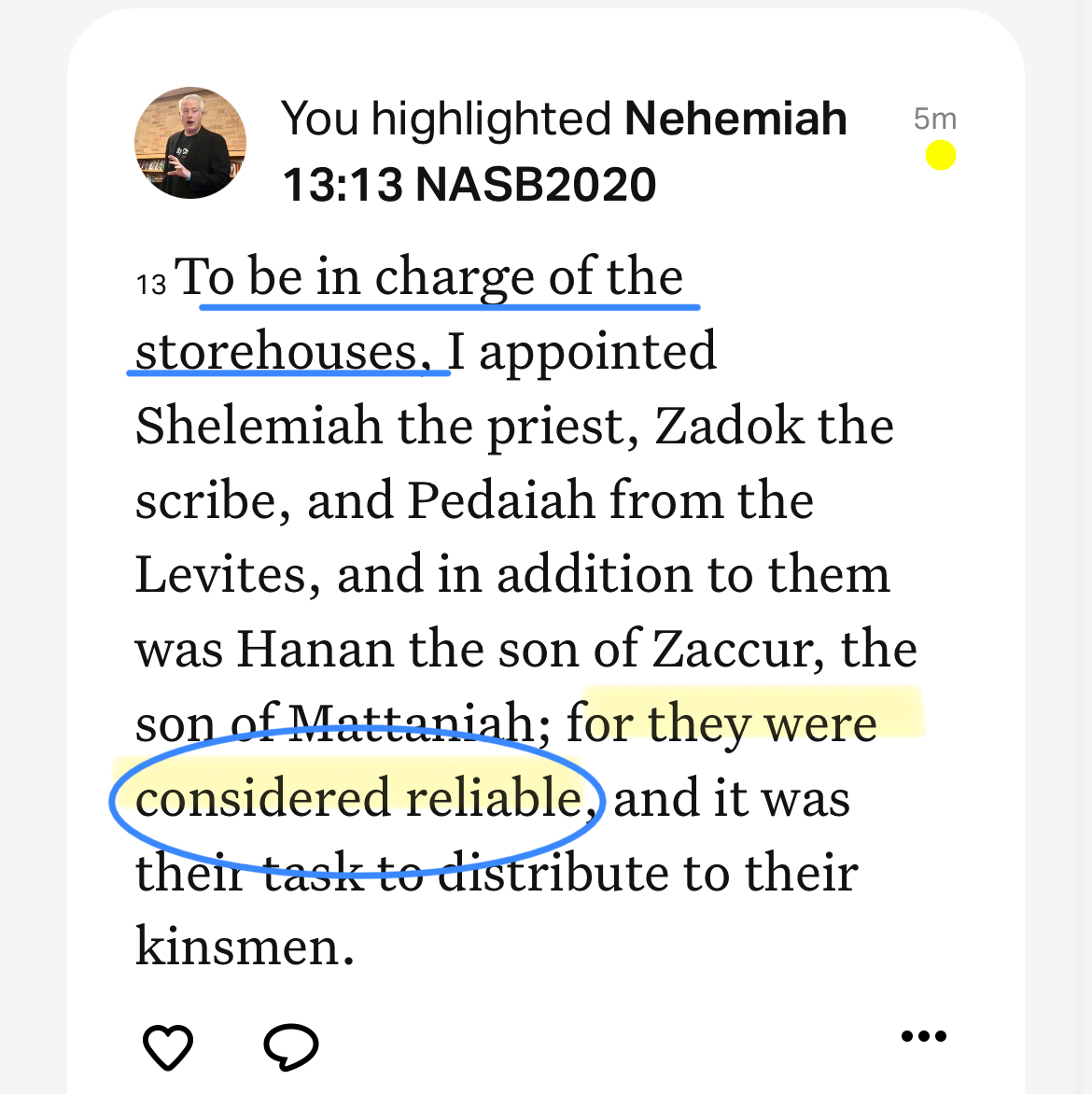
I also discovered that the portions of the Levites had not been given to them, so the Levites and the singers who performed the service had gone away, each to his own field. So I reprimanded the officials and said, “Why has the house of God been neglected?” Then I gathered them together and stationed them at their posts. All Judah then brought the tithe of the grain, wine, and oil into the storehouses. To be in charge of the storehouses, I appointed Shelemiah the priest, Zadok the scribe, and Pedaiah from the Levites, and in addition to them was Hanan the son of Zaccur, the son of Mattaniah; for they were considered reliable, and it was their task to distribute to their kinsmen. (Nehemiah 13:10-13)

According to the Hebrew definitions:

  • “considered” = accountable 
  • “reliable” = trustworthy 

Both words mean someone who has passed the test and someone who is still passing the test. These men were faithful leaders before they were given this important job, and then they continued to prove themselves faithful even as their work was carefully scrutinized. 

A title doesn’t make you a leader, and a title doesn’t sustain you as a leader. Your faithful, God-honoring, trustworthy accountability makes you a leader—even if you never get the title, God sees you and He will reward you. 

Check out my whole series on godly leadership.

The Craig And Greg Show: The Responsibility Of Power

Listen to the audio-only version of this podcast by clicking on the player below, or scroll down to watch the video.

It goes without saying, but leadership positions confer a level of power to the people who occupy them. This power is necessary for us as leaders to do our job effectively, but if we’re not very careful it can begin to corrupt us and poison our leadership. Tune in as Greg and I tackle this tricky issue.

  • [0:22] Leaders need both enough power to get things done, but not too much that they crush people. 
  • [1:44] Power can corrupt us if we are unaccountable in the use of our power.
  • [3:12] We should always be thinking in terms of how our use of power can empower others.
  • [5:16] A leader’s power should always be linked to responsibility.
  • [6:27] We earn our power—we don’t grab it form others—to better serve.
  • [9:32] Greg says, “Leadership should be dangerous!”
  • [12:40] Sometimes we must use our power to protect those around us.
  • [16:00] Greg steps into “you know what”!
  • [16:27] Are power and serving compatible?
  • [18:25] What do powerful leaders not want to do?
  • [20:26] When it comes right down to it, the use of leadership really comes down to influence.
  • [22:02] Our coaching services can help you use your power more effectively.

Check out this episode and subscribe on YouTube so you can watch all of the upcoming episodes. You can also listen to our podcast on Spotify and Apple.

Links & Quotes

On Veterans Day, Greg and I wanted to encourage you to ask a veteran to tell you their stories. Their stories are a vital link to our stories too! Watch this full conversation on The Craig and Greg Show. I have lots of new content every week, which you can check out on my YouTube channel.

“When we are foolish and young, we need more rules. As we mature, we can be trusted with extended boundaries. The wiser we are, the more we appreciate those boundaries and the less they offend us. Offense at law, accountability, hedges, and boundaries is an indicator of immaturity. The wiser we are, the more unafraid and appreciative we are of those who hold us to account.” —Dick Brogden, in Proverbs: Amplified and Applied

“When public policy begins to encroach on the Christian’s freedom and duty to proclaim the Good News, or to bring the benefits of the Gospel to the community, believers must continue our mission nonetheless and be ready to bear whatever punishments those in authority may choose to inflict. Christians do not seek suffering, but we must not shun it, particularly when by our suffering we can work for public policies more in line with the centrality of the Gospel for the wellbeing of all people.” —T.M. Moore

The Golden Rule—treat others as you would want to be treated—applies to the way you treat yourself too. Stop beating yourself up when you make a mistake. You probably don’t beat up others when they stumble, so extend the same grace to yourself. Practice healthy, affirming self-talk. Check out this full conversation from episode 68 of The Craig And Greg Show.

“A thought, a sword, and a spade should never be allowed to rust.” —Irish Proverb

Dr. C. John “Jack” Collins uses some thoughts from C.S. Lewis to help us learn a little better how to read Genesis 1-11. He writes, “We should approach any biblical passage with the conviction that God inspired the Bible to be the right tool for its job. If we can get a good idea of what kind of tool our passage is, we can discern what job God intended it to perform. And that means we need to be willing to adjust what we’re looking for and be willing to find other ways of addressing some questions.”

Sunflowers have an amazing biomechanism called heliotropism that allows them to “see” the sun. They can literally turn their face throughout the day (even a cloudy day) to follow the sun and maximize their photosynthesis potential. What an amazing Creator our God is!

“Failure to pray is simple unbelief. We must repent of our unbelief and take up the work of prayer with greater devotion and dedication. We shall not be able to realize progress in Christ’s Kingdom, or in returning our nation to a greater experience of justice and goodness, apart from prayer. Prayer is the starting point for public policy. Prayer must be the sustaining power of public policy. And prayer in the form of worship will be the outcome of public policies, forged in prayer, which lead to a peaceful, godly, dignified, true, and Gospel-friendly society.” —T.M. Moore

The Goals Of Confrontation

Listen to the podcast of this post by clicking on the player below, and you can also subscribe on AppleSpotify, or Audible. 

Say the word “confrontation” and many people cringe. “I try to avoid confrontations with others,” people will quickly say. 

The origin of the word comes from a derivative of the word for “forehead.” The original intent of confrontation was simply putting the facts in front of someone’s face so that they could acknowledge them. 

The problem for most of us (myself included) is two-fold: 

  1. I don’t like to be confronted with things I may be doing incorrectly or incompletely. 
  2. I don’t like making others defensive when I confront them with the things they may be doing incorrectly or incompletely.

As a result, we usually don’t confront others and they usually don’t confront us. Sadly, this can keep us from maturing in areas where we may be able to soar if we could only make some minor changes. 

Christians should be especially open to confrontation from a brother or sister. After all, Solomon told us, “Wounds from a friend can be trusted, but an enemy only multiplies kisses” (Proverbs 27:6). And Jesus warned us, “Woe to you when all men speak well of you, for so did their fathers to the false prophets” (Luke 6:26 NKJV). 

The best confrontation is self-confrontation in the presence of the Holy Spirit. After we have submitted to that loving spotlight, then we can proceed with our loving confrontation with our brothers and sisters. 

Remember this: 

The goals of Christian confrontation are restoration and maturity. 

We want to see wandering saints return to God’s path, and we want those saints who are immature to blossom into Christ-like maturity that brings glory to God. 

I have prepared a flowchart that can help you with a biblical framework for the work of confrontation. Please work through this flowchart slowly and prayerfully. Don’t rush any step, but make sure you can answer an honest “yes” to each question. When you get to the last step, keep in mind these three Ms:

  1. Maturity—self-confrontation and confrontation of others should always be moving us toward maturity. 
  2. Mutual accountability—agree to stay involved in this process, with each of you remaining accountable to each other. 
  3. Mercymercifully restore the one who has strayed so that the entire Christian body of believers can be strengthened.

Here are some resources to help you:

►► Would you please prayerfully consider supporting this ministry? My Patreon supporters get behind-the-scenes access to exclusive materials. ◀︎◀︎
The Craig And Greg Show: Lead Up

Listen to the audio-only version of this podcast by clicking on the player below, or scroll down to watch the video.

When we think about leadership, we often envision the people in organizationally designated leadership roles “leading down” to the people on their team. In this episode of The Craig And Greg Show, we flip the script, discussing how you can “lead up” to those above you and help your team achieve greater levels of success. 

  • [0:30] This is part 1 of a new series of periodic episodes of how to lead at all levels of your organization. 
  • [1:07] What is the real definition of a leader?
  • [1:55] You need different skills to lead up based on how receptive your leader is.
  • [3:31] Do you have the right tools to lead up, or do you need to fill your toolbox first?
  • [5:30] What happens when the leadership above you changes?
  • [6:35] There are two really important words when leading up: stewardship and accountability.
  • [7:59] “I told you so” doesn’t help you lead up, nor does withholding information from your up-leader.
  • [11:55] What are the best ways to talk to your up-leader?
  • [14:35] Everyone in the organization already knows when you have the good ideas, so you don’t have to announce it.
  • [15:05] How do you balance being proactive with being too aggressive?
  • [16:05] What lessons can you learn from working with your difficult up-leader?
  • [17:42] You shouldn’t try to “fix” your up-leader, but help your up-leader.
  • [19:34] I share how I kept my attitude in check with my difficult up-leader.
  • [22:00] Coaches can help you do what you’re already doing better than you’re currently doing it

Check out this episode and subscribe on YouTube so you can watch all of the upcoming episodes. You can also listen to our podcast on Spotify and Apple.

The Self-Aware Leader (book review)

Listen to the podcast of this post by clicking on the player below, and you can also subscribe on AppleSpotify, or Audible. 

Leaders never “arrive” at a place where they have accomplished everything they want to accomplish. John Maxwell helps leaders keep pressing on in their personal growth in his book The Self-Aware Leader. 

This book is largely autobiographical, as Maxwell leads us through lessons that he learned by not being self-aware. His leadership stumbles served as a wake-up call that allowed him to reflect, learn, and then correct his technique. Then after decades of honing these techniques, he shares with his readers the practical steps for them to become self-aware of a potential stumbling point before it actually trips them up. 

I also appreciated the self-aware leader’s questions for reflection at the end of each chapter. To me, this is an ideal place for leaders who are in mutual accountability to focus their discussion as they meet together. My biggest takeaway from this book is that I cannot become self-aware nor correct the things that could derail my leadership solely on my own. Reading The Self-Aware Leader is a good starting point, but I also highly recommend reading this book with another leader that also desires to grow and improve. 

Leaders who want to uncover the things that could be holding them back will really benefit from reading and applying this book. For my Patreon supporters, I have also shared several noteworthy quotes from this book here. 

►► Would you please prayerfully consider supporting this ministry? My Patreon supporters get behind-the-scenes access to exclusive materials. ◀︎◀︎

Links & Quotes

Premier athletes know the value of flexibility for keeping them in the game. I think we would be wise to practice flexibility in our relationships too—this is definitely a game-changing move! Check out my weekly Monday Motivation videos on my YouTube channel

“The bravest are surely those who have the clearest vision of what is before them, glory and danger like, and yet notwithstanding, go out to meet it.” —Thucydides

This week we remember Columbus Day. You probably remember the rhyme: In 1492, Columbus sailed the ocean blue. Many people have thought Columbus set out to prove the world was round, but the History Channel has a mini-biography that debunks this claim.

One of my YouVersion friends (Nikki) commented a great reminder: “God can do way more with my surrender than with my striving.”

Thomas Zimmerman was an influential leader in the early days of the Assembly of God fellowship’s history. “Over a 50-year period, Thomas F. Zimmerman (1912-1991) served the Assemblies of God as pastor, district official, department leader, assistant general superintendent, and general superintendent. His leadership greatly increased the influence of the Pentecostal movement in the evangelical world, as well as in the broader American religious landscape.”

I post quality content nearly every day. If you don’t have time to read all that I share, please let me read it for you. The Craig T. Owens Audio Blog is just like this blog, except you get to hear me read my blog posts. Check it out my podcast on Spotify, Apple, and even Audible.

“The word ‘hell’ is used in the New Testament fourteen times, twelve times by Jesus Himself. It is not a myth created by dismal and angry preachers. It is a solemn warning from the Son of God who died to deliver sinners from its curse. We ignore it at great risk.” —John Piper

Christian apologist and cold-case detective J. Warner Wallace wrote, “the battleground on the abortion issue is beginning to shift, and this shift is going to cause us to rethink our approach to the debate.” Pro-life advocates need to check out Wallace’s post Justifying Homicide: The Future Battleground In The Abortion Debate.

Responsibility isn’t supposed to be fatal! Exceptional leaders accept and promote appropriate responsibility, while weak leaders play the blame game. But accepting responsibility doesn’t mean “falling on your sword”! You can check out the rest of this conversation I had with my podcast partner Greg Heeres on The Craig And Greg Show leadership podcast.

A High And Holy Calling

Listen to the podcast of this post by clicking on the player below, and you can also subscribe on AppleSpotify, or Audible. 

When God spoke to the “princes of Israel,” He was speaking to those in leadership positions. They were men who had wealth, position, and a high level of influence. God called them to live up to their title as “prince” because leadership is a high and holy calling given by God. 

Leaders are to set an example for others. They are to provide what is lacking so that others can live up to their own God-given potential as well. Here’s the way God describes His leaders in Ezekiel 45-46:

They are to be peacemakers, never men of violence nor oppression (45:9). 

They are to be fair, consistent, and impartial in their interactions with others (45:10). 

They are to generously provide for the people under their care (45:15-17, 22; 46:13-14). 

They are to have a “get to do it” attitude toward their duties, not a “have to do it” attitude” (46:5, 7, 11). 

They are to be among their people, not aloof nor isolated from them (46:10). 

They are to provide for their family without impoverishing the people under their care (46:18). 

Since God calls leaders, He will also call them to account. Jesus made it clear that there are only one-of-two assessments that leaders will hear from God:

  1. Well done, good and faithful servant 
  2. You wicked, lazy servant

Let me say it again: Leadership is a high and holy calling. So…

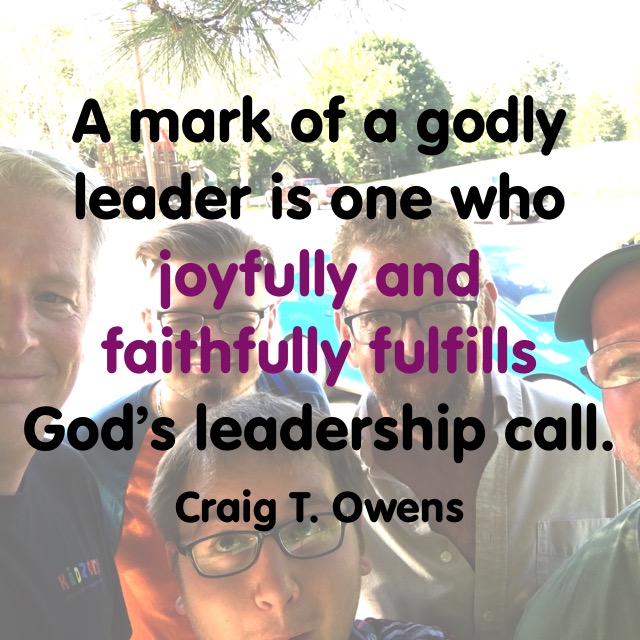
A mark of a godly leader is one who joyfully and faithfully fulfills God’s leadership call. 

This is part 67 in my series on godly leadership. You can check out all of my posts in this series by clicking here.

►► Would you please prayerfully consider supporting this ministry? My Patreon supporters get behind-the-scenes access to exclusive materials. ◀︎◀︎