No Competition In Church

What great words from A.W. Tozer!

“It is too bad that anything so obvious should need to be said at this late date, but from all appearances, we Christians have about forgotten the lesson so carefully taught by Paul: God’s servants are not to be competitors, but co-workers. … A local church, as long as it is indwelt by the Holy Spirit, cannot entertain the psychology of competition. When it begins to compete with another church, it is a true church of God no longer; it has voided its character and gone down onto a lower level. The Spirit that indwells it is no longer divine; it is human merely, and its activities are pitched on the plane of the natural. … The Holy Spirit always cooperates with Himself in His members. The Spirit-directed body does not tear itself apart by competition. The ambitions of the various members are submerged in the glory of the Head, and whatever brings honor to the Head meets with the most eager approval of the members. We should cultivate the idea that we are co-workers rather than competitors. We should ask God to give us the psychology of cooperation. We should learn to think of ourselves as being members in particular of one and the same body, and we should reject with indignation every suggestion of the enemy designed to divide our efforts.”

As Tozer said, it is too bad that we have to be reminded of the fact that the church should never be in competition with itself. It makes me appreciate all the more the relationship the churches in Cedar Springs have with each other!

My Part

The apostle Paul wrote to Timothy—

…God our Savior, Who wants all men to be saved and to come to a knowledge of the truth (1 Timothy 2:4).

And we all say, “Yes!!” Then I quickly ask, “So what’s my part in this?

The quick and easy answer springs to my mind, “I have to tell others about Jesus!” This is true—and it is needed—but this is NOT what Paul says here.

Did you notice the ellipsis (the …) at the beginning of the verse I quoted above? Here’s the part that comes before—

I urge, then, first of all, that requests, prayers, intercession and thanksgiving be made for everyone—for kings and all those in authority, that we may live peaceful and quiet lives in all godliness and holiness. This is good, and pleases God our Savior, Who wants all men to be saved and to come to a knowledge of the truth. (verses 1-4)

My part in all men coming to a knowledge of the truth is PRAYER. Specifically, prayer for those in authority over us. These prayers translate into an environment where we may live peaceful and quiet lives in all godliness and holiness.

It’s in this peaceful environment that we are better able to be “a teacher of the true faith” (verse 7).

My part is not to add to the noise.

My part is not to argue my position.

My part is not to protest.

My part is to pray.

I hope you will join me in prayer not only for the upcoming election but all year round for those in authority so that all…may come to a knowledge of the truth.

When A Christian Goes To Prison

Special Guest Blogger: Dick Brogden

Over two weeks ago some very good friends and colleagues were arrested by security police. Two men representing two families, and there has been minimal contact. Their wives are still unable to see their husbands after two long weeks. Events like these help us remember and pray through our priorities. We must approach these situations with the long term view in mind.

Emotionally this is very hard to do. When we are in the middle of the situation our priority naturally shifts to the welfare (and in our minds this means the release) of our loved one. I am not so sure God’s priority ever shifts. There are several things more important than the health and comfort and release of the incarcerated.  Let me list some of them:

1)  THE GLORY OF GOD

It is informative how central prison is to the plan of God. Joseph, Jeremiah, John the Baptist, James, Peter, Paul, and many others in Scripture and history all testify to God being glorified in confinement. We remind ourselves with Joseph that it is not about us, and that what “man intended

for evil, God intended for good.” We encourage ourselves in the Pauline Epistles and forget that many of them were written from prison repose.

2)  THE CREDIBILITY OF THE GOSPEL

When followers of Jesus go to prison, it puts the gospel on display. Do we live what we preach? Do we believe what we say? Is God enough? Is Jesus our strong tower? Is the Holy Spirit a comfort? Are these platitudes of the insulated or are they truths burned into our souls by trial? When missionaries suffer well, it sends a message to indigenous believers (who suffer much more than we do) that Jesus is indeed worth suffering for and that we are in solidarity with their difficulty. Suffering well also is a witness to our tormentors. Athanasius insisted that one of the proofs of the resurrection was the joy with which women and children faced physical abuse and death.

3)  THE CHARACTER OF THE PRISONER AND HIS FAMILY

God works in us when we are stripped down, confined, abused, and mistreated. There is a joy in the fellowship of His sufferings. The seldom-experienced (for we fear the process) reward of prison and persecution is unimaginable intimacy with Jesus, which delights our soul. Tales from the released surprise us as they pine for the good old days of the cement cell because Jesus’ presence was unmitigated and pristine. God also works in the hearts of spouses and children in these admittedly painful times, if we let Him.

All the above are more important than the health and release of the captive. This is not callous, this is Christ. It is not about us and it is not about our security. Helen Keller—who knew much about being confined—said,

Security is mostly a superstition. It does not exist in nature, nor do children of men as a whole experience it. Avoiding danger is no safer in the long run that outright exposure. Life is either a daring adventure, or nothing.

If we take the short view, we move heaven and earth to see our loved one released. In one sense this is admirable. In another sense, it can be self-serving. When I was arrested some years ago, I appreciated the efforts of those working to free me, but I would have been livid if they pursued my freedom in such a way that affected my longevity in the land (and among the people) I have been called to serve—and die for if necessary. The long term view undergirds the prisoner in his lonely cell. He does not want a frantic, panicked effort to release him. He wants to stay in the country after his release. He does not want external voices to shame the local authorities or force his expulsion … that can be a fate more cruel than lonely prison days.

Those who speak to us from prison say, “We are fine. Jesus is real. We are being upheld by the Holy Spirit and are in sweet communion with the Father. Don’t worry about us. Don’t panic. Don’t rush the process. We are improving our language skills, we have plenty of time to pray, we are witnessing to our captors. We appreciate your efforts, but we beg of you: proceed slowly and respectfully, for our greatest desire is for Jesus to be glorified in the process and to continue exalting Him in this beloved land (if at all possible) even after our release. So if we have to sit here a few extra weeks or months, so be it.”

Time is on the side of the righteous. Let’s remember who really is in prison after all, and let’s take the long term view, let’s endure what we must that THEY may be set free.

And what of the children of the imprisoned? If you are interested, read the letter I wrote to the children of our dear imprisoned friend—children we love as much as we love our own. It is what I want someone to tell my boys if I ever go back to prison or if we ever are asked to lay down our lives for Jesus.

Endless Noise

Listen to the podcast of this post by clicking on the player below, and you can also subscribe on AppleSpotify, or Audible.

The psalmist said it this way, “Be still, and know that I am God” (Psalm 46:10).

The apostle Paul said, “Study to be quiet” (1 Thessalonians 4:11).

And the prophet Elijah learned that God was not in the big crashing, jarring noises but in “a still small Voice” (1 Kings 19:12).

We are bombarded by noise. Are we missing God in all the noise? When was the last time I was quiet? Quiet enough to hear His still small Voice?

Nearly 80 years ago T.S. Eliot wrote a poem called Choruses From The Rock. Check out this passage—

The endless cycle of idea and action,
Endless invention, endless experiment,
Brings knowledge of motion, but not of stillness;
Knowledge of speech, but not of silence;
Knowledge of words, and ignorance of the Word.
All our knowledge brings us nearer to our ignorance,
All our ignorance brings us nearer to death,
But nearness to death no nearer to God.
Where is the Life we have lost in living?
Where is the wisdom we have lost in knowledge?
Where is the knowledge we have lost in information?
The cycles of Heaven in twenty centuries
Bring us farther from God and nearer to the Dust.

Jesus found time early in the silent morning to get alone with His Father. We would do well to follow this example. Let’s make some quiet time today to hear what God is saying to our hearts.

►► Would you please prayerfully consider supporting this ministry? My Patreon supporters get behind-the-scenes access to exclusive materials. ◀︎◀︎

Sola Gratia

Another great thought that the Reformation brought us is sola gratia—salvation is by grace alone.

If you are a Christian you have probably said something like, “I thank God that I’m saved!” This is a wonderful thing, but it’s also an incomplete statement. In order to fully appreciate God’s grace, and in order to have a full testimony for others, we need to work on completing this statement.

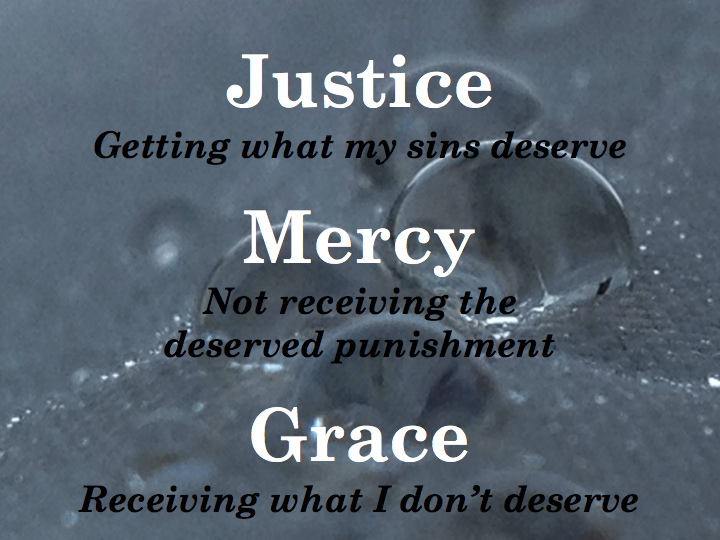
We’re saved FROM the punishment of justice.

We’re saved TO eternal life.

We’re saved FOR God’s glory.

But because of His great love for us, God, who is rich in mercy, made us alive with Christ even when we were dead in transgressions—it is by grace you have been saved. And God raised us up with Christ and seated us with Him in the heavenly realms in Christ Jesus, in order that in the coming ages He might show the incomparable riches of His grace, expressed in His kindness to us in Christ Jesus. (Ephesians 2:4-7)

—Saved From Death— …it is by grace you have been saved…

—Saved To Eternal Life—…God raised us up with Christ and seated us with Him in the heavenly realms in Christ Jesus…

—Saved For God’s Glory— …in order that in the coming ages He might show the incomparable riches of His grace…

You can fully appreciate the incomparable riches of God’s grace when you understand all that your salvation includes: from, to, and for. Look at the incredible testimony of grace that the Apostle Paul had in the from, to, and for thoughts in his statement in 1 Timothy 1:12-17.

That’s the same type of testimony we can all have! Don’t just tell people, “I’m saved!” Tell them how God’s grace saved you from the penalty of your sins, to eternal life in Christ, and for the glory of God.

If you have missed any of the messages in this series, you can find them all here.

Attaboy!

October has been designated as Clergy Appreciation Month. Some pastors live from “Attaboy!” to “Attaboy!” from their congregation, so October is like a feast for them!

But the apostle Paul has a slightly different perspective on this. More than getting an “Attaboy!” from a church congregation, he is joyful over the “Attaboy!” he hears from God.

For what is our hope, our joy, or the crown in which we will glory in the presence of our Lord Jesus when He comes? Is it not you? Indeed, you are our glory and joy.

For now we really live, since you are standing firm in the Lord. How can we thank God enough for you in return for all the joy we have in the presence of our God because of you? (1 Thessalonians 2:19-20; 3:8-9)

Paul’s goal is seeing people who have been changed because of their relationship with Jesus. And these changed lives are all the reward he desires!

YOU ARE OUR GLORY AND JOY! 

Pastor, it’s nice when you get the “Attaboys!” from your congregation. But what’s even better is to help your congregation enter into a deeper relationship with Christ, and then hear the “Attaboy!” from God Himself!

What an amazing joy that we get to play a small role in helping people stand firm in the Lord!

Thursdays With Oswald—Not A Saint, But Many Saints

Listen to the podcast of this post by clicking on the player below, and you can also subscribe on AppleSpotify, or Audible.

This is a weekly series with things I’m reading and pondering from Oswald Chambers. You can read the original seed thought here, or type “Thursdays With Oswald” in the search box to read more entries.

Not A Saint, But Many Saints 

     The Book of God is insistent on this: we cannot develop a holy life alone, it would be a selfish life, without God in it and wrong. …

     Beware of isolation; beware of the idea that you have to develop a holy life alone. It is impossible to develop a holy life alone, you will develop into an oddity and a peculiarism, into something utterly unlike what God wants you to be. The only way to develop spiritually is to go into the society of God’s own children, and you will soon find how God alters your set. God does not contradict our social instincts, He alters them. 

From Biblical Psychology 

I’ve got news for you: It’s not about you as an individual.

If you have asked God to forgive you of your sins because you believed that Jesus paid the price for your salvation on the Cross, you haven’t just been saved from death; you’ve also been saved to a fuller life. A key component of this fuller life is your interaction with other Christians.

Search through the New Testament and you will find that the word saint never appears in the singular form—it’s always plural: saintS.

I need other Christians to help form Christlike character in me, and other Christians need me to do the same for them. Don’t ever buy into the lie that you can be a Christian and live an isolated life.

You are a part of the Body of Christ. Don’t rob the Body of your vital role! Together we saintS are so much stronger and more effective than a solitary, isolated saint.

►► Would you please prayerfully consider supporting this ministry? My Patreon supporters get behind-the-scenes access to exclusive materials. ◀︎◀︎

Democracy, Immoral Laws, And A Christian’s Responsibility

We know the law is good if one uses it properly. (1 Timothy 1:8)

Whether laws are labeled spiritual or civil, the IF in that verse is very important. Law is intended to restrain unbecoming or immoral activities. Laws are aimed at lawbreakers. But in order for any law to carry weight, it has to be backed up by something more solid than a man’s opinion of what is “right” or “wrong.”

According to Scripture, a law must…

  • …be supported by sound doctrine (1 Timothy 1:10). What defines “sound doctrine” is the word of God, not man-made opinion. Jesus said about the Pharisees, “They worship Me in vain; their teachings are but rules taught by men” (Matthew 15:9). The New Living Translation renders this verse: “Their worship is a farce, for they teach man-made ideas as the commands of God.”
  • …conform to the gospel (1 Timothy 1:11). Literally this means filtered through Scripture. Any law that does not have its foundation set on a biblical principle is, by definition, an immoral, man-made law.

So what is the Christian’s role in the legislative process? I see four responsibilities for Christians:

1. Pray for our elected officials that they would have a God-fearing, biblically-sound perspective in their legislative activities (see 1 Timothy 2:1-2).

2. Stay informed on the law-making activities on both the local, state, and national levels (see Acts 17:11; 1 Chronicles 12:32).

3. Speak out against unbiblical, immoral laws (see Esther 4; 1 Peter 2:17).

4. Disobey immoral laws. The Bible commands us to “give to Caesar what is Caesar’s, and to God what is God’s” (Luke 20:25). We must never give to Caesar what is God’s (see Acts 5:29)!

I love Martin Luther King Jr’s Letter From Birmingham Jail where he addresses Christian pastors about the rightness of peacefully disobeying immoral laws. If you haven’t read this masterpiece, please take time to do so. In this letter, Dr. King wrote:

Over the last few years I have consistently preached that nonviolence demands that the means we use must be as pure as the ends we seek. So I have tried to make it clear that it is wrong to use immoral means to attain moral ends. But now I must affirm that it is just as wrong, or even more, to use moral means to preserve immoral ends.

Christian, you have a responsibility. Pray, be informed, respectfully speak out against immoral laws, and then peacefully disobey when it is necessary.

Hope For The Despairing

“There are two things that kill the soul: despair and false hope.” —Augustine

Have you ever been around those who are despairing? They only see darkness; they only feel heaviness; they cannot perceive a way out.

How about those with false hope? They may see a light, but they’re not sure it’s real; the relief they feel is only temporary; nothing seems lasting or sure.

Despair and false hope crush the soul to death.

The word encourage means to inspire with courage … to give someone reason to hope … to breathe true life into their soul.

Political unrest doesn’t disturb the one grounded in real Hope. Economic turmoil doesn’t shake the one who knows the Provider. Social instability doesn’t cause anxiety for the one who knows the Prince of Peace. Death doesn’t crush the one who knows the Resurrected Lord.

Brothers, we do not want you to be ignorant about those who fall asleep, or to grieve like the rest of men, who have no hope. We believe that Jesus died and rose again and so we believe that God will bring with Jesus those who have fallen asleep in Him. … Therefore encourage each other with these words.

…But since we belong to the day, let us be self-controlled, putting on faith and love as a breastplate, and the hope of salvation as a helmet. … Christ died for us so that, whether we are dead or alive when He returns, we can live with Him forever. So encourage each other and build each other up, just as you are already doing. (1 Thessalonians 4:13-14, 18; 5:8, 10-11)

The good news—the hope-filled news—is Jesus is alive!

A relationship with Him is life!

A life full of hope!

A life full of promise!

A life full of Him that’s unending throughout eternity!

Do you know this hope? Are you sharing this hope with others?

Sola Fide

Out of the Reformation came five sola statements—five statements that tried to bring people back to the purity of the gospel message. This week as I studied to prepare my message on sola fide (justification with God by faith alone), I was struck by how in need of another reformation we are today!

That shouldn’t be surprising, because satan is always trying to so sneakily get us off track. So he gets people believing that they don’t need faith in God, that God is a myth, or if He does exist, He’s really not that involved in our individual lives. For these people, satan tries to get them to buy into this lie:

Works > Faith

In other words, what you can do for yourself is more important than the faith you can place in anyone (or in The One).

Some people might accept that the approach to God is through faith, but then they feel they have to add something to their faith in order to stay in God’s good graces. These people have bought into the lie:

Faith + Works 

And then there are some that go to the far extreme of thought that faith means utter inactivity on their part. They have received forgiveness from God, so now they can just sit back and enjoy the ride to Heaven. They’ve bought into satan’s lie:

Works ⊈ Faith

In other words, now that I have faith, I don’t have to work anymore. Or even, the more faith I have the less work I have to do. (The mathematical symbol ⊈means faith is not a part of work, nor is work a part of faith.)

The Scripture is clear that you cannot buy your justification by working for it, nor can you keep it by adding works to your faith; however, faith does indeed require work for it to grow and mature. 

The Westminster Confession says it this way:

Faith, thus receiving and resting on Christ and His righteousness, is the alone instrument of justification: yet is it not alone in the person justified, but is ever accompanied with all other saving graces, and is no dead faith, but worketh by love.

The bottom line:

Sola Fide = Faith Works

Faith works in justification. Faith works in the atonement. Faith works in sanctification. Faith works in love.

If you have missed any of the messages in this series, you can find them all here.