Stopping Words That Hurt (book review)

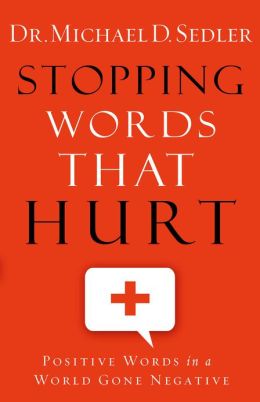
Stopping Words That HurtContrary the nursery rhyme—Sticks and stones may break my bones, but words will never hurt me—we all know that words do hurt! Dr. Michael Sedler addresses this topic in a unique way in Stopping Words That Hurt.


Reading that title you would think that this is a book about controlling your tongue, but we already know we’re supposed to do that, right? So Dr. Sedler takes a different angle and challenges us to control our thoughts and our environment. He shows us how being receptive to the negative words that others are speaking starts a downward cycle in our hearts and minds that leads to us not only receiving but perpetuating negative reports about others.

This book is not “pop psychology,” but is solidly grounded on biblical principles for heading-off negative reports at their source. Stopping Words That Hurt is filled with practical strategies for confronting gossipers, analyzing our own attitudes, and turning negative environments (where gossip flourishes) into positive environments where people are affirmed and built up.

I plan to use the strategies in this book to help the students that attend the youth center I direct to become catalysts for changing the environment in their schools and homes. Although adults can use this information too, I see a very receptive audience in pre-teens and teenagers. Parents, you need to read this book to be able to help your children as well.

I am a Chosen Books book reviewer.

Thursdays With Oswald—The Word & The Words

This is a weekly series with things I’m reading and pondering from Oswald Chambers. You can read the original seed thought here, or type “Thursdays With Oswald” in the search box to read more entries.

Oswald Chambers

The Word & The Words

     The Bible is the Word of God only to those who are born from above and who walk in the light. Our Lord Jesus Christ, the Word of God, and the Bible, the words of God, stand or fall together, they can never be separated without fatal results. A man’s attitude to our Lord determines his attitude to the Bible. 

     The “sayings” of God to a man not born from above are of no moment; to him the Bible is simply a remarkable compilation of literature—“that it is, and nothing more.” All the confusion arises from not recognizing this. 

     But to the soul born from above, the Bible is the universe of God’s revealed will. The Word of God to me is ever according to my spiritual character; it makes clear my responsibility to God as well as my individuality apart from Him. 

From Christian Disciplines (emphasis mine)

Do you agree with Chambers on this viewpoint?

In light of this, how will you view Scripture differently?

Things We Couldn’t Say (book review)

EMANPBBACK.qxdIt’s not often that a historical memoir could read like a spy thriller, but that’s exactly how Things We Couldn’t Say by Diet Eman reads.

Diet (pronounced “deet”) was a young girl when the Nazis invaded The Netherlands where she lived, and she quickly got caught up the Dutch Underground resistance against their unwelcome invaders. Alongside her fiancee, her family members, and several of her friends, they worked at hiding Jews from the Gestapo. This involved all of the tricks you would thrill at in any modern-day telling of espionage, with read page-turning excitement.

Part of the interesting underlying plot in this story is Diet’s love for her fiancee Hein and both of their families. Diet and Hein were constantly changing their names and residence to keep the Gestapo from catching up with them, yet they still found time to write some amazing love letters back and forth to each other. Their love was a bright light in a very dark time, and makes their involvement in this dangerous business even more impressive.

Not only is this a story about human ingenuity, but also about God’s divine provision as well. Diet records time after time that God miraculously provided for safety and provision and favor in order to keep alive. At the end of the war, every single one of the Jews Diet and Hein helped hide and care for were still alive!

For those reasons alone Things We Couldn’t Say is a fascinating read, but it’s an important read too. In the postscript Diet talks about her reluctance to write this book because of the painful memories it would reawaken. She said, “When the war ended we all said, ‘This can never happen again.’ But now polls show that 22 percent of the U.S. population does not believe there was a Holocaust. The story has to be retold so that history does not repeat itself.”

I can’t recommend this book strongly enough for readers of any age!

The Dictatorship Of The Routine

Wow, I am really challenged by this word from A.W. Tozer! I pray that my personal life, and my life as a pastor, never falls under the dictatorship of the routine.

Tozer“The treacherous enemy facing the church of Jesus Christ today is the dictatorship of the routine, when the routine becomes ‘lord’ in the life of the church. Programs are organized and the prevailing conditions are accepted as normal. Anyone can predict next Sunday’s service and what will happen. This seems to be the most deadly threat in the church today. When we come to the place where everything can be predicted and nobody expects anything unusual from God, we are in a rut. The routine dictates, and we can tell not only what will happen next Sunday, but what will occur next month and, if things do not improve, what will take place next year. Then we have reached the place where what has been determines what is, and what is determines what will be. That would be perfectly all right and proper for a cemetery. Nobody expects a cemetery to do anything but conform…. Everyone and everything in a cemetery has accepted the routine. Nobody expects anything out of those buried in the cemetery. But the church is not a cemetery and we should expect much from it, because what has been should not be lord to tell us what is, and what is should not be ruler to tell us what will be. God’s people are supposed to grow.” —A.W. Tozer (emphasis added)

What do you think about this?

Mouth-To-Mouth

Mouth to mouthI’ve notice that when someone feels physically tired, mentally unengaged, spiritually embattled, emotionally dry, or just plain worn out, they have an audible physical sign that is almost universal.

Those people sigh.

A sigh is an involuntary response that signifies frustration and a call for help. It should also be a reminder of the best place to find that help.

In Psalm 119, the chapter is organized in 8-verse segments. I like to look at the “bookend” verses of each section, as it usually gives a good idea of what that section is focusing on. The section called kaph has this bookended statement—

My soul faints with longing for Your salvation … Preserve my life according to Your love, and I will obey the statues of Your mouth (Psalm 119:81, 88).

Follow this progression:

  • When God created man, He breathed a soul into him. So we are created by His breath.
  • Jesus said that man does not live by bread alone, but by every word that comes from the mouth of God. God’s Word is inspired, which means it is literally God-breathed. So our soul is sustained by the breath of God.

The psalmist says his soul is sighing and wasting away, but he recognizes that his God-breathed soul can be restored through the God-breathed word. So in verse 88 he is asking God to give him mouth-to-mouth (or perhaps mouth-to-soul) resuscitation! 

The psalmist talks about clinging tenaciously to God’s Word as if it were his only lifeline … because it is! So whenever you find yourself sighing, let that be a reminder that you can get your spiritual resuscitation from the breath of God: His Word. Hold on to it as if your very life depended on it … because it does!

If you have missed any of the messages in our P119 series, you can access them all by clicking here.

Overwhelmed = Blessing

I love this quote from Dick Brogden which I used in my message this morning—

Dick Brogden“Impossibilities are the great friend of the Christian. Without Goliath there would have been no David. We need to be blocked, resisted, challenged, and confronted by impossible people and circumstances in order for it to be clear that God has done the work. … If we constantly overcome small hurdles, we inevitably appear to be self-sufficient. The humility of the believer demands impossible assignments. To ever succeed in our own strength is poison to our soul. To be overwhelmed is a blessing….” —Dick Brogden

Pastor: Pray For Yourself

Augustine

Augustine

Pastor, what do you think of these words?

“By praying for himself and for those he is about to address, he [a pastor] must become a man of prayer before becoming a man of words. As the hour of his address approaches, before he opens his thrusting lips he should lift his thirsting soul to God so that he may utter what he has drunk in and pour out what has filled him.” —Augustine of Hippo

C.S. Lewis In His Own Voice

Mere ChristianityThis address from C.S. Lewis was broadcast on the BBC in 1944. Sadly, this is the only one of his radio talks that have survived. But the good news is these talks form the bulk of C.S. Lewis’ amazing book Mere Christianity.

Thursdays With Oswald—Why Wait For A Tragedy To Get Your Attention?

This is a weekly series with things I’m reading and pondering from Oswald Chambers. You can read the original seed thought here, or type “Thursdays With Oswald” in the search box to read more entries.

Oswald Chambers

Why Wait For A Tragedy To Get Your Attention?

     God is not a supernatural interferer; God is the everlasting portion of His people. When a man “born from above” begins his new life he meets God at every turn, hears Him in every sound, sleeps at His feet, and wakes to find Him there. He is a new creature in a new creation, and tribulation but develops his power of knowing God….

From Christian Disciplines

Tribulation has an amazing power to get people’s attention. After every calamity (whether it’s the attack on Pearl Harbor or the World Trade Centers, a shooting in a school, or a young family killed by a drunk driver) our churches are filled. People are searching for something to help them make sense of that tragedy. Yet after a couple of weeks, life returns to “normal” and the churches empty out.

What we discovered in that moment of tragedy is what we should be discovering every day: God is there.

Do you hear God in all the sounds? Do you see Him at every turn? Do you sleep peacefully in Him each night? Do you go through your day without anxiety because You know He is by your side?

You can because He is there. Don’t wait for a tribulation to remind you of that fact. Open your eyes and ears and heart to His presence surrounding you even now.

22 Quotes From “The Ragamuffin Gospel”

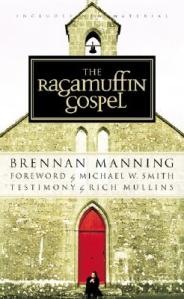
Ragamuffin GospelThe Ragamuffin Gospel by Brennan Manning really resonated with me. You can read my full book review by clicking here, but below are some of the quotes I especially appreciated.

“The institutional church has become a wounder of the healer rather than a healer of the wounded.” 

“Personal responsibility has replaced personal response. We talk about acquiring virtue as if it were a skill that can be attained, like good handwriting or a well-grooved golf swing. In the penitential seasons we focus on overcoming our weaknesses, getting rid of our hang-ups, and reaching Christian maturity. We sweat through various spiritual exercises as if they were designed to produce a Christian Charles Atlas. Though lip service is paid to the gospel of grace, many Christians live as if only personal disciplines and self-denial will mold the perfect me. The emphasis is on what I do rather on what God is doing. In this curious process God is a benign old spectator in the bleachers who cheers when I show up for morning quiet time.”

“God has a single relentless stance toward us: He loves us. He is the only God man has ever heard of who loves sinners. False gods—the gods of human manufacturing—despise sinners, but the Father of Jesus loves all, no matter what they do.” 

“Jesus comes not for the super-spiritual but for the wobbly and the weak-kneed who know they don’t have it all together, and who are not too proud to accept the handout of amazing grace.”

“The Word we study has to be the Word we pray.”

“We must never allow the authority of books, institutions, or leaders to replace the authority of knowing Jesus Christ personally and directly. When the religious views of others interpose between us and the primary experience of Jesus as the Christ, we become unconvicted and unpersuasive travel agents handing out brochures to places we have never visited.”

“Whatever past achievements might bring us honor, whatever past disgraces might make us blush, all have been crucified with Christ and exist no more except in the deep recess of eternity.” 

“It is unimaginable to picture a wooden-faced, stoic, joyless, and judgmental Jesus as He reclined with ragamuffins.”

“We miss Jesus’ point entirely when we use His words as weapons against others. They are to be taken personally by each of us.” 

“The saved sinner is prostrate in adoration, lost in wonder and praise. He knows repentance is not what we do in order to earn forgiveness; it is what we do because we have been forgiven. It serves as an expression of gratitude rather than an effort to earn forgiveness. Thus the sequence of forgiveness and then repentance, rather than repentance and then forgiveness, is crucial for understanding the gospel of grace.”

“Maybe this is the heart of our hang-up, the root of our dilemma. We fluctuate between castigating ourselves and congratulating ourselves because we are deluded into thinking we save ourselves. We develop a false sense of security from our good works and scrupulous observance of the law. Our halo gets too tight and a carefully disguised attitude of moral superiority results. Or we are appalled by our inconsistency, devastated that we haven’t lived up to our lofty expectations of ourselves. The roller coaster ride of elation and depression continues. Why? Because we never lay hold of our nothingness before God, and consequently, we never enter into the deepest reality of our relationship with Him. But when we accept ownership of our powerlessness and helplessness, when we acknowledge that we are paupers at the door of God’s mercy, then God can make something beautiful out of us.” 

“Honesty is such a precious commodity that it is seldom found in the world or the church. Honesty requires the truthfulness to admit the attachment and addictions that control our attention, dominate our consciousness, and function as false gods. I can be addicted to vodka or to being nice, to marijuana or being loved, to cocaine or being right, to gambling or relationships, to golf or gossiping. Perhaps my addiction is food, performance, money, popularity, power, revenge, reading, television, tobacco, weight, or winning. When we give anything more priority than we give to God, we commit idolatry. Thus we all commit idolatry countless times every day.”

“To be alive is to be broken. And to be broken is to stand in need of grace. Honesty keeps us in touch with our neediness and the truth that we are saved sinners. There is a beautiful transparency to honest disciples who never wear a false face and do not pretend to be anything but who they are. … Getting honest with ourselves does not make us unacceptable to God. It does not distance us from God, but draws us to Him—as nothing else can—and opens us anew to the flow of grace.” 

“When we wallow in guilt, remorse, and shame over real or imagined sins of the past, we are disdaining God’s gift of grace. Preoccupation with self is always a major component of unhealthy guilt and recrimination. … Yes, we feel guilt over sins, but healthy guilt is one which acknowledges the wrong done and feels remorse, but then is free to embrace the forgiveness that has been offered.”

“The evil one is the great illusionist. He varnishes the truth and encourages dishonesty. ‘If we say, “We have no sin,” we are deceiving ourselves, and the truth has no place in us’ (1 John 1:8). satan prompts us to give importance to what has no importance. He clothes trivia with glitter and seduces us away from what is real. He causes us to live in a world of delusion, unreality, and shadows.” 

“At Sunday worship, as in every dimension of our existence, many of us pretend to believe we are sinners. Consequently, all we can do is pretend to believe we have been forgiven. As a result, our whole spiritual life is pseudo-repentance and pseudo-bliss.”

“The way we are with each other is the truest test of our faith. How I treat a brother or sister from day to day, how I react to the sin-scarred wino on the street, how I respond to interruptions from people I dislike, how I deal with normal people in their normal confusion on a normal day may be a better indication of my reverence for life than the antiabortion sticker on the bumper of my car.” 

“A little child cannot do a bad coloring; nor can a child of God do bad in prayer.”

“The call asks, Do you really accept the message that God is head over heels in love with you? I believe that this question is at the core of our ability to mature and grow spiritually. If in our hearts we really don’t believe that God loves us as we are, if we are still tainted by the lie that we can do something to make God love us more, we are rejecting the message of the Cross.” 

“There are some real problems with projecting the perfect image. First of all, it’s simply not true—we are not always happy, optimistic, in command. Second, projecting the flawless image keeps us from reaching people who feel we just wouldn’t understand them. And third, even if we could live a life with no conflict, suffering, or mistakes, it would be a shallow existence. The Christian with depth is the person who has failed and who has learned to live with it.”

“We project into the Lord our own measured standard of acceptance. Our whole understanding of Him is based in a quid pro quo of bartered love. He will love us if we are good, moral, and diligent. But we have turned the tables; we try to live so that He will love us, rather than living because He has already loved us.” 

“No greater sinners exist than those so-called Christians who disfigure the face of God, mutilate the gospel of grace, and intimidate others through fear. They corrupt the essential nature of Christianity.”