The Case For Christ Daily Moment Of Truth (book review)

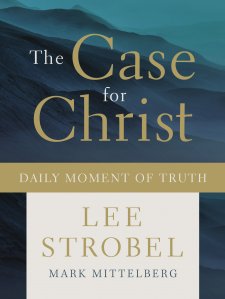
This is a fantastic study guide from Lee Strobel and Mark Mittelberg. It was originally published with the title Today’s Moment Of Truth. 

Most Christians will tell you they love God “with all my heart.” That’s a good start, but according to Jesus, there needs to be more. Jesus told us to love God with all our heart, soul, mind, and strength. It’s especially these last two areas that concerned Strobel and Mittelberg enough to put together a wonderful book: The Case For Christ Daily Moment Of Truth.

Strobel and Mittelberg were concerned (and rightly so) that Christians were engaging their heart and soul in their Christian witness, but not developing their mind and strength to the same extent. As a result, when someone challenges them to explain why they believe what they believe, many Christians struggle to answer convincingly.

Lee Strobel and Mark Mittelberg are both top-notch Christian apologists. They don’t just present solid evidence for the Christian faith, but they do so in a winsome, inoffensive way. And through 180 different lessons, they train all who read The Case For Christ Daily Moment Of Truth to do the same.

Each day you will read a quote from a notable atheist or Christian skeptic, and then be trained in solid apologetics to refute their claims. You will be given Scripture verses, proofs from all disciplines of science, and some good old-fashioned common sense. This book will expand your spiritual muscles and your mental muscles. Each day’s reading will only take a couple of minutes, but you will be well-prepared for any challenges to your faith. A must-read for all Christians!

I am a Zondervan book reviewer.

What Is Shalom?

Shalom is the Hebrew word for peace. Some of the best definitions of shalom include ideas of completeness, soundness, and wholeness. One Jewish rabbi commented that when you say “Shalom” to someone, you’re really saying, “may you be full of well-being.” Or another way of thinking of shalom is—nothing missing, nothing broken. 

Some have tried to describe shalom as the absence of conflict, but that’s not quite accurate. On the verge of going into the Promised Land to fight their enemies, God commanded Aaron to speak a blessing of peace of the people (Numbers 6:24-26). And just before Jesus said, “Blessed are those who are persecuted because of righteousness,” He said, “Blessed are the peacemakers” (Matthew 5:9-10). 

Shalom is not controlled by outward circumstances. Shalom is a deep-seated, rock-solid, unshakable assurance that I am in God’s hand. 

Isaiah describes how we live in shalom like this—

You will guard him and keep him in perfect and constant peace whose mind—both its inclination and its character—is stayed on You, because he commits himself to You, leans on You, and hopes confidently in You. (Isaiah 26:3)

How do we do keep our mind stayed on God? The Apostle Paul says, “We take captive every thought to make it obedient to Christ” (2 Corinthians 10:5). Psychologists call this process metacognition: when we think about what we’re thinking about. It’s being aware of our anxious thoughts that are robbing us of shalom and then talking back to them. 

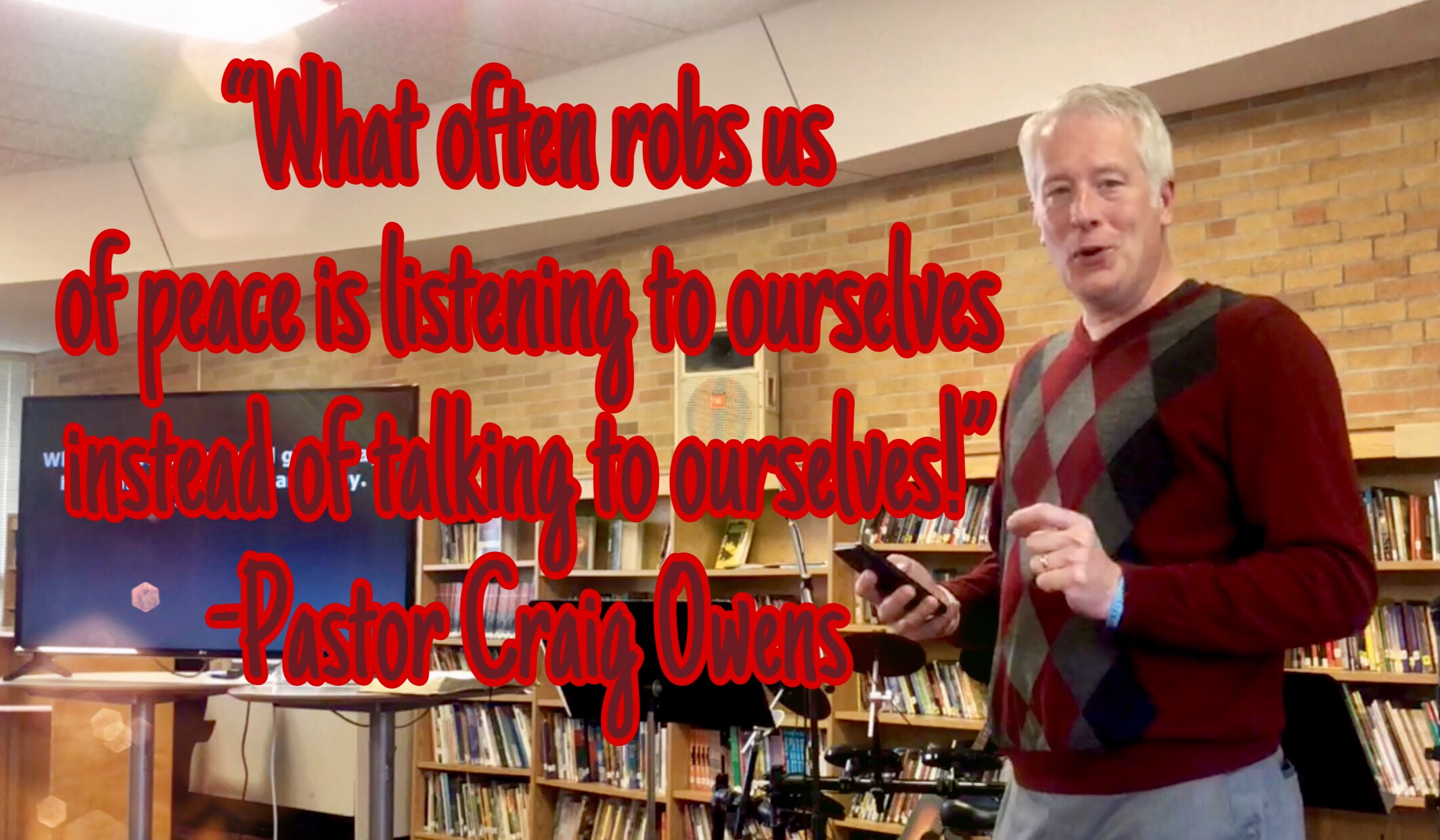
What often robs us of peace is listening to ourselves instead of talking to ourselves! 

Someone once asked evangelist Smith Wigglesworth, “Smith, how do you feel?” He replied, “I never ask Smith how I feel. I tell him how he feels!” Exactly right! 

Why do we make our thoughts obedient to Jesus? Because one of the titles given to Jesus before He was born was Prince of Peace (Isaiah 9:6), and Jesus assures us that His peace is unlike anything we can ever find in earthly things (John 14:27, 16:33). 

God’s peace is always there, but our divided minds keep us from experiencing His peace. So Isaiah tells us to keep our mind steadfast on God’s goodness, and Paul says the same thing—Don’t fret or worry. Instead of worrying, pray. Let petitions and praises shape your worries into prayers, letting God know your concerns. Before you know it, a sense of God’s wholeness, everything coming together for good, will come and settle you down. It’s wonderful what happens when Christ displaces worry at the center of your life. (Philippians 4:6-7)

I want to encourage you to practice what the Bible calls capturing your thoughts—or what psychologists call metacognition. Ask yourself, “Why am I thinking that?” Capture those thoughts and make them obedient to Christ. Don’t let your worrisome thoughts rob you of God’s shalom.

Join me this Sunday as we take a closer look at the “shalom cycle,” including the things that can derail it. 

Saturday In The Proverbs—This Is What Virtue Looks Like (Proverbs 31)

[Each chapter in the Book of Proverbs contains thoughts that fit into a theme; they are not just random thoughts gathered together. In this “Saturday In The Proverbs” series, I will share a theme that I see in each chapter. But the cool thing about God’s Word is that you may see an entirely different theme. That’s great! If you do, I would love for you to share it in the comments below.]

Do not give your strength to women … Who can find a virtuous wife…? (Proverbs 31:3, 10).

This proverb shows virtue on display in both a man and a woman. A man or woman of virtue…

… is a loyal spouse (vv. 3, 10, 12, 23, 28, 30)

… uses their strength appropriately (vv. 3, 17)

… avoids controlling substances (v. 4)

… upholds justice (vv. 5, 26)

… takes care of others (vv. 8, 9, 15, 20-21)

… is trustworthy (v. 11)

has a good work ethic (vv. 13-15, 18-19, 24, 27, 31)

… exercises good stewardship (vv. 16, 18, 25)

… renews themselves (v. 22)

… handles praise well (vv. 28-30)

How beautiful is a man or woman living out God’s virtue! 

Sunbeams From God

For You are the fountain of life, the light by which we see. Psalm 36:9

“I was standing today in the dark toolshed. The sun was shining outside and through the crack at the top of the door there came a sunbeam. From where I stood that beam of light, with the specks of dust floating in it, was the most striking thing in the place. Everything else was almost pitch-black. I was seeing the beam, not seeing things by it. Then I moved so that the beam fell on my eyes. Instantly the whole previous picture vanished. I saw no toolshed, and (above all) no beam. Instead I saw, framed in the irregular cranny at the top of the door, green leaves moving on the branches of a tree outside and beyond that, 90 odd million miles away, the sun. Looking along the beam, and looking at the beam are very different experiences.” —C.S. Lewis

“So we can say that when we ‘look along’ the heavens and not just ‘at’ the heavens, they succeed in their aim of ‘declaring the glory of God.’ That is, we see the glory of God, not just the glory of the heavens. We don’t just stand outside and analyze the natural world as a beam, but we let the beam fall on the eyes of our heart, so that we see the source of the beauty—the original Beauty, God Himself.  This is the essential key to unlocking the proper use of the physical world of sensation for spiritual purposes. All of God’s creation becomes a beam to be ‘looked along’ or a sound to be ‘heard along’ or a fragrance to be ‘smelled along’ or a flavor to be ‘tasted along’ or a touch to be ‘felt along.” —John Piper 

Thursdays With Oswald—How To Understand And Apply The Scriptures

This is a weekly series with things I’m reading and pondering from Oswald Chambers. You can read the original seed thought here, or type “Thursdays With Oswald” in the search box to read more entries.

How To Understand And Apply The Scriptures

     In order to understand the Sermon on the Mount, it is necessary to have the mind of the Preacher, and this knowledge can be gained by anyone who will receive the Holy Spirit (see Luke 11:13; John 20:22; Acts 19:2). The Holy Ghost alone can expound the teachings of Jesus Christ. The one abiding method of interpretation of the teachings of Jesus is the Spirit of Jesus in the heart of the believer applying His principles to the particular circumstances in which he is placed. “Be transformed by the renewing of your mind,” says Paul, “that you may prove,” i.e. make out, “what is that good, and acceptable, and perfect will of God” [Romans 12:2]. …

     Every mind has two compartments—conscious and subconscious. We say that the things we hear and read slip away from memory; they do not really, they pass into the subconscious mind. It is the work of the Holy Spirit to bring back into the conscious mind the things that are stored in the subconscious. In studying the Bible never think that because you do not understand it, therefore it is of no use. A truth may be of no use to you just now, but when the circumstances arise in which that truth is needed, the Holy Spirit will bring it back to your remembrance [John 14:26]. … 

     We do not hunt through the Bible for some precept to obey…but we live so in touch with God that the Holy Spirit can continually bring some word of His and apply it to the circumstances we are in. … The teaching of Jesus Christ comes with astonishing discomfort to begin with, because it is out of all proportion to our natural way of looking at things; but Jesus puts in a new sense of proportion, and slowly we form our way of walking and our conversation on the line of His precepts: Remember that our Lord’s teaching applies only to those who are His disciples.

From Studies On The Sermon On The Mount

What Chambers says about the Sermon on the Mount is true of any biblical passage we read: we need to have the Holy Spirit’s help to understand it and apply it to our unique life setting. 

Think of this—the same Holy Spirit who inspired the biblical writers is the exact same Spirit who will assist you in understanding that Word! Before I read the Bible I often pray: May the Spirit who inspired this Word now illuminate my mind to understand it and obey it. 

Try that prayer yourself and see how God’s Word is opened up to you. 

Shalom

God makes a promise in Isaiah about His perfect peace being made available to His people. 

Ahhh, who wouldn’t want God’s perfect peace?! Sadly, many people actually block God’s peace from coming into their hearts. You see, God’s peace is always there, but there are things we humans frequently do that keeps us from experiencing His perfect peace. 

The Hebrew word for peace is shalom, which is a word packed with rich meaning! There are things God-loving people can do to keep shalom at the center of their lives, and I want to share these things with you. 

Please join me this Sunday as we begin a 4-part series looking at what shalom is, how we can keep it humming in our lives, as well as the warning signs that would indicate to us a breakdown of shalom is on the horizon. 

Please join me either in person or on Facebook Live for this life-changing series.

12 Quotes From “The Strenuous Life”

Teddy Roosevelt believed firmly that a nation rose or fell as individuals exercised strong character or lived a slothful life. He not only preached it, he lived it! The Strenuous Life is a collect of TR’s speeches that emphasized what he called “the manly characters.” Check out my full book review by clicking here. 

“We do not admire the man of timid peace. We admire the man who embodies victorious effort; the man who never wrongs his neighbor, who is prompt to help a friend, but who has those virile qualities necessary to win in the stern strife of actual life.” 

“A man’s first duty is to his own home, but he is not thereby excused from doing his duty to the State; for if he fails in this second duty it is under the penalty of ceasing to be a freeman. In the same way, while a nation’s first duty is within its own borders, it is not thereby absolved from facing its duties in the world as a whole; and if it refuses to do so, it merely forfeits its right to struggle for a place among the peoples that shape the destiny of mankind.” 

“If we stand idly by, if we seek merely swollen, slothful ease and ignoble peace, if we shrink from the hard contests where men must win at hazard of their lives and at the risk of all they hold dear, then the bolder and stronger peoples will pass us by, and will win for themselves the domination of the world. Let us therefore boldly face the life of strife, resolute to do our duty well and manfully; resolute to uphold righteousness by deed and by word; resolute to be both honest and brave, to serve high ideals, yet to use practical methods. Above all, let us shrink from no strife, moral or physical, within or without the nation, provided we are certain that the strife is justified, for it is only through strife, through hard and dangerous endeavor, that we shall ultimately win the goal of true national greatness.” 

“Scant attention is paid to the weakling or the coward who babbles of peace; but due heed is given to the strong man with sword girt on thigh who preaches peace, not from ignoble motives, not from fear or distrust of his own powers, but from a deep sense of moral obligation.” 

“Strive manfully for righteousness, and strive so as to make your efforts for good count.” 

“We are in honor bound to put into practice what we preach; to remember that we are not to be excused if we do not; and that in the last resort no material prosperity, no business acumen, no intellectual development of any kind, can atone in the life of a nation for the lack of the fundamental qualities of courage, honesty, and common sense.” 

“If a man permits largeness of heart to degenerate into softness of head, he inevitably becomes a nuisance in any relation of life. If sympathy becomes distorted and morbid, it hampers instead of helping the effort toward social betterment.” 

“The quality of self-help is so splendid a quality that nothing can compensate for its loss; yet, like every virtue, it can be twisted into a fault, and it becomes a fault if carried to the point of cold-hearted arrogance, of inability to understand that now and then the strongest may be in need of aid, and that for this reason alone, if for no other, the strong should always be glad of the chance in turn to aid the weak.” 

“The Bible always inculcates the need of the positive no less than the negative virtues, although certain people who profess to teach Christianity are apt to dwell wholly on the negative. We are bidden not merely to be harmless as doves, but also as wise as serpents. It is very much easier to carry out the former part of the order than the latter; while, on the other hand, it is of much more importance for the good of mankind that our goodness should be accompanied by wisdom than that we should merely be harmless. If with the serpent wisdom we unite the serpent guile, terrible will be the damage we do; and if, with the best of intentions, we can only manage to deserve the epithet of ‘harmless,’ it is hardly worth while to have lived in the world at all.” 

“The boy who is going to make a great man, or is going to count in any way in after life, must make up his mind not merely to overcome a thousand obstacles, but to win in spite of a thousand repulses or defeats.” 

“Softness of heart is an admirable quality, but when it extends its area until it also becomes softness of head, its results are anything but admirable.” 

“A man is worthless unless he has in him a lofty devotion to an ideal, and he is worthless also unless he strives to realize this ideal by practical methods. He must promise, both to himself and to others, only what he can perform; but what really can be performed he must promise, and such promise he must at all hazards make good.” 

More quotes from TR are coming soon, so stay tuned! 

The Strenuous Life (book review)

I just finished reading Theodore Roosevelt’s Autobiography, so it was quite fascinating to read some of the speeches he was giving during the same periods he covered in his memoirs. TR practiced what he preached, and one of his consistent messages is that anything worthwhile is worth the strenuous effort it takes to get it. This collection of speeches is called The Strenuous Life. 

TR himself described the strenuous life like this: 

“The doctrine of the strenuous life, the life of toil and effort, of labor and strife: to preach that highest form of success which comes, not to the man who desires mere easy peace, but to the man who does not shrink from danger, from hardship, or from bitter toil, and who out of these wins the splendid ultimate triumph. … A life of slothful ease, a life of that peace which springs merely from lack either of desire or of power to strive after great things, is as little worthy of a nation as of an individual.” 

In The Strenuous Life, you will read the consistent message TR delivered to a wide variety of people—from the rough-and-tumble outdoorsmen and women, to the diplomats attending a World’s Fair, to business people—nothing of lasting value ever came to those who sat around and waited for it to come to them. The strenuous life is one of initiative, of hard work, of sacrifice, of perseverance, and ultimately a life rewarded by self-satisfaction in a job well done. 

This book is inspiring as a stand-alone read, but I highly recommend you read it in conjunction with TR’s Autobiography, as it adds an extra level of insight to both works. 

What’s Behind A Church’s ♥able Reputation?

Last week I said if people are going to say “I ♥ That Church!” it has to be a ♥able church. A ♥able church has a ♥able reputation that compromises what Luke captured about the very first Church—internal unity, sincere piety, supernatural results, and practical help.

Once a church has this kind of reputation, how is it sustained? 

First, let me tell you how it’s NOT sustained: A church’s ♥able reputation isn’t sustained by that church focusing on it’s ♥able reputation. 

A ♥able reputation must flow from the constant development of godly character. Otherwise, we substitute what sounds good with what is actually sound, and we substitute what looks good with what is actually good. 

That’s what the Pharisees did—they were more concerned about how their religion looked to others, and not how it aligned with God’s heart. In fact, Jesus told two stories about people that thought they were “in” with God because of their reputation, but God actually says to them, “I don’t know who you are” (see Matthew 7:21-23; 25:1-12). 

Matthew Henry reminded us, “Men may go to hell with a good reputation!” 

But D.L. Moody got the order right when he said, “If I take care of my character, my reputation will take care of itself.”

I believe the first Church shows us three components of a maturing godly character. 

  1. Our source must be pure. The Christians devoted themselves to the apostles’ teaching. In other words, they grew with sound doctrine, not with things that sounded like doctrine (2 Timothy 4:3; Acts 17:11). 
  1. Our daily disciplines must be productive. The Christians saw “church” as an every day thing. They didn’t view studying the Scriptures, prayer, fellowship, and other maturing activities a merely something to be checked off their To Do list. 
  1. Our accountability must be in our fellowship. The Greek word for fellowship (koinonia) means an active involvement with the “one anothers” in the Church. What’s especially important is maintaining the highest levels of accountability with each other so that the growth of godly character can continue (see especially Hebrews 10:24-25; James 5:16). 

“When wealth is lost, nothing is lost. When health is lost, something is lost. When character is lost, everything is lost.” —Billy Graham 

My church’s ♥able reputation will be sustained as I am committed to growing in godly character. 

So… are you committed to that continual growth? 

Saturday In The Proverbs—Lifelong Learning (Proverbs 30)

[Each chapter in the Book of Proverbs contains thoughts that fit into a theme; they are not just random thoughts gathered together. In this “Saturday In The Proverbs” series, I will share a theme that I see in each chapter. But the cool thing about God’s Word is that you may see an entirely different theme. That’s great! If you do, I would love for you to share it in the comments below.]

Surely I am more stupid than any man… (Proverbs 30:2).

That’s what he said, and then Agur records some incredibly wise words for us! I think Agur is a man who is continually learning, and realizing how little he knew before he learned something new. 

He’s learning things like…

…how vast, and powerful, and wise God is (vv. 3-6).

…how frail and dependent on God he is (vv. 7-9). 

…how disrespectful people undermine their own success and happiness (vv. 10-14, 17).

…how destructive greed is (vv. 15, 16).

…how wonderfully God has made things (vv. 18, 19).

…how sin deceives (vv. 20-23). 

…how observing even the littlest of things can teach big lessons ( vv. 24-28).

…how boastful proud people are (vv. 29-33). 

What lessons are you learning? 

When was the last time you learned something new?