Quest Study Bible (book review)

I was excited to get my copy of The Quest Study Bible. As I began to leaf through it and notice its unique format, I was suddenly transported back more than 20 years into my past…

“Daddy, what are you doing,” my young son asked, as I bent over some forms spread across my desk. 

“I’m filling out these tax forms,” I explained.

“Why?”

“So that I make sure I’m sending the right amount of tax money in to our government.”

“Why?”

“Because I don’t want to have to pay any late fees.” 

“Why?” 

“So we can keep more of my hard-earned money.” 

“Why?” 

“Go ask your mother….”

Any parent or grandparent knows that the incessant questions of kids is how they learn. Our youngsters are processing the world around them, asking questions, trying to make sense of how everything fits together. As our Heavenly Father’s children, we still learn about His world in much the same way. 

Some of the best-known catechisms of history have been handed down to us in a question-and-answer format like the Westminster Catechism—Q: What is the chief end of man? A: Man’s chief end is to glorify God, and to enjoy Him forever. 

The Quest Study Bible preserves this Q&A learning format for those of us that are (hopefully) lifelong learners of God’s Word. Each book starts off with the basic Who, Why, When, and To Whom questions that many of us are asking. Then every single page contains the catechism-like Q&As that query the text you’re reading. For example, in the first chapter of Matthew’s Gospel we are treated to questions like: “Why give the genealogy of Jesus the Messiah?” and “What’s the significance of calling Jesus the Messiah?” 

To help you more quickly find some of the answers you may be seeking, I also appreciate the quite extensive “Index to Subjects” at the back of this Bible.

If you are looking for a unique way to engage with Scripture—especially if you have an eager-to-learn mind—you will really enjoy The Quest Study Bible. 

I am a Zondervan book reviewer. 
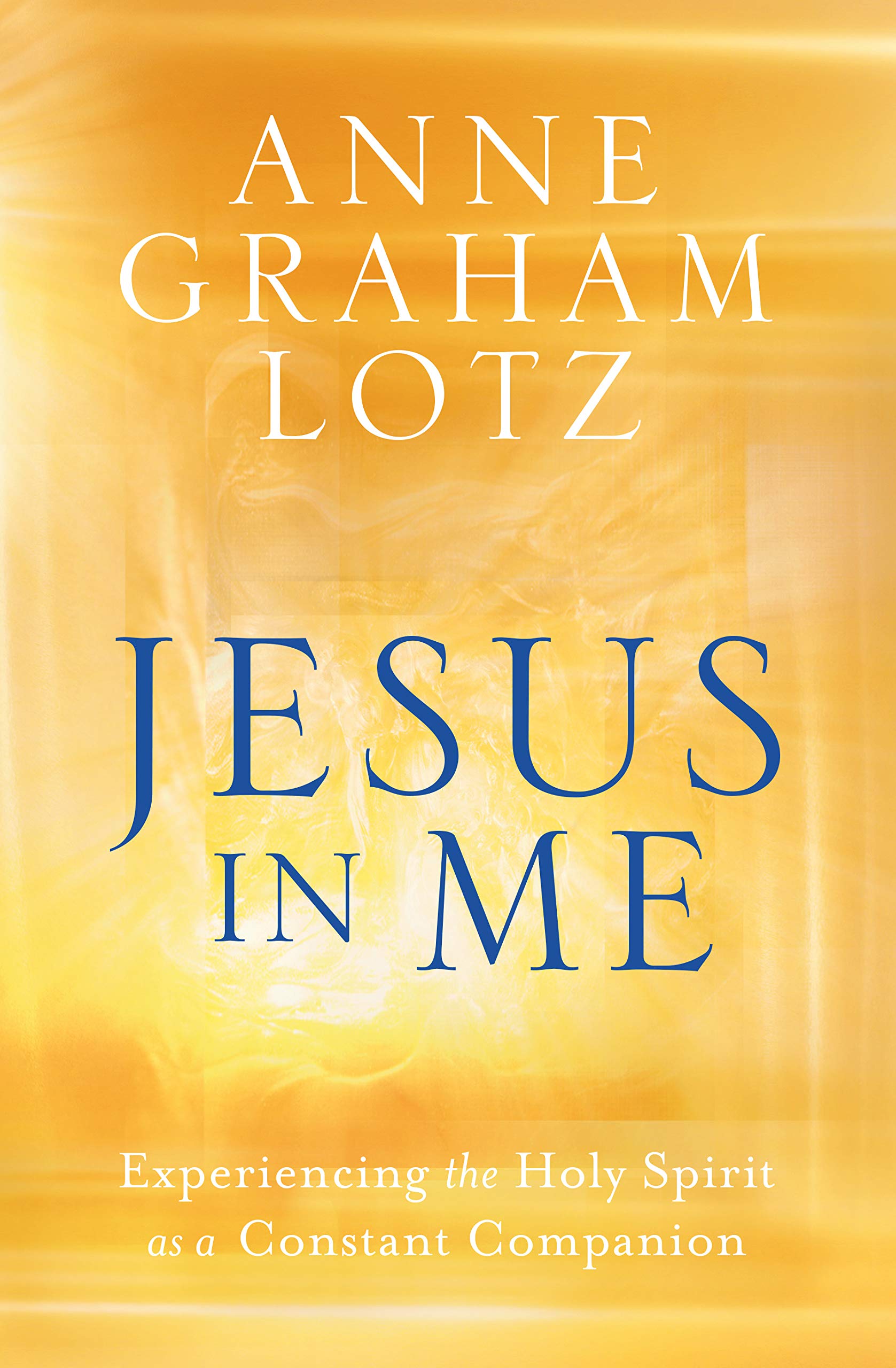
Jesus In Me (book review)

When Jesus was about to ascend back into heaven, His disciples were understandably anxious. But Jesus spoke these reassuring words to them, “I will not leave you alone. I will ask the Father to send the Comforter to you.” And true to His word, the Holy Spirit was made available to all Christians. This is what Anne Graham Lotz explores in Jesus In Me.

In the opening pages, Anne explains that an important verse to help us understand the Holy Spirit is found in John 16:7. Anne and I both like the Amplified Bible’s rendering of this verse—However, I am telling you nothing but the truth when I say it is profitable (good, expedient, advantageous) for you that I go away. Because if I do not go away, the Comforter (Counselor, Helper, Advocate, Intercessor, Strengthener, Standby) will not come to you [into close fellowship with you]; but if I go away, I will send Him to you [to be in close fellowship with you].

Using the multiple names of the Holy Spirit captured in this verse—Helper, Advocate, Intercessor, Strengthener, Standby—Anne begins to dive deeper into what the Spirit of God does in these various roles.

This is not a heavy theological dissertation, nor does this book wade deeply into complex doctrines. Jesus In Me feels like Anne is your friend, and she is just sharing with you what the Bible has said to her about the Holy Spirit and how she has experienced Him for herself. The Scripture references are there for you to read on your own, and Anne shares her personal stories, but both of these simply invite you and me to experience more of the Holy Spirit for ourselves. I really like this book! 

I am a Multnomah book reviewer. 

P.S. There are some special pre-order offers available from Anne Graham Lotz’s website which you may want to check out.

It’s Time To Come Home

I already shared the bizarre but beautiful sermon illustration that Hosea lived out for the Israelites and for us. His wife had been unfaithful to him and had gotten herself so far in debt that she was a virtual slave. Hosea, in a clear picture of God’s amazing, unrelenting love, bought back his wife, paid off her debts, and completely restored her to himself. 

Sadly, the people of Israel—even after seeing this grace-filled living lesson—continue to push farther and farther away from God. This prompted God to announce the indictment against them… 

Hear the word of the Lord, you Israelites, because the Lord has a charge to bring against you who live in the land: “There is no faithfulness, no love, no acknowledgment of God in the land. There is only cursing, lying and murder, stealing and adultery; they break all bounds, and bloodshed follows bloodshed” (Hosea 4:1-2). 

It wasn’t the first time that someone preferred the things of the world to the things of God (like Adam and Eve), and it wasn’t the last time (like you and me). We mortals tend to be seduced by what we can see and hold right now, instead of trusting God for something far better. 

Jesus told a story about a son who enjoyed the full privilege and favor of his father, yet this son thought he could do better on his own. He asked his father for his share of the inheritance and left for a distant land, determined to live a life where he called all the shots. But with his money gone, he found himself in debt, starving, and working as a hired hand in a pigsty. 

It was then that Jesus said that young man came to his senses. He had nothing to bring to his father—no gift of restitution, no token of respect, nothing except his words. All he could say was, “Father, forgive me.” 

But that’s all that was needed. Hosea counseled the Israelites to do the same thing:

Return, Israel, to the Lord your God. Your sins have been your downfall! Take words with you and return to the Lord. Say to Him: “Forgive all our sins and receive us graciously, that we may offer the fruit of our lips” (Hosea 14:1-2). 

The wayward son had a rehearsed speech asking his father to simply hire him as a servant, as if he wasn’t worthy to be considered a son any longer. But the father—in words that reflect our Heavenly Father’s love—cut the son’s speech short. He let the son only say, “Forgive me,” but before the son could make the request to be a servant the father totally restored him. 

After Hosea calls the wayward people to return with their “forgive us,” he quotes God’s reply: “I will heal their waywardness and love them freely, for My anger has turned away from them” (14:4). 

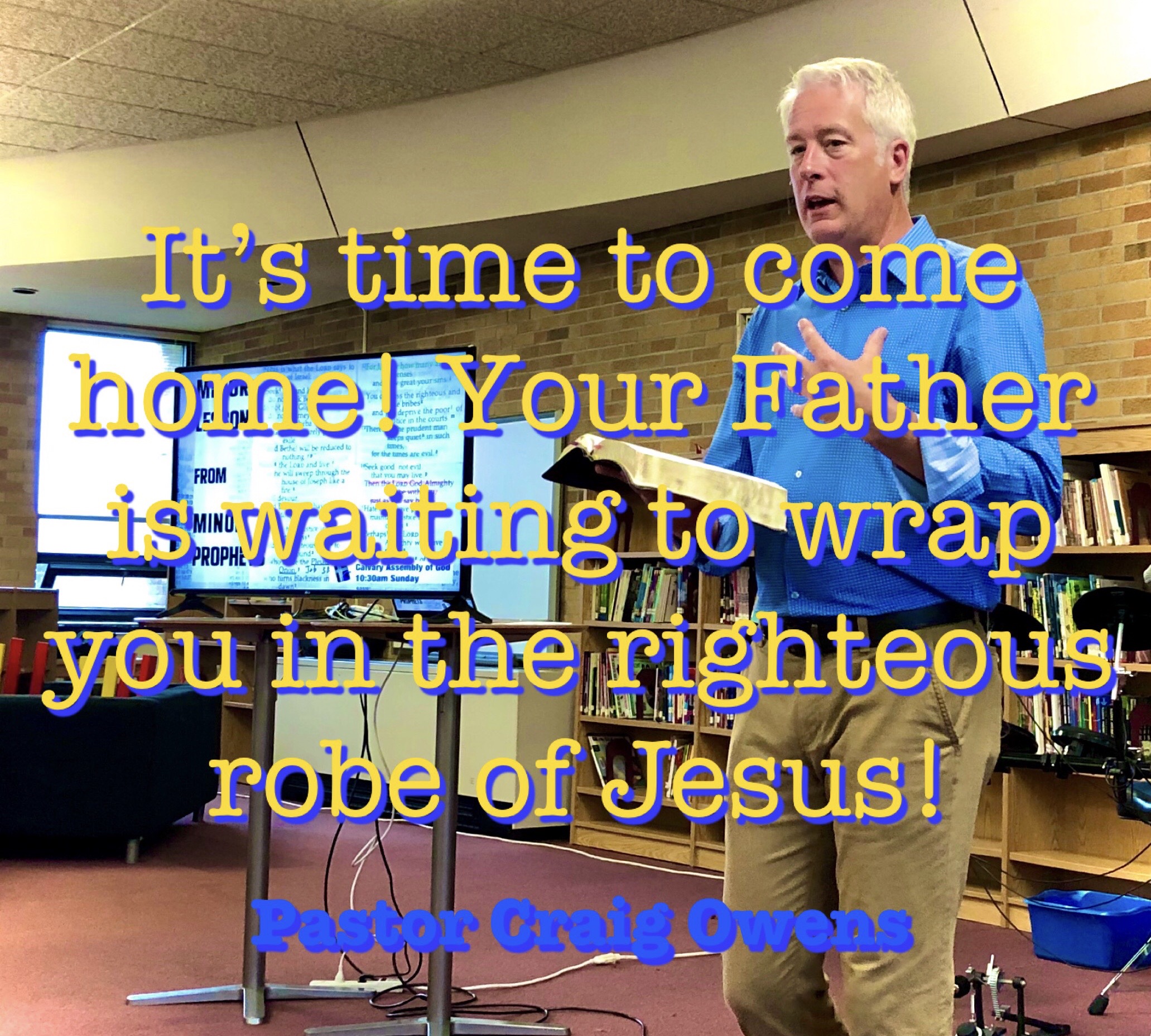
How could this be? How could God’s full judgment not fall on His wayward people? How could it not fall on you and me?! Because it fell on Jesus (2 Corinthians 5:21)! So when we come back to God with our words of forgiveness, He restores us and clothes us in the robe of Jesus (Galatians 3:27). 

Absolutely amazing! 

God longingly speaks to His wayward people, “It’s time to come home. I’m waiting for you with open arms. I am ready to restore you completely. Just come home.”

Join me next week as we continue to learn about the major lessons we can discover in the minor prophets. 

Poetry Saturday—The Precious Blood

Before Your Cross I kneel and see
the heinousness of my sin,
my iniquity that caused You to be
‘made a curse,’
the evil that excites the severity of divine wrath.

Show me the enormity of my guilt by
the crown of thorns,
the pierced hands and feet,
the bruised body,
the dying cries.

Your blood is the blood of incarnate God,
its worth infinite, its value beyond all thought.
Infinite must be the evil and guilt
that demands such a price.

Sin is my condition, my monster, my foe, my viper,
born in my birth,
alive in my life,
strong in my character,
dominating my faculties
following me as a shadow,
intermingling with my every thought,
my chain that holds me captive in the empire of my soul.

Sinner that I am, why should the sun give me light,
the air supply breath,
the earth bear my treat,
its fruit nourish me,
its creatures serve my ends?

Yet, Your compassion yearns over me,
Your heart hastens to my rescue,
Your love endured my curse,
Your mercy bore my deserved stripes.

Let me walk humbly in the lowest depths of humility,
bathed in Your blood
tender of conscience,
triumphing gloriously as an heir of salvation. —Arthur Bennett

Thursdays With Spurgeon—Holding Two Extreme Truths

This is a weekly series with things I’m reading and pondering from Charles Spurgeon. You can read the original seed thought here, or type “Thursdays With Spurgeon” in the search box to read more entries.

Holding Two Extreme Truths

     This is a deep, unsearchable mystery. Man walks without a leash yet treads in the very steps that God ordained him to tread in as certainly as though manacles had bound him to the spot! Man chooses his own seat, selects his own position; guided by his will, he chooses sin, or guided by divine grace, he chooses right. And yet in His choice God sits as sovereign on the throne, not disturbing but still overruling and proving Himself to be as able to deal with free creatures as with creatures without freedom. As able to effect His purpose when He has endowed men with thought and reason and judgment, as when He had only to deal with the solid rocks and with the imbedded sea.

     O Christians! You will never be able to fathom this, but you may wonder at it. I know there is an easy way of getting out of this great deep either by denying predestination altogether or by denying free agency altogether. But you can hold the two: You can say, “Yes, my consciousness teaches me that man does as he wills, but my faith teaches me that God does as He wills, and these two are not contrary the one to the other. And yet I cannot tell how it is. I cannot tell how God effects His end. I can only wonder, and say, ‘Oh, the depth of the riches both of the wisdom and knowledge of God! How unsearchable are His judgments and His ways past finding out!’” (Romans 11:33). Every creature is free and doing as it wills, yet God is freer still and doing as He wills not only in heaven, but also among the inhabitants of this lower earth. 

From The Infallibility Of God’s Purpose

The debate has raged for years: predestination vs. freewill. 

People will sometimes ask me, “Are you a Calvinist (predestination) or an Arminian (freewill)?” And I always give the same answer, “Yes, I am a solid Cal-minian!” As with most things that are difficult for our finite, human minds to grasp about God’s nature, the answer is not either-or but it’s both-and.

C.S. Lewis captured the same sentiments as Spurgeon. Lewis always said the best course between two immovable ideas was right between them. He added, “Heaven will solve our problems, but not, I think, by showing us subtle reconciliations between all our apparently contradictory notions. The notions will all be knocked from under our feet. We shall see that there never was any problem” (emphasis mine).

Spurgeon would agree—there never was any problem, at least not with God. Any problems of understanding are in ourselves, not in Him. So far better than choosing one over the other, choose the both-and, and then stand in awe and wonder and worship that our infinite God is sovereign over all. Even over our puny, limited theologies and doctrines. 

7 More Quotes From “Start With The Heart”

Dr. Kathy Koch has given parents—and anyone else who works with children—a marvelously helpful resource in her latest book Start With The Heart. Be sure to check out my full book review by clicking here. 

“God created you and your children with five core, basic needs that must be met. These needs are interrelated. The health of one influences the others:

  • Security—who can I trust?
  • Identity—who am I?
  • Belonging—who wants me?
  • Purpose—why am I alive?
  • Competence—what do I do well?” 

“Children who know their purpose will often choose to look for peers with similar goals and interests. They will want to hang out with people who affirm them and their purpose and be willing to end relationships that are not joyful and purposeful.” 

“When you parent so your children believe three things, their hearts will be impacted and they will be motivated to succeed. This translates into less stress and anxiety and more peace. … Children who believe these things don’t want to be average. They are willing to work for more. … Children’s character will be more Christlike. They’ll want to be more others-centered than self-centered. They’ll be compassionate, brave and able to stand up for themselves and others. 

  1. I have value. Children who do know they have value are often motivated intrinsically, from the inside. They internally recognize what is good for them and respond accordingly.
  2. Learning matters. When children believe they have worth, they are more likely to value learning. … Children who value learning will exhibit many positive character traits, including teachability. This will be true even when they are not convinced that your requests or planned activities are relevant. They’ll pay attention anyway because they know they matter and learning matters. These beliefs strengthen children’s purpose and give rise to competence.
  3. My future can be bright.” 

“Which is better: ‘Be on time!’ or ‘Don’t be late!’? Do you hear the difference? Which one is positive? ‘Be on time’ communicates ‘I believe you’re capable of this.’ It’s more hopeful. It’s about what you want your children to do. ‘Don’t be late’ reminds them of how they’ve frustrated you.” 

“Carol Dweck…has consistently found that children praised for using effort tackled more challenging tasks than those praised just for ability or for the quality of their work.” 

“Sometimes have children tell you what they think they did before you offer your opinions. If they are relatively accurate, affirm them specifically. When they’re not, have the conversation.” 

“Working to provide feedback that can be described with the following attributes will serve you and your children well—specific, believable, helpful, and thoughtful.” 

You can also check out the first set of quotes I shared from Start With The Heart by clicking here.

Symbolic Hebrew Names In The Old Testament

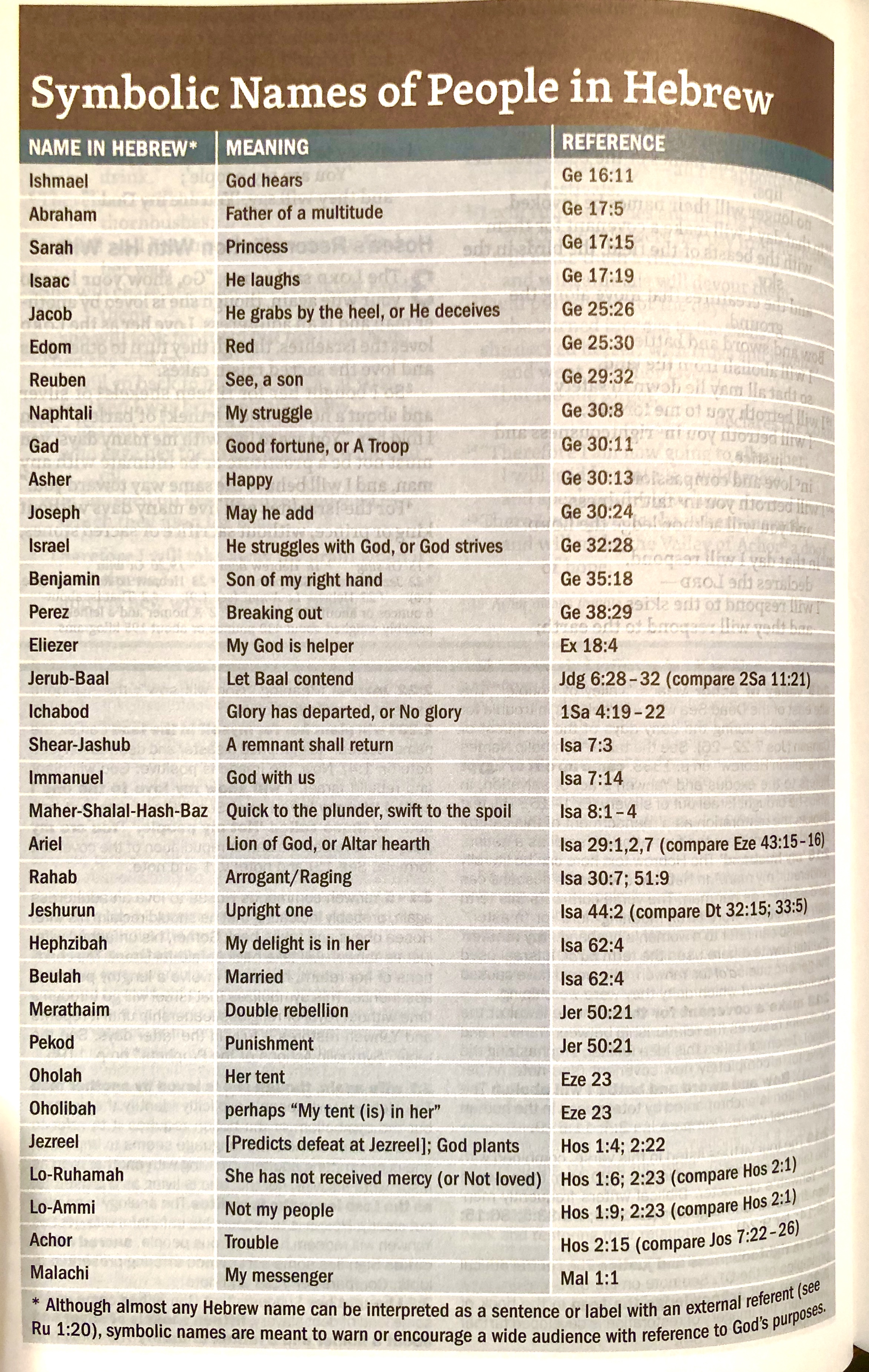
In studying for our ongoing series Major Lessons From Minor Prophets, I came across this chart in my Faithlife Illustrated Study Bible. This isn’t an exhaustive list by any means, but it is a good list to get you started on your own Bible study. 

I always find it fascinating when God names something, or instructs parents to name their children, or especially when a name gets changed. Many study Bibles contain a footnote by these names to give you the Hebrew or Greek definition, so don’t breeze by those too quickly! 

You can also find this list from the Faithlife Bible by clicking here. 

Happy studying! 

P.S. I also invite you to check out this name change which all of us can relate to!

Do It! [reblog]

[I originally posted this about 10 years ago(!), but recently came across it as I was studying the book of Ezekiel. I hope you (re)enjoy this classic.]

Here’s what God said to His people—five times!—through the prophet Ezekiel, “I will judge you according to your conduct.”

It’s not what I believe. It’s not what I discuss. It’s not what I intend to do. It’s not what I know is right and wrong. It’s what I do.

I have to give an account for my conduct. I have to answer to God for how I lived out my beliefs. I have to show God what I did with what I believed about Him. I have to put into practice what’s in my heart.

Do I believe God is God? Do I have idols?

Do I believe God is holy? Do I sin?

Do I believe God forgives? Do I repent?

Do I believe God looks after orphans and widows? Do I?

Do I believe God is my Provider? Do I steal? Do I get jealous or envious?

Do I believe He is Lord? Do I give Him control of everything?

Do I believe I should do something for the hungry, thirsty, naked, sick and imprisoned? Do I actually do something?

What God judges is not just godly beliefs, but godly actions motivated by those godly beliefs.

Don’t just believe it … do it.

A Bizarre Sermon Illustration

Hosea is the only prophet from Israel (he calls the Israelite king “our king” in 7:5), and along with Amos he is the only prophet to address the northern kingdom exclusively. Hosea addresses the northern tribes of Israel with brutal honesty—he calls them an adulteress wife! Hosea isn’t alone in saying this, as Isaiah, Jeremiah, and Ezekiel all same the same thing too. 

But Hosea alone is called on to live out his message in a most unusual way: God instructs him to marry “an adulterous woman”! The question is: was she already a promiscuous woman before they married? Or did she become unfaithful after they were married? 

I believe that she became unfaithful after marriage. When Gomer gives birth to their first son, Hosea writes that “she bore him a son”—indicating he is the father. But with Gomer’s second and third pregnancies, Hosea simply writes, “she gave birth,” leading me to think that Hosea wasn’t the father of those children. 

The names of the children are also interesting: 

  • Jezreel—This boy’s name means “God sows.” It is a neutral word meaning either sowing good seed and reaping a healthy harvest, or sowing godlessness and reaping punishment. 
  • Lo-Ruhamah—Her name means “not pitied.” God indicates that He will bring a judgment on Israel that is deserved justice. He has been patiently calling them to repentance but they kept running farther away from Him. 
  • Lo-Ammi—This boy’s name is saddest of all. It means “not My people. 

How sad! Can you imagine Hosea’s heartache?! Can you imagine God’s heartache?! God tells Hosea the penalty for their adulterous life (Hosea 2:2-13), which the apostle Paul would later sum up in these straightforward words: the wages of sin is death (Romans 6:23). 

“YET” and “THEREFORE”…

In the middle of God expressing His heartache over His wayward wife He says two amazing words “Yet” and “Therefore” (1:10; 2:14). 

  • Yet I will bless you and reverse your misfortune” 
  • Therefore I will allure you and speak tenderly to you” 

This is UNBELIEVABLE!! Who would respond like this to such vile unfaithfulness?! 

God would.

God did! But God shows and clearly proves His own love for us by the fact that while we were still sinners, Christ—the Messiah, the Anointed One—died for us (Romans 5:8). 

Hosea—whose name means salvation—is called on to do exactly what Jesus did for us. Hosea buys back his wife from her master. Hosea pays the price for Gomer’s sin, just as Jesus paid the price for our sin. 

What amazing love God has for us! 

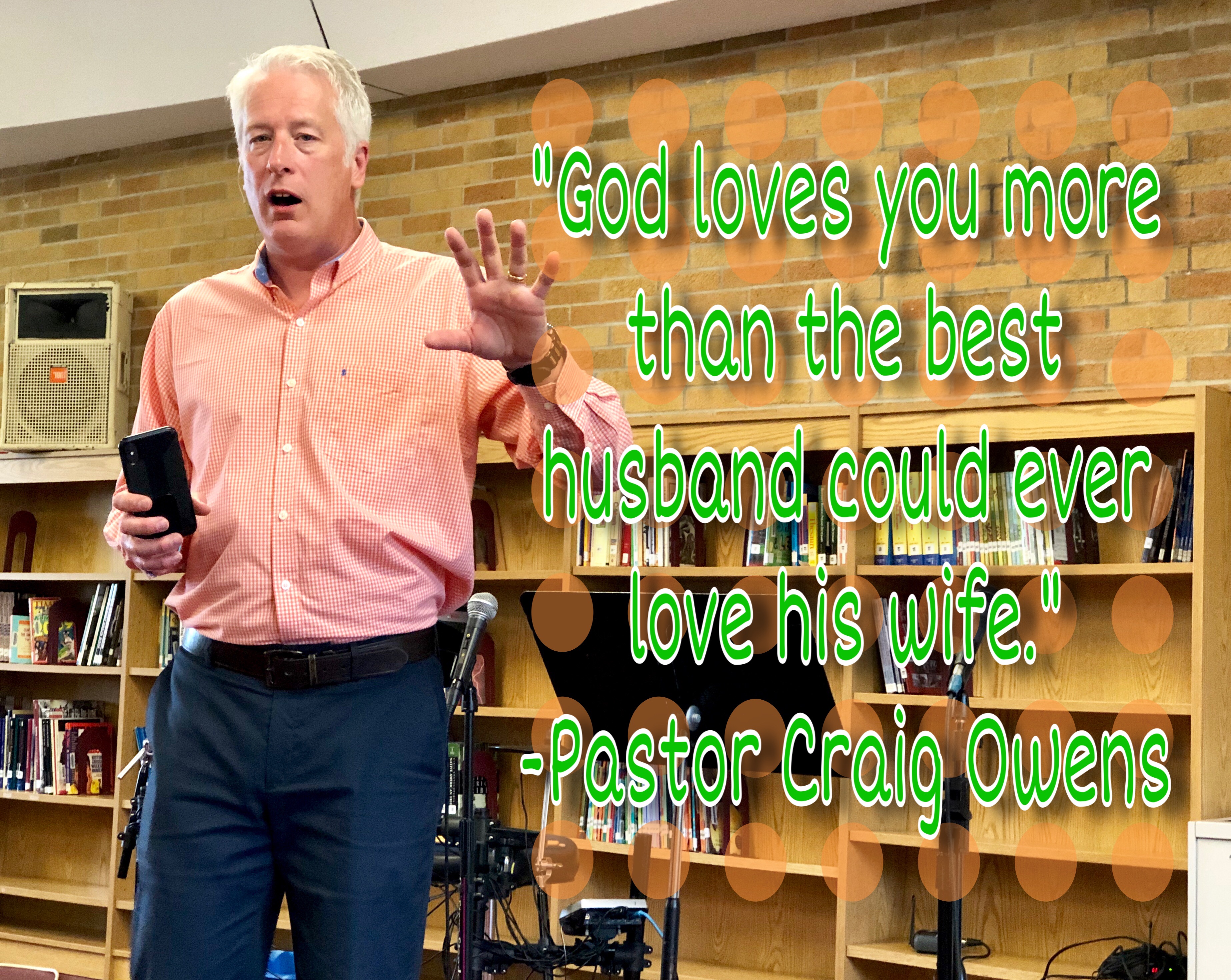
You have never lived an unloved day in your life. Not a single one! God loves you more than the best husband could ever love his wife. He paid for your forgiveness and your freedom. Will you receive that forgiveness and restoration today?

Join me next Sunday as we learn more major lessons from the minor prophets. 

Poetry Saturday—Before Jehovah’s Awesome Throne

Before Jehovah’s awesome throne,
O nations, bow with sacred joy;
Know that the Lord is God alone,
He can create, and He can destroy.

His sovereign power without our aid
Made us of clay and formed us men;
And when like wandering sheep we strayed,
He brought us to His fold again.

We are His people, we His care,
Our souls and all our mortal frame.
What lasting honors shall we rear,
Almighty Maker, to Your name?

We’ll crowd your gates with thankful songs,
High as the heavens our voices raise;
And earth with all its thousand tongues
Shall fill Your courts with sounding praise.

Wide as the world is Your command,
Vast as eternity Your love;
Firm as a rock Your truth shall stand
When rolling years shall cease to move. —Isaac Watts