I had the honor of offering the prayer of dedication for the building that will be home to City Hall in Cedar Springs, MI. In our City’s long history, this is only the fourth building which they have occupied, with the previous building being their home for 50 years. So I was probably given a once-in-a-generation opportunity!
Here is the text of my remarks and prayer.
When the Constitutional Convention convened, Benjamin Franklin rose and said, “I therefore beg leave to move, That henceforth Prayers, imploring the Assistance of Heaven, and its Blessing on our Deliberations, be held in this Assembly every Morning before we proceed to Business.”
Prayer before legislative deliberations has been ingrained in our Nation since her inception. So in that spirit, I humbly offer this prayer of dedication for our new City Hall.
Almighty God, Your servant Paul told us to “pray this way for kings and all who are in authority so that we can live peaceful and quiet lives marked by godliness and dignity” [1 Timothy 2:2]. We are also told that those in civic leadership positions are Your servants that You have appointed to do Your work [Romans 13:1].
There are so many issues that are before both our elected officials and our City staff that need a wise and prudent answer. We believe that You delight in giving us Your counsel which is far above the counsel of mere humans.
Therefore, I humbly ask for wisdom for Your servants who serve us in the City of Cedar Springs. You have told us that wisdom will be “given generously” to all who ask You for it [James 1:5]. And that by Your wisdom officials “rule wisely” [Proverbs 8:15]. Give these civil servants such wisdom to deliberate and to decide in a fashion that pleases Your righteousness and Your justice. May the City of Cedar Springs—and all of her citizens—be blessed because of Your wisdom that guides the deliberations and the decisions that will be made made in this building.
Listen to the podcast of this post by clicking on the player below, and you can also subscribe on Apple, Spotify, or Audible. Check out the video content in this post by clicking here.
Accountability is a word you might have some negative connotations attached to. Many people have only heard the word in the context of taking ownership for a mistake or a “shape up or else” talk with the boss. In today’s episode Greg and I offer a different perspective, discussing how a healthy accountability culture can strengthen and grow your organization.
[0:00] Introduction
[0:22] A leadership “4-letter word” that many weaker leaders want to avoid.
[2:21] Some people think accountability might show some chinks in their armor.
[3:36] What are the benefits of a leader being accountable to his or her team?
[6:21] A leadership team that is approachable will use accountability in a very positive and productive way.
[7:57] Is there a correlation between accountability and motivation?
[9:44] For some people, accountability might be viewed as a threat.
[11:00] Greg and I have a new book coming out about a leader’s vision-casting, which requires some accountability.
[13:05] Our childhood experiences definitely effect the way people view accountability today—for both leaders and teammates.
[16:43] Leaders should set up their teammates for success.
[17:25] Reassurance is a key part of building a culture of accountability.
[18:37] Accountability is simply accounting for your ability.
[19:09] I share a quote from John Maxwell.
[19:55] Leaders should create a culture where their team is excited to come to them, asking where they can improve.
[22:44] An outside coach can help you improve your accountability with a nonjudgmental third party.
Listen to the podcast of this post by clicking on the player below, and you can also subscribe on Apple, Spotify, or Audible. Check out the video content in this post by clicking here.
There is a phrase the apostle Paul uses frequently: “in service to God.” Let me give you one example from Romans 15:17—“Therefore I glory in Christ Jesus in my service to God.” The Amplified Bible renders this verse like this: “In Christ Jesus, then, I have legitimate reason to glory (exult) in my work for God—in what through Christ Jesus I have accomplished concerning the things of God.”
In this passage in Romans 15 Paul says he preached in service to God.
A few verses later he says that he was on his way to minister to the financial needs of the saints “in the service of the Lord’s people” in Jerusalem (vv. 25-26). He uses similar words to the church at Corinth when he speaks of people devoting themselves “to the service of the Lord’s people” (1 Corinthians 16:15; 2 Corinthians 8:4). He tells them, “This service that you perform is not only supplying the needs of the Lord’s people but is also overflowing in many expressions of thanks to God” (2 Corinthians 9:12-13).
In other words, Paul says that we may be serving people, but this is really service to God through Jesus. Jesus Himself would say that all of our ministry to people is ultimately done “for Me” (see Matthew 25:40).
Because this is service done for Jesus, it is only recognition from Jesus that we should desire. We want to hear Jesus say to us, “Well done, good and faithful servant.”
Sadly, in the very next chapter of Romans, Paul warns the saints about people who are serving “their own appetites” instead of serving Jesus—
I urge you, brothers and sisters, to watch out for those who cause divisions and put obstacles in your way that are contrary to the teaching you have learned. Keep away from them. For such people are not serving our Lord Christ, but their own appetites. By smooth talk and flattery they deceive the minds of naive people. (Romans 16:17-18)
Notice that those who speak with smooth talk and flattery are serving themselves by trying to earn accolades from other people. But this motivation only ends up causing divisions.
In my book When Sheep Bite, I call flattery from others—and the desire to receive human praise—the “sneaky bite.”
Flattery needs to be quickly identified and quarantined because it has two ways it can set up a shepherd for a painful fall.
First, the flatterers are usually more concerned about themselves than they are about the shepherd. You may appreciate the compliments at first, but if you listen closely you can begin to pick up the note of insincerity that morphs these encouraging compliments into dangerous flattery. …
The second sneaky danger in flattery is what it does to your heart, especially if you have been recently bitten, attacked, or abandoned by other sheep. Mark Twain once quipped, “I can live for two months on a good compliment.” It’s true that we can get parched for a kind word if we haven’t heard one for a while. A thirsty man will drink just about anything, and a flatterer can offer you a tasty refreshment that, if you gulp it down, can end up turning quite bitter later on.
When no one praises your sermon, or appreciates your wisdom that made the difference, or notices your long hours given in service to them, how do you feel?
If you feel like you should have been recognized for your shepherding work, let me ask another question: For whom were you working?
Jesus told us that when you lead sheep to green pastures, or when you guide them to sparkling waters, when you care for the sick, carry the weak on your shoulders, and rescue the wandering lambs, you are really doing all of this for Him. They are His sheep which have been entrusted to your care for this period of time (see Matthew 25:31-46). (From chapter 6 ‘When the Sheep Flatter You’)
Although When Sheep Bite was written for those in leadership, we can all learn this important lesson—
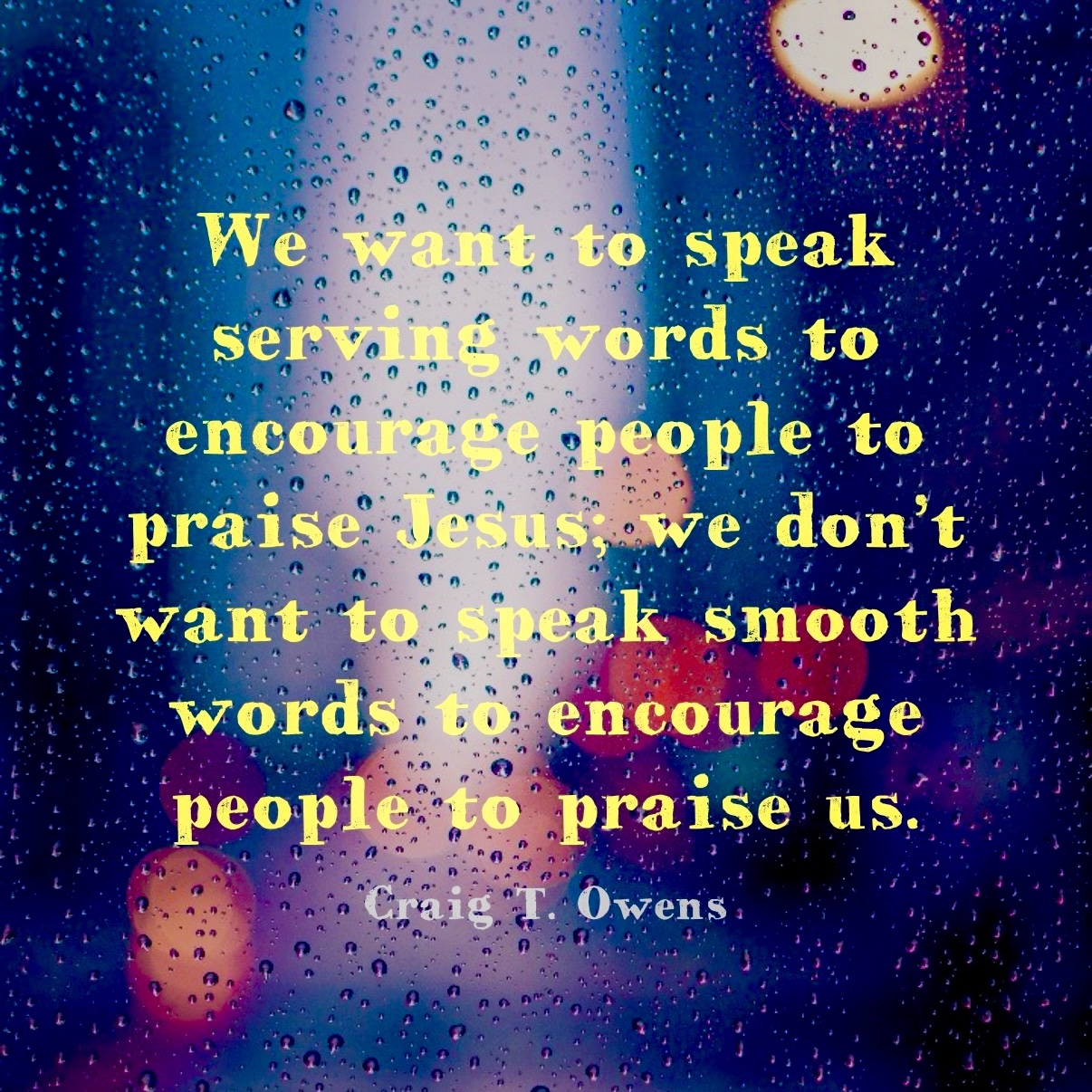
We want to speak serving words to encourage people to praise Jesus; we don’t want to speak smooth words to encourage people to praise us.
There is a massive difference between serving words and smooth words. This will be made abundantly and eternally clear when Jesus returns and says, “Take your inheritance” to those who served Him by their words, or “Depart from Me” to those who merely served themselves by their words.
Take a close listen to make sure your words are serving words, and that the posture of your heart is to only help others praise Jesus.
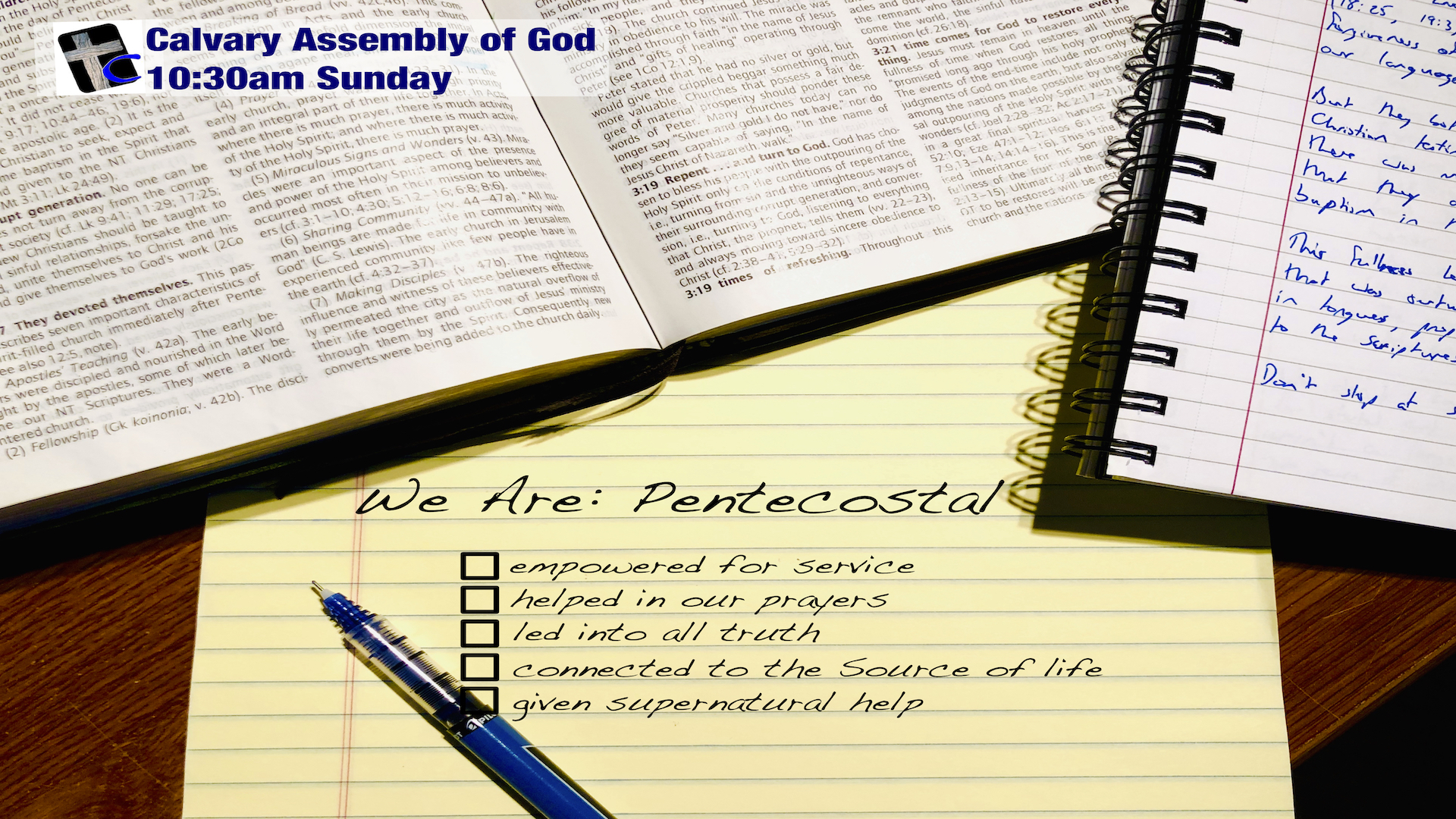
Pentecost for over 1500 years was a celebration in Jerusalem that brought in Jews from all over the world. But on the Day of Pentecost which came just ten days after Jesus ascended back into heaven, the meaning of Pentecost was forever changed!
Followers of Jesus—now empowered by an infilling of the Holy Spirit—began to take the good news of Jesus all over the world. These Spirit-filled Christians preached the Gospel and won converts to Christ even among hostile crowds, performed miracles and wonders, stood up to pagan priests and persecuting governmental leaders, and established a whole new way of living as Christ-followers.
We, too, can be Pentecostal followers of Jesus Christ today. We can experience an anointing and an empowering in our lives that turns ordinary Christianity into extraordinary Christianity!
Please join me this Sunday at Calvary Assembly of God as we rejoin this series. You can check out what I taught in this series in 2025 by clicking here.
As he does in all of his books, John shares insights from other authors that help add some impact to the ideas he is sharing. I have already shared some quotes from this book, but here are some of the notable quotes that John shared in Leading in Tough Times.
“Once we accept the fact that life is hard, we begin to grow. We begin to understand that every problem is also an opportunity. … We use [those problems] as a means of rising to the occasion.” —Hal Urban
“A mistake simply shows you something you didn’t know. Once you make the mistake, then you know it.” —Kim Kiyosaki
“The basic role of a leader is to foster mutual respect and build a complementary team where each strength is made productive and each weakness is made irrelevant.” —Stephen R. Covey
“Life is a series of problems. Do we want to moan about them or solve them?” —M. Scott Peck
“When you step into a turnaround situation, you can safely assume four things: Morale is low, fear is high, the good people are halfway out the door, and the slackers are hiding.” —Nina DiSesa
“Being heard is so close to being loved that for the average person they are almost indistinguishable.” —David W. Augsburger
Listen to the podcast of this post by clicking on the player below, and you can also subscribe on Apple, Spotify, or Audible. Check out the video content in this post by clicking here.
“To be a mother is the greatest vocation in the world. No being has a position of such great power and influence.” —Hannah Whitall Smith
A mother’s power impacts her children while she is alive, and a mother’s influence continues to empower them after she is gone. Other than Jesus Himself, I’m not sure who has a greater influence than a God-fearing mother.
A mother’s influence is seen in her children.
Paul was a prolific evangelist and letter writer. His letters make up a huge part of the New Testament of the Bible. Much of his travel and his letters were thanks to a faithful traveling companion named Timothy.
Paul’s very last letter was written to Timothy, in which he called him my dear son (2 Timothy 1:2)
Paul met him in Lystra where Timothy was well spoken of (Acts 16:1-2)
Paul knew the anointing that was on Timothy (2 Timothy 1:6; 1 Timothy 1:18)
Timothy stepped right into the fire of ministry—persecution in Philippi and Thessalonica; then he followed Paul to Corinth (Acts 18:1-5)
Timothy was entrusted to deliver valuable letters and answer questions (1 Corinthians 4:17, 16:10-11; Philippians 2:19-23; 1 Thessalonians 2:18—3:6)
In his first pastoral epistle, we see that Paul commissioned Timothy to pastor in Ephesus (a challenging place), and he reminds Timothy that he is my true son (1 Timothy 1:2)
Paul knows that this godly man, this trusted friend, this faithful companion is a product of the power and influence of his mother, who in her turn was influence by her mother (2 Timothy 1:5).
There is very little mention of Timothy’s father, other than he was aGreek. That could mean he was of Greek nationality or that he was a Gentile. We know Gentiles were looking for Jesus (John 12:20-21) and were turning to Jesus (Acts 14:1), but it would seem this wasn’t the case for Timothy’s dad, since neither Luke nor Paul mention him by name.
The fact that we don’t know his name may means that he passed away or he may have been uninvolved in Timothy’s upbringing. We can at least tell that his father—who had the right to name his children—was hoping for great things from his son. The name Timotheus means honoring God.
The main influence in Timotheus’ life was his mother and grandmother. Already he was known as a disciple. Recall that Luke seldom used the word “Christian” but usually called the followers of Jesus saints, believers, and disciples. We also read that the fellow brothers at Lystra and Iconium spoke well of him (Acts 16:2).
Paul says this is because Lois (mimi) and Eunice (mama) had a sincere faith (2 Timothy 1:5), which literally means “without any hypocrisy.” Andrew Murray wrote, “Your motherhood is in God’s sight holier and more blessed than you realize.” This was in a time before the Church was very well established, so there were very few supports around them; certainly Timothy’s father wasn’t a supporter.
Timothy felt this impact just as King David did (Psalm 86:16). Paul tells Timothy to follow my example (v. 13-14) and follow the example of your godly mother and grandmother (v. 5).
Mothers and grandmothers, keep the faith!
Your life has power and it has influence. Charles Spurgeon said, “The devil never reckons a man to be lost so long as he has a good mother alive. O woman, great is thy power!”
Great, indeed, is your power, Mom! Don’t give up, don’t give in to despair.
I hope you get to see your power and your influence in your lifetime, but even if you don’t, be assured that your influence will outlive you—I am persuaded [the faith of your mother] now lives in you also!
Kids, today would be an especially good day to let your mother and grandmother know the positive influence they have had on your life. Trust me: nothing would make their day more than hearing those words from you!
We are born with a certain level of intuition, but we can definitely build a stronger intuition by learning lessons from history. Check out the full conversation Greg and I had about a leader’s intuition + execution.
“It is idle to talk always of the alternative of reason and faith. Reason is itself a matter of faith. It is an act of faith to assert that our thoughts have any relation to reality at all. If you are merely a sceptic, you must sooner or later ask yourself the question, ‘Why should anything go right; even observation and deduction? Why should not good logic be as misleading as bad logic? They are both movements in the brain of a bewildered ape?’” —G.K. Chesterton
I keep six honest serving-men
(They taught me all I knew);
Their names are What and Why and When
And How and Where and Who. —Rudyard Kipling
“All the work of man is but the spinning of a righteousness which is undone as quickly as it is spun; but Christ has finished the seamless and spotless robe of His righteousness which is to last for ever.” —Charles Spurgeon
The Institute for Creation Research opens an article about the impact of and recovery from the biblical Flood with this, “In the beginning, God created plants and animals to multiply and fill the earth (Genesis 1:11–13, 20–25). So, when areas are devastated, living things are engineered with the innate ability to rebound and recolonize. This was seen in the rapid recovery of life at Mount St. Helens after the cataclysmic volcanic eruption of May 18, 1980. But conventional scientists seem to be finally recognizing and appreciating the reality of rapid recovery a bit more after studying the life that existed after the supposed Chicxulub impact.”
John Piper addressing the role of spiritual affections in the life of a Christian says, “No machine, no computer, no AI will ever duplicate the spiritual reality of the soul’s enjoyment of God.”
“Ignorance of Scripture is the mother of error. … Many lay aside Scripture as rusty armour (Jeremiah 8:9); they are better read in romances than in St. Paul; they spend many hours inter pectinem et speculum—‘between the comb and the glass’—but their eyes begin to be sore when they look upon a Bible. They who slight the Word written, slight God Himself, whose stamp it bears.” —Thomas Watson
Listen to the podcast of this post by clicking on the player below, and you can also subscribe on Apple, Spotify, or Audible. Check out the video content in this post by clicking here.
Nearly every church has a pulpit where the pastor stands to deliver the weekly sermon. And almost every evangelical church gathering has the same order of service. Where did these things originate?
I talk more about biblical and non-biblical issues in this video, and in my blog post and video called “Use the right term.”
The full sermon from which this clip came is here.
Listen to the podcast of this post by clicking on the player below, and you can also subscribe on Apple, Spotify, or Audible. Check out the video content in this post by clicking here.
Jesus spoke and people listened.
He taught “in the power of the Spirit” and “everyone praised Him” (Luke 4:14-15). Jesus quoted the prophet Isaiah, and everyone’s eyes “were fastened on Him.” He declared that He was the fulfillment of the prophecies about the Messiah, and “all spoke well of Him” and were “amazed at the gracious words that came from His lips” (vv. 18-22).
So how is it that in just a few verses, this same crowd of admirers is now furious with Him and ready to throw Him off a cliff?
The people liked it when the words of Scripture suited them and seemed to be pointing to blessings that were coming their way. But when Jesus continued to quote Scripture in reply to their request to do something that thrilled them, they became furious.
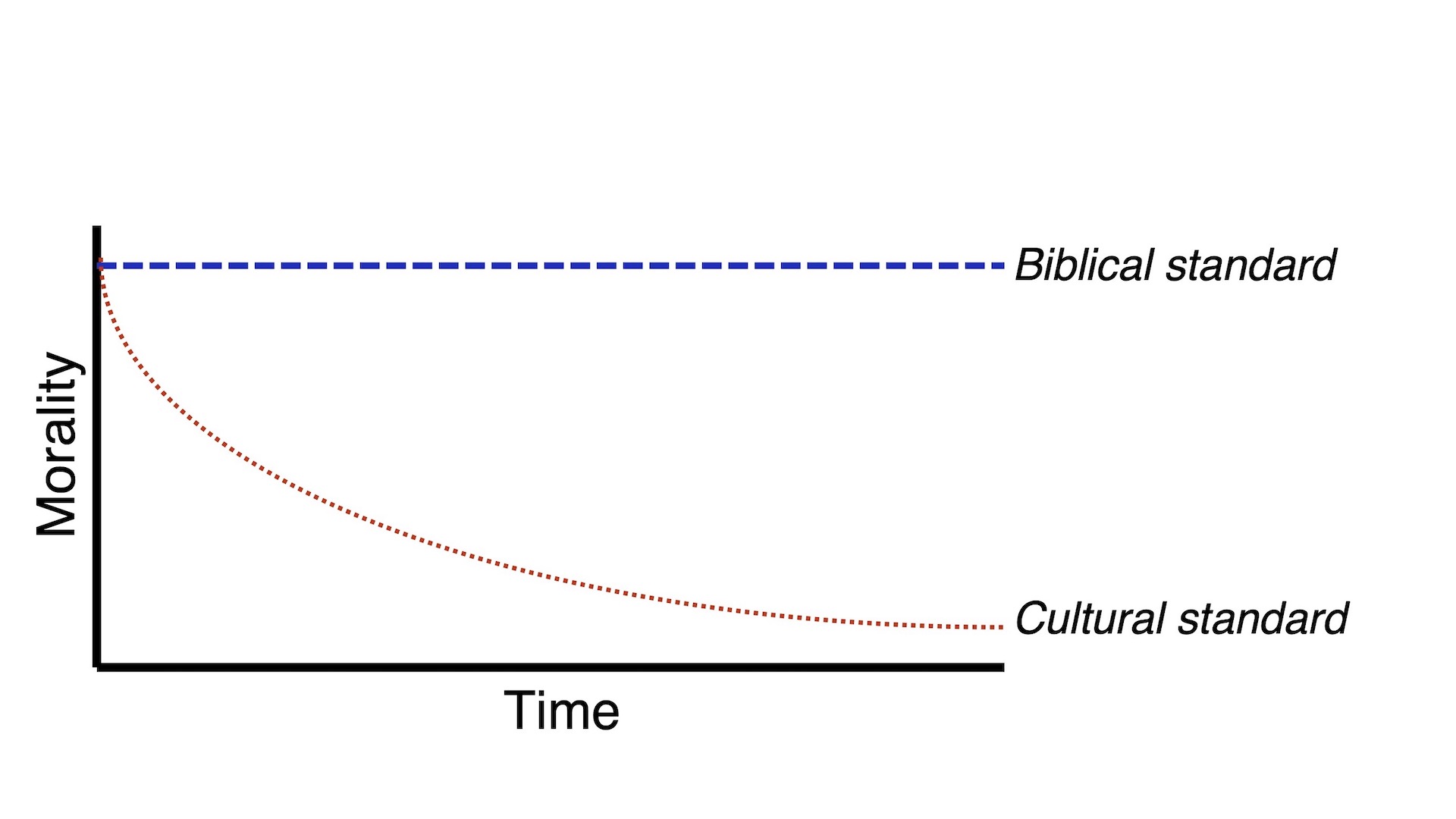
God’s Word is unwavering in presenting the righteous standard to which all people are held, while the prevailing culture is always looking for a way to bend those standards to something more palatable and comfortable.
When culture gets a hold of it, morality always decays. As a result, those who cling to the the biblical standard become the problem and must be thrown off the cliff.
Jesus never compromised on truth. This is because He was “led by the Spirit” and walked “in the power of the Spirit”—the One Whom He would later call the Spirit of Truth (Luke 4:1, 14; John 16:13).
Jesus didn’t come to speak comforting words to comfortable people, but truthful words to desperate people.
Speaking comfort to people with morals far removed from the standard of Scripture is to condone them right into hell.
If Jesus was so reliant on the indwelling power and counsel of the Holy Spirit to live righteously as morality decayed around Him, what would make us think we could get by with anything less?! We need to allow the Spirit of Truth to search us for any areas where we may have compromised with culture, so that we can repent and return to the unwavering biblical standard.
This is the only way we can shine brightly for Jesus in a culture with disintegrating morality.
Listen to the podcast of this post by clicking on the player below, and you can also subscribe on Apple, Spotify, or Audible. Check out the video content in this post by clicking here.
Imagine a couple being invited to a dinner at another couple’s house. The host and hostess want to create a special evening for their guests, so they carefully plan the meal, shop for all the ingredients, and then spend the afternoon putting together all the components of their meal.
Their friends arrive and sit down to dinner. One friend thoughtfully samples the food, letting it sit on her tastebuds, and offering comments like, “I love how you got the spices to bloom on this meat … Wow, look at the vibrant colors in your vegetable medley … I really like the way the lemon zest cuts down the sweetness of your cake frosting.” The other dinner guest inhales his meal without hardly tasting it.
For which guest would you rather spend hours preparing the meal—the thoughtful foodie or the hasty gobbler? It doesn’t have to be food. What about the one who appreciates the effort you put into your design project, noticing the fine-tuned details versus the one who simply says, “It looks nice”? Or the one who graciously receives your loving insight about something that could really help them versus the one who sulks and attacks you because you didn’t tell them everything about them is wonderful?
Statement #19—Don’t cast your pearl before swine. Is that in the Bible?Yes.
Matthew 7:6 is a paragraph unto itself. Do not give dogs what is sacred; do not throw your pearls to pigs. If you do, they may trample them under their feet, and turn and tear you to pieces.
But its placement in the Sermon on the Mount is interesting because Jesus has just addressed the hard but loving word we may need to speak to a brother or sister (vv. 1-4). I’ve discussed this before, and this requires maturity, humility, and introspection before speaking.
In v. 6, Jesus seems to be telling us to consider whom we are addressing.
The word sacred (Greek: hagios) means saintly, holy, set apart for God’s use. This word is used for the Holy Spirit and for God’s holy people. So sacred things are not to be used just anywhere by anyone in any situation in which we choose. Sacred things must be used with discretion.
The apostle Paul said, “Yet when we are among the full-grown—spiritually mature Christians who are ripe in understanding—we do impart a higher wisdom—the knowledge of the divine plan previously hidden…” (1 Corinthians 2:6 AMPC).
The word dogs in Matthew 7:6 can me a 4-legged canine, but it can also mean a person of an impure mind (see Philippians 3:2; Revelation 22:15).
(2) …do not throw your pearls to pigs.
Pearls is a word of great value; a treasure that you spent dearly to acquire. Jesus talks about precious, costly treasures in two parables in Matthew 13:44-46. And Solomon opens the Book of Proverbs by contrasting those who receive precious wisdom—those who “listen and add to their learning”—with those who reject it—“fools [who] despise wisdom and instruction” (see Proverbs 1:1-7).
Pigs in Matthew 7 are those undiscriminating gobblers of food, like the thoughtless friend I mentioned earlier who just inhaled his food without any savoring of the perfectly-prepared meal.
We want to give a good answer to everyone without quarreling. But giving a good answer doesn’t necessarily mean you are giving them your best pearls. Here are a few things I have learned the hard way.
Do gauge their sincerity with questions. Notice the masterful way Jesus did this in Matthew 22:15-46. In several exchanges, you can tell which people in His audience were getting the pearls and which weren’t. We would do well to learn this lesson from our Savior.
Don’t try to be a know-it-all. Saying, “I don’t know,” is a perfectly acceptable answer, but then come back to continue the conversation later.
We have precious, invaluable, life-changing treasures to share with people! Let’s share with them what they are ready to hear, reserving our pearls for those who are truly seeking a treasure.
If you’ve missed any of the other statements we have looked at in our series “Is That In The Bible?” you can find them all here.



 I had the honor of offering the prayer of dedication for the building that will be home to City Hall in Cedar Springs, MI. In our City’s long history, this is only the fourth building which they have occupied, with the previous building being their home for 50 years. So I was probably given a once-in-a-generation opportunity!
 There are so many issues that are before both our elected officials and our City staff that need a wise and prudent answer. We believe that You delight in giving us Your counsel which is far above the counsel of mere humans.