If I want to present my best ideas, I need to be open to the helpful, sharpening critique that people close to me have to offer. My first idea sounds great, until others come along to make it better.
“In so far as I am Man I am the chief of creatures. In so far as I am a man I am the chief of sinners.” —G.K. Chesterton
Cold case detective J. Warner Wallace applies the same scrutiny to examining the evidence of the New Testament as he does with a suspect. “There are four critical questions that must drive our examination of any eyewitness, ancient or modern: Were they actually present to see what they claim? Can their account be corroborated in some fashion, even indirectly? Have the key elements of their story shifted over time? And finally, do they possess ulterior motives or bias that would tempt them to lie or embellish? This is not a uniquely religious or anti-religious method; it is simply good investigative practice.”
“Few men, if any, step into responsible positions without preparation. Sometimes in our shortsightedness we seem to get the idea in regard to Bible characters that they come on the scene ready-made, fully prepared; here they are, God’s gift to the world! They take up the work, and that’s all there is to it. But if you will read more carefully, you will find that usually—I think we could even say always—there is a period of preparation behind them. God lays His plans well in advance.” —William Sanford LaSor
Listen to the podcast of this post by clicking on the player below, and you can also subscribe on Apple, Spotify, or Audible.
On an episode of The Craig and Greg Show, Greg and I discussed some toxic behaviors that can creep into your workplace and cause major discord. Two attitudes to watch out for are confidence without humility, and humility without confidence.
Check out this full Craig and Greg Show episode here.
Listen to the podcast of this post by clicking on the player below, and you can also subscribe on Apple, Spotify, or Audible.
Paul addresses his letter to the church at Philippi like this, “all God’s holy people … the overseers and deacons” (Philippians 1:1). Notice that Paul addresses all of the saints, whether they are in a position of leadership or not.
In verse 5, Paul says he is grateful for their “partnership in the Gospel.” Some translations use the word “fellowship” instead of partnership. This is the Greek word koinonia. By the use of this word Paul is recognizing the close relationship the church members have with their leaders, with each other, with Paul, and even with other Christians in other cities.
The root word is koinos. The Levitical Jews used this word to designate anything that their religious rules deemed unclean, common, or ordinary. One of the things these Jewish leaders would have called unclean are Gentile people. Which means they would have referred to the saints who made up the bulk of this assembly at Philippi as unclean and unworthy of God’s love!
But here is Paul using this ordinary word in an extraordinary way. That is, he is calling ordinary people something extraordinary: saints! Remember in the opening verse he addressed his letter to “God’s holy people.” The word holy here means the exact opposite of common or unclean—it means people set apart for God’s special use.
The “extra” that elevated common, ordinary, unclean people to the extraordinary position of being called a saint is their personal relationship with Jesus as their Savior and Lord.
Jesus makes the ordinary extraordinary!
Still today, our koinonia is something extraordinary. When common, ordinary, blood-cleansed people remain in relationship with Jesus and other fellow saints, God can do extraordinary things through them. Our common bond with our Savior and with other saints is itself a testimony to the life-changing power anyone can have in Jesus!
When you are in fellowship with God and in fellowship with God’s holy people, there is nothing ordinary about you. You are an extraordinary testimony of God’s loving, transforming, and keeping power!
The crucible for silver and the furnace for gold, but people are tested by their praise. (Proverbs 27:21)
The Message paraphrase says you can tell what’s in someone’s heart by how they react when they are praised—“The purity of human hearts is tested by giving them a little fame.”
The Amplified Bible says you can tell what’s in someone’s heart by listening to what they praise—“A man is judged by what he praises and of what he boasts.”
These are two sides of the same coin, and both are equally true. How we handle praise and what we praise both reveal what’s inside our heart. Both of these are responses to which we shouldpay careful attention.
Listen to the podcast of this post by clicking on the player below, and you can also subscribe on Apple, Spotify, or Audible.
I love the Fibber McGee and Molly radio broadcasts! One of the running gags on this show was Fibber’s closet: People who mistakenly opened the closet door got buried under a pile of stuff that Fibber had stashed away.
In one episode, Molly is determined to grow through all of the items that were strewn across the floor before they got shoved back into the closet. One by one Molly asked Fibber about all of the odd knick-knacks and he had a good explanation for every single one justifying why he couldn’t possibly part with it. One of my favorites was this—“What’s this bamboo pole,” Molly asked, and Fibber said, “Why, that pole is very important. If I was ever offered to be Joe Louis’ sparing partner, that’s the ten-foot pole I wouldn’t touch it with!”
I’m afraid that many of us have closets like this in our minds. We’ve accumulated a lot of just-in-case stuff for each and every scenario that may come upon us at some point in our lives.
All of our contingency plans implies that something is going to go wrong and that only the prepared and well-stocked will make it through.
Psalm 107 is the first psalm in Book 5 of the Psalter—the book that focuses mostly on praise. This author is recounting the history of Israel through the times of crisis:
lost and homeless (v. 4)
hungry and thirsty (vv. 5, 9)
trouble and distress (vv. 6, 13, 19, 28)
darkness and deepest gloom (vv. 10, 14)
prisoners in chains (v. 10)
knocking on death’s door (v. 18)
terrorized (v. 26)
at their wits’ end (v. 27)
We quickly go into crisis mode when we forget that God is in control!
In God’s Kingdom there is no emergency, no crisis, no Plan B. God is sovereignly in control—Isaiah 46:10.
God is in control of the macro—Genesis 1:1; Job 38:4-11
God is in control of the micro—Psalm 139:16; Jeremiah 29:11
God will use what we call a crisis to display His glory—Exodus 14:4 NLT
When you feel yourself spiraling into crisis mode—when you feel you’re at your wits’ end—you can get back into contentment mode.
“When a man is at his wits’ end it is not a cowardly thing to pray, it is the only way he can get in touch with Reality.” —Oswald Chambers
That’s what Job finally did—Job 42:1-2.
And that’s also what the psalmist did—Psalm 107:6-8, 13-15, 19-21, 28-31.
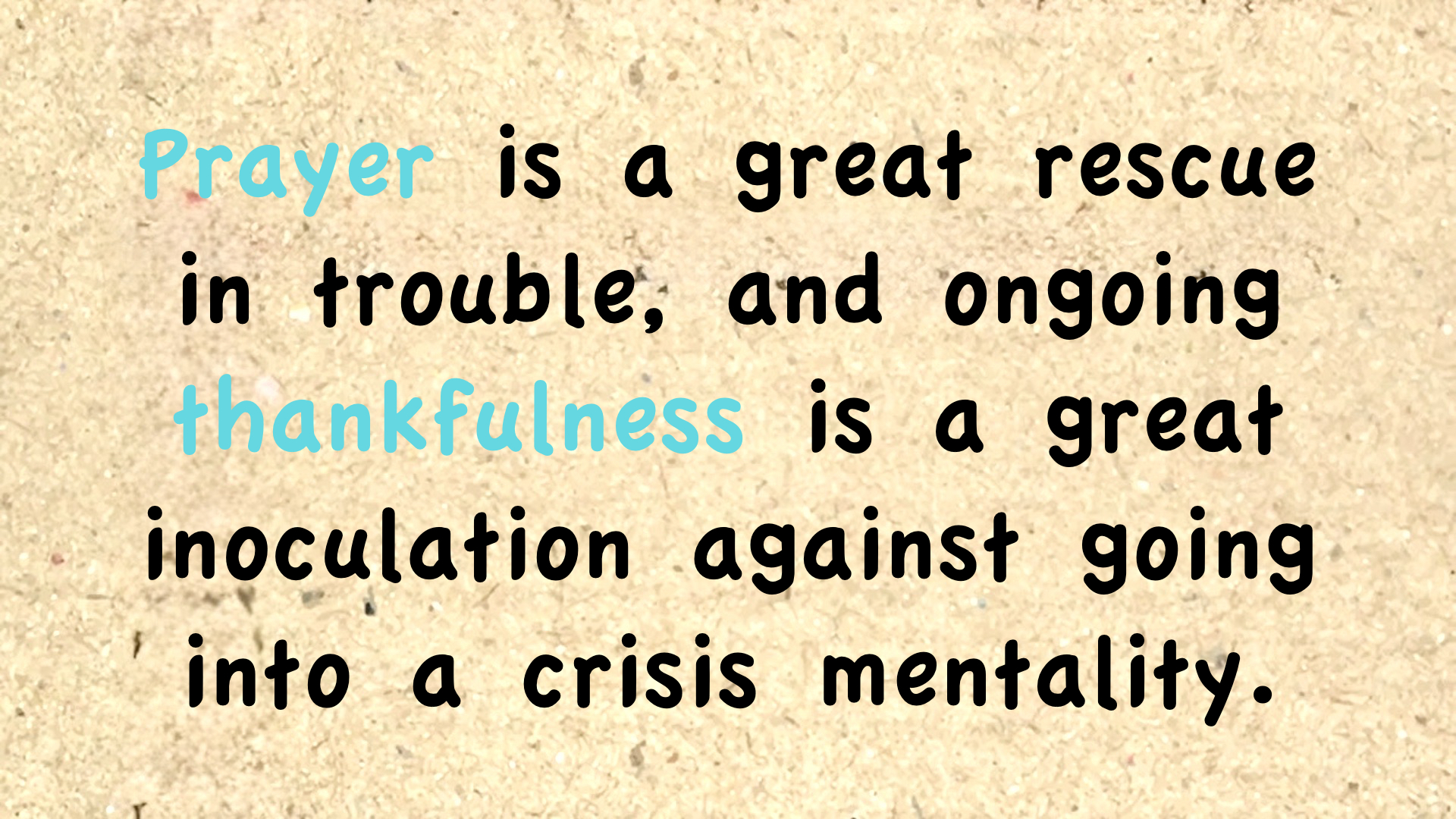
Prayer is a great rescue in trouble, and ongoing thankfulness is a great inoculation against going into crisis mentality. Notice that those four repeated phrases have both cried out to the LordANDLet them give thanks to the Lord for His unfailing love.
Let’s strive to remain aware of His unfailing love by cultivating consistent gratitude. I like v. 2 from the NLT: “Has the Lord redeemed you? Then speak out! Tell others He has redeemed you from your enemies”. When you are preoccupied with telling others and yourself how good God is, there isn’t room in your heart for the worry that leads toward crisis mode.
Remember: We can quickly go from contentment mode to crisis mode when we forget that God is in control, so remain full of thanks. “At all times and for everything giving thanks in the name of our Lord Jesus Christ to God the Father” (Ephesians 5:20 AMPC).
The writer of the Book of Hebrews challenges Christians to learn how to better encourage others and spur them on to their very best. This means we have to go deeper in our relationships with people. Here’s one way not to do this.
T.M. Moore cautions us against having a “too small God” mindset. He writes, “We are short-changing the people of God unless our preaching and teaching fits them to seek the Kingdom of God and the restoration of the world in all our life and work. We do not expect to recreate the original conditions that existed before the fall, but to remember them, to recall them, to recover a measure of them for the life of the world and, by so doing, to point ahead to the new and better and fully remade world that is to come.”
More archeological evidence from the city of Jericho helps scholars date the exodus from Egypt more precisely as well. All of this reinforces the absolute historicity of the biblical accounts.
“The Pentecostal movement emerged at the turn of the 20th century, resulting from a series of overlapping revivals that occurred around the world.” One of those revivals was in Wales.
“Although [traditional scientists] feel certain that dinosaurs went extinct 66 million years ago, unremitting soft tissue discoveries from dinosaur fossils openly challenge such age options and validate the creation model.” Check out how the Raman spectroscopy tests are aligning paleontological discoveries with the biblical timeline of Creation.
Look back through the pages of history and you will see a common theme. Whether it’s world history or your own personal history, you have so much for which you can give thanks.
In tough times, we tend to become forgetful because we are so focused on the intensity of the moment. But if we will simply look back in time, we will see just how faithful God has been to us. We bring our focus back to Him in our trying times when we remember and rehearse “the wonderful things He has done” (Psalm 107).
The season of Thanksgiving is a good time for us to be reminded of the powerful resource we have when we are giving thanks for our blessings. Thankful people are confident people because they choose hope in God’s faithful provision over grumbling about their current circumstances.
Listen to the podcast of this post by clicking on the player below, and you can also subscribe on Apple, Spotify, or Audible.
The entire Maximize team loves our veterans! Those that volunteer to serve and protect our nation deserve our utmost respect, and we honor their sacrifice. In today’s episode Greg and I discuss the leadership lessons we have learned from veterans—some directly and others by simply observing the way our nation’s protectors conduct themselves. Join us as we salute the contributions of veterans!
[0:00] Introduction
[0:15] One of our favorite days of the year
[1:08] Leadership lesson #1 from veterans: Sacrifice
[2:28] Leadership lesson #2: Selflessness
[4:12] Leadership lesson #3: Camaraderie
[5:33] Leadership lesson #4: Organization in planning and training
[8:52] Leadership lesson #5: Emotionally invested
[9:31] Leadership lesson #6: Training in action
[11:18] Leadership lesson #7: Communication skills
[12:53] Leadership lesson #8: A bigger cause—a heritage of service
[15:41] Leadership lesson #9: A visible leadership style
Listen to the podcast of this post by clicking on the player below, and you can also subscribe on Apple, Spotify, or Audible.
Jude calls Christians to contend for the faith without contention and without compromise. As we wrap up this series, there is one final question that we should ask: What are we contending for?
I believe the bottom line for Jude is that we are contending with saints for people. In other words, we have to be united in our efforts as we seek to expand the Kingdom of God.
The first hurdle we need to overcome is eliminating the dividers. Paul told the Ephesian elders about these people (Acts 20:29-30). And Jude describes them in verses 12, 16-19 as…
blemishes
self-serving and boasting about themselves
unfruitful
grumblers and faultfinders
ungodly desires
following natural instincts = governed by their appetites
Jude then makes a stark distinction—saints are to be different! Saints are to be united in their love for Jesus and their love for each other. In fact, this is what Jesus said would distinguish His followers (John 13:35) and Paul elaborates on this in Philippians 2:1-4.
In verses 20-25, Jude calls saints to live in contrast to “these men” who divide. He challenges saints to—
keep being built up in our faith (see also Ephesians 2:20; Colossians 2:7)
praying in the Holy Spirit
keeping ourselves in God’s love
waiting in assurance for Christ’s imminent return
And as we are building, praying, keeping, and waiting, we must also be rescuing people from their path toward Hell. Our battle is never against flesh and blood. Our battle is against those powers that divide and those powers that bind and blind (Ephesians 6:12; 2 Timothy 2:26).
We must not get sidetracked or distracted, we must not contend in a contentious way, but we must remain united with Jesus and united with fellow saints as we seek to expand the Kingdom of God.
If you’ve missed any of the previous messages from this series on the Book of Jude, you can find them all here.


















 Craig T. Owens