Shift Your Faith

Listen to the podcast of this post by clicking on the player below, and you can also subscribe on AppleSpotify, or Audible. 

When Luke says first that “Jesus grew in wisdom,” that is our indication that a healthy mind is at the foundation for every other aspect of health (Luke 2:52). We don’t see Jesus anxious or worried, we don’t see Him confused in His thinking, or even indecisive of what to say or do. So by studying the life of Jesus—and the Scriptures on which He relied—we, too, can improve our mental health. 

This may sound unbelievable when you first read this, but I believe that at their foundation, anxiety and assurance are remarkably similar. The similarity is that they both have faith. 

The dictionary defines faith as a strong or unshakeable belief in something. The biblical definition of faith is remarkably similar: “Faith is confidence in what we hope for and assurance about what we do not see” (Hebrews 11:1). 

Using those definitions of faith, let me point out the similarity and the difference between the anxious mind and the assured mind:

  • Anxiety is faith or expectation that something bad is going to happen. 
  • Assurance is faith or expectation that something good is going to happen. 

But the biggest difference of all is seen in the mental health of the one worried and anxious about the bad things that are coming versus the one who is confidently assured of the good things that are coming. 

If we are going to be mentally healthy people, we need to shift our faith from anxiety to assurance every single time we feel the worry building in our hearts. This isn’t just changing our mindset but knowing what we believe and why we believe it. 

Assurance and anxiety both believe in the unseen. The assured person believes in God’s promises to provide all that we need, while the anxious person doubts their own abilities and resources will be able to sustain them. 

As a result, the assured person has an abundance mindset, while the anxious person has a scarcity mindset. 

These feelings can be traced back to our faith about the origins of the universe. The assured person believes that God transcends this universe—that He existed before time began and spoke all created things into existence (Hebrews 11:3). But the anxious person is still trying to find answers in constantly-changing theories about the universe’s beginning. 

Since the anxious person thinks the universe’s beginning was an accident, they can easily wonder if their own life is an accident. But the assured person believes they have been uniquely and purposefully created by God to have eternal purpose (Psalm 139:13, 16; Jeremiah 1:5). 

Finally, the person who sees the universe and their own life as accidental becomes quite anxious and uneasy when they think about death, and what may or may not come on the other side. But the one who trusts God as their Creator is confident that God is their eternal reward (Hebrews 11:6). 

Hebrews 11 is filled with the accounts of assured people who shifted their faith away from anxiety—believing something bad was going to happen—to the assurance that God was bringing about something incredibly good! Hebrews 12 then invites Christians today to remember that cloud of witnesses and keep our eyes on Jesus, who is described as the Author and Perfecter of our faith, so that we don’t lose hope (Hebrews 12:1-3). 

I’ve previously shared seven strategies for a Christian to maintain a strong mental health. Our eighth strategy is a constant shifting of our faith away from anxiety to assurance. Every single time an anxious thought tempts us to believe something bad is coming, we need to make a shift toward the assurance of God’s goodness. 

Really quickly, here is how we can use the first seven strategies to help us make that shift: 

  1. Pray for the Holy Spirit to help you make a new path. 
  2. Notice your fearful or anxious words and pull them out by the root.  
  3. Confront the thought patterns that are causing fear or anxiety. 
  4. Talk back to those fearful thoughts with the truth from God’s Word. 
  5. Check the inputs that may be causing fear (poor diet, not taking time for solitude, anxious friends, etc.). 
  6. Focus on today—I like the words of the song “strength for today and bright hope for tomorrow! 
  7. Don’t look to escape, but take time to de-escalate. 

If you’ve missed any of the messages in this series on mental health, you can find all of them by clicking here. 

►► Would you please prayerfully consider supporting this ministry? My Patreon supporters get behind-the-scenes access to exclusive materials, like a 10-minute video I just shared on study tips for the poetic books of the Bible. ◀︎◀︎

Links & Quotes

The word “saints” is always plural in the New Testament. That means that each us needs all of us, and all of us need each of us. Check out this full message hereI have lots of new content every week, which you can check out on my YouTube channel.

“The words of the civil codes of God’s Law are neither salvific nor exhaustive; they are, rather, designed to illustrate applications of the Ten Commandments in various situations, so that local judges and authorities could reason based on the words of the Law concerning what the spirit of the Law required in any situation.” —T.M. Moore

“Sin grows when we think we deserve something from God, or life. Godliness grows when we remember we are debtors to God, throughout life.” —Tim Keller

“Pornography is not new. Archeological discoveries testify that fascination with sexual portrayals is nearly as old as humanity. Yet our times present new challenges. Technological advancements coupled with moral corrosion are increasing the accessibility and normality of pornography at a dizzying rate.” Check out this post that shares nine ways parents can talk about pornography with their children.

Is Your Love Growing?

Listen to the podcast of this post by clicking on the player below, and you can also subscribe on AppleSpotify, or Audible. 

Are you a more loving person today than you were a year ago? If you said, “Yes,” how do you know?

Check out this episode of The Podcast.

Resources mentioned in this video:

►► Would you please prayerfully consider supporting this ministry? My Patreon supporters get behind-the-scenes access to exclusive materials, like a 10-minute video I just shared on study tips for the poetic books of the Bible. ◀︎◀︎
Probably Not A Straight Path

Listen to the podcast of this post by clicking on the player below, and you can also subscribe on AppleSpotify, or Audible.

Sometimes, as I look back on my life, I wonder how I ended up where I ended up. It certainly hasn’t been a journey that I could have mapped out. 

Nor would I have wanted to try. 

God has so perfectly and lovingly led me to positions and experiences that have taught me invaluable lessons. These are lessons I would have missed out on had I been the one in charge of my path. 

As I was meeting with a group of pastors online, I shared a brief story about one of the unexpected paths God brought me to.

There are two places in the Bible that have really helped me. First is the wise words of King Solomon: “Trust in the Lord with all your heart and lean not on your own understanding; in all your ways submit to Him, and He will make your paths straight” (Proverbs 3:5-6).

I don’t think “straight“ means a clear path. But it does mean that God is leading me straight to His destination for me. 

The other verse is this, “And we know that in all things God works for the good of those who love Him, who have been called according to His purpose” (Romans 8:28). This promise assures me that not one experience in my life—pleasant or unpleasant—has been wasted. God is using all these things for my good and for His glory.

So, the next time you find yourself wondering how you ended up where you ended up, be assured that God has a plan and a purpose for your life and that He is overseeing every step of your journey. 

►► Would you please prayerfully consider supporting this ministry?  My Patreon supporters get behind-the-scenes access to exclusive materials, like a 10-minute video I just shared on study tips for the poetic books of the Bible. ◀︎◀︎

Spotting The Attitude That Derails

Listen to the podcast of this post by clicking on the player below, and you can also subscribe on AppleSpotify, or Audible. 

There is an attitude that can derail almost everything. I’d like to help you spot it ahead of time.

Check out this episode of The Podcast.

Resources mentioned in this video:

►► Would you please prayerfully consider supporting this ministry? My Patreon supporters get behind-the-scenes access to exclusive materials. ◀︎◀︎

A Proactive Pause

Listen to the podcast of this post by clicking on the player below, and you can also subscribe on AppleSpotify, or Audible. 

Let’s keep in mind why we are learning and working on these spiritual disciplines. The key phrase is “so that”—I get stronger so that we can get stronger.

Today we are looking at spiritual discipline #2—Solitude. We will need discipline to abide with Jesus in our time of solitude—removing all distractions—so that we can respond better to our circumstances, and help other saints respond better too. 

Part of the dictionary definition of solitude is “a place absent of human activity.” Note that important word human activity. Solitude is a time for stepping back from all our human striving to get a heavenly perspective. Solitude is a proactive pause in difficult times so that we can respond with a God-honoring reaction. 

Let me give you five ideal situations to discipline ourselves to find solitude. 

(1) After ministry exertion. I’m sure there have been times when an interaction with another person or a group of people has exhausted you. It’s at these times we should find a place of solitude to be refreshed, just as Jesus did (Luke 5:16). 

(2) In stormy times. When everything around us seems to be unstable, proactively pausing in a time of solitude is saying with the psalmist, “God is our refuge and strength, an ever-present help in trouble,” and then hearing God say to our anxious hearts, “Be still, and know that I am God” (Psalm 46:1, 10). These are the same words Jesus said to both the stormy seas and the disquieted hearts of His disciples (see Mark 4:35-39). 

(3) When we’re between a rock and a hard place. This is when we feel like neither option before us is a pleasant one. Like when the Israelites were caught between the onrushing Egyptian army and the uncrossable Red Sea. Listen to how similar the words of Moses sound, “The Lord will fight for you; you need only to be still” (see Exodus 14:1-14). 

(4) When we have a big decision ahead. We may gather all of the information and do our our research and still feel inadequate to make a good decision. Jesus had hundreds of disciples, but He needed to choose just twelve to serve as His apostles. Before making this decision, Jesus spent the night in solitude with His Father (Luke 6:12-13). 

(5) When we get angry. There are other strong emotions that sometimes seem to overwhelm us, but I’ve noticed that anger causes more people to fly off the handle than most of the other emotions. When Jesus saw the shameful way the temple was being used, He got so angry that His disciples recalled the Psalm that said zeal was burning Him up (Psalm 69:9; John 2:17). Instead of reacting in the heat of the moment, Jesus spent all night in solitude with His Father (Mark 11:11, 19).  

Our solitude time could include Bible reading, but it’s probably more of a time for quieting ourselves—taking a break from human activity—so we can hear the Holy Spirit reminding us of what we’ve already studied (John 14:26).  

Then keep in mind that solitude is not retreating and staying away from others, but solitude is so that I can effectively respond to pressing situations. Christian solitude is not me-time, it’s us-time (where the “us” is me + Jesus) so that I’m ready for we-time (where the “we” is me + others). 

This is such an important discipline for Christians so that we don’t respond inappropriately in an intense situation, but we respond in a Christ-like way that brings glory to God. Pay attention to your strong emotions, listen to the Holy Spirit, and proactively find a place of solitude. 

If you have missed any of the other messages in this series called Saints Together, you can find them all by clicking here.

►► Would you please prayerfully consider supporting this ministry? My Patreon supporters get behind-the-scenes access to exclusive materials, like a 10-minute video I just shared on study tips for the poetic books of the Bible. ◀︎◀︎

Links & Quotes

Questions engage people more than statements do. Check out the full conversation Greg and I had on The Craig And Greg Show. I have lots of new content every week, which you can check out on my YouTube channel.

How should Christians engage with artificial intelligence (AI)? This is a very thoughtful and biblically-centric post.

The Bible records the fall of Jerusalem to the Babylonians in 586 BC and to the Romans in AD 70. For the first time, archeologists have discovered evidence of both armies in close proximity to each other. Yet again, archeology confirms the historicity of the Bible. 

“In America, we have a tendency to worship our work, work at our play, and play at our worship.” —Lenny Esposito

“Young people are told, ‘You’ve got plenty of time, live a little, first,’ as if life ends after the wedding. The truth about marriage, however, is that it is, statistically, the single best predictor of long-term happiness. Making this even more important to understand is that for at least the last 20 years now, Americans have been steadily getting less happy.” Here’s how John Stonestreet shares this report from the University of Chicago.

T.M. Moore shared an interesting component of early-colonial American lawmaking: “Peruse the civil codes of the American colonies and you will discover a curious phenomenon. Frequently, colonial legislators drafted their civil codes by looking to the Old Testament Law of God.”

Dr. Tim Clarey said, “The global Flood also answers why dinosaurs were still alive and flourishing until the end of the Cretaceous. At that moment in the Flood, they were likely trying to stay on the highest ground available as waters encroached closer, week by week. As the dry land rapidly disappeared, many species herded together. This explains why varied types of dinosaurs were buried together at the end of the Cretaceous. The Flood’s tsunami-like waves eventually crashed over the remaining dinosaurs and entombed them in what’s called Upper Cretaceous strata.” Check out more evidence for the Flood that is recorded in the Book of Genesis. 

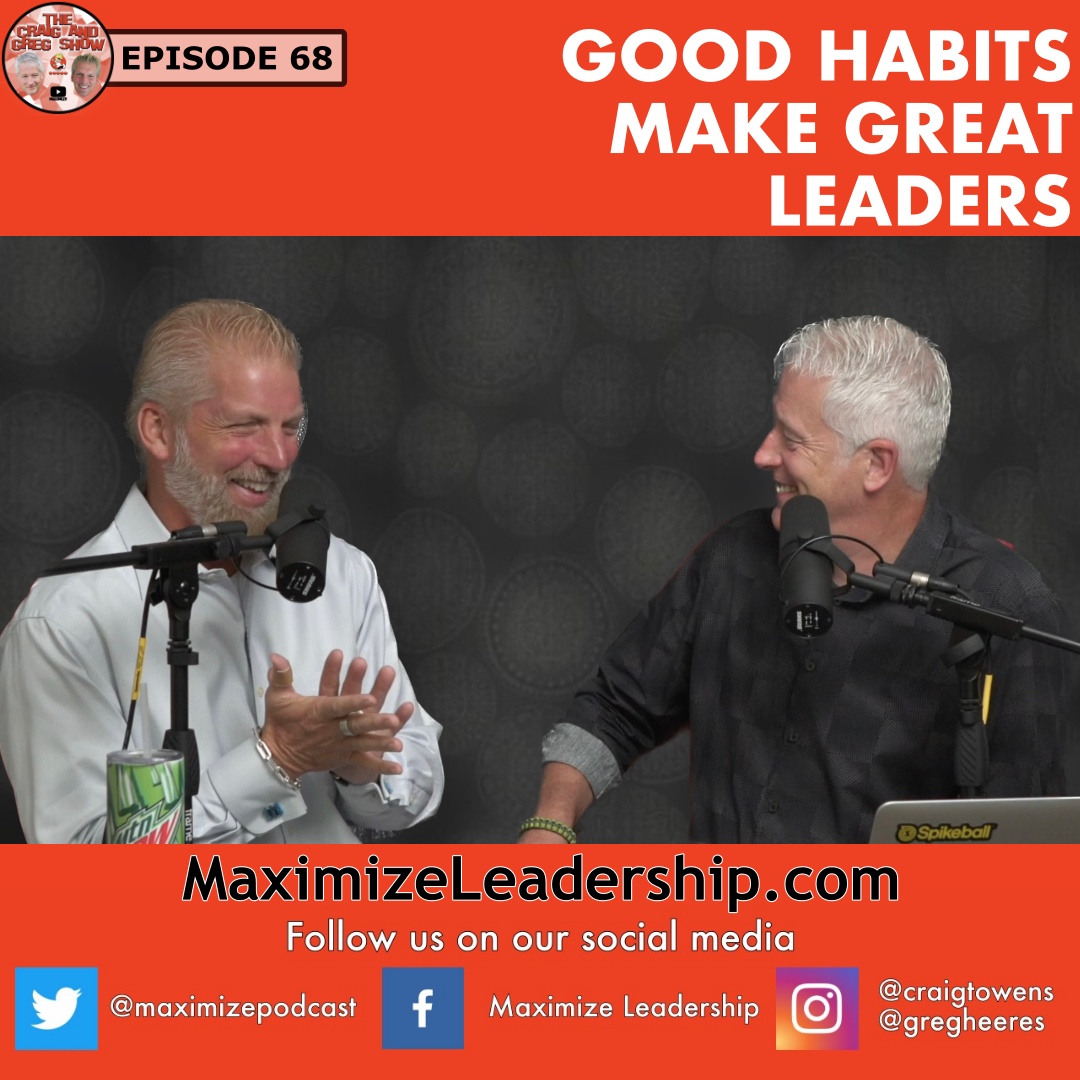
The Craig And Greg Show: Good Habits Make Great Leaders

Listen to the audio-only version of this podcast by clicking on the player below, or scroll down to watch the video.

Automatic habits are an integral part of our everyday lives. From driving a car to the way we tie our shoes, these habits help us all the time with very little thought. Of course, habits aren’t limited to these mundane tasks, we also form them in other areas, like our leadership. As a leader, it’s important to be self-reflective of our habits and make sure they are taking us in the direction we want to go. In this episode, Greg and I discuss how cultivating the right habits will help you flourish as a leader.

  • [0:19] Aristotle said excellence is a matter of our habits. 
  • [1:27] Our habits are mostly automatic—both the good and the bad habits.
  • [3:10] How do we keep our habits healthy during chaotic times?
  • [5:54] What about coping habits—should a leader use them or avoid them?
  • [7:15] My most beneficial leadership habit.
  • [9:13] Time-wasters are habits too.
  • [10:37] When we make changes in our habits, they should be incremental changes.
  • [12:17] We need to know why we want to make the change in a habit. The “why” determines the “what” and the “how.”
  • [15:24] How do leaders sustain their healthy habits?
  • [16:33] How can leaders regain their list momentum of good habits?
  • [19:27] Leaders need to be aware of the pull of their unintentional habits.
  • [22:23] How do we get our habits to serve us?
  • [23:30] I share two vital habits all high-performing leaders need.
  • [24:56] Leaders need to develop “muscle memory” to keep their healthy habits serving them.
  • [26:27] Greg shares some important quotes about a leader’s habits.

Check out this episode and subscribe on YouTube so you can watch all of the upcoming episodes. You can also listen to our podcast on Spotify and Apple.

Save Your Breath

Listen to the podcast of this post by clicking on the player below, and you can also subscribe on AppleSpotify, or Audible.

I know you want to lash out against those evil people who come at you—just to say something that will “put them in their place.” 

I get it. I feel like that at times too. 

But pause. 

Think about the last rain storm that came your way. The rain beat down on your roof and the wind blew against the walls of your house. You knew that there was no reason to yell at the rain because you were safe in your house. You also knew that yelling at the wind and the rain wouldn’t do a thing to it. 

Isaiah describes the breath of ruthless, wicked people as “a rain storm against a wall.” The wicked may rain on you, but you have an unshakable house.

Recall the words of Jesus—

Therefore everyone who hears these words of Mine and acts on them, may be compared to a wise man who built his house on the rock. And the rain fell, and the floods came, and the winds blew and slammed against that house; and yet it did not fall, for it had been founded on the rock. (Matthew 7:24-25)

When you abide in Jesus—when His words are the foundation of your life—you are safe and secure. There is no reason to fret about the breath of the ruthless, there is no reason to lash out at them. In fact, there might not be any reason to speak to them at all.

The stormy breath of the wicked will eventually give out. Their power has a limit. But you are secure inside the Limitless One, the Omnipotent One! The One who is eternal will never run out of strength and love for you. 

Let the evildoers rage, but you can save your breath. Instead of using your breath to respond to their howling words, use your breath to praise the One who holds you securely forever!

►► Would you please prayerfully consider supporting this ministry? My Patreon supporters get behind-the-scenes access to exclusive materials. ◀︎◀︎

Give Yourself Grace

Listen to the podcast of this post by clicking on the player below, and you can also subscribe on AppleSpotify, or Audible. 

If you are going to keep growing in a heathy way, you’re going to have to give yourself some more grace.

Check out this episode of The Podcast.

Resources mentioned in this video:

►► Would you please prayerfully consider supporting this ministry? My Patreon supporters get behind-the-scenes access to exclusive materials. ◀︎◀︎