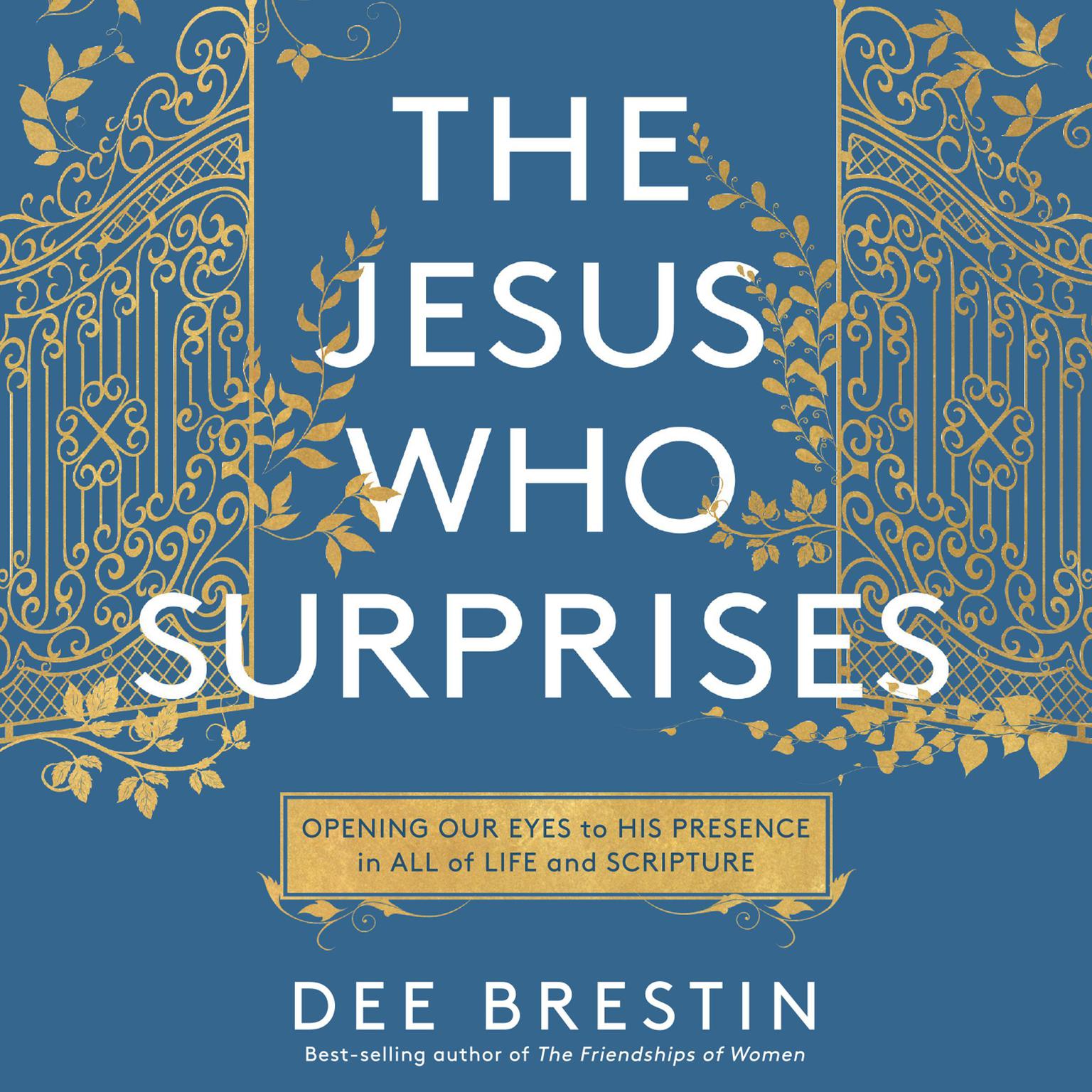
8 Quotes From “The Jesus Who Surprises”

Dee Brestin has given us an excellent “starter’s guide” to help you discover Jesus on every page of the Old Testament. Be sure to check out my full book review by clicking here. 

“Every time we sin, it is because we do not trust the goodness of God, so we endeavor to meet our needs our way.” 

“The blood of innocent lambs spills throughout the pages of the Old Testament but ceases when John the Baptist heralds Jesus as the Lamb of God. Jesus is the only Lamb who can take away our sins (Hebrews 10:4, 10). All other sacrificial lambs were simply a foreshadowing of the One to come.” 

“What satan wants to do is cause attachment disorder between God and us. … satan wants to convince us that God does not love us and does not want the best for us so that we will back away and stop talking to Him, throwing away our only lifeline.” 

“Think about what makes Jesus so angry over and over again—it is the pretense and dishonesty of the Pharisees. He is not angry with Job, Naomi, the prophets, or the psalmists who lament, and indeed He often comes running to them. But He is angry with the Pharisees. They put up a façade, a wall that keeps them from experiencing intimacy with the Lord, and one day He may surprise them by saying, ‘I never knew you; depart from Me’ (Matthew 7:23).” 

“Recording and retelling increases memory—memory that is sorely needed in times of trouble.” 

“God knows the shaking of our world can awaken us to understand what is transitory and what is eternal. If we press into Him, we will discover what can never be shaken.” 

“Prayer is not getting God to give you what you want but dialoguing with Him, listening to Him, submitting to Him, and asking Him to give you what He wants, even if it is costly.” 

“Love is not love if it is only grace. That is enablement.” 

The Jesus Who Surprises (book review)

Oswald Chambers wisely noted, “God did not give a progressive revelation of Himself through the Old Testament: the people progressively grasped the revelation, which is very different.” Jesus is all throughout the Old Testament, giving us ample opportunity to discover Him on every page. A helpful guide to get you started on this journey of discovery is The Jesus Who Surprises by Dee Brestin. 

Dee wrote that she was intrigued by Christ’s words to the questioning disciples walking the road to Emmaus on the morning of His resurrection. These men were having a hard time wrapping their minds around the report from eyewitnesses who said Jesus was alive! As Jesus walked with them (although unrecognized by them for the moment), Luke records, “And beginning with Moses and all the Prophets, He explained to them what was said in all the Scriptures concerning Himself” (Luke 24:27). 

The Jews divided their Scripture—the part we now refer to as the Old Testament—into three sections: the Law, the Writings (the poetic books), and the Prophets. In The Jesus Who Surprises, Dee divides her book into the same three sections, giving us samples of how Jesus surprises us in the pages of each section of the Old Testament Scripture. Each chapter concludes with a Bible study that can be done on your own, or in a small group setting. 

The two disciples on the road Jesus commented to each other later that they felt their hearts burning as Jesus revealed Himself all throughout the Scriptures. I pray that as you read The Jesus Who Surprises you will experience the same burning. Then I believe this book will start you on your own lifelong journey to read the Scriptures for yourself and see Jesus on every single page! 

I am a Multnomah book reviewer. 

The Nearness Of God

I think too often we’re in too big of a hurry when we read the Bible. 

Think with me for a moment how much longer it takes to sing the lyrics of a heart-stirring song than it does to just say the words. The psalms were written as songs, and although the melodies that accompanied them have been lost to the pages of history, we would still do well to move more slowly and deliberately and passionately through these inspired songs. 

Let’s slowly consider Psalm 46 from four different perspectives…

First, as a pause from the noise. Selah can be used three different ways: (1) a pause to reflect; (2) a deep breath to crescendo into something bigger; or (3) a contrast between two very different things. There are three selahs in this psalm, and all of them call us to a pause from something noisy. To pause from…

    • natural upheavals—the earth gives way, the mountains fall, the waters roar, the mountains quake
    • political upheavals—nations are in an uproar, kingdoms fall 
    • religious upheavals—God has to serve the judgment of desolation, as He breaks the bow, shatters the spear, burns the shield

Selah/Pause from these upheavals and reflect—God is our refuge … the Lord Almighty is with us.

Second, notice the contrasts. The songwriter takes us to man’s mountains that fall and quake, but reminds us that THE mountain of God is our sure fortress. In the imagery of water, we see man’s attempts at refreshing that are roaring and foaming, but we also see God’s river that brings life and makes people glad. And look at how man’s use of power results in an uproar, but God makes wars to cease. 

Selah/Pause and reflect—aren’t God’s ways better than man’s ways? 

Third, notice the nearness of God. Twice the songwriter reminds us “The Lord Almighty is with us.” And then we hear God Himself speak to our anxiety-prone hearts, “Be still and know that I am God.” Those words “be still” can also mean “let go.” Let go of earthly things, negative voices, fears, trying to control events. If your hands are full of that, how can you grab onto God?! 

Selah/Pause and reflect—God is calling me to go—and stay—near to Him! 

Fourth, see how God’s peace and protection surrounds AND permeates me. In our Western literature, we are used to the climax—or the payoff—being at the end of the story. The story builds and then comes to a conclusion where the hero prevails. But in Hebrew poetry, the climax—or the payoff—is typically in the middle. So when we read Psalm 46, it’s tempting to say, “Hallelujah! Verse 11 says God is my fortress. That’s the climax, the payoff!” But really the payoff—the most important part—is the middle. In this psalm, that is verse 6. Everything else builds to this and radiates out from this. 

Read this psalm for yourself by reading the verses in this order: 6, 5, 7, 4, 8, 3, 9, 2, 10, 1, 11.

Selah/Pause and reflect—God is not only IN me, He also surrounds me. I’m invited to come close to Him because He is already in me. Nations rage, but His voice in my heart silences the upheaval. He is with me. He is the Most High Sovereign God that controls the outcome of all nations. Earth quakes and kingdoms rumble, but I will have no fear; I will be still and know He is God. He is my refuge, my strength, my help, my fortress! 

Don’t rush the reading of the Psalms. Slowly “sing” these inspired lyrics and listen to how the Holy Spirit will whisper to your heart. 

I’ll be continuing our series on the Selahs in the Psalms this Sunday, and I would love to have you join me. 

Poetry Saturday—Walking With God

Alas, my God, that we should be
Such Strangers to each other!
O that as Friends we might agree,
And walk, and talk together!
Thou know’st my Soul doth dearly love
The Place of Thine Abode;
No Music drops so sweet a Sound,
As those two words, My God.

I long not for the Fruit that grows
Within these Gardens here;
I find no sweetness in their Rose
When Jesus is not near:
Thy gracious Presence, O my Christ
Can make a Paradise;
Ah, what are all the goodly Pearls
Unto this Pearl of Price!

May I taste that Communion, Lord,
Thy people have with Thee?
Thy Spirit daily talks with them,
O let it talk with me!
Like Enoch, let me walk with God,
And thus walk out my Day,
Attended with the Heavenly Guards
Upon the King’s High-way.

When wilt Thou come unto me, Lord?
O come, my Lord most dear!
Come near, come nearer, nearer still;
I’m well when Thou art near.
When wilt Thou come unto me, Lord?
I languish for Thy Sight;
Ten Thousand Suns, if Thou art Strange,
Are shades instead of Light.

When wilt Thou come unto me, Lord?
For, till Thou dost appear,
I count each Moment for a Day,
Each Minute for a Year.
Come, Lord and never from me go,
This World’s a darksome Place;
I find no Pleasure here below,
When Thou dost veil Thy Face.

There’s no such Thing as Pleasure here;
My JESUS is my All;
As Thou didst shine or disappear,
My pleasures rise and fall.
Come, spread Thy Savour on my Frame,
No sweetness is so sweet;
Till I get up to sing Thy Name,
Where all Thy Singers meet. —Thomas Shepherd

Thursdays With Spurgeon—Evidence Of Christian Maturity

This is a weekly series with things I’m reading and pondering from Charles Spurgeon. You can read the original seed thought here, or type “Thursdays With Spurgeon” in the search box to read more entries.

Evidence Of Christian Maturity

     One of the first evidences that anyone is a child of God is that he hates with a perfect hatred and seeks to live a holy, Christlike life. … 

     I bless God that I have learned to have very little respect for the vision of the man with the measuring line. When I see an angel with it, I am glad enough; but when I see a man with it, I tell him that he must give me a warrant from God and show me how he is to know the elect by any other method than that laid down by our Lord Jesus Christ: “Ye shall know them by their fruits” (Matthew 7:16). … 

     He who truly grows in grace does not say, “Dear me! I can feel that I am growing; bless the Lord! Let’s sing a hymn. ‘I’m a-growing! I’m a-growing!’” I have often felt that I was growing smaller; I think that is very probable, and a good thing, too. If we are very great in our own estimation, it is because we have a number of cancers, or foul gatherings, that need to be lanced, so as to let out the bad matter that causes us to boast of our bigness. 

From The Autobiography Of Charles Spurgeon 

Some Dos and Don’ts for Christian growth:

Do—hate those things that keep you from God’s presence
Do—seek to be conformed to the image of Jesus

Don’t—look at other people as your measuring line
Do—make sure your life is fruitful according to God’s standards

Don’t—brag about your growth
Do—humbly thank God for your growth
Do—be quick to repent of un-Christlike things the Holy Spirit reveals to you


Walk This Way

In his letter to the Christians in Ephesus, Paul uses the word “walk” seven times to instruct them how to follow the path Jesus laid down for us. 

In Greek, the word for “walks” (peripatēo) means something that regulates my life, or something that keeps me on the right path. It’s my lifestyle that is kept in proper boundaries by something outside of me. 

First of all, notice how Paul tells Christians how not to walk. DON’T WALK THIS WAY…

…following pop culture (2:2)—Living a certain lifestyle because “everyone” is doing it, or because some popular people are living that way. 

…without thinking about why you’re walking the way you are (4:17)

…without comparing your walk to truth (5:8)—Living a life because it feels good to me is a dangerous way to live. I must make sure there is an objective truth that is keeping me on a proper path.

…foolishly (5:15)—To be foolish is either (a) not knowing the truth, (b) not applying the truth I have been shown, or (c) choosing to disregard the truth I’ve been given. 

Instead, Paul tells Christians to WALK THIS WAY

…knowing I am God’s workmanship, created for a great purpose (2:10)—It may take me some time to discover my purpose and my talents, but I keep at it. 

…worthy of my vocation (4:1)—Once I have discovered my talents, I develop them into strengths that will benefit others. 

…lovingly (5:2)—Just as Jesus did! 

…in the light of God’s truth (5:8)—This is the exact opposite of foolishly walking. It means I seek the truth and I apply the truth to my life. 

…circumspectly (5:15)—Not wasting my moments, but making sure I am giving 100 percent every single day.

When I WALK THIS WAY people will inevitably notice that I’m motivated not by popularity with people, but by intimacy with God (5:2-7). They will see that my path is bordered by the principles in God’s Word (5:8-14; Psalm 119:105). And they will notice that my life has purpose and is productive (5:15-20). 

All Christians should ask themselves:

  • Is Jesus pleased with the path I’m on today?
  • Can others follow my footsteps toward their own relationship with Christ? 

If you can answer “yes” to those questions, then Jesus will be pleased that you WALK THIS WAY! 

[You can check out the Scriptures I referenced in this post by clicking on DON’T WALK THIS WAY and WALK THIS WAY above.]

Don’t Go—Flow

“…My time has not come…” —Jesus (John 7).

Jesus never rushed. He was never late. He was never early. Nor did He ever remain silent when He should have spoken. Nor did He ever misspeak. 

His timing and His wording were always spot on.

This wasn’t just a “Jesus thing,” as He told His followers that we could flow in God’s timing just as He was doing. 

We don’t have to try to figure out our timing or our wording by external standards (v. 24). But when we are so immersed in the same Holy Spirit that directed Jesus, we simply flow in His living water to where we need to be, when we need to be there. Whether it’s time to speak or time for silence, the Holy Spirit can again flow our thoughts and words perfectly. 

Others won’t understand. 

They have their own agenda, and they will want me to be a part of their plans (vv. 3-5, 18, 32-36, 42, 52). I must listen to the unmistakable voice of the Spirit and squelch the voices of the crowd. 

A mark of a godly leader is one who flows with the Spirit of God.

Don’t go with the flow of culture or others’ agendas. Don’t try to figure out where you need to be or what you need to say. Simply flow in the Spirit. Then your timing and your wording will be just as spot-on as Jesus showed us. 

This is part 38 in my series on godly leadership. You can check out all of my posts in this series by clicking here.

God’s Preference Is You

My dear friend Josh Schram relaunched our summertime series looking at the Selahs in the Psalms. “Selah” (or “Interlude” in some Bible translations) can mean either a time of reflection, a deep breath to go into something stronger, or a time to weigh the contrasts. 

Psalm 44 is a classic example of a Selah calling us to weigh the contrasts! The first 8 verses of this psalm celebrate the recollections of God’s past victories, declarations of God being our King, and crescendoing to a note of continual praise—O God, we give glory to You all day long and constantly praise Your name!

Then comes the Selah—pause. 

And after the pause, the scene turns dark. The psalmist now recounts how bad his situation is, descending to the low note of “we collapse in the dust, lying face down in the dirt” (v. 25). 

Josh reminded us how our preferences change over time. Consider the telephone—we’ve gone from push-button corded phones, to phones with longer cords, to cordless phones, to bulk bag phones, to smaller cell phones, to smartphones. It’s very human for our preferences to want more and better. 

But God’s preference never changes. God’s preference is YOU! 

He can never love you any more than He already does. Nor can He love you any less. 

The apostle Paul quotes Psalm 44:22—yet for Your sake we face death all day long; we are considered as sheep to be slaughtered—when he explains that absolutely nothing can separate us from God’s love (see Romans 8:31-39).

In marriage vows, we usually promise to love our spouse “for better or for worse, for richer or for poorer, in sickness or in health.” True love goes through it all! 

God’s love goes through it all with us. That’s why the psalmist’s last words are so hopeful: Rise up and help us; rescue us because of Your unfailing love. His unfailing love is our assurance of His presence and His ultimate rescue. Paul also reminds us “indeed we share in His sufferings in order that we may also share in His glory” (Romans 8:17). 

Josh said, “I want you to remember one thing: Nothing!” Nothing can separate you from God’s love. Ever!  

Hillsong United has some memorable words in their song Highlands—“I will praise You on the mountain, and I will praise You when the mountain’s in my way. … You’re the heaven where my heart is, in the highlands and the heartache all the same.” 

No matter what you’re facing, God’s preference is you. He loves you, and He wants you to grow closer to Him through this trial. Praise Him for His unfailing love on the mountain and in the valley, and then wait in eager expectation for Him to come to rescue you. 

Poetry Saturday—These Eyes Have Never Seen

Jesus, these eyes have never seen
that radiant form of Thine;
the veil of sense hangs dark between
Thy blessed face and mine.

I see Thee not, I hear Thee not,
yet art Thou oft with me;
and earth hath ne’er so dear a spot
as where I meet with Thee.

Yet, though I have not seen, and still
must rest in faith alone,
I love Thee, dearest Lord, and will,
unseen, but not unknown.

When death these mortal eyes shall seal,
and still this throbbing heart,
the rending veil shall Thee reveal
all glorious as Thou art. —Ray Palmer

Thursdays With Spurgeon—God’s Faithful Provision

This is a weekly series with things I’m reading and pondering from Charles Spurgeon. You can read the original seed thought here, or type “Thursdays With Spurgeon” in the search box to read more entries.

God’s Faithful Provision

     My witness is, and I speak it for the honor of God, that He is a good provider. … My first income as a Christian minister was small enough in all conscience, never exceeding forty-five pounds a year, yet I was as rich then as I am now, for I have enough; and I had no more cares, nay, not half as many then as I have now; and when I breathed my prayer to God then, as I do now, for all things temporal and spiritual, I found Him ready to answer me at every pinch, and for many pinches I have had. … My faith has been often tried, but God has always been faithful and sent supplies in hours of need. If any should tell me that prayer to God is a mere piece of excitement, and that the idea of God answering human cries is absurd, I should laugh the statement to scorn, for my experience is not that of one or two singular instances, but that of hundreds of cases in which the Lord’s interposition, for the necessities of His work, has been as manifest as if He had rent the clouds and thrust fourth His own naked arm and bounteous hand to supply the needs of His servant. 

From The Autobiography Of Charles Spurgeon 

I, too, can declare with Spurgeon how many times God has faithfully provided for us just in time. Every instance of true need has been met by miraculous provision as we have prayed to Him. 

It’s a lie to think that God doesn’t care about your need, or that He is too busy with bigger matters, or that He only helps those who help themselves. 

God loves to help those who cannot help themselves, so that He receives all of the glory. 

Do not be anxious about anything, but in every situation, by prayer and petition, with thanksgiving, present your requests to God (Philippians 4:6).