Valuing Life

SOHL“As surely as I valued your life today, so may the Lord value my life and deliver me from all trouble.” —David, in 1 Samuel 26:24

This is as strong of a pro-life statement as any in the Bible! 

The Hebrew word for value in this verse means…

  • to grow up
  • to become great or important
  • to do great things

Throughout the Old Testament this word is used to describe people growing from a small, infantile state to a place of maturity and prominence.

David held King Saul’s life in his hand. Since Saul was hell-bent on messing up David’s life (even killing him, if he could), we could say that David had plenty of rationale to justify ending Saul’s life. But David would not touch Saul because he recognized Saul’s God-given human dignity.

David asked God to value his life in the same way that David valued Saul’s life. Even Saul himself affirmed this when he said, “May you be blessed, my son David; you will do great things and surely triumph” (v. 25).

What if God only valued your life as much as you valued others’ lives? 

What if God only spoke up for you as much as you spoke up for the not-yet-born? 

What if God only blessed you as much as you blessed the aged and disabled? 

How much would your life be blessed by God?

Something to think about as we celebrate Sanctity of Human Life month. We will be honoring Sanctity of Human Life Sunday this week by bringing our donations for Alpha Family Center of Cedar Springs. I would love for you to join us!

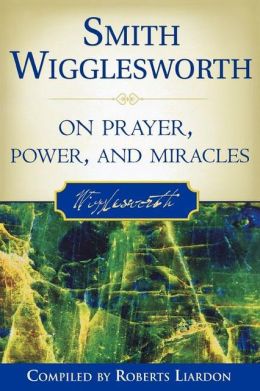
Smith Wigglesworth On Prayer, Power, And Miracles (book review)

Prayer, Power & MiraclesWhenever I need a booster shot of faith, or a challenge to believe God for even greater things, or just a unabashed reminder of the power of the Scriptures, I pick up a book by Smith Wigglesworth. By the time I got done reading Smith Wigglesworth On Prayer, Power, And Miracles compiled by Roberts Liardon I was totally fired up!

This book is a collection of sermons delivered by Wigglesworth and articles he authored for various Pentecostal publications. Every one of the chapters is simply saturated in Scripture and the anointing of the Holy Spirit! Each of the articles made we want to dig into the Bible more, believe God for more, and crave the empowerment of the Spirit more!

If you are tired of humdrum church-as-usual, or if you are ready for your faith to be stretched like it’s never been stretched before, pick up a copy of this book and strap yourself in. I promise that you will not think about the things of God the same after these messages have worked their way into your heart.

Promotion (book review)

PromotionFinding the right person to promote in your organization can be one of the most crucial decisions a leader has to make. It’s hard enough when the organization is a profit-driven one, but the stakes get elevated when a faith-based ministry is considering the eternal ramifications of its success. A book chock-full of helpful advice for making the right personnel decisions is Promotion by Rick Renner.

Rick is a successful pastor and ministry leader. He shares through his personal examples—both successful and not so successful—the principles he has learned. He is quick to point out that these principles are not because some people are more valuable than others, but because some people are ready for more responsibility and others are not. His list of promotion principles will help you, regardless of the type of organization you lead.

I found the scriptural principles Rick shared to be right on target, though I thought he tried to put too fine of a point on a few of them. In other words, some of his ideals are so high that hardly anyone may quality for promotion. I also found some of his personal stories to be a bit too much personal back-patting for my taste. Despite those two personal observations, I still found the material helpful.

A big thanks to my brother-in-love for putting this book in my hands.

The Prophet Almost Blew It

Jeremiah 33-3Samuel had anointed Saul to be the first king of Israel, but Saul’s disobedience led to God’s rejection of him as the king. God dispatched Samuel to anoint the next king of Israel, and that’s when Samuel almost blew it.

God knows what He’s doing. He has a purpose and a plan, and He invites us to be a part of it. So when God sent Samuel on his mission, He gave him very specific instructions, “I have chosen one of Jesse’s sons to be king. I will show you the one I have chosen” (1 Samuel 16:1-4).

That seems clear enough, but Samuel’s mistake is often our mistake: we think we can figure out what God is doing, and then we rush ahead of Him.

When Jesse’s oldest son Eliab appeared, he was a tall, handsome man. Samuel knew that the next king would be one of Jesse’s sons, and when he saw Eliab he thought to himself, “Surely this is the one” (v. 6). One problem: Eliab wasn’t the one.

God told Samuel, “You are looking with your eyes and can only see the things on the surface. I don’t look like you look; I see the way things really are” (v. 7). In other words, God has a discernment that we don’t have.

Here’s great news: God wants to give us His discernment! But we need to ask Him for it—

Call to Me and I will answer you and tell you great and unsearchable things you do not know. (Jeremiah 33:3, emphasis added)

One thing that stands out to me in this story is how many times it says, “The Lord said.” God is always speaking to us, but are we listening? If not, we’re missing out on His vital discernment.

There is an important link between reading the Bible and getting God’s discernment. That’s why the Bible is more than a Book to read, it’s a Book to pray! A.W. Tozer said it this way—

“To think God’s thoughts requires much prayer. If you do not pray much, you are not thinking God’s thoughts. If you do not read your Bible much and often and reverently, you are not thinking God’s thoughts.”

Don’t make the mistake that Samuel almost made. Read the Bible, pray the Bible, and you will be amazed at how much discernment God gives to you.

I will be continuing our series on prayer—If You Will Ask—this Sunday, and I hope you can join us!

15 Quotes From “Mansfield’s Book Of Manly Men”

Mansfield's Book Of Manly MenFrankly, fellas, there are just way too many passages I highlighted to share them all here, but I did want to give you a taste of some of the manly wisdom in Mansfield’s Book Of Manly Men. You can read my full book review by clicking here, but I suggest every red-blooded male who wants to be a manly man go get this book! You’ll be reading a lot more from me in the next few weeks that is inspired from this book.

“What makes a man a warrior is his willingness to place himself between what he holds dear and anything that threatens it. Honor is the chief motivator for the warrior. Dishonor is unthinkable. He does the right thing without expectation of reward because honor is an intrinsic value that, when manifested in one’s life, provides its own rewards.” —William Boykin

“By words like manly and manhood, I don’t mean the kind of behavior we see in the fake masculinity that surrounds us today. There’s nothing manly about a guy downing booze until he throws up in the street. There’s nothing manly about cruising for women like some predatory beast and then devouring them for pleasure before casting them aside. There’s nothing manly about making a child but then running like a coward before that child is born. There’s nothing manly about dominating a woman or treating her like a servant or leaving her with burdens that aren’t rightly hers. To think these actions make up true manhood is like thinking the average ‘gentleman’s club’ is actually for gentlemen. It’s not. Instead, it is a Palace of Perpetual Adolescence where incomplete males go to get on the cheap what they don’t have the guts to fight for righteously and make their own. … I am talking about the kind of manhood that makes a family whole, a woman safe, a child confident, and a community strong.” —Stephen Mansfield

“All it takes for a contagious manly culture to form is for one genuine man to live out genuine manhood. It creates a model, something for other men to feed upon and pattern themselves after. It also gives other genuine men a vital connection that sustains and extends who they are.” —Stephen Mansfield

“A man cannot fulfill his purpose if he is living for applause, approval, and affirmation in this world.” —Stephen Mansfield

“If a man does not have an ideal and try to live up to it, then he becomes a mean, base and sordid creature, no matter how successful.” —Theodore Roosevelt, in a letter to his son Kermit 

“Honorable men refuse to wallow in the small and the bitter. Honorable men refused to hate life because something once went wrong. Honorable men don’t build monuments to their disappointments, nor do they let others brand into them and curse them to their destruction. Honorable men seek out the highest definition of their lives, the nobler meaning granted by heritage, by their ancestors’ dreams and their parents’ hopes. Honorable man cry out to God until curses are broken and a grander purpose is achieved. Honorable man don’t settle for lives of regret.” —Stephen Mansfield

“Nothing great will ever be achieved without great men, and men are great only if they are determined to be so. For glory gives herself only to those who have always dreamed of her.” —Charles de Gaulle

“True friends stand in harm’s way for each other. True friends take the hits for one another. … Genuine men stand with their friends and look on the scars that result has signs of manly honor.” —Stephen Mansfield

“Weak men assume what they need to know will seek them out. Men of great character and drive search out the knowledge they need.” —Stephen Mansfield

“For a man to become a great man, he will have to defeat the force of bitterness in his life. No one escapes it. There is enough offense and hardship in the world to assure that all of us will be wounded and betrayed, all of us will have opportunity to drink the sweet-tasting poison of bitterness against those who have wronged us. The art of surviving untainted is to learn the art of forgiveness.” —Stephen Mansfield

“The question we all face is not whether or not we have defects. We do. Everyone of us. The question is whether we are capable of envisioning a life defined by forces greater than the weight of our flaws. The moment we can—the moment we can envision a life beyond mere compromise with our deformities—that is the moment we take the first steps toward weighty lives. Manly men know themselves, work to understand their God-ordained uniqueness and their unique brand of damage, and accept they will always be a work in progress, always be a one-man construction project that is never quite finished in this life. They don’t despair. They don’t settle. They don’t expect perfection of themselves. They understand that destiny is in the hand of God. They also understand that these destinies are fashioned in a man’s struggle against the enemies of his soul.” —Stephen Mansfield

“Every man must decide whether he will walk in the light of creative altruism or in the darkness of destructive selfishness.” —Martin Luther King Jr.

“Virtue is a state of war, and to live in it we have always to combat with ourselves.” —Jean-Jacques Rousseau

“Adversity toughens manhood, and the characteristic of the good or the great man is not that he has been exempt from the evils of life, but that he has surmounted them.” —Patrick Henry

“The man, whom I called deserving the name, is one whose thoughts and exertions are for others rather than himself.” —Walter Scott

Myth Buster

Dick BrogdenGuest Blogger: Dick Brogden

Currently there is an inordinate emphasis on size and speed when it comes to the development of the church. Church history soberly shows that orthodoxy tends not to spread as swiftly as heresy and that bad teaching outpaces good. It is the slow, steady repeated truth of God that builds the enduring church. The largest church at the end of the first century was found in Rome, thought by most scholars to be around two hundred members. The churches in Ephesus, Corinth, Philippi, Colosse, and Thessalonica (among others) were most probably between fifteen and fifty. The record of Acts takes place over about fifty years. Biblical precedent indicates that it takes about a generation to get a few churches to what we now consider modest size. One myth is that the church has to grow quickly; another that a strong church is a big church. The best churches tend to grow slowly and steadily, and the normal first century church comprised less than fifty people.

Disciples, too, are forged over time. If a church is but a collection of disciples, then it makes sense that strong churches require time to become solid. Another common myth today in mission is that all new disciples need is the Bible and the Holy Spirit. As appealing as this sounds, it has never been true in history, and if we are honest, it has not been true for any of us experientially. Consider how many books, sermons, mentors, friends, and external inputs help shape and form our spirituality over time. None of us grew to where we are without multiple sources of input over disparate seasons, all the input submitted to the authority of Holy Spirit and the Word. Biblically there always remains the need for an outside catalyst to help correct our biases and heresies. A group of people studying the Scriptures can just as easily end up pooling ignorance as illumining one another. Acts 15 is a classic example of ongoing external input necessary for the formation of strong disciples and churches. The negative example of external input (requiring circumcision) does not negate the massive, ongoing positive external input.

Paul and Barnabas report the wonderful turning of the Gentiles to Jesus. They also report the negative external pressure. James and the counsel respond by correcting the error and reinforcing what is necessary. In Acts 15:20, James delineates what they should not do–former religious forms and rituals. Paul reminds the council that coming to Jesus demands conversion (v. 3) and James cites Peter that the Gentiles must come out of false religion (v. 14). In Acts 15:32, Judas and Silas “exhort and strengthen the brethren with many words.” In verse 35, Paul and Barnabas teach and preach to the Gentiles and in verse 36, Paul and Barnabas commit to revisit their converts to ensure they are walking correctly. Disciples and churches are forged over time. Let us continue to believe that God will do great things and bring millions into His church. Let us continue to understand that it is slow, steady, life-on-life work to make disciples and build churches.

Mansfield’s Book Of Manly Men (book review)

Mansfield's Book Of Manly MenIn my experience, men today aren’t allowed to be true men, manly men. I’m sure there are a lot of reasons why (but that’s another subject for another time), but for those men who are yearning to be the manly men that God has created them to be, Mansfield’s Book Of Manly Men by Stephen Mansfield will make you jump up and growl!

Men are wired by God in a unique way that makes them, well, men. When men embrace their God-implanted uniqueness they become manly men (which is another way of saying God-honoring men) who are better husbands, fathers, friends, and citizens. Stephen Mansfield quickly outlines his four maxims for manly men, and then shares a list of manly qualities to which all manly men should strive.

Each of these manly qualities are introduced by the life story of a manly man from history’s pages. Mansfield presents these men in all their manliness, including both their strengths and weaknesses; there are no perfect men, but there are many real men from which Mansfield allows us to learn. These manly qualities also come with some real in-your-face challenges of how to assess the growth of that quality in a man’s life.

In the foreword, written by retired Lt. General William G. Boykin (himself a true manly man), is this challenge: “This book is a must read for every American male. We must restore the understanding of what it means to be a manly man. The nation’s future depends on getting back to the fundamentals of being men of courage and values.” I couldn’t have said it any better!

I am a Thomas Nelson book reviewer.

Thursdays With Oswald—Questions

This is a weekly series with things I’m reading and pondering from Oswald Chambers. You can read the original seed thought here, or type “Thursdays With Oswald” in the search box to read more entries.

Oswald Chambers

Questions

A series of questions Oswald Chambers asked his audience:

  • Can God do what He likes in your life? 
  • Can He help Himself liberally to you? 
  • Can He take you up and put you down? 
  • Can He introduce His schemes through you, and never tell you the reason why? 
  • Can He make you a spectacle to men and angels, as He did Job, without giving you any explanation? 
  • Can He make you a wonder to yourself and to others, while He gives you the implicit child-like understanding that somehow or other things are working out all right? 
  • Can it be said of us that Jesus so loved us that He stayed where He was because He knew we had a capacity to stand a bigger revelation? 
  • Are we making it easy for the Holy Spirit to work out God’s will in us, or are we continually putting Him on one side by the empty requests of our natural hearts, Christians though we be?”

From If Ye Shall Ask

Oswald Chambers was a big proponent of allowing the Holy Spirit to search and examine those who call themselves Christians. He believed the truthfulness of the statement, “The unexamined life is not worth living.”

My brother, my sister, can you allow God’s Spirit to test you with these types of questions? Are you willing to pray, as David did, “Search me, O God”? If you and I don’t allow the Holy Spirit to search us, how will we know if we are truly in the faith?

19 Quotes From “If Ye Shall Ask”

If Ye Shall AskA challenging and educational look at prayer from the unique perspective of Oswald Chambers is If Ye Shall Ask. You can read my book review of this book and another book on prayer Chambers wrote by clicking here. These are some of the quotes that I especially liked from this book.

“Prayer is not an interruption to personal ambition, and no man who is busy has time to pray. What will suffer is the life of God in him, which is nourished not by food but by prayer.”

“The purpose of prayer is to reveal the Presence of God, equally present at all times and in every condition.”

“Our Lord in His teaching regarding prayer never once referred to unanswered prayer; He said God always answers prayer.” 

“As long as we are self-sufficient and complacent, we don’t need to ask God for anything, we don’t want Him; it is only when we know we are powerless that we are prepared to listen to Jesus Christ and to do what He says.”

“If prayer is not easy, we are wrong; if prayer is an effort, we are out of it.” 

“If once we accept the Lord Jesus Christ and the dominion of His Lordship, then nothing happens by chance, because we know that God is ordering and engineering circumstances.”

“A thing is worth just what it costs. Prayer is not what it cost us, but what it cost God to enable us to pray. It cost God so much that a little child can pray. It cost God Almighty so much that anyone can pray.” 

“It is not a prayer that is strenuous, but the overcoming of our own laziness.”

“We must be in continual practice so that when we find ourselves in a tight place we are perfectly fit to meet the emergency.” 

“There is no such thing as a holiday for the beating of your heart. If there is, the grave comes next. And there is no such thing as a moral or spiritual holiday. If we attempt to take a holiday, the next time we want to pray it is a struggle because the enemy has gained a victory all around, darkness has come down and spiritual wickedness in high places has enfolded us. If we have to fight, it is because we have disobeyed; we ought to be more than conquerors.”

“God’s silences are His answers.”

“Can it be said of us that Jesus so loved us that He stayed where He was because He knew we had a capacity to stand a bigger revelation?”

“Some prayers are followed by silence because they are wrong, others because they are bigger than we can understand.” 

“Jesus Christ does not make monks and nuns, He makes men and women fit for the world as it is (see John 17:15).”

“God does not expect us to work for Him, but to work with Him.” 

“God will not leave us alone until we are one with Him, because Jesus has prayed that we may be.”

“A Christian’s duty is not to himself or to others, but to Christ. We think of prayer as a preparation for work, or a calm after having done work, whereas prayer is the essential work. It is the supreme activity of everything that is noblest in our personality.”

“As long as we get from God everything we ask for, we never get to know Him, we look upon Him as a blessing-machine, that has nothing to do with God’s character or with our characters. … Then why pray? To get to know the Father.”

“All other fields have the glorious but risky snare of publicity; prayer has not.”

Yahweh Vs. Polytheism

I have been reading through the Bible chronologically for awhile now using The Archeology Study Bible, and I am really enjoying the new insights into Scripture that I am gaining.

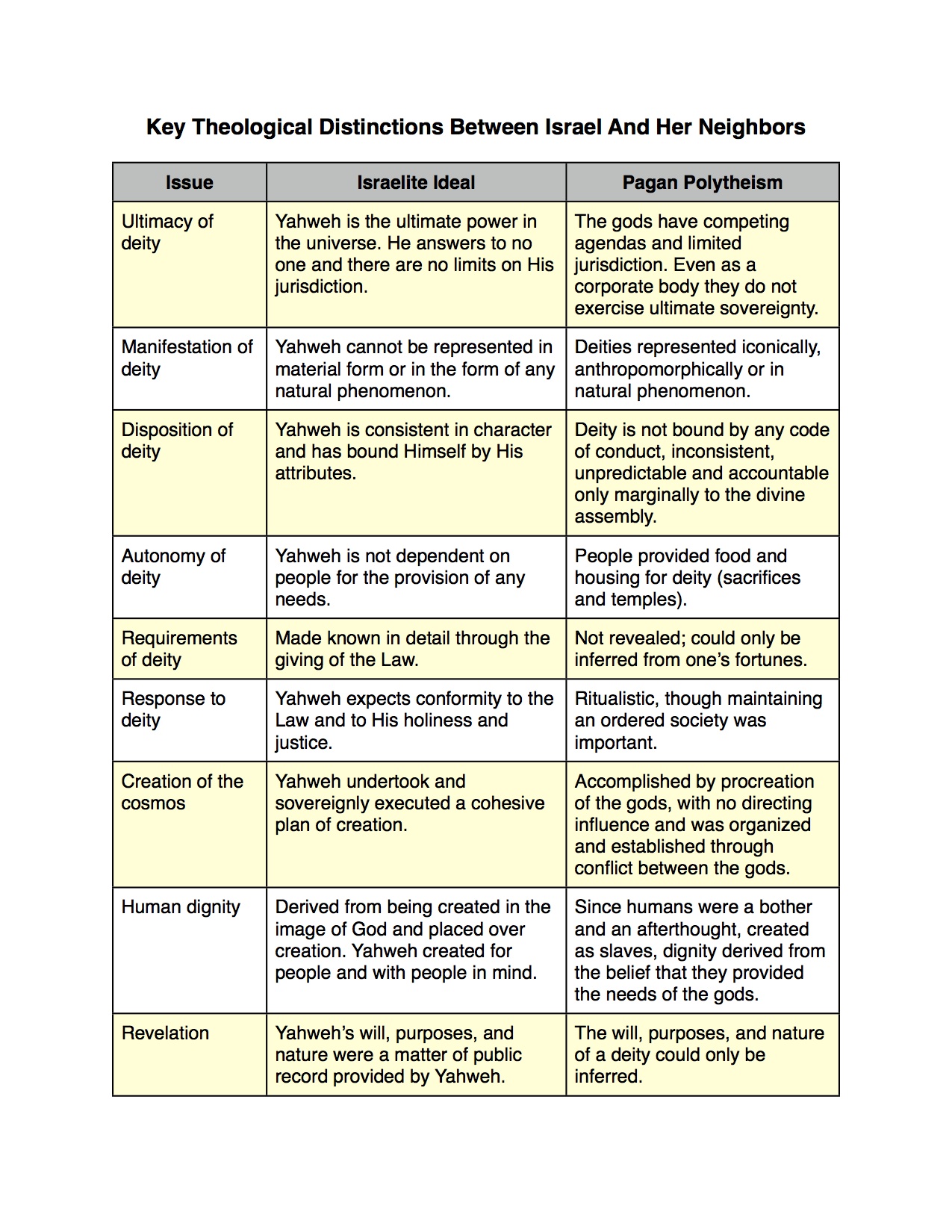
A couple of weeks ago I saw this chart (on page 408) contrasting the monotheistic characteristics of the one true God (Yahweh) with the polytheistic characteristics which the nations surrounding Israel adhered to. It’s quite a fascinating contrast!

Theological difference between Israel and others

(Click the image to see a larger view, or download a PDF version here → Theological difference between Israel and others. Or better yet, purchase a copy of this amazing study Bible for your own use.)

The monotheistic worldview presented in the Bible is the only worldview which makes the most sense of the universe in which we live. Therefore, the Bible is the filter through which I process all of the other books I read.