Am I The Genuine Article?

Examine and test and evaluate your own selves to see whether you are holding to your faith and showing the proper fruits of it. Test and prove yourselves… (2 Corinthians 13:5). 

The root word for discern in the New Testament Greek is dokimazō. This word means to examine something—scrutinize it closely—to see if it is genuine. We’re instructed to take a close, scrutinizing look at…

  • …our beliefs about God (Romans 1:28)
  • …our understanding of God’s will for our lives (Romans 12:2)
  • …our relationship with God and others (1 Corinthians 11:28) 
  • …our faith (2 Corinthians 13:5)
  • …our motives (2 Thessalonians 2:4)
  • …the teaching we are listening to (1 John 4:1) 

In his book Romans: God’s Glory, Donald Grey Barnhouse discussed the root word for discern (the Greek word dokimos). He said, 

“In the ancient world there was no banking system as we know it today, and no paper money. All money was made from metal, heated until liquid, poured into moulds and allowed to cool. When the coins were cooled, it was necessary to smooth off the uneven edges. The coins were comparatively soft, and of course many people shaved them closely. In one century, more than eighty laws were passed in Athens to stop the practice of whittling down the coins then in circulation. But some money-changers were men of integrity, who would accept no counterfeit money; they were men of honour who put only genuine, full-weight money into circulation. Such men were called dokimos, and this word is used here for the Christian as he is to be seen by the world.” (emphasis mine)

This should be said of every Christian: “They are dokimos—men and women who are honorable and are the real deal. They don’t shave anything off; they don’t water anything down. They can be scrutinized closely and found to be the genuine article.” 

The Bible makes it clear that before the world can call us dokimos, the Holy Spirit first has to stamp that word on us. It’s only after we have allowed Him to scrutinize (and correct) our beliefs, relationships, faith, and motives that we can be labeled dokimos. When we are the real deal in His presence, the world cannot help but see the genuine article when they examine us. 

Let’s live this way! May both God and the watching world be able to call us dokimos! 
Saturday In The Proverbs—Backfire! (Proverbs 26)

[Each chapter in the Book of Proverbs contains thoughts that fit into a theme; they are not just random thoughts gathered together. In this “Saturday In The Proverbs” series, I will share a theme that I see in each chapter. But the cool thing about God’s Word is that you may see an entirely different theme. That’s great! If you do, I would love for you to share it in the comments below.]

…honor is not fitting for a fool (Proverbs 26:1).

However well-intentioned, there are some things guaranteed to backfire. Things like…

… honoring a fool (vv. 1, 8)

… trying to curse or bring down a good man (v. 2)

… letting a fool roam without restraint (v. 3)

… trying to reason with a fool (vv. 4, 5)

… trusting an untrustworthy man to deliver a message accurately (v. 6)

… allowing a fool to teach others (vv. 7, 9)

… not letting a fool learn from the consequences of his foolishness (vv. 10-12)

… entrusting a lazy man with an important task (vv. 13-16)

… meddling in someone else’s quarrel (v. 17)

… inappropriate joking (vv. 18, 19)

… gossiping (vv. 20-22)

… judging by outward appearances (vv. 23-26)

… trying to entrap someone (v. 27)

… lying and flattery (v. 28)

Stay clear of these guaranteed-to-backfire traps! 

Mark Mittelberg On What Is Faith

Today's Moment Of Truth“No doubt about it. You live your life by faith every day, even in the mundane details. What is faith? My broad definition is beliefs and actions that are based on something considered to be trustworthy—even in the absence of absolute proof.

“You believed the food was safe, so you ate it; you trusted the chair would hold you, so you sat in it; you had luck in the past with computers, random canines, and commutes home—so why not try them again? You didn’t have conclusive evidence that any of these things would workout, but the odds seemed to be in your favor, so you went for it. All of us do similar things—routinely.

“But also in the bigger issues related to religion, God, and eternity. All adopt ‘beliefs and actions’ related to these areas ‘based on something considered to be trustworthy—even in the absence of proof.’ So if you are a Christian, you’re trusting in the teachings of Christ; if a Muslim, you’re trusting in the teachings of Mohammad; if a Buddhist, you’re trusting in the teachings of Buddha.

“Even nonreligious people live in the trust that their nonreligious beliefs are accurate and that they won’t someday face a thoroughly religious Maker who actually did issue a list of guidelines and requirements that they failed to pay attention to.” —Mark Mittelberg, in Today’s Moment Of Truth

Poetry Saturday—The Time For Faith To Shine

F.B. Meyer

When nothing on which to lean remains,
   When strongholds crumble to dust;
When nothing is sure but that God still reigns,
   That is just the time to trust.

It’s better to walk by faith than sight,
  In this path of yours and mine;
And the darkest night, when there’s no outer light
   Is the time for faith to shine. —F.B. Meyer

Is Christ Real To Me?

John WesleyJohn Wesley was deeply introspective about his faith in Jesus Christ. He once wrote—

“I did go thus far for many years…using diligence to eschew all evil, and to have a conscience void of offense; redeeming the time; buying up every opportunity of doing all good to all men; constantly and carefully using all the public and all the private means of grace; endeavoring after a steady seriousness of behavior, at all times, and in all places; and, God is my record, before Whom I stand, doing all this in sincerity; having a real design to serve God; a hearty desire to do His will in all things; to please Him who had called me to ‘fight the good fight,’ and to ‘lay hold of eternal life.’ Yet my own conscience beareth me witness in the Holy Ghost, that all this time I was but almost a Christian.”

To help keep himself on the right path, Wesley came up with this list of questions he regularly asked himself. This is a list any Christian would do well to read through regularly—

  1. Am I consciously or unconsciously creating the impression that I am better than I am? In other words, am I a hypocrite?
  2. Am I honest in all my acts and words, or do I exaggerate?
  3. Do I confidentially pass onto another what was told me in confidence?
  4. Am I a slave to dress, friends, work, or habits?
  5. Am I self-conscious, self-pitying, or self-justifying?
  6. Did the Bible live in me today?
  7. Do I give it time to speak to me everyday?
  8. Am I enjoying prayer?
  9. When did I last speak to someone about my faith?
  10. Do I pray about the money I spend?
  11. Do I get to bed on time and get up on time?
  12. Do I disobey God in anything?
  13. Do I insist upon doing something about which my conscience is uneasy?
  14. Am I defeated in any part of my life?
  15. Am I jealous, impure, critical, irritable, touchy or distrustful?
  16. How do I spend my spare time?
  17. Am I proud?
  18. Do I thank God that I am not as other people, especially as the Pharisee who despised the publican?
  19. Is there anyone whom I fear, dislike, disown, criticize, hold resentment toward or disregard? If so, what am I going to do about it?
  20. Do I grumble and complain constantly?
  21. Is Christ real to me?

Links & Quotes

link quote

“I have learned now that while those who speak about one’s miseries usually hurt, those who keep silence hurt more.” —C.S. Lewis

“Jesus spilled His blood for you. You can spill your heart before God.” —Max Lucado

“Too often, when issues of sexual abuse come up, the Church simply stays silent. But a Gospel-centered response to sexual violation of anyone at any age begins with understanding that silence is not an option.” Read more in The Scandal Of Silence.

An abortion clinic in Michigan was shut down for numerous health and safety violations, but now it appears it may re-open.

[VIDEO] Here’s the truth of what abortion providers do—

Eric Metaxas shares the really cool story behind the Navy Hymn.

“You can be saved, Spirit-filled, and walking holy before God, yet still be guilty of unbelief. You may think, ‘I don’t have any unbelief.’ But do you get upset when things go wrong? Are you fearful of failing God? Are you restless, afraid of the future? The believer who has unconditional faith in God’s promise enjoys complete rest. What characterizes this rest? A full, complete confidence in God’s Word, and a total dependence on His faithfulness to that Word. Indeed, rest is the evidence of faith.” —David Wilkerson

Seth Godin discusses what starts to happen when our expectations slip.


Links & Quotes

link quote


“The way to thwart the devil is to strengthen the very thing he is trying most to destroy—your faith.” —John Piper

“O blessed hurricane that drives the soul to God and God alone! … And now you have nothing but your God to trust to, what are you going to do? To fret? To whine? O, I pray you, do not thus dishonor your Lord and Master! Now, play the man, play the man of God. Show the world that your God is worth ten thousand worlds to you. Show rich men how rich you are in your poverty when the Lord God is your helper. Show the strong man how strong you are in your weakness when underneath you are the everlasting arms. Now man, now is your time to glorify God.” —Charles Spurgeon

“When it comes to a question of our forgiving other people, it is partly the same and partly different [from asking God to forgive us]. It is the same because, here also, forgiving does not mean excusing. Many people seem to think it does. They think that if you ask them to forgive someone who has cheated or bullied them you are trying to make out that there was really no cheating or no bullying. But if that were so, there would be nothing to forgive. They keep on replying, ‘But I tell you the man broke a most solemn promise.’ Exactly: that is precisely what you have to forgive. (This doesn’t mean that you must necessarily believe his next promise. It does mean that you must make every effort to kill every taste of resentment in your own heart—every wish to humiliate or hurt him or to pay him out.) The difference between this situation and the one in which you are asking God’s forgiveness is this. In our own case we accept excuses too easily; in other people’s we do not accept them easily enough.” ―C.S. Lewis, in Weight Of Glory

“Forgiveness is not foolishness. Forgiveness, at its core, is choosing to see your offender with different eyes. By the way, how can we grace-recipients do anything less? Dare we ask God for grace when we refuse to give it?” —Max Lucado

“Money is the currency of human resources. So the heart that loves money is a heart that pins its hopes, and pursues its pleasures, and puts its trust in what human resources can offer. So the love of money [1 Timothy 6:10] is virtually the same as faith in money—belief (trust, confidence, assurance) that money will meet your needs and make you happy.” —John Piper

“When the devil throws our sins up to us and declares that we deserve death and hell, we ought to speak thus: ‘I admit that I deserve death and hell. What of it? Does this mean that I shall be sentenced to eternal damnation? By no means. For I know One who suffered and made satisfaction in my behalf. His name is Jesus Christ, the Son of God. Where He is, there shall I be also.’” ―Martin Luther

Really proud to see how my fellowship, The Assemblies of God, is helping those with mental diseases.

What emotions pop up when someone says to you, “Can we talk about this?” Seth Godin has some helpful thoughts on this.

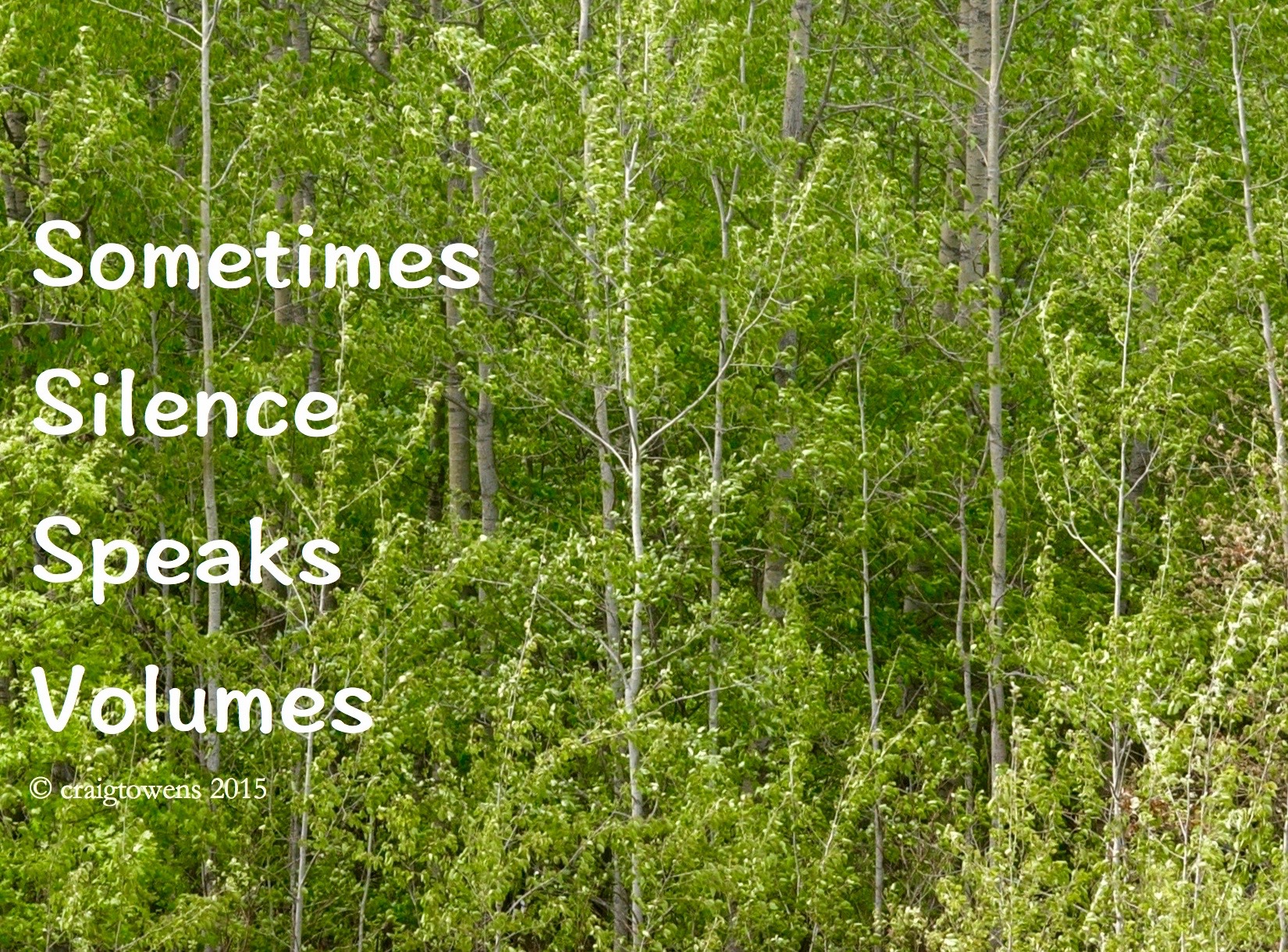
Sometimes Your Silence Says A Lot

Silence speaks“Pilate [knew] it was out of envy that the chief priests had handed Jesus over to him” (Mark 15:9, 10).

There was no credible evidence against Jesus, and Pilate knew it! Yet, “wanting to satisfy the crowd, Pilate released Barabbas to them. He had Jesus flogged, and handed Him over to be crucified” (v. 15). Even without evidence, Pilate was still swayed by the noise of the crowd.

How eerily similar to our culture today: Noise trumps evidence; emotions trump facts; the “popular crowd” gets their way.

It was not Christ’s words at this time—but His silence—that had the lasting impact. He did not try to defend Himself of the false charges before Pilate, but committed Himself to God (John 19:11; Luke 23:46). It was this that both amazed Pilate (Mark 5:5), and prompted the centurion to say, “Surely this Man was the Son of God!” (v. 39).

When I simply share the gospel, God will confirm His Word with miracles (Mark 16:20). I don’t need to match volume levels with the crowd, nor sink to their base rhetoric, nor defend myself—I commit myself to my God and His directive for me to be His witness (16:15). He will take care of the results!

Don’t Misuse God’s Name

Representing God's nameYou’ve heard the old nursery rhyme: Sticks and stones may break my bones but words will never hurt me. We all know this isn’t true: words do hurt, and names that people call us may leave lasting wounds.

Words and names are important to God. God used His word to create the universe (God said, “Let there by light”); Jesus was called The Word (see John 1:1); God has named people and even renamed them to reflect their character or destiny.

The most important name of all is God’s own name, so the Third Commandment says, “You shall not misuse the name of the LORD your God…” (Exodus 20:7). How can we misuse God’s name? There are five ways—

(1) As emptiness or nothingness

  • Are our words empty? Do we use filler phrases like “Oh my God!” that neither talk to Jehovah or about Jehovah? We shouldn’t use God’s name unless we’re talking to Him or about Him in a respectful way.

(2) In vanity

  • In reality this means calling ourselves a Christian, but speaking in an un-Christlike way.
  • “Giving God a ‘bad name’ might diminish or demolish people’s belief, respect, and awe for God, a tragedy for a world that needs holiness. … It is a major responsibility to represent God; one which should not be taken lightly.” —Dr. Laura Schlessinger

(3) Being insincere

  • Are our promises empty, or is our word our bond? If we have to use phrases like “I swear to God that I will…” then that means we cannot be trusted on our own merits. When we claim to be Christians but cannot be trusted, we undermine the trustworthiness of God in the minds of other people.
  • “The godly man, therefore, will make promises cautiously but keep them conscientiously once they are made, knowing that irresponsibility and unreliability here are great and grievous sins.” —J.I. Packer

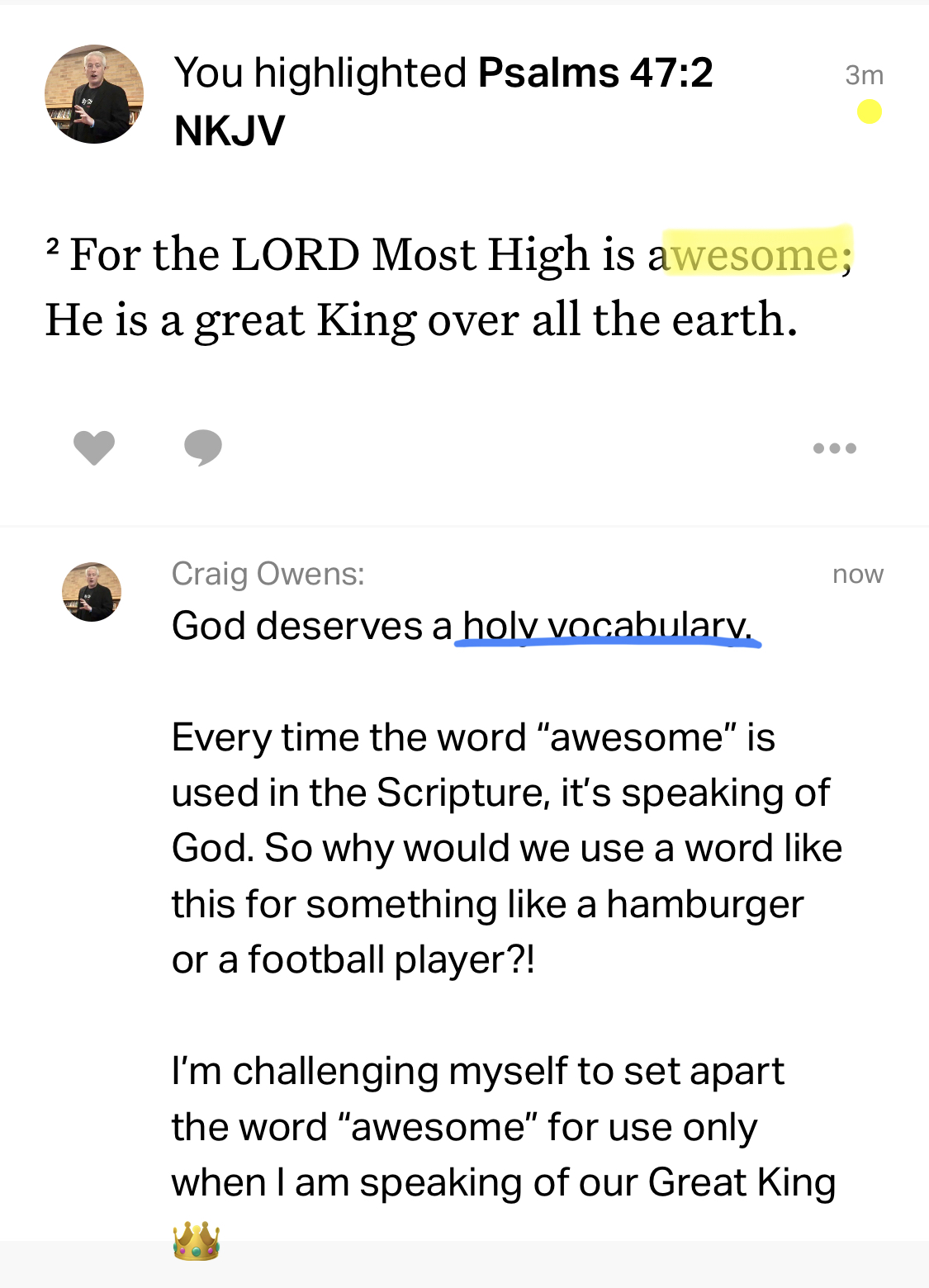
(4) Having an unholy vocabulary

  • Holy means something set apart for a special use. Perhaps there are words we use to describe God that we are also using for lesser things. It might be good to listen to how the Holy Spirit would challenge us to have a unique vocabulary to talk to or about our unique God.

(5) Worthlessness of conduct

  • As the cliche goes, “What you do speaks so loudly that I cannot hear what you are saying.” So we need to make sure that we both talk like Jesus talked and live like Jesus lived.

Anything less than these standards just may be misusing God’s holy name and character by misrepresenting Him or giving Him a “bad name.” What do you think?

If you have missed any of the messages in our series The Love In The Law, you can find them all by clicking here.

Signing A Blank Check

In our current series on prayer, we’re using the prayer that Jesus taught as our pattern. Yesterday we looked at this part of the pattern:

Your kingdom come, Your will be done on earth as it is in heaven.

This is all about trust. It’s about acknowledging to God that He is in control and He knows what’s best. It’s not about me coming into His presence and telling Him how things should work. I love the quote from C.S. Lewis:

There are two kinds of people: those who say to God “Thy will be done” and those to whom God says, “All right then, have it your way.”

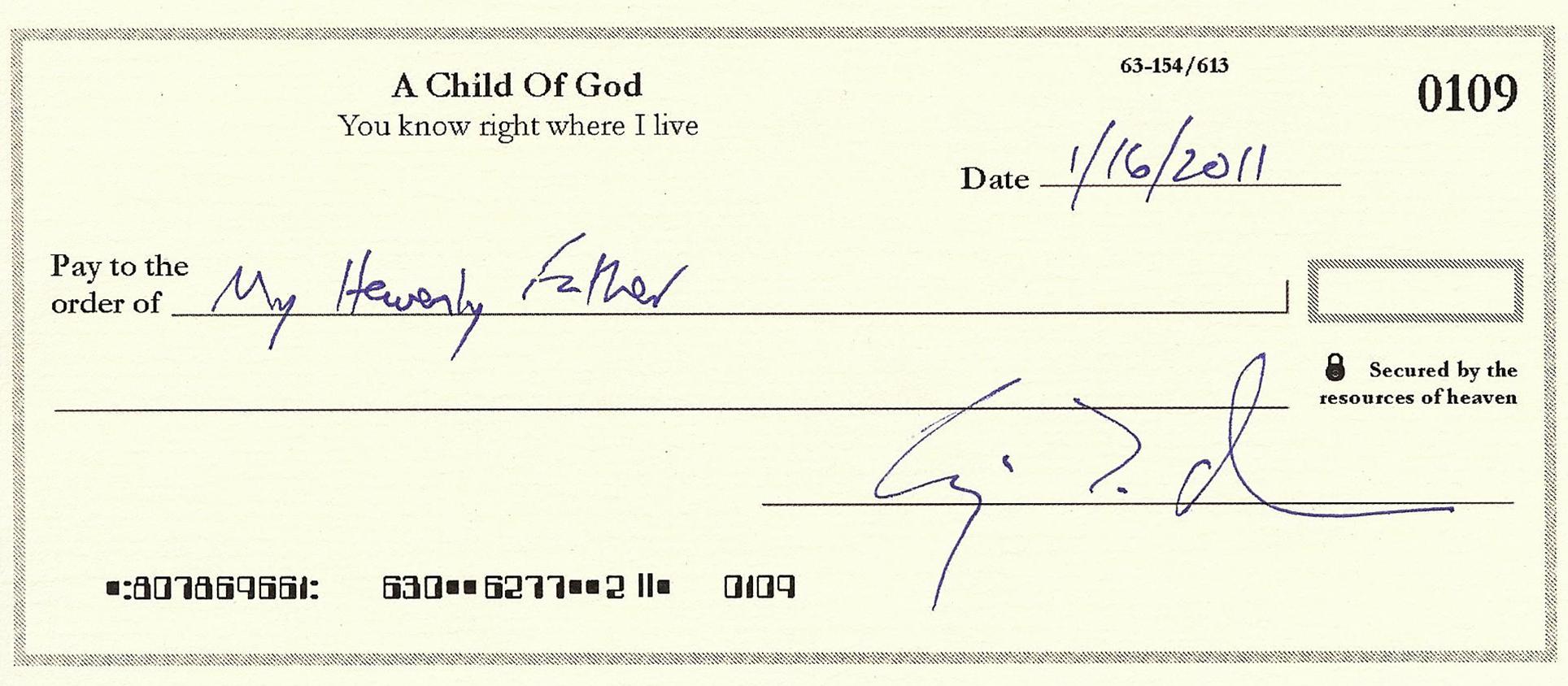
When we come into God’s presence in prayer, we say, “Before I ask You for what I need, I want You to know that I trust You. No matter what.” In essence, we sign a blank check and trust God to fill in the amount.

And, by the way, the verb for “Your kingdom come” in this model prayer is an imperfect verb. That means that we have to keep on signing those blank checks, as we keep on submitting to His will and His kingdom.

Are you willing to sign a blank check to God?