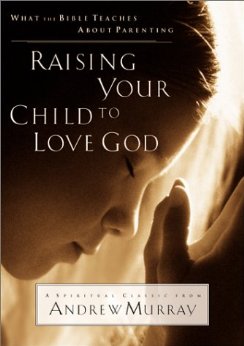
 It’s a book I called a “must read for all parents” (you can read my full book review by clicking here). After typing up my notes of all the quotes I highlighted in this book, I ended up with 18 pages of notes, so these quotes from Andrew Murray’s book are, in my opinion, the cream of the crop. Tomorrow I will share some of the prayers Murray offered in his book.
“Example is better than precept. … Love that draws is more important than law that demands. … Let parents be what they want their children to be.”
“How terrible is the curse and power of sin! Through the father the child becomes a partaker of the sinful nature, and the father so often feels himself too sinful to be a blessing to his child; thus the home becomes a path to destruction rather than to eternal life. But—blessed by God!—what sin destroyed, grace restores. … Let God’s Father-heart and His Father-love be your confidence. As you know and trust Him the assurance will grow that He is fitting you for making your home, in ever-increasing measure, the bright reflection of His own.”
“God seeks a people on earth to do His will. The family is the great institution for this object; a believing and God-devoted father is one of the mightiest means of grace.”
“What God says of Abraham gives us further insight into the true character of this grace: ‘For I have chosen him, so that he will direct his children and his household after him to keep the way of the Lord.’ The spirit of modern so-called liberty has penetrated even into our family life; and there are parents, who some from a mistaken view of responsibility, some from lack of thought as their sacred calling, somer from love of ease, have no place for such a word as ‘command.’ They have not seen the heavenly harmony between authority and love, between obedience and liberty. Parents are more than friends and advisers; God has clothed them with a holy authority to be exercised in leading their children in the way of the Lord.”
“Oh that Christian parents would realize, just as Judah did, what it means to stand in that place for their child! How often—when our children are in danger because of the prince of this world, when the temptations of the flesh or the world threatened to make them prisoners and slaves, holding them back from ever reaching the Father’s home—are we found careless or unwilling to sacrifice our ease and comfort in order to rescue them!”
“Oh, that the eyes of God’s people might be opened to the danger that threatens the church! It is not infidelity or superstition, it is the spirit of worldliness in the homes of Christian families, sacrificing the children to the ambitions of society, to the riches or the friendship of the world—that is the greatest danger of Christ’s church. If every home once won for Christ were a training school for His service, we would find in this a secret of spiritual strength no less than all that ordinary preaching can accomplish.”
“With a parent’s love comes a parent’s influence. … The character of a child is formed and molded by impressions; continual communion with the parent can render these impressions deep and permanent. The child’s love for a parent rises to meet the parent’s love.”
“The first four commandments have reference to God, the last five to our neighbor. In between stands the fifth. It is linked to the first four because to the young child the parent represents God; from him the child must learn to trust and obey God. And this command is the transition to the last five because the family is the foundation of society, and there the first experience comes of all the greater duties and difficulties with humankind at large.”
“The child can only honor what he sees to be ‘worthy of honor.’ And this is the parent’s high calling: always so to speak and act, so to live in the child’s presence, that honor may be spontaneously and unconsciously rendered. … Above all, let parents remember that honor comes from God. Let them honor Him in the eyes of their children, and He will honor them there too.”
“There is nothing that drive home the word of instruction as powerfully as a consistent and holy life. … The entrance of divine truth into the mind and heart, the formation of habits and the training of character—these are not attained by sudden and isolated efforts, but by regular and unceasing repetition.”
“Love knows no sacrifice, counts nothing a burden; love does not rest until it has triumphed.”
“We don’t want to be just another family with whom God dwells and is pleased. Ours must be wholly consecrated to God. And do not be afraid that strength will not be given to keep the vow. It is with the Father in heaven, calling and helping and tenderly working both to will and to do in us, that we are working.”
“We need renewed wisdom directly from above for the individual needs of each child. Daily prayer is the secret of training our children for God. … Those who have already communicated with God and received divine teaching about their children will be those who desire still more and pray earnestly for it.”
“Nothing open the fountains of divine love and renewed love for each other more than the prayerful desire to know how to raise our children to love God.”
“Not to restrain a child is to dishonor God and the child.”
“My duty is never measured by what I feel is within my power to do but by what God’s grace enables me to do.”
“Every thoughtful parent knows that there are times and places when the temptations of sin will be more apt to surprise even the most well-behaved child. Such are the times, both before and after the child goes into a situation or circumstance where he may be tempted, that a praying father and mother should do what Job did, bring the children before God in repentance and faith and where possible to confront them with questions concerning their behavior.”
“Let us ask God to make us very watchful and very wise in availing ourselves of opportunities to admonish our children and to pray audibly with them.”
“In our family’s life, the first thing of importance must not be our earthly happiness, or even the supply of our daily needs, nor seeing to the child’s education for a life of prosperity and usefulness, but rather the yielding of ourselves to God in order to be conveyors of His grace and blessing to our children. Let us live for God’s purpose: deliverance from sin. Thus our family life will forever be brightened with God’s presence and with the joy of our heavenly home to come, of which our earthly one is by the nursery and the image.”
“‘The children of Your servants will live in Your presence; their descendants will be established before You’ (Psalm 102:25-28). Death may separate one generation from another, but God’s mercy connects them as it passes on from one to another; His righteousness, which is everlasting, reveals itself as salvation from generation to generation. … It is God’s will that His salvation should be known from generation to generation in your family too, that your children should hear from you and pass on to their children the praises of the Lord.”
“God’s purpose is that the Holy Spirit should take possession of our sons and daughters for His service; that they should be filled with the Holy Spirit, consecrated for service. They belong to Him and He to them.”
“Jesus desires that we rise above the experiences of fatherhood on earth to know more deeply the Father in heaven.”
“The earthly father must not only make the Father in heaven his model and guide, but he must so reflect Him that his child will naturally desire to emulate the One whom he so aptly represents. … In a Christian father a child ought to have a better picture than the best of sermons can give of the love and care of the heavenly Father and all the blessing and joy He wants to bestow.”
“If we are to watch over the heavenly quality of our children, we must ourselves be childlike and heavenly-minded. … Children lose their childlikeness all too soon because parents have so little of it.”
“Fathers, you have sons whom you would fain bring to Jesus to be saved, come and hear the lessons the Lord would teach you. Let these children first send you to Jesus in confession, prayer, and trust; your faith can bring them in.”
“Your motherhood is in God’s sight holier and more blessed than you realize.”
“The effect of the good advice parents give is more than neutralized by their own behavior.”
“A child should never be allowed to feel that his immaturity is not taken into account, that his young reasoning is not regarded, that he has not received empathy, or help, or justice that he expects. This will take a kind of love and thoughtfulness that parents are all too short of.”
“If you feel that you do not know how to teach the Word to them, to make it interesting or exciting for them, take heart—God will make it come alive to them if you are faithful to read it and live it.”
“I am the giver of their physical life, the framer of their character, the keeper of their souls, the trustee of their eternal destiny. I was first blessed that I may bless them, first taught how my Jesus loved me and gave Himself for me that I may know how to love and how to give myself for them. … And the more tenderly my love to them is stirred up, the more I feel the need to be wholly and only the Lord’s, entirely given up to the love that loves and makes itself one with me. This will fill me with a love from which selfishness shall be banished, giving itself in a divine strength to live for the children that God has given me.”



 When looking at God’s commandments, we must look at them through a lens of love. If God—the Lawgiver—is love, then all of His laws must be saturated in His love.



 Craig T. Owens