Craig Groeschel On Online Gossip

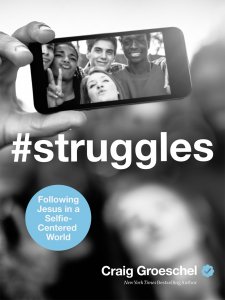
#strugglesI love technology! I love how social media and my iPhone can keep me in touch with family and friends. But one of the dark sides to this easy access to technology is the ease with which people can gossip—or even slander!—people publicly online. In his book #struggles, Craig Groeschel has some good counsel for avoiding gossip.

“God is crystal clear on how He feels about gossip. Solomon said, ‘There are six things the Lord hates, seven that are detestable to Him…a false witness who pours out lies and a person who stirs up conflict in the community’ (Proverbs 6:16, 19). What a perfect way to describe a gossip: ‘A false witness who pours out lies,’ and someone who ‘stirs up conflict in the community.’ God hates that.”

“The people being gossiped about hate it, and God hates it. So before you post, comment, or link, consider three sets of questions to keep yourself gossip-free online.

  1. Is what I’m about to say helpful or hurtful? Will this build others up or tear them down? What’s my intention behind what I’m about to type? [Ephesians 4:29]
  2. Am I making private matters public? Am I about to share something that would be better handled privately? [Proverbs 11:12-13]
  3. Am I permitting—maybe even encouraging—others to gossip? It’s not only wrong to dish it out; it’s also wrong to eat it up. Notice that this verse [Proverbs 17:4] doesn’t say that only gossipers are wrongdoers. No, it says wrongdoers are also those who ‘listen to gossip.’ It’s not just wrong to spread gossip; it’s wrong to consume it. Why? Because what you permit, you promote.”

You can read my review of #struggles by clicking here. I have also posted other quotes from this book here and here.

Confession: I Struggle With Being An Atheist

ITLWYou see, I love my day to be highly organized. I like to get to all my meetings on time, and then have them run smoothly and efficiently. I like to setup my To Do list, and then methodically check off each item as I go through my day. I like to be in charge of my day.

I am an atheist.

I’m the one calling the shots. I set my agenda. I determine my day. I decide who to see and what project to accept.

There was a guy that Jesus talked about who did the exact same thing. This guy thought to himself and talked to himself all about his plans. Seriously, in just three verses he says me/I/my a dozen times (Luke 12:17-19)!

But God said, “You fool!” The word for fool means without mind. He didn’t mind his mind. He thought the thoughts he wanted to think, without ever consulting anyone else. Not even God.

Jesus made prayer a priority every day (Mark 1:35). What do you think He prayed? Do you think He said, “Here’s what I’m going to do today, and I want You to bless it, Father”? No way!

When Jesus taught us to pray He said, Your kingdom come, Your will be done” (Matthew 6:9-13). Not only did Jesus pray this way, He lived this way too. He didn’t do a single thing unless His Father directed Him to do it (John 6:38), and He didn’t say a single word unless His Father directed Him to say it (John 12:49).

The problem is not going into my prayer closet to meet with God in the morning, the problem is thinking I can leave God in the closet as I go about my day! That is atheism!

The Apostle James gave us this sound counsel: Instead of making my plans all on my own, I should say, “If the Lord wills, this is what I will do today” (James 4:13-17). And wise King Solomon said I shouldn’t lean on my own thoughts when planning my days, but lean onto God, and then watch to see how He will direct my life in the right way (Proverbs 3:5-6).

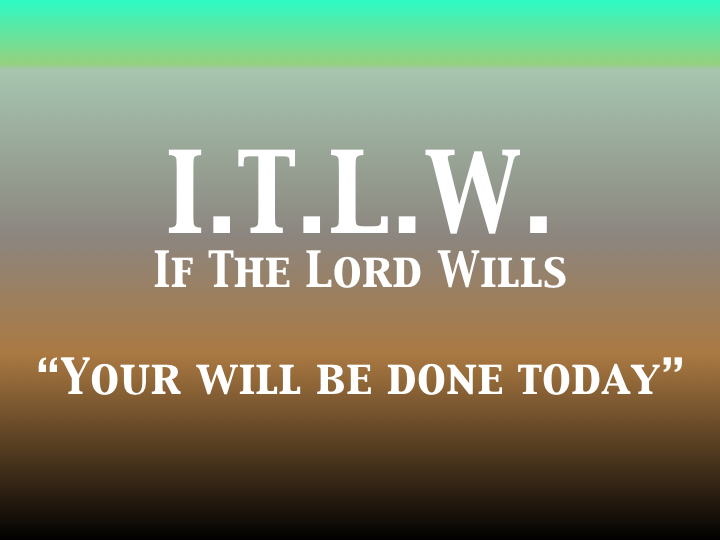
I’ve begun writing I.T.L.W. on the top of my daily calendar. It’s my reminder to say, “If The Lord Wills” this is what I will do today. And if something else comes up, I quickly acknowledge that God is directing my path where He needs me to go.

Your Kingdom come means my kingdom has to go. Your will be done means my agenda takes a distant second.

If you’re feeling stressed about your schedule, that should be your reminder to pray: “God, what do you want to have done here.” Silence the atheistic thoughts that sound like, “I have to get my list done.” Stop and pray right there on the spot.

Here’s the full video of my message on this topic—

We will be continuing our series called Practical Prayer this Sunday. If you don’t have a home church in Cedar Springs, please come be our guest. Or you can tune into our live broadcast via Periscope.

Making Hearts Burn

Living WordThere is an interesting line the angels speak to the ladies who came to anoint Christ’s dead body in the tomb: “Why are you looking for the living among the dead?” (Luke 24:5).

That phrase sums up much of our culture. People are looking for life, but they are looking for it among dead things. Wise King Solomon wrote that God has placed a God-shaped void in the heart of every human being (Ecclesiastes 3:11). But Solomon went on to say that anything “under the sun” that we try to use to fill that God-void will be utterly meaningless.

Peter wrote to aliens and strangers about living such good lives that will point people to God. This means Christians need to help people who are looking for the living among the dead see that real life is in Christ. To do this, we need to be immersed in the Living Word of God.

In the conversations after Christ’s resurrection, look at the references to God’s Living Word:

  • Remember how He told you … Then they remembered His words (Luke 24:6-8)
  • what was said in all the Scripture concerning Himself… (Luke 24:27)
  • …written about Me in the Law of Moses, the Prophets and the Psalms … so they could understand the Scriptures ( Luke 24:44-45)

There is life in God’s Word! When the two disciples of Jesus remembered His Living Word, they said their hearts burned inside them (Luke 24:32).

If you want to help those searching for life to find it, let them hear God’s Living Word coming from your lips. This will make their hearts burn, and lead them to a personal relationship with Jesus Christ.

If you’ve missed any messages in this series, you may find the complete list by clicking here.

Read The Red Letters

Read the red lettersLet’s see if you can guess what famous person said the following (the answers are below … but no cheating!):

  1. “The phonograph is of no commercial value.”
  2. “I think there is a world market for about five computers.”
  3. “I tell you Wellington is a bad general, the English are bad soldiers; we will settle the matter by lunch time.”
  4. “There will never be a bigger plane built.”
  5. “The world potential market for copying machines is 5000 at most.”

People get it wrong lots of times. Even really smart, successful people. King Solomon, who was called the wisest of all, wrote a book called Ecclesiastes in which he shared some bad advice he tried to follow. In the closing verses he gave this warning, “My son, be warned. Of making many books there is no end so do not believe everything you read, and much study is the weariness of the flesh” (Ecclesiastes 12:12).

In the Hebrew world there were three departments of knowledge:

  • Law―words from God to man
  • Prophesy―judgment from God on how man is doing in observing God’s law
  • Wisdom―man’s attempt to live out God’s law based on observation, experience, and reflection (for a great example of all three departments at work, see Luke 10:25-37)

What we need is someone who (1) knows God’s way, (2) lives God’s way, and (3) can teach us how to live out God’s way for ourselves. Someone who is perfect, flawless in every phase. We need the One Who said, “Heaven and earth will pass away, but My words will never pass away” (Matthew 24:35). That One is Jesus.

Can I make a suggestion that will bring you amazing results? Spend some time reading the red letters. That is, go to the Gospels of Matthew, Mark, Luke and John and focus on the words of Jesus (which many Bible translations print in a red font). There I am certain you will discover the greatest words ever spoken!

If you can, please join me over the next few Sundays as we will be attempting to discover the greatest words ever spoken on a variety of subjects. Folks have turned in the questions that they would like answered, and we are going to look to the red letters to see what Jesus has to say.

Answers to the quiz:

  1. Thomas Edison, remarking on his own invention 
  2. Thomas Watson, Sr., chairman of IBM
  3. Napoleon Bonaparte, at a breakfast with his generals preceding the Battle of Waterloo
  4. A Boeing engineer, after the first flight of the 247, a twin engine plane that held ten people 
  5. IBM board of directors, to the eventual founders of Xerox

Links & Quotes

link quote

John Calvin explaining how singing together in church is like praying together. “We do this [sing corporately] openly, that all men mutually, each one from his brother, may receive the confession of faith and be invited and prompted by his example.” —John Calvin

“It is not that we prepare a palace for God, but that He comes into our mortal flesh and we do our ordinary work, in an ordinary setting, amongst ordinary people, as for Him.” —Oswald Chambers

“Let every man remember that to violate the law is to trample on the blood of his father, and to tear the character of his own, and his children’s, liberty. Let reverence for the laws be breathed by every American mother to the lisping babe that prattles on her lap. Let it be taught in schools, in seminaries, and in colleges. Let it be written in primers, spelling books, and in almanacs. Let it be preached from the pulpit, proclaimed in legislative halls, and enforced in courts of justice.” —Abraham Lincoln

This makes me respect Tim Tebow even more―he is organizing Valentine proms for students with special needs.

Have you ever read how Solomon describes his bride in the Song of Songs? The talented folks at The Overview Bible Project have actually put this together, and it is quite…eye-opening! Check it out.

[VIDEO] I like Kid President! Check out his letter to the future―

13 Quotes From “The Solomon Seduction”

Solomon SeductionThe Solomon Seduction is a biography on King Solomon, a Bible study, a book for men to overcome temptation, a leadership book, and a great discussion starter for a men’s group. In other words, there are lots of reasons for guys to read this book! You can read my full book review by clicking here, and below are some of the quotes I highlighted from this book.

“Moderation can be a great thing. But the idea that anything is okay as long as it’s done in moderation has given rise to some of the wackiest notions known to man. … One of the big problems with using moderation as a justification for whatever you want to do is that it’s almost impossible to take just a bite when you’re really hungry.” 

“Are you just a guy who goes to church, or are you serious about growing spiritually and acquiring discernment? satan’s chances of seducing you will rise or fall on your answers to these questions.”

“Solomon is the perfect example of the fact that you can have your cranium crammed full of discernment and still end up embarrassing yourself. Keep in mind, he not only knew the book of Proverbs, he wrote the vast majority of it! And then ended up doing many of the very things he himself said were foolish!” 

“All of satan’s various attempts at seducing believers must include an attempt to undermine Scripture.”

“What we have here is a case not of ignorance or confusion or misinterpretation, but of satan subtly and artfully manipulating Solomon’s thinking to the point where he felt the commands of God seemed out of touch with his real-world experience.”

“satan doesn’t try to get you to forsake your good priorities. He just encourages you to mix in a few lesser priorities that will compete with those good priorities.”

“Mark it down. When the word I starts replacing the word we in your speech, something ugly is happening in your heart. Your ego is swelling.” 

“Big-ego people almost never back up and take another look at their actions. Why should they? They’re convinced that everything they do is right. It never occurs to them that they might be on the wrong track. They’re so infatuated with themselves that they can see nothing but that beautiful image in the mirror.”

‘What’s the big deal?’ If ever a question spoke to the attitude of our generation towards sin, that one does. We shrug off sin as though it’s just a little harmless fun. You know, boys will be boys. Everybody sows some wild oats, right? Or, if we don’t play the what’s-the-big-deal card, we claim that the sin we are indulging in is actually necessary.” 

“Instead of repenting, instead of exterminating, illuminating, or correcting their bad behavior, [sin managers] try to manage it. They believe that if they can keep the behavior from getting out of hand, keep people from being hurt or offended, keep the status quo from being upset, keep the ugliness under wraps and out of sight, they can hang on to their sin and everything will be fine. … This is typical of sin managers. Instead of seeing sin as the problem, they see the awkwardness the sin creates as the problem and believe, therefore, that if they can find an answer for the awkwardness, they will have solved the problem.”

“In the category of cold, hard truths, this is a doozy: God doesn’t share the throne of your heart with anybody or anything. You either give it to Him wholly and completely, or He vacates it. You can tell yourself that God comes first and that the sin you’re harboring is just a little something you need to work on, but if you choose a lifestyle of sin management over repentance, you’ve pledged your allegiance to your sin, not to God.”

“Repentance is not what saves us; grace is. But repentance is a response to grace that makes what we are after having received grace different from what we were before. … Repentance concerns itself with how things are while sin management only worries about how things look. Think of a messy closet. Repentance cleans out the closet. Sin management straightens up the closet. Repentance throws away the junk. Sin management rearranges the junk. Repentance gives you a better closet. Sin management only gives you a better-looking closet.”

“When we see Solomon at the height of his idolatrous lifestyle, marrying and buying and indulging like an out-of-control sailor on a weekend pass, what does he say over and over again? ‘I said to myself…’ (Ecclesiastes 1:16, 2:1, 2:15, 3:17, 7:23). Solomon was talking to himself about a lot of things he should have been discussing with God. Who can argue that the reason why he was seduced and eventually reduced to an object of scorn and pity was because he excluded God from so many areas of his life?” 


Helpers

HelpersI was at the University of Michigan with a friend who is on the list waiting for a liver transplant. We spent a half-day listening to doctors, nurses, dietitians and others tell us what to expect through this process.

One social worker really emphasized the care of the patient’s body prior to the transplant as a way to help with recovery from the surgery. He said, Pre-habilitation helps rehabilitation.” 

I like that!

It’s sort of a variation on Benjamin Franklin’s maxims, “An ounce of prevention is worth a pound of cure,” and “A stitch in time saves nine.” Even wise King Solomon wrote, “A prudent person sees trouble coming and ducks; a simpleton walks in blindly and is clobbered” (Proverbs 22:3, The Message).

To help things go better later, we need to start working sooner. Later things go better with helpers that begin sooner. 

Here are a few helpers I thought of:

Pre-habilitation helps rehabilitation. 

Preparing helps repairing. 

Exercise helps recovery. 

Proaction helps better reaction. 

Accepting responsibility helps apologizing. 

Praying helps working. 

Daily study helps studying the night before a test. 

What other helpers would you add to the list? (Add them in the comments below….)

The Solomon Seduction (book review)

Solomon SeductionI love Bible character studies that read like a biography, and in The Solomon Seduction by Mark Atteberry, that’s exactly what I got. Not only that, but this book is an excellent discussion book for men and a pretty good leadership lesson as well.

Pastor Atteberry uses the life and writings of King Solomon to show us that even someone called the wisest man can be reduced to a fool. Solomon was given a gift of wisdom unequaled in any other man, but his gift was misused and mismanaged by Solomon, and led to his downfall.

This is a timely book for men today. Atteberry wrote early on in the book—

“Simply put, Solomon was better equipped to see through satan’s deceptions than any man who has ever lived, other than Jesus. But in the end, he became just as blind to them as everyone else. This, of course, is quite a tribute to satan’s cleverness. If he were an author, his blockbuster best seller would be How I Made A Fool Out Of The Wisest Man Who Ever Lived (And Why The Program Still Works). And it does still work.”

It’s true: satan’s seductions still work today, and Atteberry gives us ten seductions that worked on wise King Solomon, and will work on men today if we don’t pay attention to them.

I hope men not only read The Solomon Seduction, but that they use it as a springboard for discussion with other men too. This is a needed book for our time.

I am a Thomas Nelson book reviewer.

Are You Listening?

Are you listening?David subdued Israel’s enemies. His son, Solomon, brought Israel incredible wealth and prestige. And his son, Rehoboam, brought it all crashing down.

How? “…the king did not listen to the people” when they asked him for relief (2 Chronicles 10:15).

It’s hard to lead people you don’t listen to! In fact, not only did Rehoboam not lead them, he destroyed a strong, rich, peaceful, united kingdom.

Actually Rehoboam’s problem goes back even earlier. He couldn’t hear his people because he didn’t hear his God—“He did evil BECAUSE he had not set his heart on seeking the Lord” (2 Chronicles 12:14, emphasis added).

If I set my heart fully on God, I can hear His voice.

If I can hear His voice, I can accurately hear others’ voices.

If I can accurately hear other people, I can serve them (see 1 Kings 12:7).

This is the only way to have God-enabled success with people!


But Power!

But PowerIt’s not quite a League Of Justice superhero power … but it’s pretty close! Beginning in the first verse of Proverbs 10, King Solomon introduces a small, but powerful, conjunction—

The wise son brings joy to his father, BUT a foolish son grief to his mother (10:1).

Starting here and in nearly every following verse for the next 12 chapters(!) you will find this powerful little 3-letter word.

Sometimes it’s a “yet” and sometimes the semicolon implies the “but,” but it’s there in all of it’s life-changing strength!

Whatever the scenario, Solomon lists the stark contrast between a life on which God’s blessing can rest, and a foolish life that is immune to God’s blessing.

There’s almost a year’s worth of BUT POWER in these chapters. Why don’t you contemplate just one contrasting statement everyday and see what God begins to reveal to you.

BUT POWER is here to save the day!