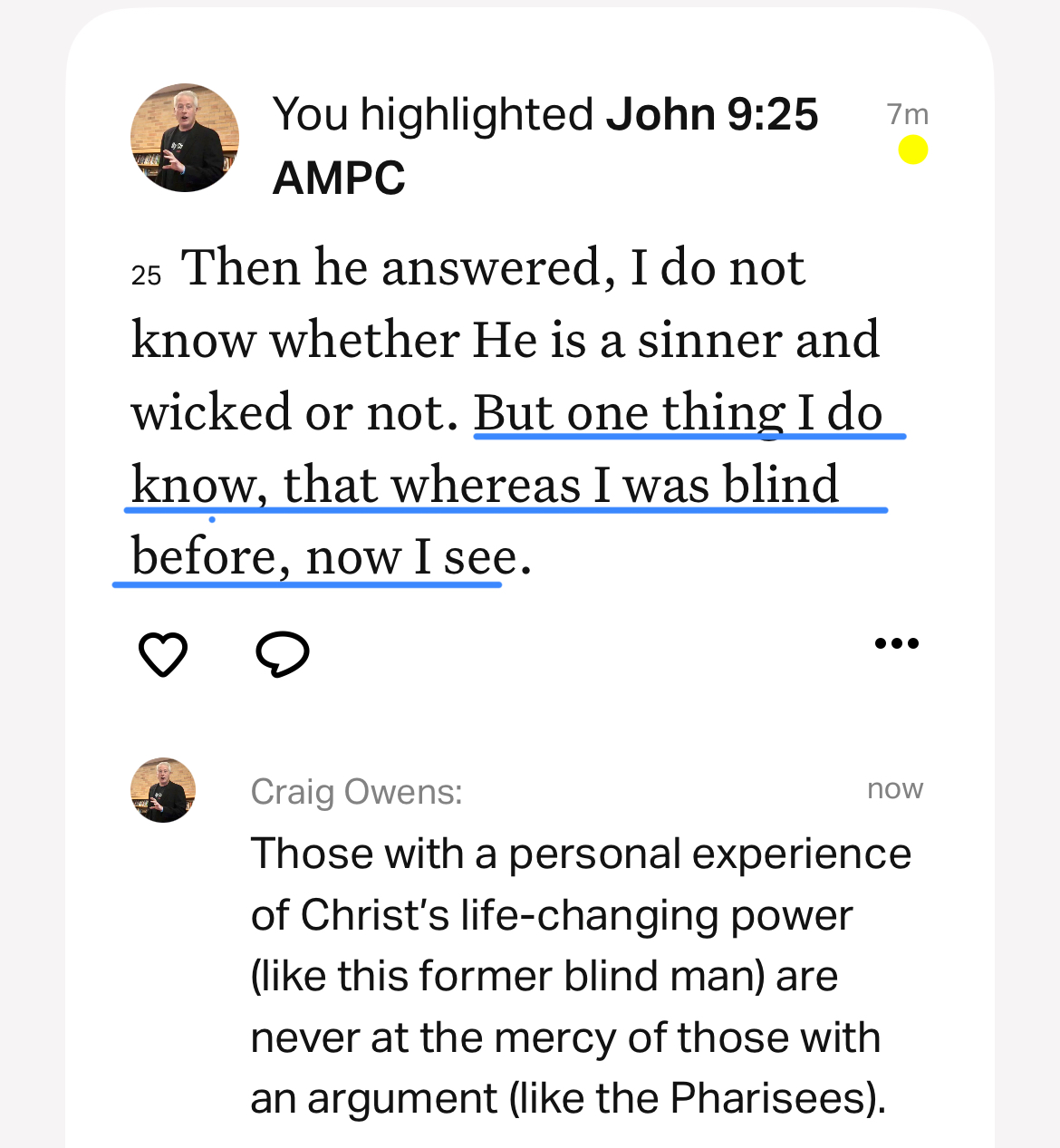
The religious leaders asked a man who had been healed by Jesus of his blindness whether he though Jesus had sinned by healing on the Sabbath. He said, “I do not know whether He is a sinner and wicked or not. But one thing I do know, that whereas I was blind before, now I see” (John 9:25).
I find it interesting that the Pharisees didn’t try to argue whether or not this man had truly been healed—that was obvious to everyone!—but they wanted to discredit Jesus and call Him a sinner because He healed on the Sabbath day.
Those with a personal experience of Christ’s life-changing power (like this former blind man) are never at the mercy of those with an argument (like the Pharisees).
In fact, this man who can now see not only has the most sound logic, but he has immediately become an evangelist for Jesus as well!
The man replied, “Well, this is astonishing! Here a Man has opened my eyes, and yet you do not know where He comes from. That is amazing! We know that God does not listen to sinners; but if anyone is God-fearing and a worshiper of Him and does His will, He listens to him. Since the beginning of time it has never been heard that anyone opened the eyes of a man born blind. If this Man were not from God, He would not be able to do anything like this.” (John 9:30-33)
I love this truism: The man with an experience is never at the mercy of the man with an argument. I have blogged extensively about this. Check out these posts.
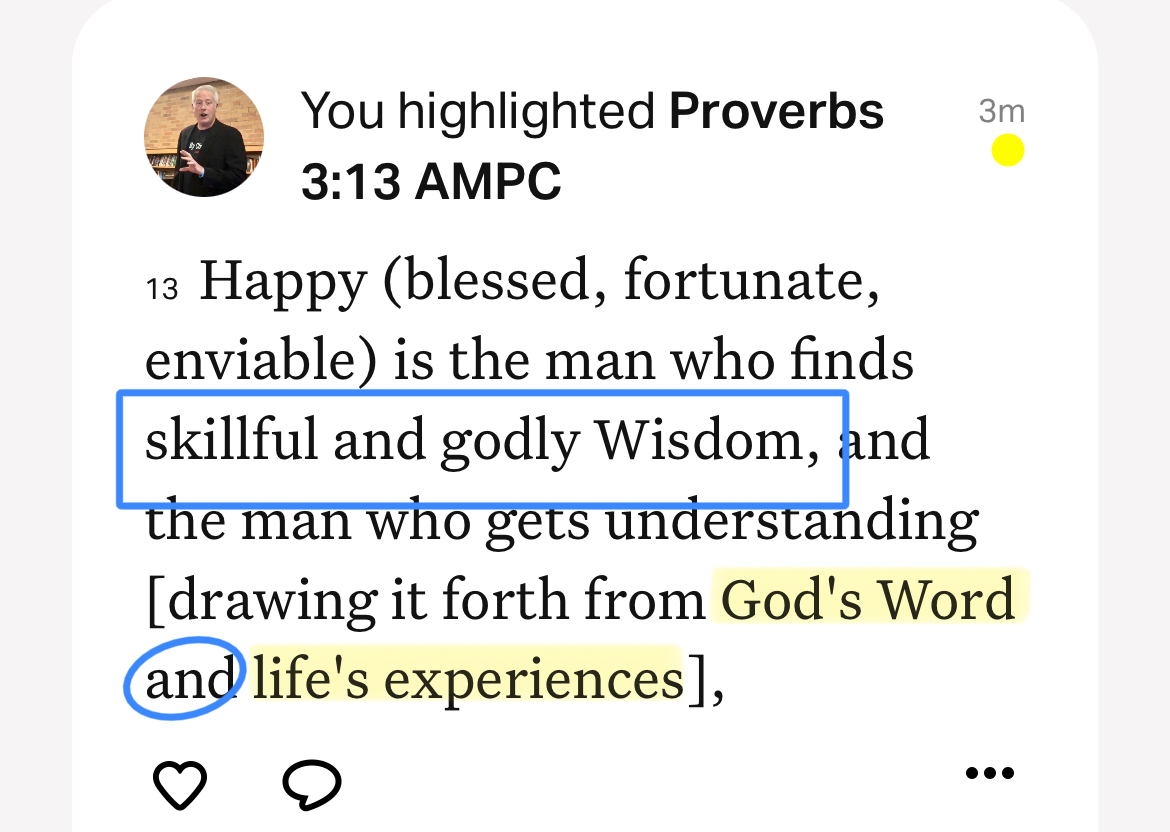
Happy (blessed, fortunate, enviable) is the man who finds skillful and godly Wisdom, and the man who gets understanding [drawing it forth from God’s Word and life’s experiences]. (Proverbs 3:13 AMPC)
Sir Francis Bacon wrote, “God has, in fact, written two books, not just one. Of course, we are all familiar with the first Book He wrote, namely Scripture. But He has written a second book called creation.”
God’s Word tells us about our life’s experiences, and it tells us about our observations of His creation and our experiences. These observations and experiences should take us back to God’s Book to fully appreciate and apply them in a manner which glories God.
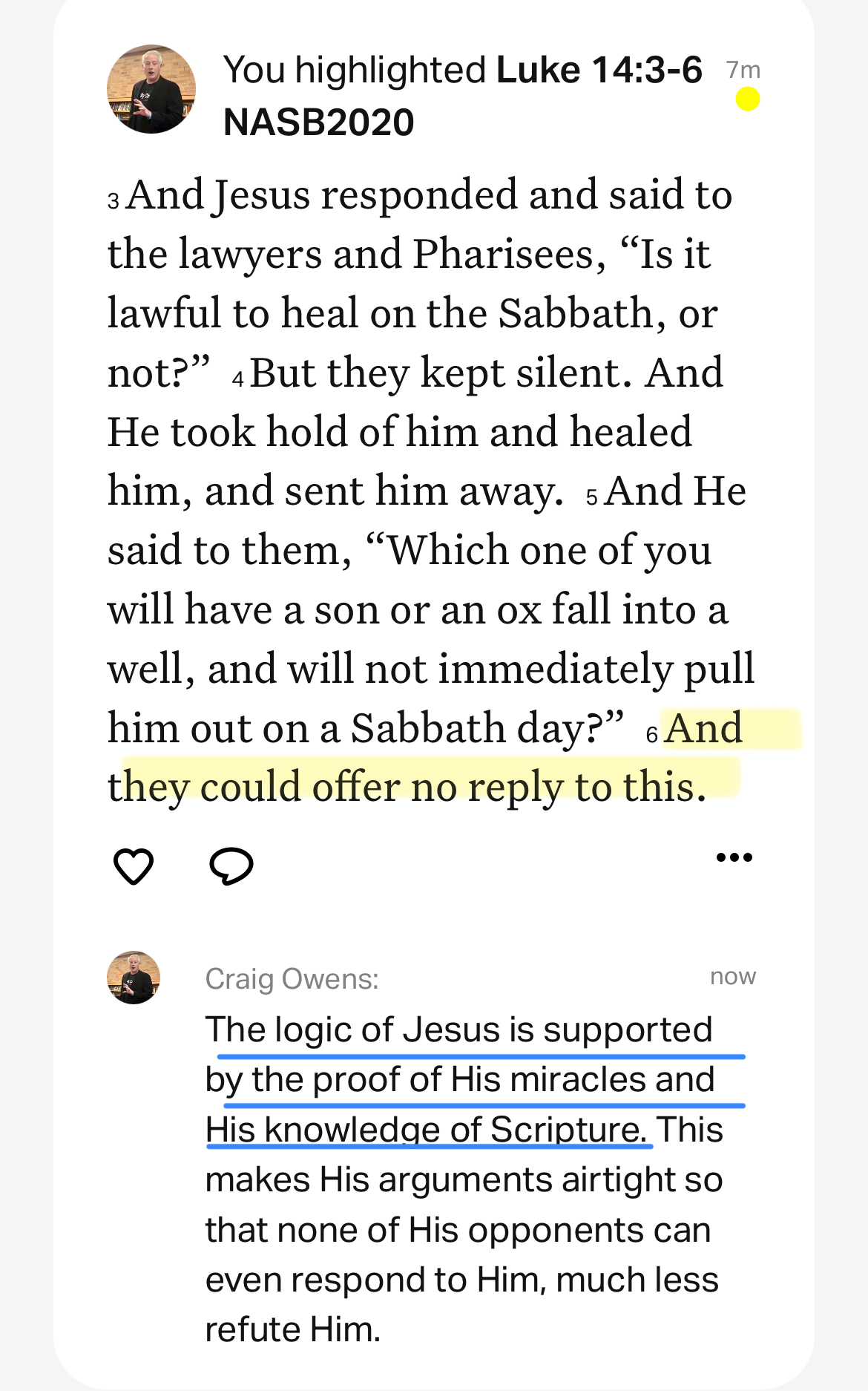
And Jesus responded and said to the lawyers and Pharisees, “Is it lawful to heal on the Sabbath, or not?” But they kept silent. And He took hold of him and healed him, and sent him away. And He said to them, “Which one of you will have a son or an ox fall into a well, and will not immediately pull him out on a Sabbath day?” And they could offer no reply to this.
The logic of Jesus is supported by the proof of His miracles and His knowledge of Scripture. This makes His arguments airtight so that none of His opponents can even respond to Him, much less refute Him.
We have the same things available to us:
(1) The Word of God which the Holy Spirit illuminates to our minds, and which He helps us use when critics attack.
(2) The example of our lives which have been changed by a personal encounter with Jesus.
(3) The logical connection of Scripture to the situation in which we find ourselves.
Listen to the podcast of this post by clicking on the player below, and you can also subscribe on Apple, Spotify, or Audible.
As missionaries, we are people sent on a mission. We are sent to everyone everywhere. We are to take Him to every street where God sends us.
“Main Street” (or Jerusalem) is a great place to start, and probably a place where we will always have work to do. These will typically be the people that are most like us—people with whom we will have the most in common.
There are others that need to hear the Good news of forgiveness that Jesus has made available. As our circle of witness widens, we may have less in common with those with whom we are interacting. This may take us out of our comfort zone, but since the Holy Spirit is in us we will never be out of our empowerment zone!
But you will receive power when the Holy Spirit comes on you; and you will be My witnesses in Jerusalem, and in all Judea… (Acts 1:8).
We need to ask two questions:
What did it mean then? Judea was still compromised of Jewish people, but it was the area slightly outside the neighborhood of Jerusalem.
What does it mean now? These are people very similar to people on Main Street, but we are starting to see more differences. These differences often become the source of controversies.
I’m going to describe some people in our Judea as cultural Christians but not biblical Christians. In the time of Jesus we could think of the Pharisees: People who would call themselves godly because they have set their own standards.
Lombard Street in San Francisco is a short, curvy street. This is a one-way street and motorists are only supposed to drive 5 mph, and still there are frequent controversies on the right-of-way between homeowners, motorists, work crews, bicyclists, and pedestrians. Everyone thinks their way is the right way.
How do we take the message of Jesus to those on our “Lombard Street”?
(1) Distinguish the biblical from the non-biblical.
Both the Pharisees that interacted with Jesus and today’s cultural Christians seem to quote more from their own traditions than they do from the Scripture, so we need to distinguish that the source of our beliefs is from God’s inspired Word. (I share more about the concept of biblical, unbiblical, and non-biblical in this post.)
A great example for us is how Jesus answered two questions from an expert in the Mosaic law: How do I earn eternal life? Who is my neighbor? See Luke 10:25-37.
(2) Stick to Scripture and your personal story.
Remember that the person with an experience is never at the mercy of the person with an argument. When the Sanhedrin questioned the legitimacy of the healing of a lame man, Luke wrote, “But since they could see the man who had been healed standing there with them [Peter and John], there was nothing they could say” (Acts 4:14)!
Love the personal story of the healed blind man in John 9!
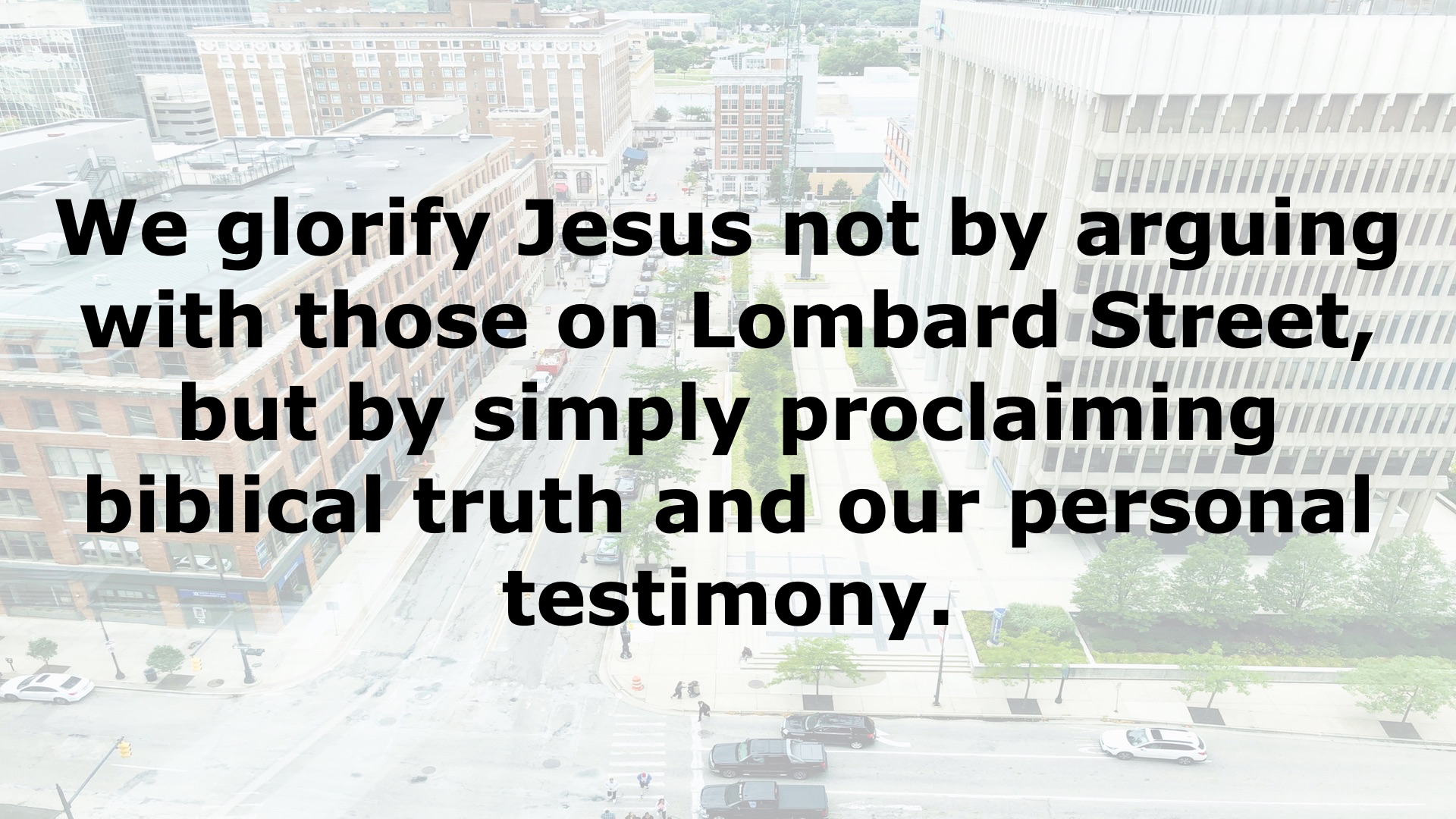
Judea can be translated “he shall be praised.” We glorify Jesus not by arguing with those on Lombard Street, but by simply proclaiming biblical truth and our personal testimony.
Sing to the Lord, all the earth; proclaim good news of His salvation from day to day. Tell of His glory among the nations, His wonderful deeds among all the peoples. (1 Chronicles 16:23-24)
As we stick with the Scripture and our personal testimony, the Holy Spirit will use our witness to open minds to the Good News of Jesus (2 Corinthians 3:18-4:5).
Follow along with all of the streets we are looking at in our series Takin’ Him to the streets by clicking here.
Listen to the podcast of this post by clicking on the player below, and you can also subscribe on Apple, Spotify, or Audible.
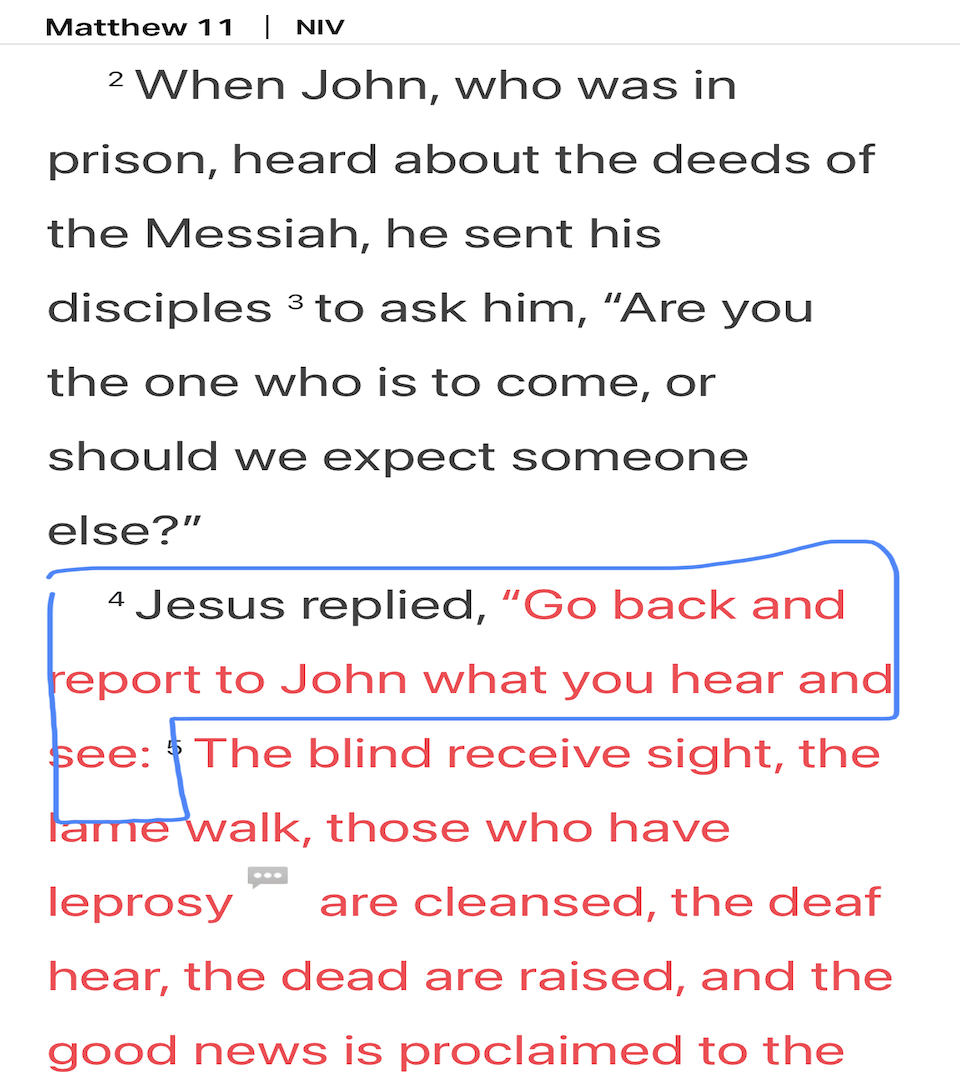
I had an encounter with my atheist college professor that has always stuck with me. I was reminded of that interaction when I was reading the question John the Baptist sent to Jesus from prison.
Always remember:
The one with a firsthand experience is never at the mercy of the one with only secondhand information.
I love Charle Spurgeon’s definition of godliness: “God Himself is the power of godliness. The Holy Spirit is the life and force of it. Godliness is the power that brings a man to God and bind him to Him. Godliness is that which creates repentance toward God and faith in Him. Godliness is the result of a great change of heart and reference to God and His character. Godliness looks toward God and mourns its distance from Him. Godliness hastens to draw near and rests not till it is at home with God.
“Godliness makes a man like God. Godliness leads a man to love God and to serve God. It brings the fear of God before his eyes and the love of God into his heart. Godliness leads to consecration, to sanctification, to concentration. The godly man seeks first the kingdom of God and His righteousness and expects other things to be added to him. Godliness makes a man commune with God and gives him a partnership with God in His glorious designs. And so it prepares him to dwell with God forever.”
The folks at Axis Ministry provide some amazing insights for parents (and youth pastors) of pre-teens through the early college years. I would highly recommend subscribing to their free weekly email. Here is their Parent’s Guide To Teen Emotions, which is a free PDF for you to download.
Listen to the podcast of this post by clicking on the player below, and you can also subscribe on Apple, Spotify, or Audible.
Have you ever heard this truism: The person with an experience is never at the mercy of the person with an argument?
There are, sadly, many who deny the reality of God’s divine healing for today. They may say God healed in the past, but that age has passed, or they may simply deny all supernatural activity. I have the best reply to these skeptics or deniers—and you may have this same reply: God does heal today; I know this is true because He has healed me!
Our truth statement about this says: “Divine healing is an integral part of the gospel. Deliverance from sickness is provided for in the atonement, and is the privilege of all believers.” Let me break this down into three parts.
(1) “Divine healing is an integral part of the gospel.” After that word “integral” I’d like to insert the word “indisputable.” When God does the miraculous, it is an undeniable proof of His love and power. A great story to prove this point is when Jesus healed a paralytic after He forgave him of his sins (Luke 5:17-26).
Notice how the people responded: Everyone was amazed and gave praise to God. This glory to God has always been the reason God performs miracles (see Mark 6:7-13; Acts 2:43; Acts 3:9-12).
(2) “Deliverance from sickness is provided for in the atonement.” I like to remember that the word atonement means “at-onement” and stands opposed to disease which I like to say as “dis-ease.” Sin is our ultimate dis-ease—the ultimate separator—so Jesus took care of both our spiritual dis-ease and our physical dis-ease when He died on the Cross for us, just as Isaiah prophesied. That’s why the New Testament also shows us salvation and healing frequently being linked together (Acts 10:38; 8:4-8).
(3) “And is the privilege of all believers.”ALL believers, not just a select few and not just those who lived at the time of the first apostles.
Divine healing has been—and always will be—an integral and indisputable part of the gospel precisely because it exalts God as THE Healer.
Many people today still believe what the disciples of Jesus believed: Disease is a consequence of personal sin. In addressing this misunderstanding, Jesus said that disease was “so that the work of God might be displayed” in the life of the one about to be healed. He said something similar while at the graveside of Lazarus, before he raised that dead man back to life (John 9:1-38; 11:4-45).
Sometimes God heals us now, but ALWAYS He heals us in our glorified bodies (2 Corinthians 12:9-10; 5:1-9; Revelation 21:4). Our patience and hope in our future, ultimate healing glorifies God in the present.
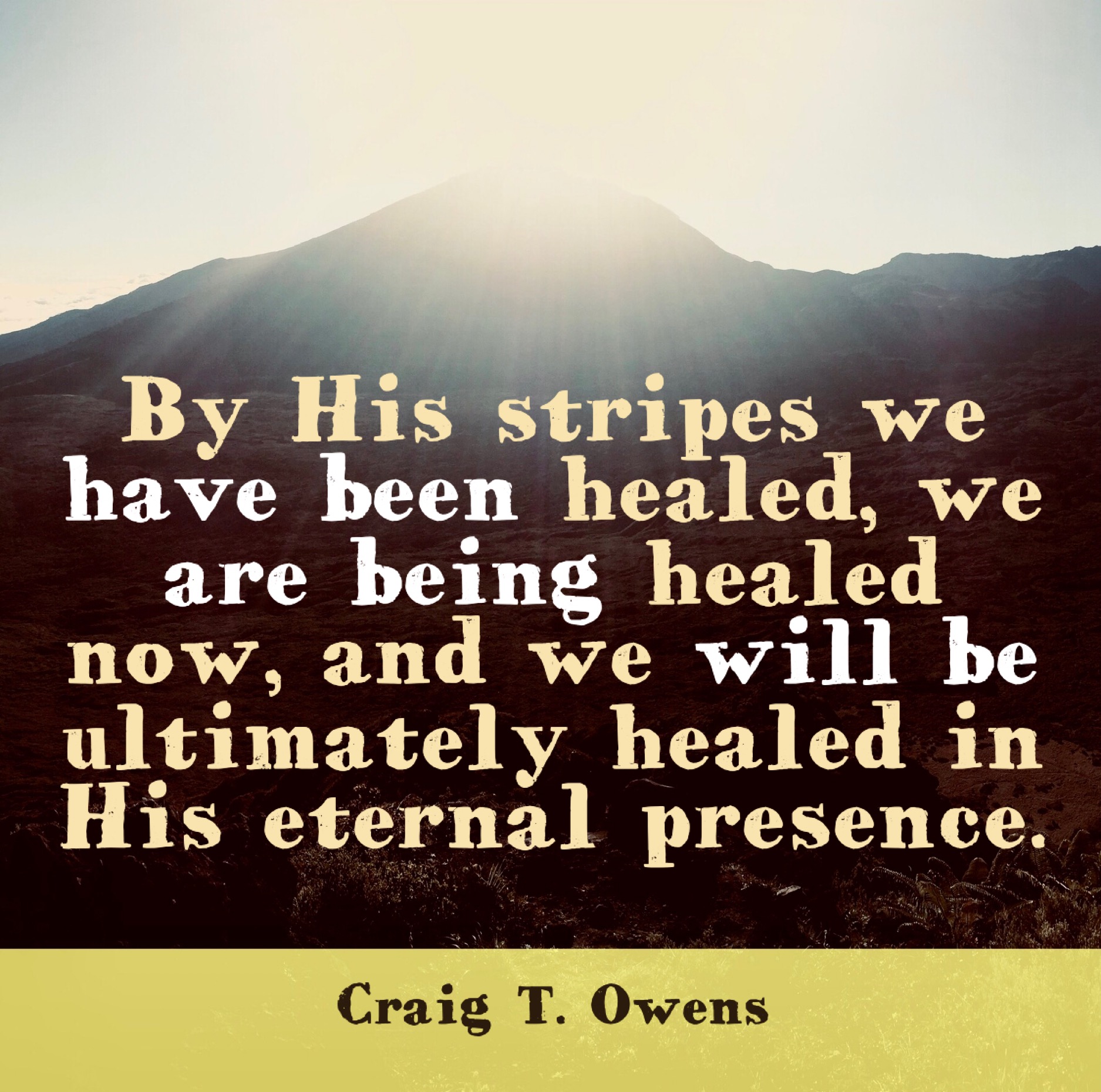
By faith in Jesus we can claim that “by His stripes we have been healed” (1 Peter 2:24). The verb tense Peter uses means we have been healed, we are being healed now, and we will be ultimately healed in Christ’s eternal presence. Whether we are healed here or not, we can live knowing that His healing power always brings Him glory and always draws people to Him, so don’t hesitate to keep on asking Him for His healing touch on your body and soul.
This is a weekly series with things I’m reading and pondering from Charles Spurgeon. You can read the original seed thought here, or type “Thursdays With Spurgeon” in the search box to read more entries.
Listen to the podcast of this post by clicking on the player below, and you can also subscribe on iTunes or Spotify.
The Basis Of Our Hope
If there is no resurrection, apostolic preaching fails. ‘If Christ is not risen, then our preaching is empty’ [1 Corinthians 15:12-22]. … If Christ was not raised, the apostles were false witnesses. When a man bears false witness, he usually has a motive for doing so. What motive had these men? What did they gain by bearing false witness to Christ’s resurrection? It was all loss and no profit to them if He had not risen. They declared in Jerusalem that He had risen from the dead, and straightway men began to haul them to prison and to put them to death! Those of them who survived bore the same testimony. They were so full of the conviction of it that they went into distant countries to tell the story of Jesus and His resurrection from the dead. … They were brought before Roman emperors again and again, and before the proconsuls, and threatened with the most painful of deaths, but not one of them ever withdrew his testimony concerning Christ’s resurrection! …
If Christ is not raised, your faith is in vain. If it is in vain, give it up! Do not hold on to a thing that is not true! I would sooner plunge into the water and swim or wade through the river than I would trust myself to a rotten bridge that would break down in the middle. If Christ did not rise, do not trust Him, for such faith is in vain! But if you believe that He did die for you and did rise again for you, then believe in Him, joyfully confident that such a fact as this affords a solid basis for your belief! …
If [Jesus] died for you and rose again for you, that is the groundwork of your confidence, and I pray you keep to it. … Go your way and sing, ‘The Lord is risen indeed,’ and be happy as all the birds in the air, till you are, by and by, as happy as the angels in heaven through Jesus Christ our Lord. Amen.
From If There Is No Resurrection
I shared a series of messages that said, “I know Jesus is A.L.I.V.E. because of…” and each of the letters of ALIVE reminded us of a convincing proof of His resurrection. I would especially direct your attention to two of those letters.
The “L” stands for lives changed. When someone has a complete about-face life change because of their interaction with Jesus, that is pretty strong proof that their encounter was with a living Savior.
And the “E” stands for the engagement of Christ’s followers. It’s astounding to see how much of our world’s history has been positively impacted because of the influence of Christians. Their lives had become so radically different because of the life of Jesus in them that they could not help but change the culture around them.
As I said last in the last Thursdays with Spurgeon installment, always remember that the one with a personal experience is never at the mercy of the one with an argument. If your life has been changed by personal and ongoing interactions with Jesus Christ, don’t keep that good news to yourself. Let that assurance you have be a bright and winsome witness to all who are around you.
This is a weekly series with things I’m reading and pondering from Charles Spurgeon. You can read the original seed thought here, or type “Thursdays With Spurgeon” in the search box to read more entries.
Listen to the podcast of this post by clicking on the player below, and you can also subscribe on iTunes or Spotify.
Stop Arguing
Our religion is not based upon opinions, but upon facts. We hear persons sometimes saying, ‘Those are your views, and these are ours.’ Whatever your views may be is a small matter; what are the facts of the case? We must, after all, if we want a firm foundation, come down to matters of fact. …
Beloved friends, let us never tamper with the truth of God. I find it is as much as I can do to enjoy the comfort of the truth and to learn the spiritual lessons of God’s Word without setting up to be a critic upon it. And I find it immeasurably more profitable to my own soul to believingly adore than unbelievingly to invent objections, or even industriously to try to meet them. The meeting of objections is an endless work. When you have killed one regiment of them, there is another regiment coming on, and when you have put to the sword whole legions of doubts, doubters still swarm upon you like the frogs of Egypt! It is a poor business. It answers no practical end. It is far better to firmly believe what you profess to believe and to follow out to all the blessed consequences all of the truths of God that, in your own heart and soul, you have received of the Lord.
From If There Is No Resurrection
I have presented evidence numerous times that makes it reasonable to believe that the Bible is God’s inspired Word (check out my posts here, here, here, and here). And yet there are still people who stubbornly want to argue that the Bible is made-up stories, or that there was no such person as Jesus, or that if there were a Jesus, He was just a good man but not God Himself who was raised from the dead. These arguments are nothing new. Paul had to address them just a few years after Jesus had ascended back to heaven, so what would make us think that we would escape those doubters?
As Spurgeon says, there is so much more joy when we simply “believingly adore” the God who is revealed to us on the pages of Scripture than it is to address such flimsy arguments. So that is what I typically do. Trying to debate with someone who won’t even accept basic facts is typically an unprofitable use of my efforts because they usually aren’t open to listening to what I have to say.
Instead, I simply remember this: The one with a personal experience of a life-changing encounter with a risen Savior is never at the mercy of the critic with only a handful of arguments! So you can simply say to that argumentative critic, “I know how different my life is because Jesus is in me and I am in Him.”
Stop arguing with close-minded critics and start adoring the God who loves you!



 The religious leaders asked a man who had been healed by Jesus of his blindness whether he though Jesus had sinned by healing on the Sabbath. He said, “I do not know whether He is a sinner and wicked or not. But one thing I do know, that whereas I was blind before, now I see” (John 9:25).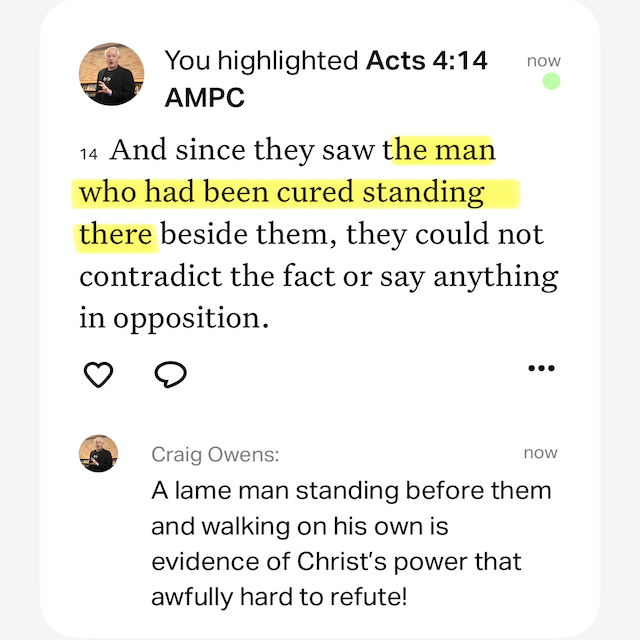




 Craig T. Owens
Links & Quotes
January 28, 2022 — Craig T. OwensI love Charle Spurgeon’s definition of godliness: “God Himself is the power of godliness. The Holy Spirit is the life and force of it. Godliness is the power that brings a man to God and bind him to Him. Godliness is that which creates repentance toward God and faith in Him. Godliness is the result of a great change of heart and reference to God and His character. Godliness looks toward God and mourns its distance from Him. Godliness hastens to draw near and rests not till it is at home with God.
“Godliness makes a man like God. Godliness leads a man to love God and to serve God. It brings the fear of God before his eyes and the love of God into his heart. Godliness leads to consecration, to sanctification, to concentration. The godly man seeks first the kingdom of God and His righteousness and expects other things to be added to him. Godliness makes a man commune with God and gives him a partnership with God in His glorious designs. And so it prepares him to dwell with God forever.”
The folks at Axis Ministry provide some amazing insights for parents (and youth pastors) of pre-teens through the early college years. I would highly recommend subscribing to their free weekly email. Here is their Parent’s Guide To Teen Emotions, which is a free PDF for you to download.
Share this: