“If you read history you will find that the Christians who did most for the present world were just those who thought most of the next. The Apostles themselves, who set on foot the conversion of the Roman Empire, the great men who built up the Middle Ages, the English Evangelicals who abolished the Slave Trade, all left their mark on Earth, precisely because their minds were occupied with heaven. It is since Christians have largely ceased to think of the other world that they have become so ineffective in this.” —C.S. Lewis
“To think secularly is to think within a frame of reference bounded by the limits of our life on earth: it is to keep one’s calculations within this-worldly criteria. To think christianly is to accept all things with the mind as related, directly or indirectly, to man’s eternal destiny as the redeemed and chosen child of God…. There is nothing in our experience, however trivial, worldly, or even evil, which cannot be thought about christianly.” —Harry Blamires
“Most of us do not think; we live healthy ordinary lives and don’t bother about thinking at all; but when an upheaval comes from underneath proving that the basis of things is not rational, we find the value of the Bible attitude, which is that the basis of things is tragic and not rational…. We have to live based on our relationship to God in the actual condition of things as they are.” —Oswald Chambers
“God wants a child’s heart, but a grownup’s head. He wants us to be simple, single-minded, affectionate, and teachable, as a good children are; but He also wants every bit of intelligence we have to be alert at its job, and in first-class fighting trim.” —C.S. Lewis
“Don’t let anyone capture you with empty philosophies and high-sounding nonsense that come from human thinking and from the spiritual powers of this world, rather than from Christ.” —Apostle Paul (Colossians 2:8)
“We do not think on the basis of Christianity at all. We are taught to think like pagans for six days a week and to reverse the order for one day, consequently in critical moments we think as pagans and our religion is left in the limbo of the inarticulate.” —Oswald Chambers
[Emphasis in these quotes added by me]
To read thought-provoking quotes like this every day, please follow me on Twitter and Tumblr.
This is a weekly series with things I’m reading and pondering from Oswald Chambers. You can read the original seed thought here, or type “Thursdays With Oswald” in the search box to read more entries.
A Biblical View Of Government
The Bible point of view about government is that God compels men to govern man for Him, whether he likes it or not. The ordinance of government, whether it is a bad or good government, does not lie with men, but is entirely in God’s hands; the king or the government will have to answer to God (cf. 1 Peter 2:13-14). …
In politics also it is difficult to steer a course; there is a complication of forces to be dealt with which most of us know nothing about. We have no affinity for this kind of thing, and it is easy to ignore the condition of the men who have to live there, and to pass condemnation on them. … It is easy to condemn a state of things we know nothing about while we make excuses for the condition of the things we ourselves live in. …
We say, “Why does God allow these things? Why does He allow a despot to rule?” In this dispensation it is the patient long-suffering of God that is being manifested. God allows men to say what they like and do what they like (see 2 Peter 3:14). Peter says that God is long-suffering, and He is giving us ample opportunity to try whatever line we like both in individual and national life. If God were to end this dispensation now, the human race would have a right to say, “You should have waited, there is a type of thing You never let us try.”
God is leaving us to prove to the hilt that it cannot be done in any other way than Jesus Christ’s way, or the human race would not be satisfied.”
From Shade Of His Hand
Oswald Chambers wrote these words during The Great War (what we now call World War I), when everyone was questioning how governments could do such horrendous things.
I think Chambers sums up how a Christian should respond to earthly governments:
Remember they are placed in their positions by God, so treat them with respect (Romans 13:6-7).
Don’t condemn government officials, but pray for them (1 Timothy 2:1-2).
Clean up the areas where we can clean up, and let the politicians clean up their own areas.
This is a weekly series with things I’m reading and pondering from Oswald Chambers. You can read the original seed thought here, or type “Thursdays With Oswald” in the search box to read more entries.
You Don’t Have To Get Worn Out By Sin
To begin with we are not prepared to accept Jesus Christ’s diagnosis of the human heart, we prefer to trust our own ignorant innocence. Jesus Christ says, “Out of the heart proceed fornication, adultery, murder, lasciviousness, thieving, lying,” etc. (Mark 7:21-23). No man has ever believed that. We have not the remotest conception that what Jesus says about the human heart is true until we come up against something further on in our lives. We are apt to be indignant and say—“I don’t believe those things are in my heart,” and we refuse the diagnosis of the only Master there is of the human heart. We need never know the plague of our own heart and the terrible possibilities in human life if we will hand ourselves over to Jesus Christ; but if we stand on our own right and wisdom at any second an eruption may occur in our personal lives, and we may discover to our unutterable horror that we can be murderers, etc. …
Many a man out of havoc and sin and the clanging of the gates of Paradise on the irreparable past, has come to Jesus Christ with a life exhausted by sin. Why should he? We know what Jesus Christ can do for a man in that condition, but why cannot we see what He can do for the man who is not exhausted by sin? God does rescue the man who is down and out in sin, but there is no reason why any man should get there.
From Shade Of His Hand
In this book, Oswald Chambers is walking us through Solomon’s thoughts in Ecclesiastes. Solomon went to the highest of human ecstasies and lowest of human depravity to discover one thing: Nothing apart from a personal relationship with God through Jesus Christ has any meaning at all.
If you have been worn out by sin, come to Jesus and find relief.
But don’t ever, ever, EVER feel like sinning is unavoidable, or that you have to have a “history” in order for God to forgive you. Come to Jesus before sin wears you out, and know the freedom of living a life victorious over sin!
This is a weekly series with things I’m reading and pondering from Oswald Chambers. You can read the original seed thought here, or type “Thursdays With Oswald” in the search box to read more entries.
Is Your Religion Rotten?
No man can redeem his own soul, or give himself a new heredity; that is the work of the sovereign grace of God. Man has nothing to do with Redemption, it is God’s “bit”; but God cannot give a man a good character, that is not God’s business, nor is it an inevitable thing. God will give us what we cannot give ourselves, a totally new heredity (see Luke 11:13). God will put the disposition of His Son, Holy Spirit, into any man who asks, then on that basis man has to work out a holy character. “Work out your own salvation with fear and trembling; for it is God which worketh in you….” [Philippians 2:12]
If your religion does not make you a better man, it is a rotten religion. The test of true religion is when it touches these four things—food, money, sex and mother earth. These things are the test of a right sane life with God, and the religion that ignores them or abuses them is not right. … A man needs to hold a right attitude to all these things by means of his personal relationship to God.
From Shade Of His Hand
God gives Christians a new heredity—a new way of looking at life through a relationship with Jesus Christ—by placing His Holy Spirit in us. That, as Chambers says, is God’s bit.
What we do with this new heredity—this new way of looking at life—is our bit.
So… how are you doing? Does your relationship with Jesus Christ help you handle food, money, sex and mother earth in God-honoring ways? Is the Holy Spirit able to correct your attitude so it aligns with the biblical viewpoint on these topics?
If you can answer “yes” to those questions, your religion is true. If not, Chambers says you have “a rotten religion.”
This is a weekly series with things I’m reading and pondering from Oswald Chambers. You can read the original seed thought here, or type “Thursdays With Oswald” in the search box to read more entries.
The Wisdom In Appearing Foolish
A man can kill his own wisdom by living a part; he can atrophy his real life by keeping up a certain role. … It takes a tremendous amount of relationship to God for a man to be what he is. …
A wise man who has built his life in confidence in God will appear a fool when he is amongst people who are sleek and cunning. … If you stand true to your faith in God, there will be situations in which you will come across extortioners, cunning, crafty people, who use their wits instead of worshiping God, and you will appear a fool. Are you prepared to appear a fool for Christ’s sake? …
If you are going to be true to God, you will appear a fool amongst those who do not believe in God, and you must lay your account with this. Jesus said, “Every one therefore who shall confess Me before men…,” and it tests a man for all he is worth to confess Jesus Christ.
From Shade Of His Hand
Oswald Chambers is referencing Solomon’s words—Extortion turns wise people into fools, and bribes corrupt the heart (Ecclesiastes 7:7).
True wisdom comes from a trusting relationship to God as He is revealed in His Word, which to cunning people “who use their wits instead of worshiping God” sounds like pie-in-the-sky foolishness. Much like satan did with Eve, they will ask you, “Did God really say that?” and you are faced with a decision: will you stand true to God’s wisdom and look like a fool in their eyes?
Jesus said it would take the courage that comes from a sold-out relationship to Him to be able to endure the bribes and barbs of the world’s cunning people.
I pray we can all be wise enough to be willing to appear as fools in the world’s eyes!
This is a weekly series with things I’m reading and pondering from Oswald Chambers. You can read the original seed thought here, or type “Thursdays With Oswald” in the search box to read more entries.
What To Do With Spiritual Barriers
The inevitable barriers are there in every one of our lives. … The thing to do is to recognize that the barriers are inscrutable, that they are not by chance but entirely by God’s permission, and they should be faced and not ignored. …
The peril of the inevitable barriers is that if I have not faced the facts sufficiently, I am apt to blame God for them. There is one fact more that I do not know, and that fact lies entirely with God, not with me. It is no use to spend my time saying, I wish I was not like this, I am just like it. The practical point in Christianity is—Can Jesus Christ and His religion be of any use to me as I am, not as I am not? Can He deal with me where I am, in the condition I am in?
From Shade Of His Hand
What a wretched man I am! Who will rescue me from this body that is subject to death? Thanks be to God, Who delivers me through Jesus Christ our Lord!(Romans 7:24-25)
To keep me from becoming conceited because of these surpassingly great revelations, there was giving me a thorn in my flesh, a messenger of satan, to torment me. Three times I pleaded with the Lord to take it away from me. But He said to me, “My grace is sufficient for you, for My power is made perfect in weakness.” Therefore I will boast all the more gladly about my weaknesses, so that Christ’s power may rest on me. That is why, for Christ’s sake, I delight in weaknesses, in insults, and hardships, persecutions, and difficulties. When I am weak, then I am strong. (2 Corinthians 12:7-10)
For I am convinced that neither death nor life, neither angels nor demons, neither the present nor the future, nor any powers, neither height nor depth, nor anything else in all creation, will be able to separate us from the love of God that is in Christ Jesus our Lord.(Romans 8:38-39)
“The Bible point of view seems to cover most of the facts” (Oswald Chambers).
This is a weekly series with things I’m reading and pondering from Oswald Chambers. You can read the original seed thought here, or type “Thursdays With Oswald” in the search box to read more entries.
Do You Think Life Is A Drudgery?
God made man a mixture of dust and Deity—“And the Lord God formed man of the dust of the ground, and breathed into his nostrils the breath of life; and man became a living soul” (Genesis 2:7). The dust of a man’s body is his glory, not his shame. …
Drudgery is the outcome of sin, but it has no right to be the rule of life. It becomes the rule of life because we ignore the fact that the dust of the earth belongs to God, and that man’s chief end is to glorify God. Unless we can maintain the presence of Divinity in our dust, life becomes a miserable drudgery. If a man lives in order to hoard up the means of living, he does not live at all, he has no time to, he is taken up with one form of drudgery or another to keep things going. …
The wisdom of today concerns itself chiefly with the origin of things and not with God, consequently neither the philosopher nor the mystic has time for actual life.
From Shade Of His Hand
God created us to enjoy life as we enjoy Him, enjoy His creation, and enjoy doing what He has created us to do.
If you find life toilsome, burdensome or a downright drudgery, can I suggest one simple question: How is your relationship with God?
If you truly ask Him, God will show you how to live a life filled with JOY!
This is a weekly series with things I’m reading and pondering from Oswald Chambers. You can read the original seed thought here, or type “Thursdays With Oswald” in the search box to read more entries.
On Rituals And Vows To God
There is a use for ritual in a man’s religious life. Because anything is necessary at one time of life, it does not follow that it is necessary all through. … When a man is in a right relationship to God ritual is an assistance; the place of worship in the atmosphere are both conducive to worship. …
Any amount of futile religion is based on this line of things—“I have been eating too much, but now Lent has come and I will fast for a time.” There is nothing genuine in it, it has not the grip of God about it. When a man comes into the presence of God he refrains himself and remembers that he is not there to suffer from his own reactions, to get comfort for himself, to pray along the line of “O Lord, bless me.” He is there to refrain from his own personal needs and to get into the scope of God’s outlook. …
No man can keep himself a Christian, it is impossible; it is God Who keeps a man a Christian. … Jesus Christ came for the weak, for the ungodly and the sinful, and He says, “Blessed are the poor in spirit,” not—“Blessed is the man who has the power to decide and to keep his vow.” Jesus Christ calls the man who says—“I cannot do it; others may have the strength, but I haven’t.” Jesus Christ says to such, “Blessed are you.” It is not our vows before God that tell, but our coming before God, exactly as we are in all our weakness, and being held and kept by God.
From Shade Of His Hand
These words from Oswald Chambers are his commentary on Solomon’s words in Ecclesiastes 5:1-7. In this passage, Solomon warns against making hasty vows. Solomon says it’s better to remain silent than to make a vow and not follow through.
Chambers reminds us that it is impossible for us to keep a vow in our own strength. We don’t make vows to try to impress God, or as a part of a ritual, or because we think we need to do something special to “make up” for where we’ve fallen short. God wants us to come to Him in our weakness and say, “I can’t do this, but Christ in me can do this. I need Your help!” This is the posture and attitude that God honors and delights to help.
This is a weekly series with things I’m reading and pondering from Oswald Chambers. You can read the original seed thought here, or type “Thursdays With Oswald” in the search box to read more entries.
What Makes Life Worth Living?
Think of the devastations and havoc throughout the world just now. What is going to make up to the people who are broken? To say that “every cloud has a silver lining” is a kind lie. Unless a man can get into a relationship with the God Whom the Bible reveals, life is not worth living. …
Solomon says whether you are wise or foolish, upright or not, a king or tyrannized over by a king, successful or a failure, in society or solitary, stubborn or sagacious, all alike ends the same way. All is passing, and we cannot find our lasting joy in any element we like to touch. It is disastrous for a man to try and find his true joy in any phase of life, or in the fulfillment of ambition, or in physical or intellectual solitariness, or in society; he will find his joy only in a personal relationship to God. …
When once a man is there, he receives a hundredfold more of all he gave up to get there, and he never demands an infinite satisfaction from those other relationships. The man or woman who does not know God demands an infinite satisfaction from other human beings they cannot give, and in the case of the man, he becomes tyrannical and cruel. It springs from this one thing, the human heart must have satisfaction, but there is only one Being Who can satisfy the last abyss of the human heart, and that is the Lord Jesus Christ.
From Shade Of His Hand
As a Christian, you have an opportunity to show people how much joy there is for a life in Christ. And then Peter tells us to be ready to tell people the Source of your joy (see 1 Peter 3:15-16).
Do you have the spiritual courage and moral backbone to show and tell? Chambers says, “The Christian faith is exhibited by the man who has the spiritual courage to say that that is the God he trusts in, and it takes some moral backbone to do it.”
Have you ever been stumped by someone’s argument against Christianity or the Bible? Has anyone ever made fun of you because the Bible sounds like a fairy tale? Over 100 years ago Oswald Chambers described how our post-Christian world was beginning to treat Christianity and the Bible on which it’s based—
“We have made ambition and competition the very essence of civilized life. No wonder there is no room for Jesus Christ, and no room for the Bible. We are all so scientifically orthodox nowadays, so materialistic and certain that rationalism is the basis of things, that we make the Bible out to be the most revolutionary, unorthodox and heretical of books.”
It’s that “rationalism” that we need to address. We need to ask scoffers and seekers alike, “What makes you so sure of your beliefs? How did you come to that conclusion?”
Every human being exercises some sort of faith—that the chair will hold them when they sit down, that their spouse will honor their marriage vows, and that their worldview is correct. We need to explore what kind of faith they (and we) have:
Unreasonable faith—believing in something in spite of the evidence.
Blind faith—believing in something without any evidence.
Reasonable faith—believing in something because of the evidence.
I want to show evidence that makes it reasonable to believe in the Bible.
Empirical evidence—
The bibliographical test: determining whether the text of the historical record has been transmitted accurately.
Josh McDowell states, “No other work in all literature has been so carefully and accurately copied as the Old Testament.” He can make this claim because the profession of “scribe” was one of the most professional and exacting of all professions. The rigorous standards employed to prove the accuracy of a copy of a biblical manuscript was higher than for any other literature.
Most of our modern-day Bibles are based on a 1000-year-old manuscript. But after the Dead Sea scrolls were discovered, we found biblical manuscripts going back to 250 B.C. that confirmed the accuracy of the manuscripts we already had. This led Dr. Peter Flint to conclude: “The biblical Dead Sea Scrolls are up to 1,250 years older than the traditional Hebrew Bible, the Masoretic text. We have been using a one-thousand-year-old manuscript to make our Bibles. We’ve now got scrolls going back to 250 BC. … Our conclusion is simply this—the scrolls confirm the accuracy of the biblical text by 99 percent.”
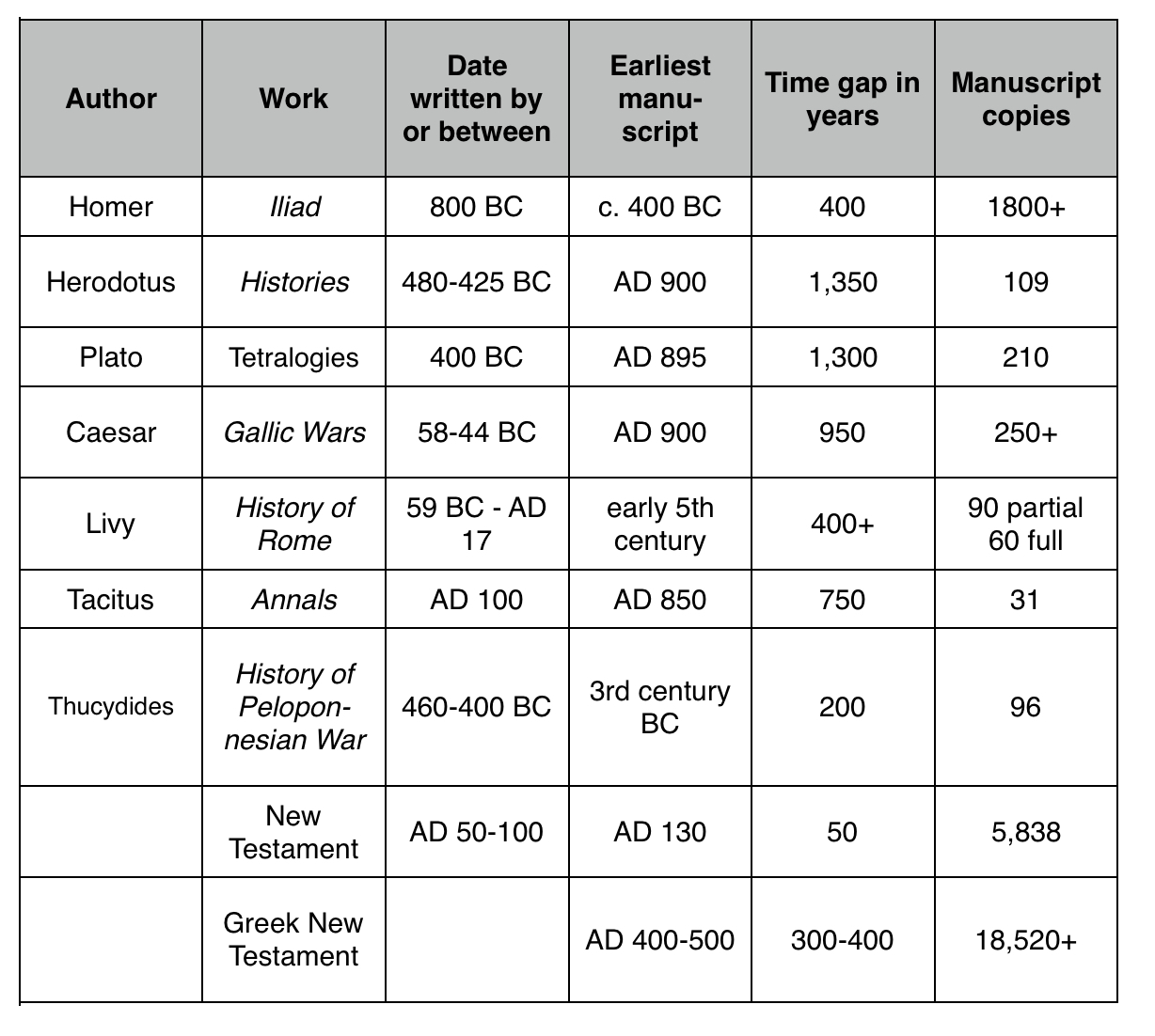
Then regarding the New Testament, Josh McDowell says, “I believe there is more evidence for the reliability of the New Testament than for any other ten pieces of classical literature put together.” Check out this chart reproduced from McDowell’s book God-Breathed to see by comparison to other literature, how close in dating the earliest biblical manuscripts are, and how many of those manuscripts have been discovered!
2. The external evidence test: determining whether the historical record has been verified or affirmed by data outside of itself.
Over one-fourth of the Bible is prophetic, and two-thirds of its prophesies have already been fulfilled. For example, 700 years before His birth, the city in which Jesus was to be born was identified by a man named Micah.
Time and time again archeologists discover articles that verify the claims in the Bible. This led archeologist Nelson Glueck to conclude, “It may be stated categorically that no archeological discovery has ever controverted a single biblical reference. Scores of archeological findings have been made which confirm in clear outline or in exact detail historical statements in the Bible.”
3. The internal evidence test: determining how of the historical record stands up to the test of internal validity.
The Bible was written by 45 different authors, over a span of 1500 years, on 3 different continents, and in 3 different languages. Yet there are no contradictions!
Anecdotal evidence—
Changed lives. My life is one that has been amazingly impacted by the God of the Bible, as was a man named Saul, who had a total about-face after encountering Jesus. As a result, Christianity was spread far and fast through his writings and world travels.
2. Changed societies. Wherever the Christian faith of the Bible has been put into practice, societies improve. Leonard Sweet notes—
“Before Christianity, there were cults that practiced all sorts of human sacrifice as well as self-mutilation and self-castration. Before Christianity, the weak were despised, the poor maligned, the handicapped abandoned. Before Christianity, infanticide was rampant, slavery run-of-the-mill, and gladiatorial combat a form of entertainment. In Jesus’ day, Corinth was famous for its temple prostitutes, continuing a long-standing tradition symbolized by the Corinthian athlete Xenophon.… Aristotle…not only condoned institutionalized slavery but provided an elaborate argument in favor of it. As if that weren’t enough, Aristotle called man ‘begotten’ and woman ‘misbegotten,’ and because a woman’s reasoning was ‘without authority’ accepted no female students.
“Only Jesus and His followers known as the church insisted on the concept of human dignity and the value of every human soul. Only the church built hospitals and took care of the abandoned and disabled. Only the church celebrated charity and selflessness as the highest virtue and elevated the status of women.”
Is all of this “proof positive” that the Bible is God’s Word? No, it’s not. But I think the evidence is compelling enough that it is certainly reasonable to reach this conclusion.
Here are some great application questions from this lesson:
Other than because it says so in the Bible, how do I know that it is God’s Word?



 “If you read history you will find that the Christians who did most for the present world were just those who thought most of the next. The Apostles themselves, who set on foot the conversion of the Roman Empire, the great men who built up the Middle Ages, the English Evangelicals who abolished the Slave Trade, all left their mark on Earth, precisely because their minds were occupied with heaven. It is since Christians have largely ceased to think of the other world that they have become so ineffective in this.” —C.S. Lewis


 Craig T. Owens