Listen to the podcast of this post by clicking on the player below, and you can also subscribe on Apple, Spotify, or Audible.
Let me give you the bottom line right at the top: God in the Dock by C.S. Lewis is a challenging book, but it is so worth your time to work your way through it!
Sometimes I feel that Lewis is from a different planet that allows his mind to move so beyond the things the rest of us are observing. It reminds me a little of Edwin Abbott’s book Flatland where 3-dimensional Sphere is talking with 2-dimensional Square. Sphere can see so much more than Square can, but he is trying to describe it in terms that Square can grasp.
This is why I say that God in the Dock is a challenging read. The phrase “in the dock” is how the English would describe someone who is on trial, listening to the evidence against them and presenting evidence in their own favor. Imagine that Person on trial was God! As Lewis himself notes, “The ancient man approached God (or even the gods) as the accused person approaches his judge. For the modern man the roles are reversed. He is the judge: God is in the dock.”
This book is made up of Lewis’ essays, responses to critical attacks on his other written works, conversations with atheists, and correspondence with people of all levels of society. His arguments are witty, biblical, philosophical, logical, sophisticated, and frequently other-worldly. This is why I said it is a challenge to keep up with his line of reason. But I promise you that those who persevere through this book will be the better for it.
This is the audio of an exclusive video that I shared with my Patreon supporters. We are currently in a series of lessons learned from Paul’s second missionary journey. This is the third lesson in this series.
Paul was very consistent and systematic in each city he visited. One of the consistent words Luke records about Paul is “reasoned.”
What does that word mean? Are there lessons from Paul’s example we can apply to our lives today? I think there is something very important and easily accessible for all Christians who want to be able to share their faith with unbelievers.
My Patreon supporters get exclusive content, as well as early access to content that will be shared publicly at a later date. You can have access to all of this for just $5 per month. Your support will get you immediate access to not only this video, but all of the previous videos as well.
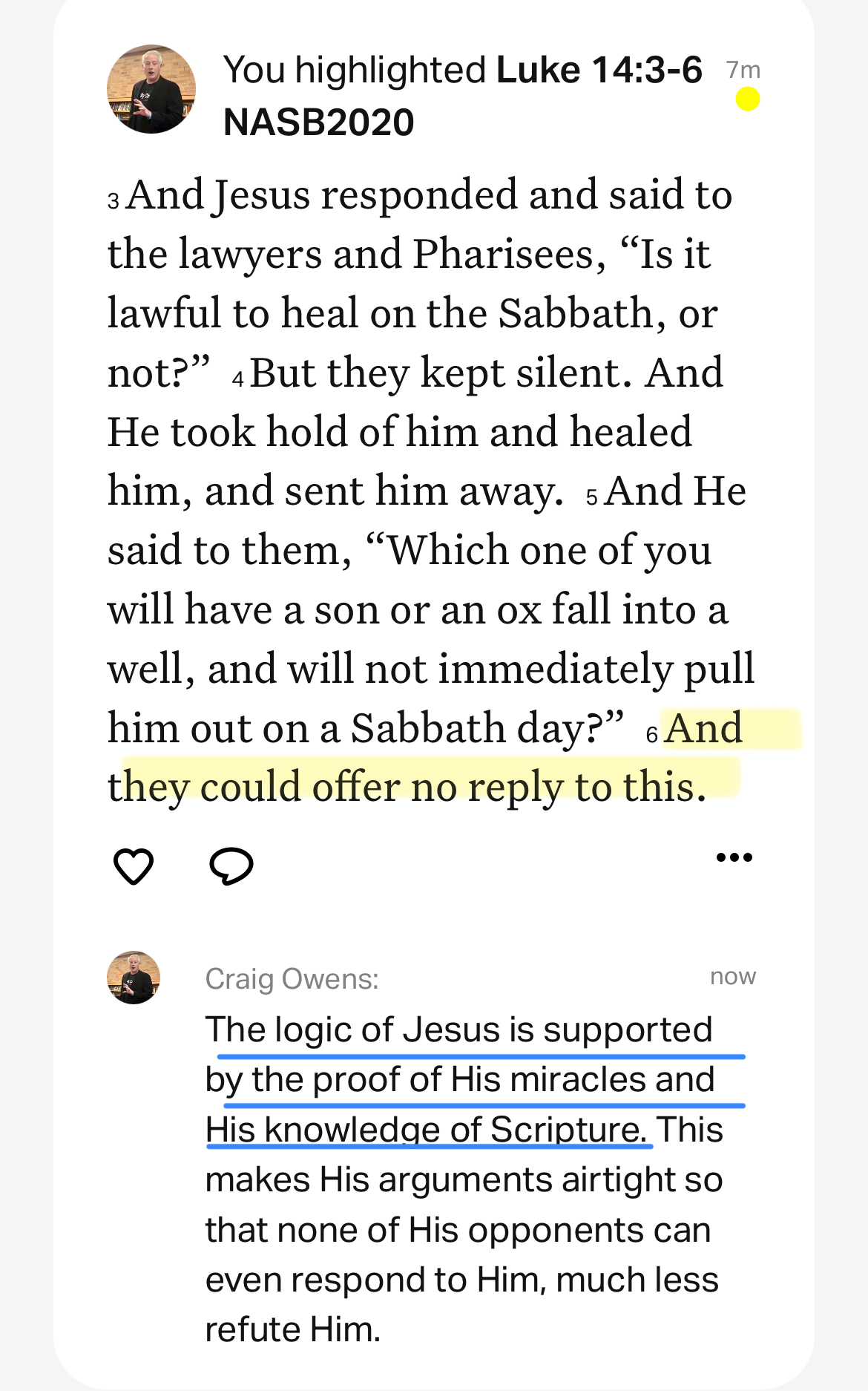
And Jesus responded and said to the lawyers and Pharisees, “Is it lawful to heal on the Sabbath, or not?” But they kept silent. And He took hold of him and healed him, and sent him away. And He said to them, “Which one of you will have a son or an ox fall into a well, and will not immediately pull him out on a Sabbath day?” And they could offer no reply to this.
The logic of Jesus is supported by the proof of His miracles and His knowledge of Scripture. This makes His arguments airtight so that none of His opponents can even respond to Him, much less refute Him.
We have the same things available to us:
(1) The Word of God which the Holy Spirit illuminates to our minds, and which He helps us use when critics attack.
(2) The example of our lives which have been changed by a personal encounter with Jesus.
(3) The logical connection of Scripture to the situation in which we find ourselves.
Listen to the podcast of this post by clicking on the player below, and you can also subscribe on Apple, Spotify, or Audible.
“…the Jews there tried to stone You, and yet You are going back?” (John 11:8).
The disciples were sitting around Jesus contemplating the next steps when they heard the news that Jesus’ friend Lazarus was sick and on death’s doorstep.
This statement seems to be a very logical thought. At least it is logical from a human perspective. But God sees wider, farther, and deeper than we ever will, so His logic is both perfect and limitless.
Yes, the Jews had tried to stone Jesus (8:59; 10:31, 39), and for mere men operating and thinking as men, staying away from danger is a logical conclusion.
But Jesus was on-mission from His Father (5:19). He had to go to Bethany because the sickness of Lazarus “will not end in death. No, it is for God’s glory so that God’s Son may be glorified through it” (11:4). Later, at the tomb of Lazarus, Jesus prayed, “This is for the benefit of the people standing here, that they may believe that You sent Me” (v. 42). When the dead Lazarus was returned to life and came out of the grave, God indeed was glorified!
Jesus declares that when we walk with Him, we always walk in the light (v. 9). This is because He IS the light of the world (8:12; 9:5). And as we walk with Him, we too bear the light wherever He calls us to walk (Matthew 5:14).
To walk in our own logic is to stumble in the darkness (John 11:10). We calculate and plan from a place of scarcity and fear. As a result, we stumble right past—or we sit still out of fear—and miss the opportunities for God’s glory to be displayed.
My logic always has a dark edge that I cannot see past. But the logic of God has no dark places because He can see from beginning to end perfectly.
I must daily walk in His light, even into those places where my limited logic would tell me to avoid. It is there that I will be able to witness God’s glory that I wouldn’t have seen had I sat still in my “safe” place.
Listen to the podcast of this post by clicking on the player below, and you can also subscribe on Apple, Spotify, or Audible.
You may have heard it this last weekend. Someone says, “Jesus is risen,” and their friend responds, “He is risen indeed!” Jesus Christ’s resurrection from the dead is the greatest event ever! And yet some people just can’t seem to grasp how good this truly is.
We’ve been trained to believe if something sounds too good to be true, then it probably is. So we are careful to be skeptical of any too-good-to-be-true claims that we may hear. Our heart might get excited at the possibilities, but then our logical mind begins to shout, “Wait!”
Here’s what a logical argument looks like: P1 + P2 + P3 = C.
The Ps are premises, and if we put true premises all together, then the C (conclusion) is true as well. All I have to do is invalidate one of the Ps and the whole argument falls apart. Then my logical mind can say, “See! I told you it was too good to be true!”
People heard the teachings of Jesus, they saw His miracles, thousands of them had even tasted the bread and fish He miraculously multiplied. They had hoped He was the One they had been longing for—the Messiah that would deliver them. But then He was crucified and their excitement was extinguished.
On the Sunday morning after His crucifixion, rumors began to swirl that Jesus had been resurrected back to life. Others said they had actually seen Him and talked with Him. Hearts began to swell with excitement again. But for many of them, their logical minds began to shout, “Wait! Don’t fall for another too-good-to-be-true story!”
We meet a couple of men who felt like this in Luke 24:13-24. They so wanted it to be true that Jesus was the Messiah they had longed for, but I notice that they use the word “but” three times. That’s their logical mind trying to invalidate any one of the premises.
Jesus was indeed resurrected from the dead. There is so much evidence that I don’t have time to go through today, but let me just share one item with you: Paul listed all of the people who had seen Jesus alive (1 Corinthians 15:3-8). Facing persecution and even martyrdom, none of these eyewitnesses recanted their faith.
Chuck Colson, who was at the center of the Watergate scandal and who was not a Christian at that time, said,
“I know the resurrection is a fact, and Watergate proved it to me. How? Because twelve men testified they had seen Jesus raised from the dead, then they proclaimed that truth for 40 years, never once denying it. Every one was beaten, tortured, stoned and put in prison. They would not have endured that if it weren’t true. Watergate embroiled twelve of the most powerful men in the world and they couldn’t keep a lie for three weeks. You’re telling me twelve apostles could keep a lie for 40 years? Absolutely impossible.”
Remember our logical statement: P1 + P2 + P3 = C.
Jesus gave one of His own in Luke 18:31-33. It would go something like this:
✔️ P1 (He was turned over to the Romans)
✔️ P2 (He mocked, flogged, killed)
✔️ P3 (He was raised from the dead)
✔️ C (Jesus fulfills every promise of God)
The disciples on their way to Emmaus used the word “but” three times, but Jesus counteracted that by using the word “all” three times (Luke 24:25-27), when He said all of the Scriptures point to Him and are fulfilled in Him!
The Bible is packed with promises! Promises of courage, assurance, wisdom, healing, direction, provision. And they are all valid promised because of the resurrection of Jesus—
For no matter how many promises God has made, they are “Yes” in Christ. And so through Him the “Amen” is spoken by us to the glory of God. … What, then, shall we say in response to these things? If God is for us, who can be against us? He who did not spare His own Son, but gave Him up for us all—how will He not also, along with Him, graciously give us all things? (2 Corinthians 1:20; Romans 8:31-32)
It may seem like these promises are too-good-to-be-true, but Jesus is so good that He makes all of the promises true!
If you missed any of the messages in our series looking at how Jesus fulfilled the smallest of details of prophecy, check them out here.
Listen to the podcast of this post by clicking on the player below, and you can also subscribe on Apple, Spotify, or Audible.
Plato said, “Arguments, like men, are often pretenders.” This is both true and a logical syllogism. It is true because men often pretend, and they design their arguments to support their pretenses.
One of my favorite classes in college was “Introduction to Logic.” In fact, it is one of my few college textbooks that is still in my personal library today. It always struck me that God created logic. That means He is infinitely logical.
So we can restate Plato’s quote like this, “God’s arguments, like God Himself, are always authentic, logical, and valid.”
In my Bible study time, I often highlight the words that denote premisses and conclusions. In just Ezekiel 36 alone I find:
therefore (6x)
because (2x)
then (6x)
for (1x)
so that (1x)
We can argue against God’s logic, and we can even try to invalidate His arguments. But to do so makes me illogical. God not only gives the premisses and the conclusion, but He makes them both logical and valid. God told Jeremiah, “I am watching to see that My word is fulfilled” (Jeremiah 1:12).
So any of my attempts to redefine or re-order or invalidate what God has logically presented ultimately brings disorder, collapse, and frustration. It is far better for me to simply follow the premisses and trust God to bring about His promised—and logical—conclusion.
I encourage you to look for these logic statements as you read the Bible yourself. Here is a Bible study from Proverbs 2 that can help get you started.
Listen to the podcast of this post by clicking on the player below, and you can also subscribe on Apple, Spotify, or Audible.
I’m a bit of a nut about the exactness of words, so one of my pet peeves is the incorrect use of imply and infer. “Imply” is something I do as the speaker; “infer” is something you do as the listener. Or you might say implying is like throwing and inferring is like catching.
A big problem arises when I infer something that you didn’t imply. Or even worse, when I infer something based on something you didn’t say. People will often say something like this, “Since Jesus didn’t specifically talk about ________ then it must be okay.” In logic, this would be called an argument from ignorance: concluding that an action must be acceptable because it has not been specifically stated to be unacceptable.
Statement #10 in our series asking “Is that in the Bible?” is—Love your neighbor. Is that in the Bible? Yes!
Later on, Jesus would add to this Deuteronomy 6:5—Love the Lord your God with all your heart and with all your soul and with all your strength—to answer the question about the greatest commandment of all.
In Leviticus 19, the Hebrew word for love means love in the broadest sense of the word, and neighbor means a friend or a fellow citizen. Unfortunately, the rabbis inferred that someone not a Jew was therefore an enemy and therefore not worthy of love. They further inferred that the opposite of love was hate.
Matthew Henry commented, “They were willing to infer what God never designed.”
Statement #11 is—Hate your enemy. Is that in the Bible? Yes, in the fact that it appears in print in Matthew 5:43, but it doesn’t appear in the Scripture that Jesus knew. It had become so ingrained in the thinking of people that they now assumed it was in the Bible.
In many ways, the Old Testament laws were easier to live out because they were all external and easy to measure, like don’t murder or don’t sleep with someone who isn’t your spouse. But Jesus made it a heart issue—He said lust is the same as adultery and hate is the same as murder.
Jesus also made love for enemies a heart issue. The word He used for love in the Greek is agape—the same word describing God’s love for His enemies in John 3:16—For God so LOVED the world, that He gave His one and only Son, that whoever believes in Him would not perish but would have everlasting life.
Jesus said our enemies were really our neighbors and were worthy of sacrificial love because they, too, were loved by God.
Matthew 5:44 is shortened in the NIV and has a footnote explaining that the longer verse was not seen in the earlier manuscripts. But given the fact that Jesus demonstrated everything found in the longer version of this verse, I think we are safe in using it. So let’s look at the response Jesus calls us to from the NKJV: But I say to you, love your enemies, bless those who curse you, do good to those who hate you, and pray for those who spitefully use you and persecute you.
Here’s what Jesus says it means for us to love our enemies:
(2) Help the haters. Jesus said we are to do those things that are beautiful and excellent—like the Good Samaritan did for his enemy-turned-neighbor (see Luke 10:25-37).
(3) Pray for the persecutors. Talk to God about them; don’t talk to others about them.
This response from Christians toward people whom others would call an enemy is totally unexpected by the world. This unexpected response will begin to draw enemies toward Jesus (1 Peter 2:12). If we will treat enemies and neighbors, they may soon become brothers and sisters in the family of God!
When the world hits us Christians out of hate, let’s respond with unexpected love: blessing those who curse us, helping those who hurt us, and praying for those who persecute us.
This is a weekly series with things I’m reading and pondering from Charles Spurgeon. You can read the original seed thought here, or type “Thursdays With Spurgeon” in the search box to read more entries.
Listen to the podcast of this post by clicking on the player below, and you can also subscribe on Apple, Spotify, or Audible.
Logical Conclusions
Every doctrine of the Word of God has its practical bearing. … Hence you will find the apostle Paul very full of ‘therefores.’ … I marvel that our excellent translators should have divided the argument from the conclusion by making a new chapter where there is least reason for it.
From The Watchword For Today: “Stand Fast”
The Bible is the most practical, applicable, and timeless Book I know! In order for this Book to be of both immediate and eternal help to us, it has to be a book that is logical. The Bible is a logical book, but far too many readers miss the logic unfolding right before their eyes.
In this particular sermon, Charles Spurgeon takes his text from Paul’s letter to the Philippians, so let me use that epistle as an example. There are three logic signposts that I would ask you to look for: therefore, so that, and if…then.
Let’s start with “therefore.” I have trained myself—and I endeavor to train the folks in my church—to ask this question every time they come to the word “therefore” in the Bible: What’s that there for?Therefore always signals a logical conclusion to a set of premises that are constructing the argument. As Spurgeon mentioned, sometimes the verse and chapter breaks can obscure this, so we must always go back from the “therefore” to see what the argument was.
I find the word “therefore” used three times in this letter in the New International Version:
Therefore God exalted Him [Jesus] to the highest place and gave Him the name that is above every name (2:9). What’s it there for? Because Jesus was obedient, therefore God exalted His name.
Therefore, my dear friends, as you have always obeyed—not only in my presence, but now much more in my absence—continue to work out your salvation with fear and trembling (2:12). What’s it there for? Because Jesus has conquered death and purchased our salvation, therefore this is how Christians should now live.
Therefore, my brothers and sisters, you whom I love and long for, my joy and crown, stand firm in the Lord in this way, dear friends! (4:1). What’s it there for? Because our citizenship is in Heaven, we must stand firm in that hope.
A second logical statement to watch for when you’re reading is “so that.” This logical phrase, much like “therefore,” is telling us what comes next in light of what came before. I see this phrase multiple times in Philippians (1:10, 13, 20, 26; 2:15, 19, 28; 3:21).
Finally, watch for those “if…then” statements. These also follow the logical argument of, “If you do this, then this will happen” or “If you ignore or disobey this, then you can expect this to follow.” I see this quite clearly in Philippians 2:1-2 and 4:8-9.
Don’t rush through your Bible reading time. Slow down and watch for these very logical and practical arguments—the Bible is absolutely full of them! By reading your Bible this way, you will be getting your doctrine directly from the Holy Spirit, which is the best way to know the heart of God.
If you’re interested in digging deeper into this, I’ve shared some other Bible studies you can try:
Listen to the podcast of this post by clicking on the player below, and you can also subscribe on Apple, Spotify, or Audible.
One of my favorite classes that I took in college was a philosophy class where we studied the rules of logic. I found it so intriguing to learn how to construct or deconstruct an argument by looking at the premises and its conclusion.
One of the keywords that we would look at is “therefore.” This helped us understand what the conclusion of an argument was. If the argument was made well, what came after the “therefore” was a natural progression from the premises. With that in mind, I always keep an eye out for the “therefores” when I am reading my Bible.
Except I have noticed that God frequently uses “therefore” in unexpected ways.
The classic rules of logic lay out connecting and supporting premises that flow to a natural “therefore” conclusion. But God’s conclusions typically defy natural, conventional logic. His conclusions are frequently supernatural!
Notice a couple of examples from Isaiah. God’s people are suffering the natural consequences for their open rebellion against God. In my mind, the natural “therefore” would be: “You are getting what you deserve.” However, God’s supernatural “therefore” is: “I have taken this cup of My wrath from you” (Isaiah 51:21–22).
In another example, the way God’s people were behaving and the way the enemies of God’s people were treating them, the natural “therefore” that I would expect is: “No one revered God’s name any longer.” But God’s supernatural “therefore” declares: “All people will know My name. All people will know I have fulfilled what I foretold, and all will revere Me” (Isaiah 52:6).
Ultimately, these supernatural conclusions were proven true by Jesus. Our Savior drank our cup of wrath on our behalf and gave us His cup of righteousness in its place. The natural conclusion of Christ’s work for us is also God’s supernatural conclusion: God exalted Jesus to the highest place of honor and reverence (Philippians 2:5–11).
My natural logic fails. God’s supernatural logic succeeds. Always!
His supernatural conclusions should always lead to my revering and glorifying Him even more. Let me encourage you in your Bible study time to pay close attention to God’s “therefores” and rejoice in His Christ-exalting supernatural work.
Listen to the podcast of this post by clicking on the player below, and you can also subscribe on Apple, Spotify, or Audible.
I love studying Christian apologetics and learning how to explain to skeptics and seekers the eternal value in the Bible as it points me to a deeper relationship with Jesus Christ. David Limbaugh has given apologetics a new slant in his book Jesus On Trial.
Mr. Limbaugh uses his personal story from a childhood church attendee, to a skeptic of Christianity, to a reluctant seeker of the truth, and finally to a vibrant, growing relationship with Jesus. But he also lets us see how he examined the evidence for the truth claims of the Bible through the eyes of a trained lawyer.
Throughout this book you will discover legalese terms like rules of evidence, items of probative value, rules of logic, and expert testimony. Each chapter feels like another witness Mr. Limbaugh has called to testify, or another piece of evidence that needs to be weighed and evaluated, and we the readers are empaneled as the jury deciding the case. As witness after witness takes the stand, as more evidence piles up, and as Mr. Limbaugh delivers his closing argument, the preponderance of evidence seems to make an airtight case of the truth claims in the Bible.
Whether you are looking for answers or hunting for evidence to use in discussions with your friends, Jesus On Trial is a reference book to which I believe you will repeatedly return.



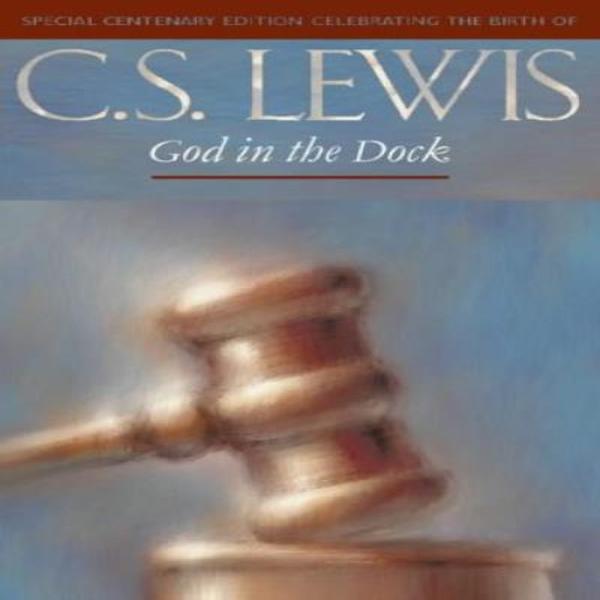 Let me give you the bottom line right at the top: God in the Dock by C.S. Lewis is a challenging book, but it is so worth your time to work your way through it!
  ►► Would you please prayerfully consider supporting this ministry? My Patreon supporters get behind-the-scenes access to exclusive materials. ◀︎◀︎











 Craig T. Owens