In Name Only

Brennan ManningPhiladelphia, as most people know is “The City of Brotherly Love.” The original Philadelphia in Asia Minor was founded in the second century BC by a man named Attalus who, quite the contrary to cultural norms, kept his brother in a position of power and influence alongside him.

Where many leaders were suspicious of anyone who could make a claim on the throne, Attalus loved (the Greek word is phileo) his brother (Greek adelphos meaning “from the same womb”), so the city took on this name and attitude as well. After the city was leveled by an earthquake in 17 AD, Emperor Tiberius sent the funds needed to rebuild. Out of gratitude to the emperor’s generosity there was a movement to rename the city Neocaesarea in his honor. But the people liked being known for their brotherly kindness, so the name Philadelphia stuck.

At least it stuck in name only. As the first century progressed, Philadelphians bowed more and more to Rome’s influence and this city once known for kindness to all began to persecute Christians.

This reminds me of the United States of America today. Our pledge of allegiance still includes “one nation under God,” and “in God we trust” is still on our currency, and we haven’t repealed the First Amendment which gives us freedom of religion. It appears that we are a “Christian nation,” but in name only.

Many cast the blame far and wide, but as Jesus addressed the people in the first city of Philadelphia (see Revelation 3:7-13), we see the blame is on those self-professing Christians who didn’t live Christ-like lives. They were Christians in name only.

For those who “have kept My Word and not denied My name” Jesus promises a list of rewards longer than the list for any of the other seven churches addressed in the book of Revelation! Those promises are still in effect for those who will not deny Christ. More specifically for those who by their words and their lifestyle hold true to Jesus Christ.

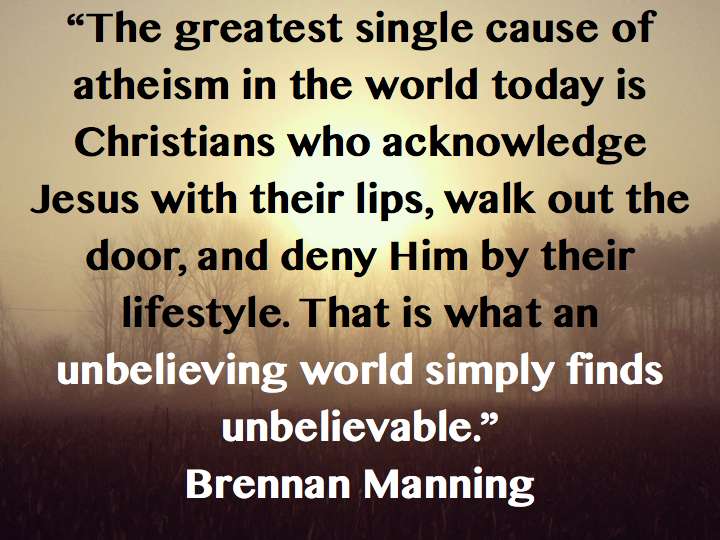
Brennan Manning was exactly right when he said, “The greatest single cause of atheism in the world today is Christians: who acknowledge Jesus with their lips, walk out the door, and deny Him by their lifestyle. That is what an unbelieving world simply finds unbelievable.”

My prayer is that Christians everywhere would be known not just by the name Christian, but by the way they hold true to Christ and His Word!

Please join me next Sunday as we look at the last of the churches in our series The 7-Star Church.

Thursdays With Oswald—The Will Of God

This is a weekly series with things I’m reading and pondering from Oswald Chambers. You can read the original seed thought here, or type “Thursdays With Oswald” in the search box to read more entries.

Oswald Chambers

The Will Of God 

     Supernatural voices, dreams, ecstasies, visions and manifestations, may or may not be an indication of the will of God. The words of Scripture, the advice of the saints, strong impressions during prayer, may or may not be an indication of the will of God.

     The one test given in the Bible is discernment of a personal God and a personal relationship to Him, witnessed to ever after in walk and conversation. 

From Christian Disciplines

The will of God may or may not come to you in a thundering voice or even in a still, small impression in your heart. But the way you walk and talk will absolutely attest to what you believe the will of God is. The way you walk and talk witnesses to what you believe.

So when you look at you, do you see God’s will on display?

Start With Thanksgiving Day

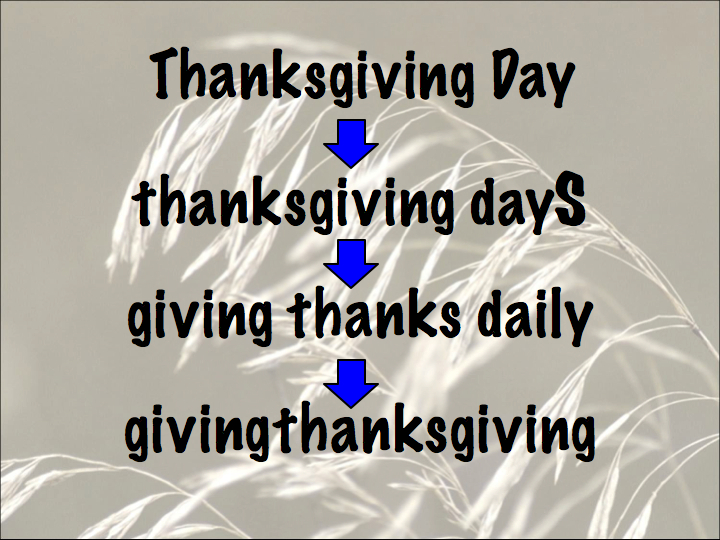
Thanksgiving Day is a good place to start. It’s a good day to begin to flex your gratitude muscles.

But don’t stop there! 

Allow those thankful feelings from Thanksgiving Day to expand into multiple thanksgiving dayS.

But don’t stop there! 

Let multiple thanksgiving dayS expand into a habit of daily thanksgiving.

But don’t stop there! 

Let the habit of daily thanksgiving become a lifestyle of givingthanksgiving—a lifestyle that is always God-focused, Christ-centered, and Spirit-led in constant thanks for everything!

Givingthanksgiving looks like this…

Always giving thanks to God the Father for everything, in the name of our Lord Jesus Christ. (Ephesians 5:20)

Do not be anxious about anything, but ineverything, by prayer and petition, withthanksgiving, present your requests to God. (Philippians 4:6)

For everything God created is good, and nothing is to be rejected if it is received with thanksgiving. (1 Timothy 4:4)

Let’s not limit ourselves to only one day of giving thanks, but a lifestyle of givingthanksgiving every single day!

Live Like A Star

Listen to the podcast of this post by clicking on the player below, and you can also subscribe on AppleSpotify, or Audible.

Do you want to influence people?

The first step may sound simple, but it takes a lot of work: People have to want to be around you.

Think about it—it’s hard to influence anyone who doesn’t even want to be in the same room with you, let alone get up-close-and-personal! Here are some wise words:

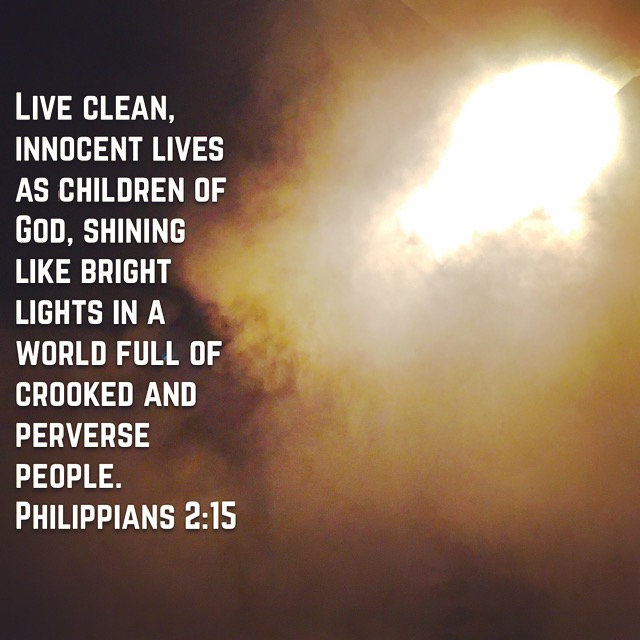
Do everything without complaining or arguing, so that you may become blameless and pure, children of God without fault in a crooked and depraved generation, in which you shine like stars in the universe as you hold out the word of life… (Philippians 2:14-16)

Here’s what the Bible says we can do to be the kind of person others want to be around:

  • Don’t be a complainer when things don’t go your way.
  • Stop arguing about everything. There is a time to stand up, and there’s a time to quiet down. Learn the difference between the two.
  • Live above reproach. Simply stated: do the right thing all the time.
  • Live a life that pleases God.
  • Set an example worth following and people will want to follow you!
  • Use the Bible as the infallible standard for all of your life choices.

Living this way makes you shine like a star. Not a rock star or a superstar, but a powerful influencer.

Want to see something cool? The dictionary gives this amazing bit of information about the origin of the word influence

An astrological term which meant the streaming ethereal power from the stars acting upon the character or destiny of men.

If you live the way the Bible says in these three verses, you will not only shine like a star, you will be positively affecting the character and destiny of those in your circle of influence. How cool is that?!

And that is a great reason to live a God-pleasing life!

►► Would you please prayerfully consider supporting this ministry? My Patreon supporters get behind-the-scenes access to exclusive materials. ◀︎◀︎

Counterculture

[koun-ter-kuhl-cher] noun the lifestyle of those people who reject or oppose the dominant values and behavior of society.

In Ephesians 4:17 Paul tells his audience “you must no longer live as the Gentiles do.” Okay, but his audience was made up of, um, Gentiles! Paul was not telling them to change their heredity, but to change their mindset.

He was asking them to live counterculture. 

If the Apostle Paul was writing to us in America today, no doubt he would tell us: you must no longer live as the Americans do.

Here is the Christian Counterculture:

  • Speak only what’s true
  • Deal with your anger quickly and productively
  • Have a strong work ethic
  • Only speak wholesome words
  • Please the Holy Spirit in all you do
  • Get rid of unbecoming behaviors
  • Be kind to everyone
  • Be compassionate toward everyone
  • Be forgiving of everyone
  • Imitate Christ
  • Remain sexually pure
  • Don’t be greedy
  • Don’t use obscenities
  • Be perpetually thankful

(You can find all of these in Ephesians 4:24-5:4.)

That’s a lot to work on! But as a Christian I want to exhibit a lifestyle that rejects the dominant values and behavior of American society.

With God’s help, I want to live counterculture.

Flexibility

I am working through a fascinating devotional book called Live Dead. It’s not just a book, but a challenge to live differently. I strongly encourage you to purchase this book, and then take the Live Dead challenge. With the permission of the book’s editor, I am reproducing Day 22’s challenge.

Flexibility: God’s Music, Written In Three Flats by Bob McCulley

Some of the most dangerous times in our life and ministry are when we lock our dreams and hopes in concrete, when we become so focused on what we are planning to do that we cannot see what God is trying to do. One day, while serving among the Maasai people of East Africa, I was running late for an appointment to meet with the village elders in a place called Mbirikani, which was about an hour away from our home. The purpose of the meeting was to appeal for a site where we could build a church in that village. My planned departure was delayed and my wife, Murriell, tried to soothe my anxiety with the words, “God has everything under control.”

I drove my four-by-four vehicle quickly up the road and was making good time until I got a flat tire, which I hurriedly changed. A few minutes later, I had a second flat and again made a tire change that would make a pit crew proud. Deep in the bush and well off the road, I had a third flat tire, and my third and final spare had to be removed from the luggage rack. In the process of getting it off the roof, it rolled away from me and down the hill into a large clump of thorn brush. By the time I retrieved it, my clothes were torn and my face and arms were bleeding from multiple scratches.

As I was preparing to mount the third spare tire, a Morani, a Maasai warrior, came walking out of the forest and greeted me. I did not wish to have a conversation because I was dirty from changing the flats and was now very late for what I thought was a critical appointment. His greeting was congenial and correct, while mine was harsh and abrupt. But I had good reason: I was late, dirty, bleeding, and angry. His next words stopped me. He knew my name. He had heard me preach a few weeks before, and that morning on awakening had decided to go to town to find me and to ask me to help him receive Christ. He had set off before sunrise to walk about 15 miles to town to find me and only halfway there, had found me on the roadside. I stopped changing the tire, cleaned my hands, and got my Bible out. Soon we were sitting under a thorn tree, reading and praying together as he became a newborn follower of Jesus.

When we were done, he thanked me and disappeared back into the forest, and I sat in wonder of the way God schedules our lives. By then I knew I had been right on time for the only appointment God had scheduled for me that day. I had no spare tires left, so I finished mounting the third spare and turned the truck around and headed home. Days later, I learned that the meeting had been postponed until the following day and our appeal had been granted. The community had given us 10 acres of ground on which to develop the ministry.

Our plans and dreams are often far removed from what God has in mind for us, and a lack of flexibility may cause us to miss Him and to be broken in the missing.

Live Dead Challenge—Look for a way you can be flexible today. Anticipate an interruption and welcome it as an opportunity, an event God has scheduled for you — even if it makes you late or it means that something you planned does not happen. In the days to come, look for ways you can be flexible. In service opportunities down the road, commit to flexing — dying to your plan and schedule that you might live to the surprises God injects in your daily life.

You can order the Live Dead book and other resources by clicking here.

And, for those of you who live in or near Cedar Springs, join us for a series of messages and a free copy of Live Dead in February.

Watch Your Prepositions

Prepositions are interesting words: they tell us the position of something relative to something else. Changing just one small preposition changes the whole meaning—“I left my wallet in the car” or “I left my wallet on the car.” In the first case, you can probably find your wallet again. In the second case, your wallet could be anywhere along the side of the road!

There’s a well-known story in the Gospels where a woman anoints Jesus with an expensive perfume. Some people are upset that she would “waste” something so valuable. But as Jesus corrects their incorrect view of this, notice the preposition He uses:

She has done a beautiful thing TO Me. (Matthew 26:10)

Most of the time we think we do things for Jesus. But He really doesn’t need us to do anything for Him, does He? After all, He is all-sufficient, all-powerful, all-knowing.

But Jesus loves when we do something beautiful TO Him!

We often praise God because of what He has done; that is, we praise Him for His deeds. But what if we praise God for Who He is; that is, give praise TO Him?

For is good, but TO is best.

I’m going to be watching my prepositions, to make sure I’m not only doing things for Jesus, but to Him as well—not just giving praise for what He’s done, but praise TO Him for Who He is.

The Measure Of A Man

An anonymous poem that should make any man or woman ponder the impact of their legacy…

Not “How did he die?”

But “How did he live?”

Not “What did he gain?”

But “What did he give?”

These are the units

To measure the worth

Of a man as a man

Regardless of birth.

Not “What was his station?”

But “Had he a heart?”

And how did he play

His God-given part?

Was he ever ready

With a word of good cheer,

To bring back a smile,

To banish a tear?

  Not “What did the sketch in the newspaper say?”

But “How many were sorry when he passed away?”

Dichotomy & Ricky Gervais

Dichotomy is a big word that means two parts that are opposed to each other. But it also means that they were once joined together—they were once in unity. Much like the first Christians: when people looked at them they saw Jesus; when they heard them speak they heard Jesus; when they watched their lives they saw the life of Jesus.

Christ and Christian were the same unified picture.

Today this is, sadly, far from the truth. People have a lot of wonderful things to say about Jesus, and a lot of nasty things to say about Christians. An unfortunate, and unnecessary, dichotomy exists.

I read an editorial from Ricky Gervais, a self-proclaimed atheist, entitled “Why I’m A Good Christian.” You can read his full editorial in the Wall Street Journal here, but for me this was the key passage:

I am of course not a good Christian in the sense that I believe that Jesus was half man, half God, but I do believe I am a good Christian compared to a lot of Christians.

It’s not that I don’t believe that the teachings of Jesus wouldn’t make this a better world if they were followed. It’s just that they are rarely followed.

Gandhi summed it up really. He said, “I like your Christ, I do not like your Christians. Your Christians are so unlike your Christ.”

I have always felt this way, even when I believed in God, and in a weird way I feel I am still a pretty good “Christian” who doesn’t believe in God.

I think the way back from this dichotomy is two-fold:

(1) Christ-followers need to make an intentional effort to act more Christ-like.

(2) We Christians need to be more thoughtful in our responses to people like Ricky Gervais. I like the pattern Peter recommends

Honor Christ and let Him be the Lord of your life [our motivation for action]. Always be ready to give an answer when someone asks you about your hope [“hope,” not theology, not bad behavior]. Give a kind and respectful answer and keep your conscience clear [there is zero justification for a Christian to give a crass, disrespectful, or sarcastic answer]. This way you will make people ashamed for saying bad things about your good conduct as a follower of Christ [good conduct = we live, talk, and act like Jesus].

C’mon, followers of Christ, let’s close this dichotomy between us and Jesus!

Um, That’s A Bit Awkward

Somehow I don’t think this is the most effective way to start a conversation about your faith!

Here are four thoughts I have…

Don’t compartmentalize. In other words, don’t put on your “Christian hat” to talk about your relationship with Jesus. Just be Christ-like all the time. People are looking for something real, not someone who’s playing an act.

Develop relationships first. Don’t lead with a sermon; lead with a friendship. As the saying goes, “People don’t care how much (or Who) you know, until they know how much you care.” Be a genuine friend first.

Wait until they’re ready. Jesus told stories with a deeper meaning and asked a lot of questions of people before He spoke to them directly about the kingdom of God. Don’t force people into a conversation. Keep the door open, and let them step in when they are ready.

Don’t get discouraged. Just like there are some topics you’re not ready to discuss right now, others feel the same way. So just because they say “No thanks” today doesn’t mean nothing happened. The Bible says that we are the salt of the earth and the light of the world. Salt and light are always seasoning and illuminating everywhere they go. Your life is making a difference.