It was by faith that Abel brought a more acceptable offering to God than Cain did. Abel’s offering gave evidence that he was a righteous man, and God showed His approval of his gifts. Although Abel is long dead, he still speaks to us by his example of faith.(Hebrews 11:4 NLT)
I want to live my life so in step with God that people can say of me as the writer of Hebrews said of Abel: “Although Craig is long dead, he still speaks to us by his example of faith.”
Don’t you want that for your life too?
I believe God wants that to be said of your life. Are you ready?
You can start today by putting your name in the blank: Although ________ is long dead, they still speak to us by their example of faith.
Listen to the podcast of this post by clicking on the player below, and you can also subscribe on Apple, Spotify, or Audible.
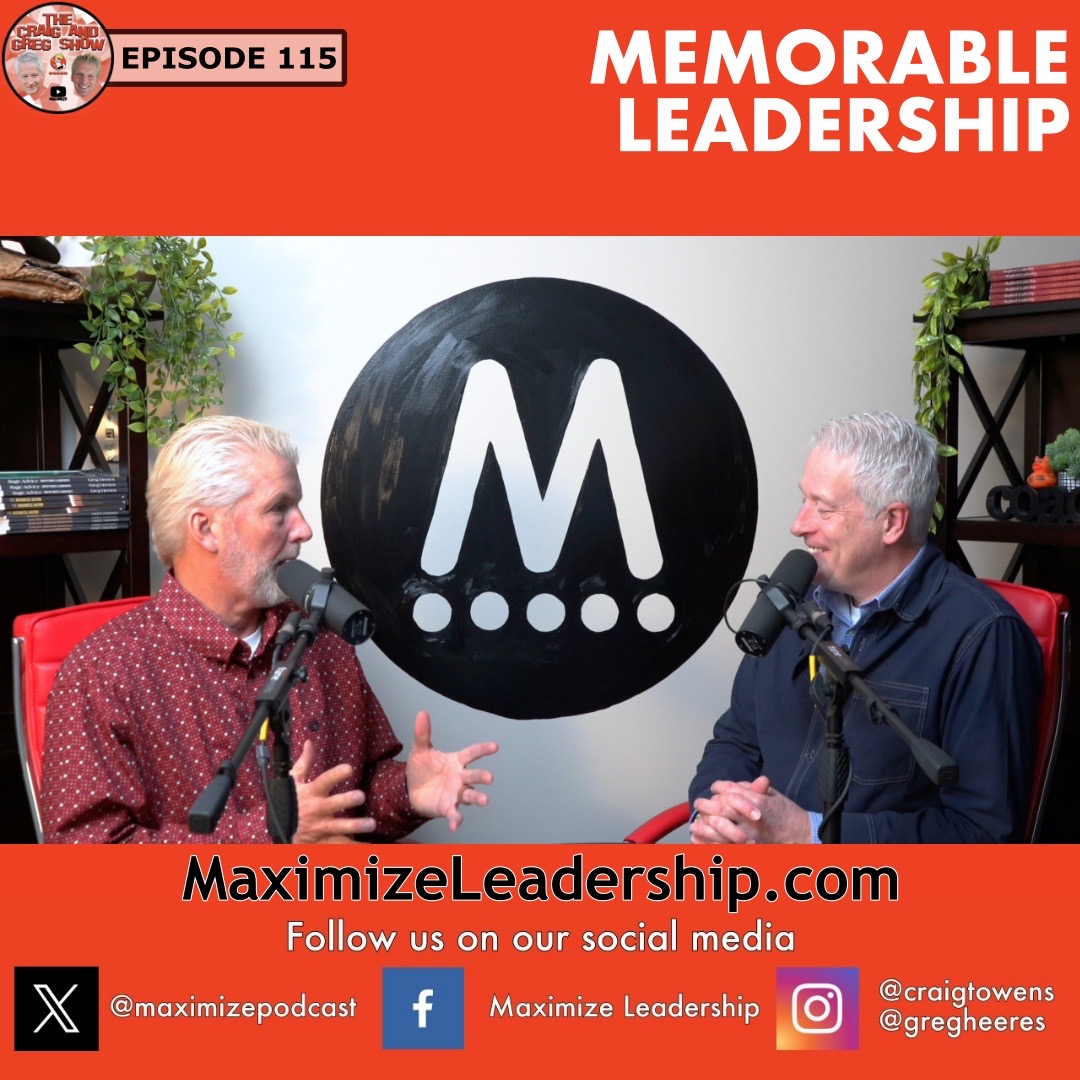
What do you want people to remember about your leadership? It’s an easy question to overlook, but striving to be remembered well can help you to be a better leader every day. In today’s episode Greg and I discuss the attributes of a memorable leader and reminisce about past leaders in our lives.
[0:00] Introduction
[0:42] Here’s a really important leadership question to contemplate about your legacy.
[1:53] Memorable leaders give us freedom to use our gifting.
[3:48] We debate going negative.
[4:07] Memorable leaders believe in us.
[7:10] Memorable leaders are calm in turbulent times.
[8:16] Memorable leaders love us enough to tell us the truth.
[10:20] Memorable leaders show us a preferable end goal.
[11:22] Memorable leaders are complimentary.
[12:46] Memorable leaders let us take the victory lap for the wins, but they take the blame for the losses.
[13:29] Memorable leaders give us grace for second chances.
[15:16] What’s one word we would like on our epitaph?
[17:59] Memorable leaders have an abundance mindset.
[18:41] How do you start becoming a memorable leader today?
[22:14] People are watching how you, as a leader, treat others.
[22:53] The value of a coach is so impactful for leaders who want to become more memorable.
Listen to the podcast of this post by clicking on the player below, and you can also subscribe on Apple, Spotify, or Audible.
On Mother’s Day, I mentioned that Proverbs 31 might be an intimidating description for Moms, but it doesn’t need to be that way. This chapter lists what is possible when a woman is fully committed to God, her husband, and her children.
Her faithfulness is her superpower which unleashes so many good things for those around her. Or as we said it: Her nobility helps her be a king maker.
I concluded by saying that men have an important role to play in order to honor the king-making power which the godly women in his life have unlocked. This is a man’s superpower! Together, God-fearing men and women can create a legacy of king makers. But separated or self-focused men and women can create a legacy of king breakers.
The Hebrew word for noble is used five times in Proverbs: three times for the godly superwoman (Proverbs 12:4, 31:10, 31:29), and twice for the godly superman (13:22, 31:3).
Remember that this word is also translated in different versions of the Bible as excellent, virtuous, and strong in character.
In Proverbs 31:3 the word vigor for men is attached to that same Hebrew word. In this context, the word can be defined as strength, efficiency, ability, or wealth.
On Mother’s Day, we said that Eve is the “help meet” (as the old King James Version says), which means that she is the key that unlocks Adam’s potential. The teaching throughout Proverbs says that men can squander this unlocked potential by…
…forgetting God’s laws—Proverbs 31:4-5
…not stewarding the unlocked leadership opportunities in our marriage, parenting, work, or community involvement (Proverbs 5:15-20; 2:1-5, 12-17; 22:29; 31:23).
In essence, we cancel the definition of vigor that we saw above, changing strength to weakness, efficiency to inefficiency, ability to inability, and wealth to poverty.
On Mother’s Day we looked at virtuous Ruth who used her godly superpower to unlock the potential for Boaz, the man who would become her husband. Let’s look at his example:
he was called a man of standing because his righteousness was well known in Bethlehem—Ruth 2:1
he was obedient to the smallest details of the law—Ruth 2:3; Leviticus 19:9-10
he honored his father by following his example—Matthew 1:5; Joshua 2:1-24, 6:23
he was an honored employer—Ruth 2:4
he was also (just like Ruth) called a man of noble character—Ruth 3:7-11, 14
A Dad’s superpower looks very similar to a Mom’s superpower. The godly woman unlocks the potential, and when the godly man carefully stewards that potential, he is also using his godly superpower (Luke 12:42-43, 48)!
Guys, when we use our God-given superpower, we honor Him and the godly women in our lives who have made this possible for us. We do this by…
…faithfully loving God with all our heart, soul, mind, and strength—Proverbs 31:4-5; Mark 12:28-31
…caring for our bride like Jesus cares for His bride—Ephesians 5:25
…honoring the legacy of our parents—Ephesians 6:2-3
…passing on a godly heritage to our children—Ruth 4:21-22
This is God’s design. And it is God’s delight when we live this way. So we must make the choice to either carry on the godly heritage that was handed down to us, or reverse the ungodly heritage that we may have inherited.
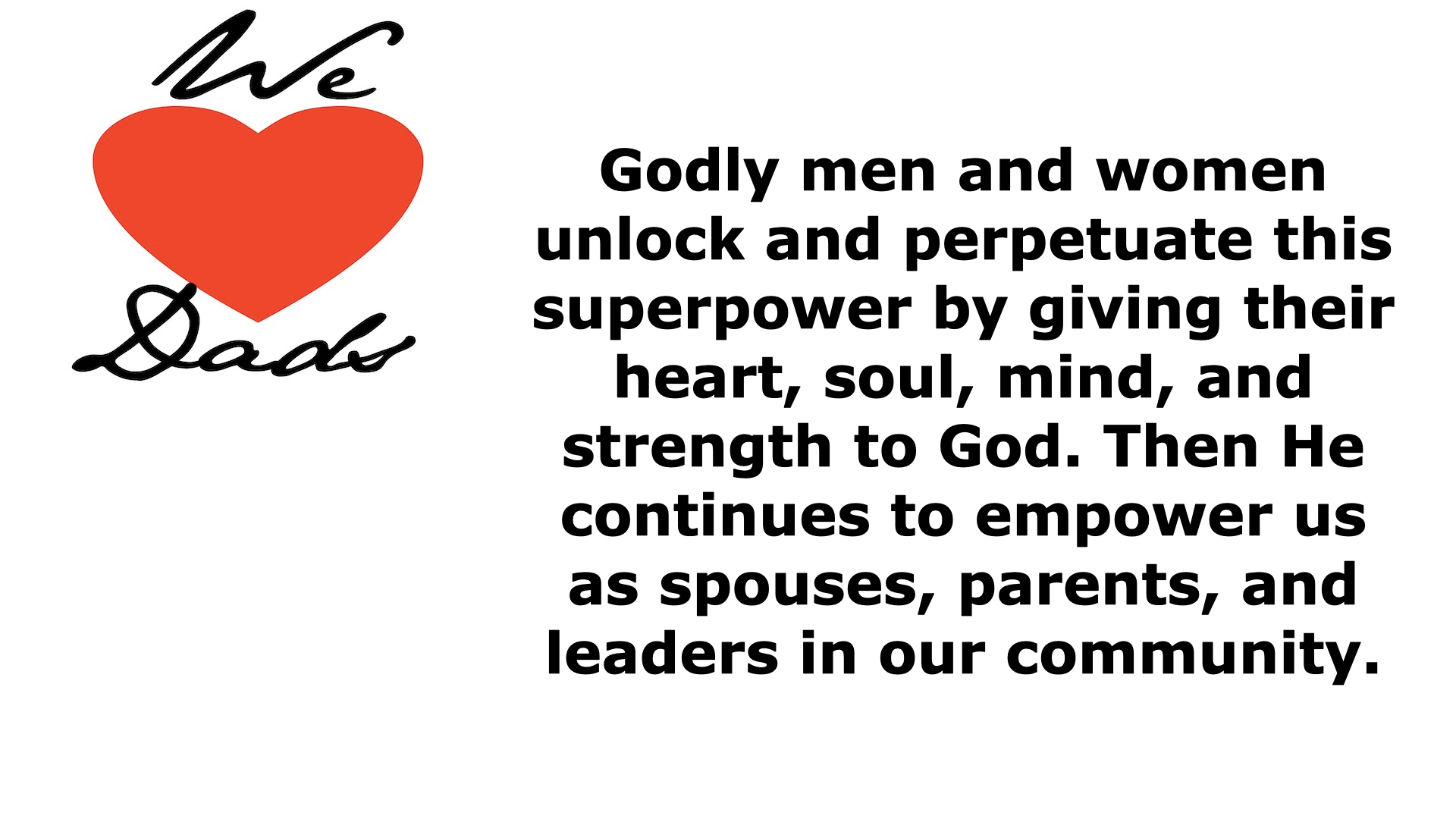
Godly men and women unlock and perpetuate their God-given superpower by giving their heart, soul, mind, and strength to God. And then God will continue to empower us as the spouses, parents, and leaders in our community that He desires for us to be!
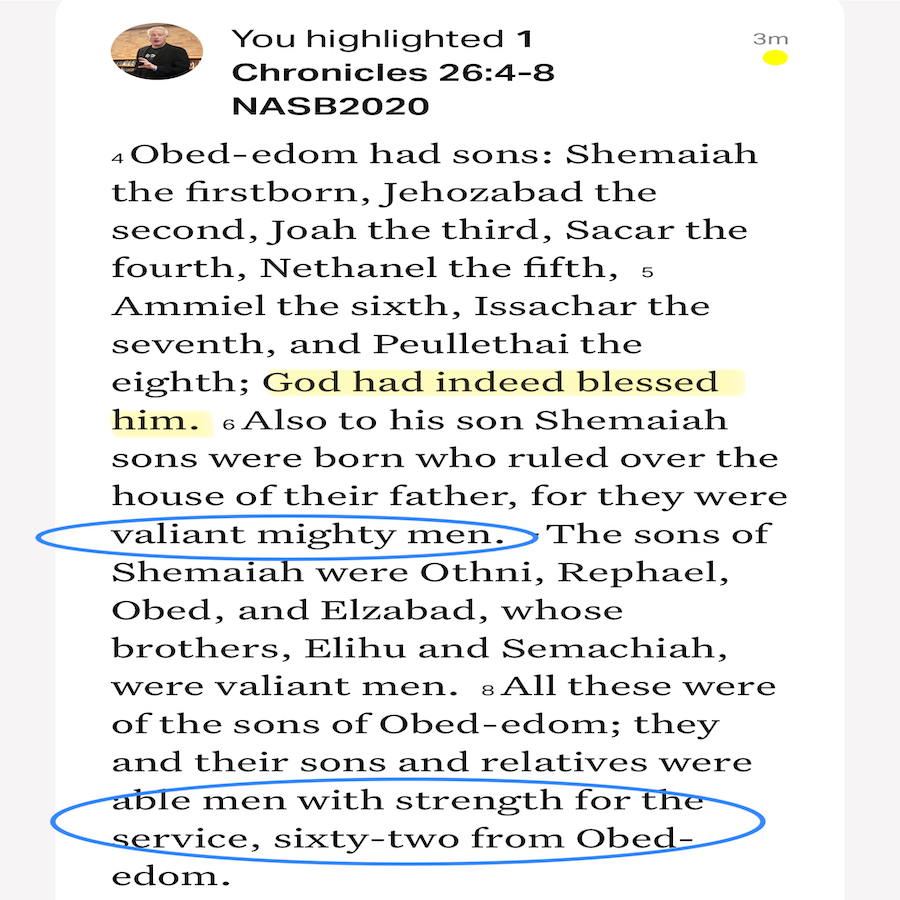
Every historical mention of Obed-Edom shows him serving God: as the guardian of the ark of the covenant of the Lord, as a gatekeeper, and as a worship leader. Here in this genealogy we learn that he faithfully served his family in a God-honoring way as well.
“God had indeed blessed him” so that his future generations were also known as valiant men of service before the Lord.
Obed-Edom demonstrates something I unpack in my book Shepherd Leadership. I wrote—
Humility is often misunderstood as allowing others to advance, and in so doing, I am completely overlooked. Others get the accolades and I get nothing. As a result, humility has gotten a bad reputation. People begin to think of a humble person as someone who never speaks up for himself, someone who can be taken advantage of, someone who becomes a doormat for everyone else. But the picture of a humble person in the Bible couldn’t be more different!
We all have to bow to someone or something. The humble shepherd leader has chosen to bow to God and to follow God’s righteous standards. One name for God is Jehovah Tsidkenu, which means God is righteous (see Psalm 119:137). The Hebrew letter tsadhe is a part of God’s righteous title, and it’s how we are called to live. Tsadhe means the humble, faithful servant. …
When you zoom in on the Hebrew letter tsadhe, you will see that the faithful, humble, kneeling servant is depicted with a crown. Far from being pushed down, left behind, or left unrewarded, the humble person is the one God delights to exalt!
Listen to the audio-only version of this podcast by clicking on the player below, or scroll down to watch the video.
Have you thought about what you’d like said at your funeral? Stick with me here, this isn’t an episode about contemplating your death. In this episode, Greg and I want to encourage you to begin with the end in mind, and live as the type of leader that you picture yourself being remembered as.
[0:15] Hang with us on this one: We’d like you to take a moment to think about your funeral.
[3:15] We could think of our own epitaph like we’re building a house.
[4:14] Greg asks me what I would like on my epitaph.
[6:00] We aren’t talking about planning our funeral, but about doing lasting and beneficial things with “the dash” between our birth date and our death date.
[9:20] There is a leadership caution when we’re thinking about this topic.
[10:21] Greg has been thinking about one word that could sum up his life.
[13:31] Here’s what we need to live for today.
[15:41] I give an example of someone whose character and reputation didn’t align.
[18:09] I brag on something special Greg does for others.
[20:54] How do leaders get beyond themselves?
[24:05] We need to be living our leadership story every single day.
Check out this episode and subscribe on YouTube so you can watch all of the upcoming episodes. You can also listen to our podcast on Spotify and Apple.
“Courage is the mastery of fear, not the absence of fear.” —Mark Twain
“A good man leaves an inheritance to his children’s children…” (Proverbs 13:22). In his excellent book Proverbs: Amplified and Applied, my cousin Dick Brogden uses our grandfather as an example of the principle in this verse: “Good has multi-generational implications. My grandfather was an incredibly generous man, and his children, grandchildren, and great-grandchildren have reaped the benefit. I am convinced that one of the reasons my family is so generously provided for is because our ancestor repeatedly gave significant financial gifts to his church, the Billy Graham Association, and missionaries around the world. Contrary to Shakespeare’s pessimism in the mouth of Mark Antony, the good that men do does indeed live after them, it is not interred with their bones.”
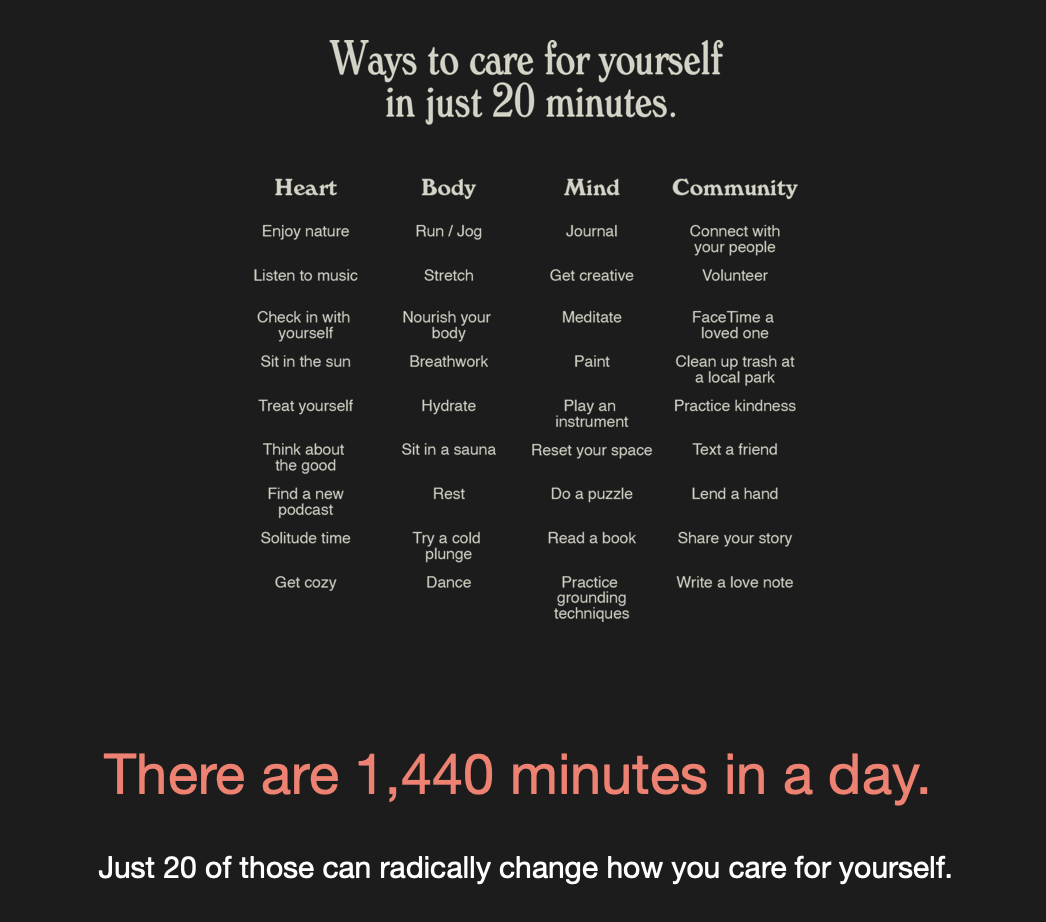
Self-care is vital. Without taking care of yourself first, how will you have any strength to take care of others? To Write Love On Her Arms has a helpful list of self-care items you can do in just 20 minutes per day.
“Knowledge follows understanding. We invert it and think that if we know facts, we are wise. In reality, it is only the wise who can rightly interpret the facts. … There is a posture of humility before God that opens the lowly to the understanding of God. This spirit of understanding becomes the filter with which we sift facts. Facts sifted by understanding lead us to accurate knowledge. Scoffers reject the reality that they need God’s help and God’s Spirit to understand facts. They foolishly think that true knowledge can be gained outside divinely enabled understanding. They have earned their PhD in ultimate idiocy.” —Dick Brogden, in ‘Proverbs: Amplified and Applied’ commenting on Proverbs 14:6
[18:30] Legacy is determined by what our family says about us
[19:56] How leaders can set family leadership goals for the New Year
Check out this episode and subscribe on YouTube so you can watch all of the upcoming episodes. You can also listen to our podcast on Spotify and Apple.
Listen to the podcast of this post by clicking on the player below, and you can also subscribe on Apple, Spotify, or Audible.
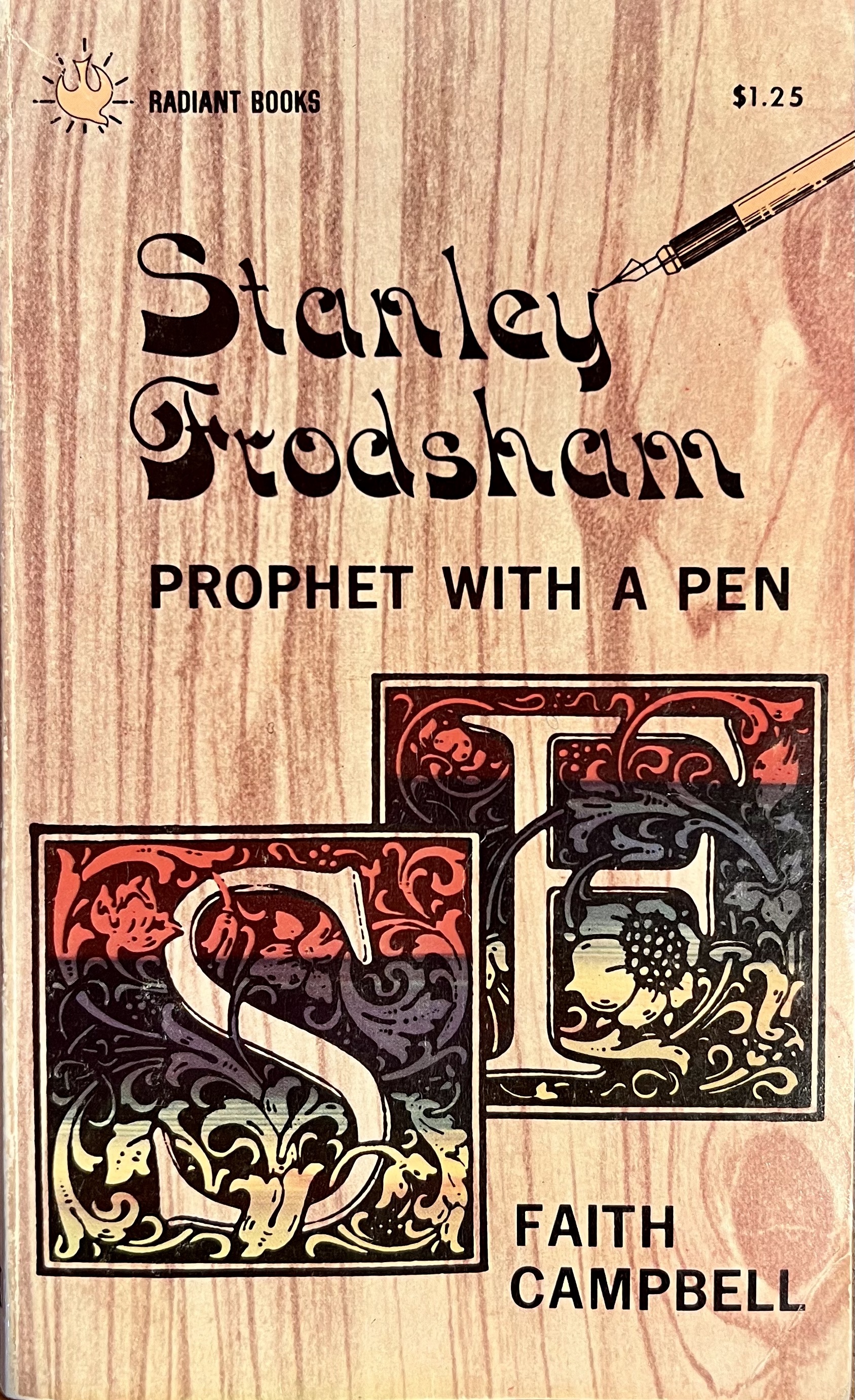
This book is personal for me—it’s a part of my family tree and my spiritual legacy. Prophet With A Pen is the biography of Stanley Frodsham, lovingly told by his only daughter Faith Campbell.
Stanley Frodsham’s pen was truly anointed. From his history of the modern-day Pentecostal movement, to his biography of renown evangelist Smith Wigglesworth, to his editing of the worldwide Pentecostal Evangel magazine, all the way down to his personal correspondence. Frodsham’s pen may have done more for the Pentecostal movement than anyone else’s did.
As a case in point, consider the powerful preaching of Smith Wigglesworth. His sermons were not prepared and written out ahead of time, but they were Holy Spirit-breathed at the moment Wigglesworth was preaching them. Most of those sermons that have been preserved for us in writing were due to the careful shorthand notes of Stanley Frodsham.
In Prophet With A Pen, Frodsham’s daughter tells us his life story through her personal recollections, her extensive library of her father’s letters, and the remembrances of lifelong friends of the Frodshams. It’s an intimate portrait of a man who never sought the limelight, but simply wanted everyone to personally experience the power of Pentecost.
I mentioned that this book is personal for me. Faith Campbell was my great-aunt, and her husband (who was quite an evangelist himself) shared many of these stories with me personally as I was growing up. Reading this collection of remembrances of Stanley Frodsham has reinforced my commitment to honor the heritage that I’ve been given, and to pass on a vibrant spiritual legacy to those who will come after me.
Anyone who enjoys church history will thoroughly enjoy this behind-the-scenes look at the men and women who were so crucial to the early Pentecostal movement.











 Craig T. Owens